





























Lilium Baferrari - Lis oriental hybride Baferrari
Lilium Baferrari - Oriental Lily
Lilium Baferrari
Oriental Lily
Special offer!
Receive a €20 voucher for any order over €90 (excluding delivery costs, credit notes, and plastic-free options)!
1- Add your favorite plants to your cart.
2- Once you have reached €90, confirm your order (you can even choose the delivery date!).
3- As soon as your order is shipped, you will receive an email containing your voucher code, valid for 3 months (90 days).
Your voucher is unique and can only be used once, for any order with a minimum value of €20, excluding delivery costs.
Can be combined with other current offers, non-divisible and non-refundable.
Home or relay delivery (depending on size and destination)
Schedule delivery date,
and select date in basket
This plant carries a 6 months recovery warranty
More information
We guarantee the quality of our plants for a full growing cycle, and will replace at our expense any plant that fails to recover under normal climatic and planting conditions.
Would this plant suit my garden?
Set up your Plantfit profile →
Description
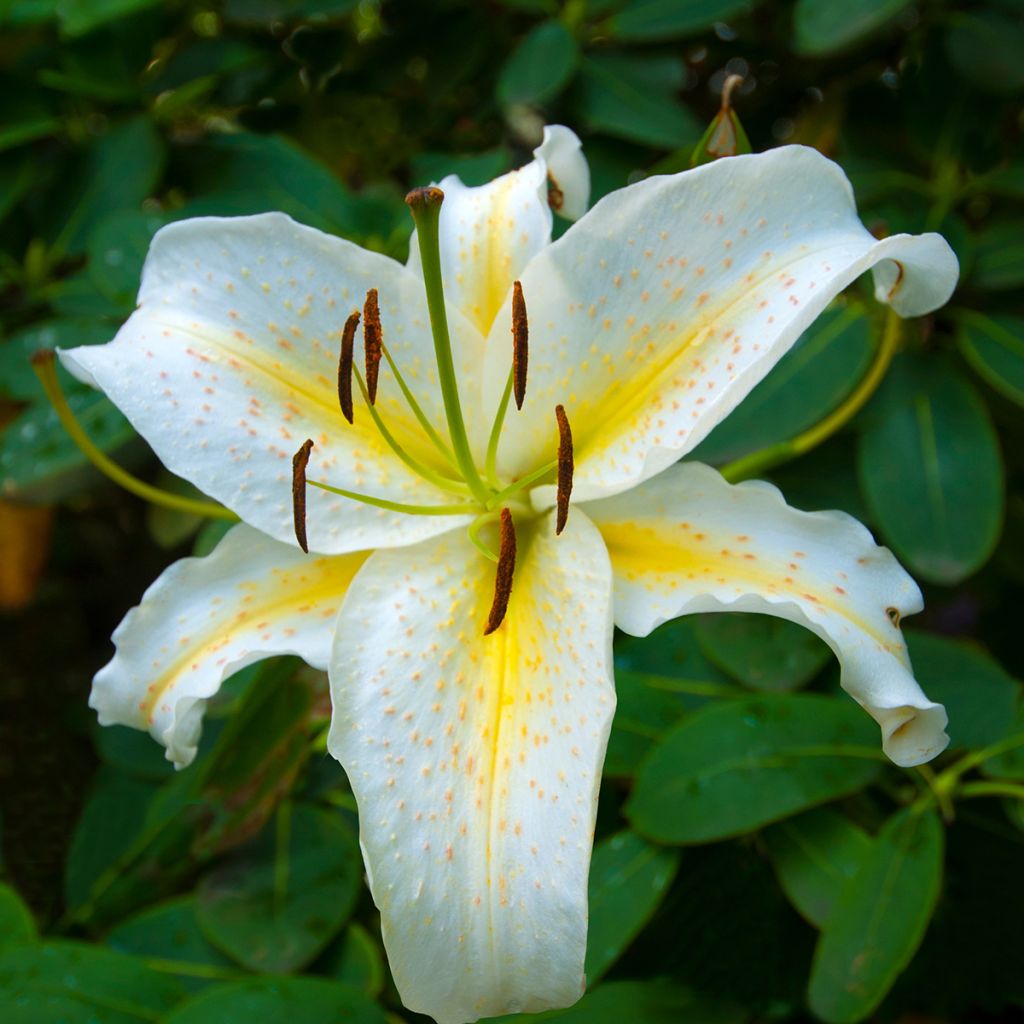
The Lilium ‘Baferrari’ is an Oriental hybrid lily with classic charm, prized for its large white flowers with a yellow centre, its powerful fragrance, and its vigour. It is a tall, summer-flowering perennial that brings light to borders, patios, or any part of the garden frequented in summer. It also makes a remarkable cut flower, perfect for rustic or contemporary cut flower arrangements, or for special occasions.
Botanically, Lilium ‘Baferrari’ belongs to the Liliaceae family, which includes many ornamental bulbous plants. It is a deciduous bulbous perennial: the foliage dies back in winter, the bulb remains dormant in the soil, and regrows in spring. It is a hybrid from the Oriental group (VIIa/b). Its distant ancestors are great Japanese lilies such as Lilium auratum and L. speciosum, known for their immense, highly fragrant flowers. Selected by the Dutch breeder M.A. van den Berg & Zn before 2010 and registered in the Netherlands in 2015, ‘Baferrari’ is widely cultivated by bulb growers. The plant reaches 90 cm to 1.20 m in height, on a single, straight stem covered in lanceolate, glossy, dark green leaves. The flowers, borne at the top of the stem, measure 15 to 18 cm in diameter. They are cup-shaped with 6 slightly undulate petals and face upwards or are held horizontally. Each tepal is creamy white, with a lemon-yellow to yellow-green stripe running its entire length, sometimes punctuated with small pale spots. The stamens bear brown-red anthers rich in pollen. Flowering occurs from July to August, depending on the region. Like all true lilies, it is very decorative, but all parts are toxic to cats, which is important to remember.
In the garden, ‘Baferrari’ is often used in small groups of three to five bulbs, planted in the middle of a perennial border. Its light-coloured flowers pair particularly well with Paniculate Phlox ‘Blue Paradise’, with its violet-blue panicles, or with the Agapanthus ‘Windsor Grey’, with its umbels of sparkling white. You can also plant it in front of a tall ornamental grass like Panicum virgatum ‘Cloud Nine’ or in front of a Hydrangea paniculata ‘Great Star’ (Le Vasterival) with its large white panicles. In a vase, its flower stems pair beautifully with fern foliage, a few stems of Arum Lily (Zantedeschia aethiopica), and Baby's Breath (Gypsophila).
Report an error about the product description
Plant habit
Flowering
Foliage
Botanical data
Lilium
Baferrari
Liliaceae
Oriental Lily
Cultivar or hybrid
Planting and care
The 'Baferrari' lily does not appreciate chalky, poorly drained and heavy soils. You should plant it in full sun, with its base in the shade, preferably in spring, burying the bulbs 15 cm deep in a pocket of soil mixed with leaf mould. Surround them with a pocket of sand which will protect them from rot as well as slug attacks, while allowing them to grow more easily. Mark the planting location, as the foliage only starts in April. When the stems reach 30 cm in height, stake them discreetly.
If red insects appear, treat without delay; these are lily beetles whose larvae can devour all the leaves. The most effective method is to catch them manually; be careful, they drop off as soon as they are touched, so place a box underneath.
Tip for planting lilies in compact soil: the scaly bulbs of large lilies fear clay soils which suffocate them and cause rot.
In Eastern Europe, the following technique is used to help these bulbs survive the winter. Plant them on 'benches' built above ground level. These benches consist of a first layer of gravel, on which tightly packed branches are placed. Then cover the whole with a thick layer of 20 to 30 cm of compost. Plant the bulbs in the compost, on which you can also let a few carpeting plants creep.
On the terrace, you can create sumptuous pot displays with lilies. Choose a container wide and deep enough (at least 16 cm in diameter for 1 bulb). Fill it with a mixture of leaf mould and sand. Plant the lilies in groups of 3 to 5 bulbs, 10-15 cm apart, then water thoroughly. Place the pots in a cool room, or outdoors once the frosts have passed. The ambient temperature should be around 12°C. When the shoots appear, place the pot in a conservatory or a very bright room, at a temperature of about 18°C. Apply liquid fertiliser twice a month until the flower buds appear.


Planting period
Intended location
Care
This item has not been reviewed yet - be the first to leave a review about it.
Haven't found what you were looking for?
Hardiness is the lowest winter temperature a plant can endure without suffering serious damage or even dying. However, hardiness is affected by location (a sheltered area, such as a patio), protection (winter cover) and soil type (hardiness is improved by well-drained soil).

Photo Sharing Terms & Conditions
In order to encourage gardeners to interact and share their experiences, Promesse de fleurs offers various media enabling content to be uploaded onto its Site - in particular via the ‘Photo sharing’ module.
The User agrees to refrain from:
- Posting any content that is illegal, prejudicial, insulting, racist, inciteful to hatred, revisionist, contrary to public decency, that infringes on privacy or on the privacy rights of third parties, in particular the publicity rights of persons and goods, intellectual property rights, or the right to privacy.
- Submitting content on behalf of a third party;
- Impersonate the identity of a third party and/or publish any personal information about a third party;
In general, the User undertakes to refrain from any unethical behaviour.
All Content (in particular text, comments, files, images, photos, videos, creative works, etc.), which may be subject to property or intellectual property rights, image or other private rights, shall remain the property of the User, subject to the limited rights granted by the terms of the licence granted by Promesse de fleurs as stated below. Users are at liberty to publish or not to publish such Content on the Site, notably via the ‘Photo Sharing’ facility, and accept that this Content shall be made public and freely accessible, notably on the Internet.
Users further acknowledge, undertake to have ,and guarantee that they hold all necessary rights and permissions to publish such material on the Site, in particular with regard to the legislation in force pertaining to any privacy, property, intellectual property, image, or contractual rights, or rights of any other nature. By publishing such Content on the Site, Users acknowledge accepting full liability as publishers of the Content within the meaning of the law, and grant Promesse de fleurs, free of charge, an inclusive, worldwide licence for the said Content for the entire duration of its publication, including all reproduction, representation, up/downloading, displaying, performing, transmission, and storage rights.
Users also grant permission for their name to be linked to the Content and accept that this link may not always be made available.
By engaging in posting material, Users consent to their Content becoming automatically accessible on the Internet, in particular on other sites and/or blogs and/or web pages of the Promesse de fleurs site, including in particular social pages and the Promesse de fleurs catalogue.
Users may secure the removal of entrusted content free of charge by issuing a simple request via our contact form.
The flowering period indicated on our website applies to countries and regions located in USDA zone 8 (France, the United Kingdom, Ireland, the Netherlands, etc.)
It will vary according to where you live:
- In zones 9 to 10 (Italy, Spain, Greece, etc.), flowering will occur about 2 to 4 weeks earlier.
- In zones 6 to 7 (Germany, Poland, Slovenia, and lower mountainous regions), flowering will be delayed by 2 to 3 weeks.
- In zone 5 (Central Europe, Scandinavia), blooming will be delayed by 3 to 5 weeks.
In temperate climates, pruning of spring-flowering shrubs (forsythia, spireas, etc.) should be done just after flowering.
Pruning of summer-flowering shrubs (Indian Lilac, Perovskia, etc.) can be done in winter or spring.
In cold regions as well as with frost-sensitive plants, avoid pruning too early when severe frosts may still occur.
The planting period indicated on our website applies to countries and regions located in USDA zone 8 (France, United Kingdom, Ireland, Netherlands).
It will vary according to where you live:
- In Mediterranean zones (Marseille, Madrid, Milan, etc.), autumn and winter are the best planting periods.
- In continental zones (Strasbourg, Munich, Vienna, etc.), delay planting by 2 to 3 weeks in spring and bring it forward by 2 to 4 weeks in autumn.
- In mountainous regions (the Alps, Pyrenees, Carpathians, etc.), it is best to plant in late spring (May-June) or late summer (August-September).
The harvesting period indicated on our website applies to countries and regions in USDA zone 8 (France, England, Ireland, the Netherlands).
In colder areas (Scandinavia, Poland, Austria...) fruit and vegetable harvests are likely to be delayed by 3-4 weeks.
In warmer areas (Italy, Spain, Greece, etc.), harvesting will probably take place earlier, depending on weather conditions.
The sowing periods indicated on our website apply to countries and regions within USDA Zone 8 (France, UK, Ireland, Netherlands).
In colder areas (Scandinavia, Poland, Austria...), delay any outdoor sowing by 3-4 weeks, or sow under glass.
In warmer climes (Italy, Spain, Greece, etc.), bring outdoor sowing forward by a few weeks.