





























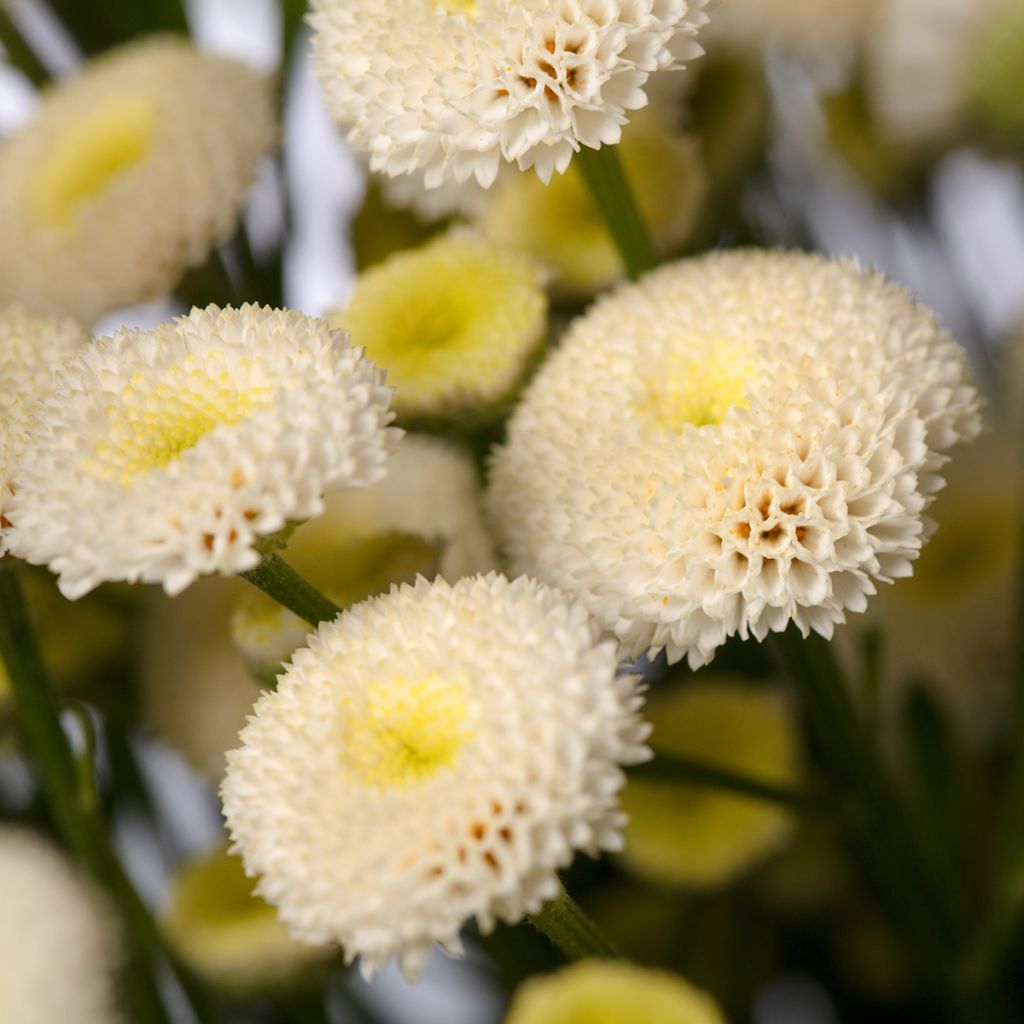
Tanacetum parthenium Baya - Matricaria Baya, Chamomile Baya
Tanacetum parthenium Baya seeds - Feverfew
Tanacetum parthenium Baya
Feverfew
Special offer!
Receive a €20 voucher for any order over €90 (excluding delivery costs, credit notes, and plastic-free options)!
1- Add your favorite plants to your cart.
2- Once you have reached €90, confirm your order (you can even choose the delivery date!).
3- As soon as your order is shipped, you will receive an email containing your voucher code, valid for 3 months (90 days).
Your voucher is unique and can only be used once, for any order with a minimum value of €20, excluding delivery costs.
Can be combined with other current offers, non-divisible and non-refundable.
Home or relay delivery (depending on size and destination)
Schedule delivery date,
and select date in basket
This plant carries a 6 months recovery warranty
More information
We guarantee the quality of our plants for a full growing cycle, and will replace at our expense any plant that fails to recover under normal climatic and planting conditions.
Would this plant suit my garden?
Set up your Plantfit profile →
Description
Le Tanacetum parthenium Baya est une sélection de Grande Camomille ou Matricaire bien adaptée à la fleur coupée. Elle offre des fleurs blanches très doubles évoquant des pâquerettes, portées par des tiges longues et bien ramifiées. Dénuée de parfum, très florifère en été et facile à réussir en plein soleil, cette plante s'utilise en bordure d'un potager ornemental, pour ponctuer un massif estival ou dans des bouquets faits maison.
Les graines enrobées sont des semences entourées d’une fine pellicule qui augmente leur volume : elles se manipulent plus facilement et permettent un semis plus précis et homogène.
Membre de la famille des Asteracées, la Matricaire double Baya® est un cultivar issu du Tanacetum parthenium (syn. Chrysanthemum parthenium, Matricaria parthenium, parfois Pyrethrum parthenium). Cette espèce eurasiatique est spontanée des Balkans, d’Anatolie et jusqu’à l’ouest de l’Himalaya, largement naturalisée en climat tempéré.
Baya® est une sélection néerlandaise destinée à la fleur coupée, développée dans un programme d’amélioration variétale ; elle se distingue de l’espèce type par ses capitules très doubles, hémisphériques, sans parfum, une ramification régulière et de longues tiges uniformes, optimisées pour la coupe.
Vivace de courte vie, souvent conduite en annuelle ou bisannuelle, Baya® forme une touffe buissonnante composée de tiges dressées, naturellement très branchues ; sa croissance est rapide, avec une mise à fleur possible 12 semaines après le semis. En pleine terre, la plante atteint 60 à 80 cm de haut ; en pot de 20–25 cm et plus, entre 40 et 60 cm. Le feuillage, caduc, vert franc, aromatique au froissement, est découpé, légèrement pubescent ; les tiges, fermes, portent de nombreux bouquets appelés corymbes. Cette variété peut se ressemer spontanément là où elle se plaît. L’inflorescence est un capitule de 2 à 2,5 cm, très double, d’un blanc pur, dissimulant presque le disque central. La floraison s'étale de juin à septembre.
La Matricaire double Baya® installe une trame blanche d'aspect soigné dans les scènes estivales : plantez-la au pied de rosiers buissons ou d’arbustes légers. Placez-la par petits groupes au milieu d’un massif de vivaces. Excellente fleur à couper, elle a toute sa place au potager fleuri. Parmi ses meilleures compagnes figurent les achillées millefeuilles, les sauges des bois, les gauras et les scabieuses.
Nos conseils : tuteurez dans les sites venteux, arrosez régulièrement, mais sans excès, coupez court après chaque vague de floraison. Pour la coupe, récoltez les tiges quand la majorité des capitules est ouverte ; la tenue en vase atteint 7 à 10 jours avec un conservateur.
L’usage traditionnel de la Grande camomille est attesté de longue date dans les herbiers antiques. Dans les jardins, la matricaire est appréciée pour ses tiges fines et son abondance de petites fleurs, utilisées fraîches ou séchées.
Report an error about the product description
Tanacetum parthenium Baya seeds - Feverfew in pictures
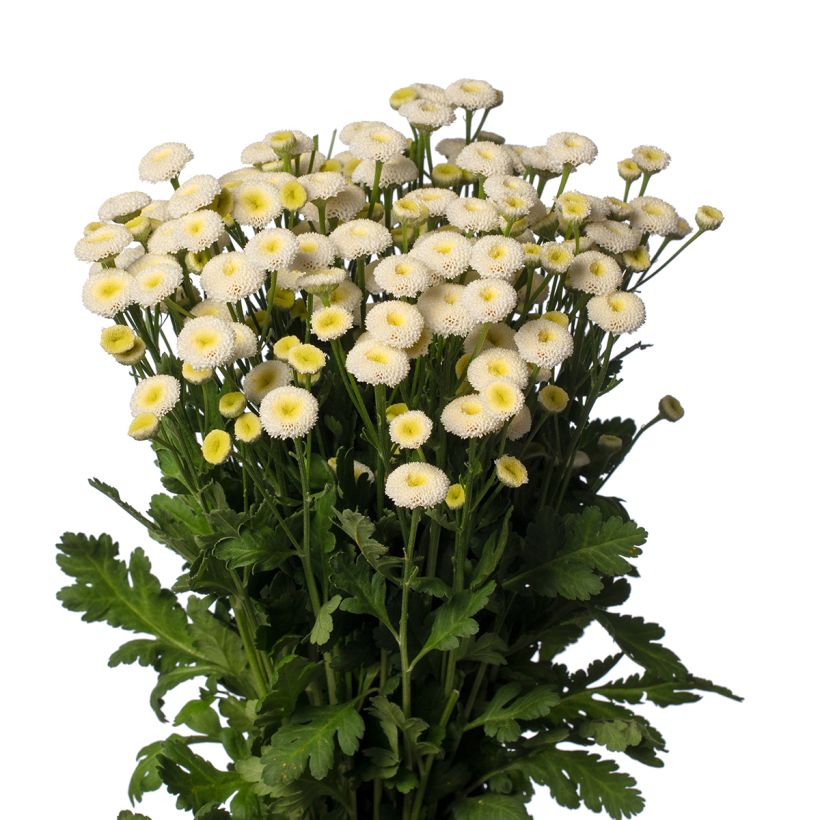
Flowering
Foliage
Plant habit
Botanical data
Tanacetum
parthenium
Baya
Asteraceae
Feverfew
Chrysanthemum parthenium, Chrysanthemum praealtum, Leucanthemum parthenium, Matricaria parthenium, Matricaria eximia
Cultivar or hybrid
Planting and care
Sow Tanacetum parthenium 'Baya' 6 to 8 weeks before planting out in the garden, after the last frosts, in a seed tray. Use good quality compost. Broadcast your seeds. Cover the seeds by sprinkling compost or vermiculite, firm lightly and water thoroughly with a fine spray. Place your seed tray in the light, without direct sun, at a temperature of 15°C to 20°C. Lower the temperature slightly at night.
Growth is rapid. Once the young plants have reached a height of 5 cm, transplant them into pots. 15 days before their final planting out, begin to acclimatise them gradually to the outdoor temperature.
By the end of May, the temperature in the garden will be warm enough to install your young plants. Choose a location in full sun. Space your plants 30 to 40 cm apart.
To obtain more ramified plants, pinch out the growing tips between 2 and 4 times during cultivation.
Remove faded flowers to encourage flowering.
You can also sow feverfew directly in situ, after the last frosts.



Sowing period
Intended location
This item has not been reviewed yet - be the first to leave a review about it.
Similar products
Available in 1 sizes
Available in 1 sizes

Available in 1 sizes
Available in 1 sizes

Available in 1 sizes

Available in 1 sizes
Available in 1 sizes
Available in 1 sizes
Haven't found what you were looking for?
Hardiness is the lowest winter temperature a plant can endure without suffering serious damage or even dying. However, hardiness is affected by location (a sheltered area, such as a patio), protection (winter cover) and soil type (hardiness is improved by well-drained soil).

Photo Sharing Terms & Conditions
In order to encourage gardeners to interact and share their experiences, Promesse de fleurs offers various media enabling content to be uploaded onto its Site - in particular via the ‘Photo sharing’ module.
The User agrees to refrain from:
- Posting any content that is illegal, prejudicial, insulting, racist, inciteful to hatred, revisionist, contrary to public decency, that infringes on privacy or on the privacy rights of third parties, in particular the publicity rights of persons and goods, intellectual property rights, or the right to privacy.
- Submitting content on behalf of a third party;
- Impersonate the identity of a third party and/or publish any personal information about a third party;
In general, the User undertakes to refrain from any unethical behaviour.
All Content (in particular text, comments, files, images, photos, videos, creative works, etc.), which may be subject to property or intellectual property rights, image or other private rights, shall remain the property of the User, subject to the limited rights granted by the terms of the licence granted by Promesse de fleurs as stated below. Users are at liberty to publish or not to publish such Content on the Site, notably via the ‘Photo Sharing’ facility, and accept that this Content shall be made public and freely accessible, notably on the Internet.
Users further acknowledge, undertake to have ,and guarantee that they hold all necessary rights and permissions to publish such material on the Site, in particular with regard to the legislation in force pertaining to any privacy, property, intellectual property, image, or contractual rights, or rights of any other nature. By publishing such Content on the Site, Users acknowledge accepting full liability as publishers of the Content within the meaning of the law, and grant Promesse de fleurs, free of charge, an inclusive, worldwide licence for the said Content for the entire duration of its publication, including all reproduction, representation, up/downloading, displaying, performing, transmission, and storage rights.
Users also grant permission for their name to be linked to the Content and accept that this link may not always be made available.
By engaging in posting material, Users consent to their Content becoming automatically accessible on the Internet, in particular on other sites and/or blogs and/or web pages of the Promesse de fleurs site, including in particular social pages and the Promesse de fleurs catalogue.
Users may secure the removal of entrusted content free of charge by issuing a simple request via our contact form.
The flowering period indicated on our website applies to countries and regions located in USDA zone 8 (France, the United Kingdom, Ireland, the Netherlands, etc.)
It will vary according to where you live:
- In zones 9 to 10 (Italy, Spain, Greece, etc.), flowering will occur about 2 to 4 weeks earlier.
- In zones 6 to 7 (Germany, Poland, Slovenia, and lower mountainous regions), flowering will be delayed by 2 to 3 weeks.
- In zone 5 (Central Europe, Scandinavia), blooming will be delayed by 3 to 5 weeks.
In temperate climates, pruning of spring-flowering shrubs (forsythia, spireas, etc.) should be done just after flowering.
Pruning of summer-flowering shrubs (Indian Lilac, Perovskia, etc.) can be done in winter or spring.
In cold regions as well as with frost-sensitive plants, avoid pruning too early when severe frosts may still occur.
The planting period indicated on our website applies to countries and regions located in USDA zone 8 (France, United Kingdom, Ireland, Netherlands).
It will vary according to where you live:
- In Mediterranean zones (Marseille, Madrid, Milan, etc.), autumn and winter are the best planting periods.
- In continental zones (Strasbourg, Munich, Vienna, etc.), delay planting by 2 to 3 weeks in spring and bring it forward by 2 to 4 weeks in autumn.
- In mountainous regions (the Alps, Pyrenees, Carpathians, etc.), it is best to plant in late spring (May-June) or late summer (August-September).
The harvesting period indicated on our website applies to countries and regions in USDA zone 8 (France, England, Ireland, the Netherlands).
In colder areas (Scandinavia, Poland, Austria...) fruit and vegetable harvests are likely to be delayed by 3-4 weeks.
In warmer areas (Italy, Spain, Greece, etc.), harvesting will probably take place earlier, depending on weather conditions.
The sowing periods indicated on our website apply to countries and regions within USDA Zone 8 (France, UK, Ireland, Netherlands).
In colder areas (Scandinavia, Poland, Austria...), delay any outdoor sowing by 3-4 weeks, or sow under glass.
In warmer climes (Italy, Spain, Greece, etc.), bring outdoor sowing forward by a few weeks.