





























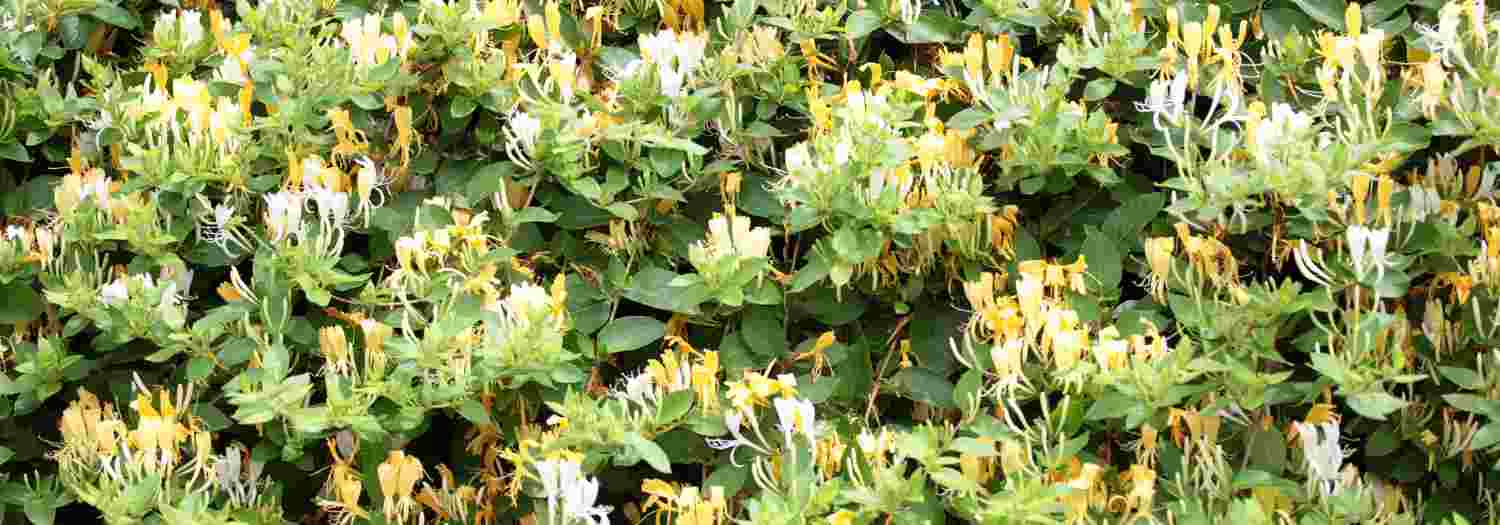
10 perfect plants for a private and soothing garden
The must-haves for a wellbeing garden!
Contents
The garden is our breath of fresh air, a restorative space that we often want to feel intimate and soothing to escape the hustle and bustle of city life or stress.
To create an intimate ambience and make the outdoor space a protective refugium, far from the daily bustle, some plants are magical, as their sensory appeal provides the ultimate escape: fragrant climbing plants, soft, silky grasses, perennials in soft colours, bamboos rustling in the breeze, but also shrubs bending under the weight of their blooms and zen-inspired maples… They display pastel colours, from white to blue, or greyed foliage that soothes the eye.

Jasmine
Let us begin this haven of peace with fragrant plants. They are unrivalled in offering an olfactory escape that transports us far from daily life thanks to sweet and flowering fragrances, enchanting! Climbing and generous like jasmine, they also provide a necessary privacy screen to shield us from the environment that can feel all too present in the city.
Jasmine varieties are numerous, and are chosen mainly according to the region of residence because not all are hardy (see our advice in Which jasmine to choose?). The white or slightly pink colour of its flowers also provides a soothing visual. Many are evergreen, with medium to dark green foliage, adding a splash of colour year-round.
♥ My favourites: Jasminum polyanthum in mild-climate regions for its exuberance, and Star Jasmine or Trachelospermum jasminoides for its ability to grow in shadier spots.
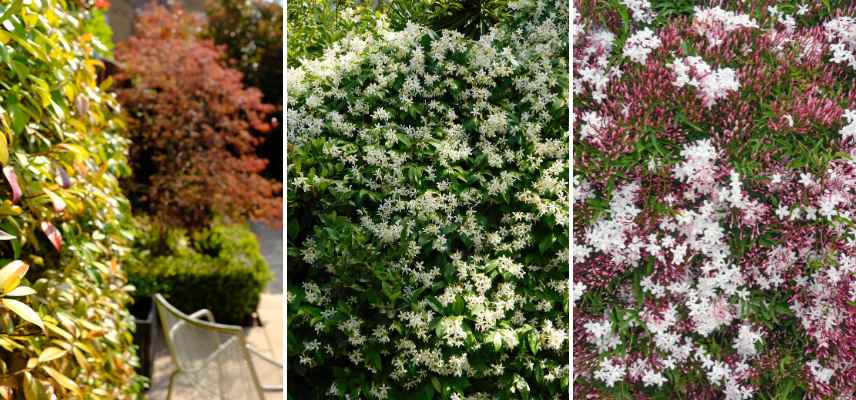
Trachelospermum jasminoides: foliage and flowering. On the right, the elegant Jasminum polyanthum (also known as winter jasmine)
→ Read also: Jasmin, planting, maintenance, pruning, 7 ideas for pairing star jasmine and 5 jasmines with decorative foliage
Honeysuckle
Another indispensable fragrant climber, honeysuckle is superb at creating a soft, delicate screen around the house. Encasing, it can reach up to 10 m in length with certain species and varieties. Most species prefer sun, but especially partial shade, which allows it to thrive in many gardens. It perfumes spring and summer evenings. Choosing it for its evergreen foliage, it provides a cocoon-like feel in the garden, useful in both small urban spaces and large properties.
Apricot tones or pale yellow hues are particularly sought after for a soothing visual effect. Trained around a pergola or running along a wall, honeysuckle is the indispensable companion of intimate gardens. Paired with climbing roses, it also lends a decidedly romantic ambience.
♥ My favourites: Lonicera henryi for its evergreen foliage, Lonicera x periclymenum ‘Graham Thomas’ and the exquisite sweetness of its white and yellow flowers, and Lonicera heckrottii.
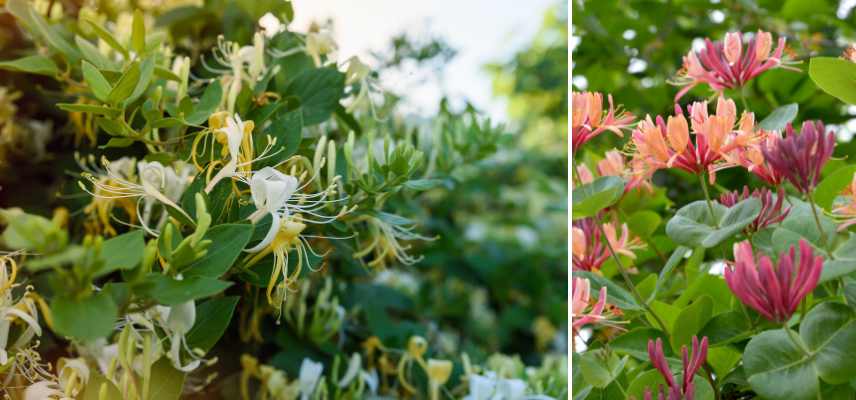 Lonicera ‘Graham Thomas’ and Lonicera heckrottii ‘American Beauty’
→ Also read: The most fragrant honeysuckles! ; Choosing a honeysuckle and Honeysuckles: reliable choices.
Lavender
In the top three scented plants to include in a garden to make it calming, lavender and its summery scents are essential, not least since we also enjoy brushing past its violet spikes as we walk along a path, for example. Nectariferous, the gentle hum of nectar-feeding foragers and butterflies around it invites a nap beside it. Finally, its blue-tinged violet, or white, colouring on greyed foliage invites daydreaming and meditation. Southern plants par excellence, most lavenders have the advantage of being relatively hardy and able to establish themselves in many regions. Lavender generally flowers from June to August.
Resembling lavender, with a more airy appearance, also fall for the Perovskia, known as Afghan sage, with greyed colours and mauve hues that are ultra-soothing.
♥ My favourites: Lavender ‘Munstead’, compact and highly fragrant, and Lavandula angustifolia ‘Hidcote’ with blooms in a superb deep violet.
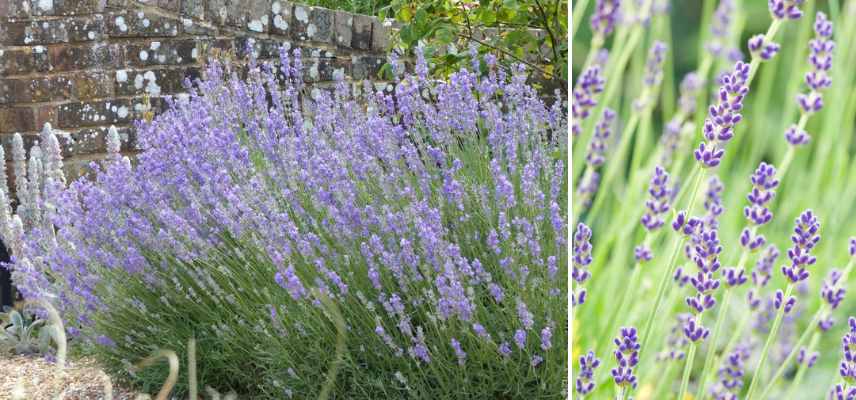
Lavandula angustifolia ‘Munstead’
→ For inspiration: Create a lavender garden, Pair lavenders, and Lavender, which to choose?
Read also
Fluffy plantsPennisetum
After scent, touch also provides a soothing sensation, and life becomes sweeter when the inflorescences or leaves mingle with it! Among the grasses that invite a caress, the Pennisetum are among the most attractive, with blooms so distinctive in the shape of a fluffy bottle-brush. They appear from late summer into autumn. Their compact size allows them to be incorporated into any type of garden, their lightness and brightness make an impact in both a natural, rustic style or, conversely, a contemporary one. They are truly the stars for infusing softness through their tactile quality, but also through their very soft colours, from cream to mauve, or even brighter in some varieties. Planted in pots on a terrace, or in a swath in a large border, Pennisetum dance with the wind and in the sunlight. What could be more relaxing than watching these easy-to-live grasses? They will harmonise with all flower colours, especially blue and mauve-pink for a relaxing immersion.
♥ My favourites : Pennisetum orientale ‘Shogun’ for its stature (about 90 cm) and Pennisetum alopecuroides ‘Hameln’, a safe bet for its floribundity.
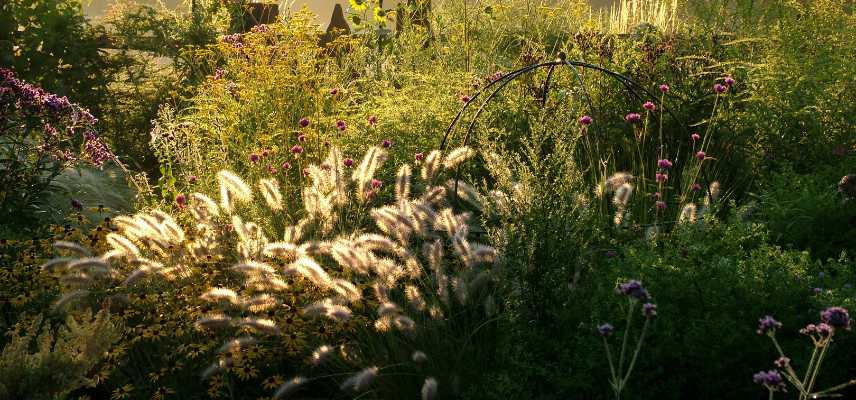
Pennisetum alopecuroides, soothing with their light, softness and plush texture
→ For inspiration: Pennisetum, buying guide and Pennisetum, 7 ideas for pairing them.
Stipa grasses
Evergreen, the stipas are other grasses of interest for their soothing effect. They all boast beautiful silky panicles and delicately fine foliage, dancing in the wind. We like to run our hands over them to feel their softness. The impression of graceful movement is at its peak, the cream-to-straw-coloured inflorescences act as a true natural relaxant! They require a well-draining soil that does not retain water, as the quintessential drought-tolerant plants. So you would plant them in a sandy, coastal garden, or on a lean, stony, poor substrate. A row of stipa along a small path or mingled with blue salvias and some evergreen shrubs in a border transports us almost to the water’s edge…
♥ My favourites: Stipa tenuissima for its unrivalled brilliance in the sun, and Stipa calamagrostis for its impressive stature and for the contrast between its green leaves and beige panicles.
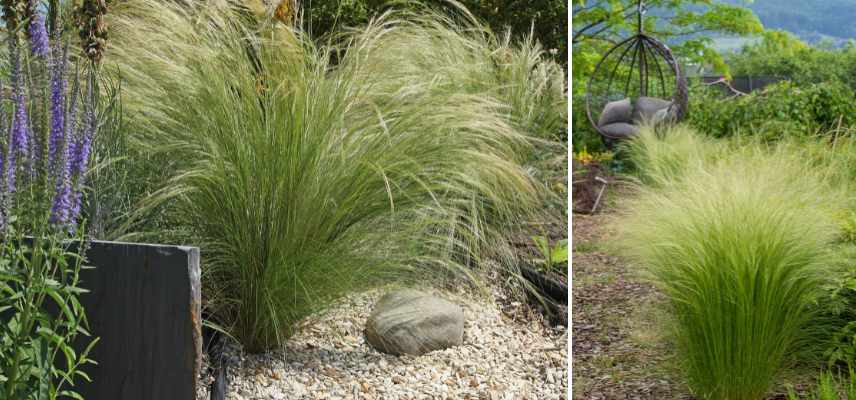
Stipa tenuissima (also known as Stipa tenuifolia)
→ For inspiration: Angel hair or Stipa tenuifolia, what do we do with it? and 7 ideas for pairing Stipas.
Miscanthus
Miscanthus are among the grasses offering the most imposing varieties, forming a soft, unique screen in the garden. Choose tall or mid-sized; they manage to combine a screening effect with alightness often due to a fountain-like habit, and the airy texture of their inflorescences. Like many grasses, they retain their foliage in winter, and thus provide a presence in the garden during the coldest months. The clumps gradually increase in size and become a garden focal point. In terms of needs, give them sun and soil that is moist to dry (but never wet).
♥ Prefer cream-splashed Miscanthus, which have a very soft appearance, or varieties with very delicate foliage such as Miscanthus sinensis ‘Gracilimus’ and Miscanthus sinensis ‘Morning Light’ with silvery reflections, or the silky inflorescences of Miscanthus nepalensis.
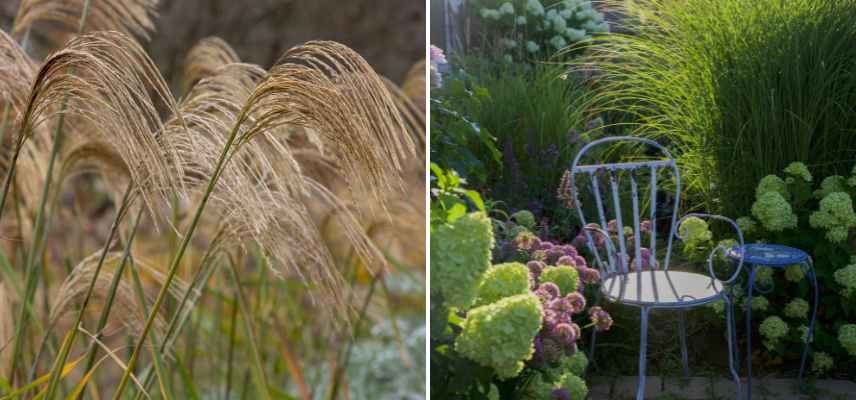
On the left, Miscanthus nepalensis in late-summer bloom. On the right, a plant enclave comprising Miscanthus ‘Morning Light’, Hydrangea ‘Little Lime’ and Allium millenium
→ For inspiration: 9 ideas for pairing Miscanthus and How to choose a Miscanthus?
Buddleia alternifolia
To create a verdant oasis, arching-habit shrubs or spreading shrubs are very well suited to the garden boundaries, in hedges for example. Beyond their romantic charm, they also provide a handsome ground cover for an intimate garden, and achieve the alchemy of a burst of blooms. Among the many options, the Buddleja alternifolia is certainly deciduous, but it makes its mark with a cascade of pink flowers in late spring. The colourful spray, in pale lilac, bows under the mass of flowers arranged in clusters along the length of the branches. The grey-green foliage adds to the softness of the whole. It too bears its name as a butterfly bush, another virtue as it attracts them in numbers, providing a countryside escape.
Clethra alnifolia is another fine option, with white flowers, flowering later in late summer, and in a comparatively shadier position.

Charm of Buddleja alternifolia
→ For inspiration: Extraordinary Buddlejas, and 7 shrubs with a weeping habit
Climbing roses
Perfect for trellises or walls, the climbing roses or lianas offer natural cover and an abundance of flowers to bring colour and fragrance. Selected for their fragrance and for their repeat-flowering habit, they can be trained against an arch to visually partition a space, or to climb along a wall or a trellis. They are the perfect companions for urban gardens as well as large country gardens.
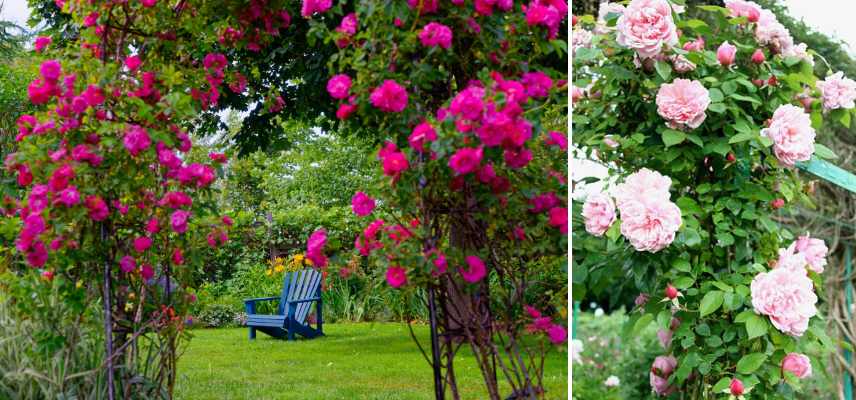
On the right, the rose ‘Albertine’
→ For inspiration: Which rose to bloom on an arch?, 10 white-flowered climbing roses.
Japanese maples
Acer palmatum, or Japanese maples, enhance a deliberately Japanese-inspired and zen ambience. They are therefore ideal for incorporating into a garden designed to be relaxing, bringing a sense of calm and serenity. The elegance and colour of their seasonally evolving foliage across all three seasons make this sought-after shrub a must-have for semi-shaded gardens.
The world of Japanese maples is vast, including among others, dwarf maples that can be grown in pots, Acer palmatum with finely dissected leaves and the Acer palmatum ‘Dissectum’ with lacy leaves, the green Japanese maples and the Japanese maples with red to purple foliage, those that stand out with a very graceful spreading habit, and those that reveal winter branches of interest.
→ To help you choose, see our guides with Alexandra’s advice: Japanese Maples: How to Choose the Right Variety?, Japanese Maples: 9 Successful Pairing Ideas, and Unusual Japanese Maples.
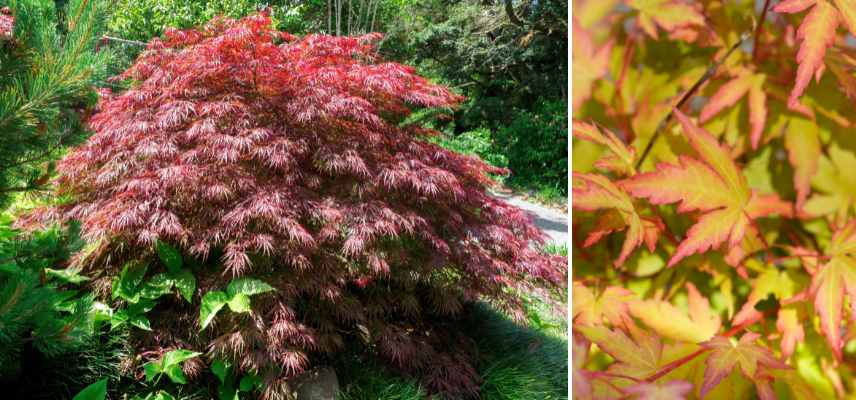 Acer palmatum dissectum ‘Crimson Queen’ and Acer ‘Sango Kaku’
Bamboos
With their canes and the rustle of their leaves swaying in the wind, the bamboos emit a relaxing sound and, above all, a Zen-tinged visual, transporting us to a realm imbued with exoticism. Although they are handy for their rapid growth, creating an effective screen, they can also be a source of concern due to their invasive habit. We mitigate this drawback by choosing clumping, i.e. non-running, species such as Fargesia or compact varieties that can even be planted in pots with proper care, particularly with regard to watering. Bamboos then become a showpiece plant in the garden, transforming a dedicated area into a striking display.
Choose them based on their foliage, but especially their size, to achieve the right proportion for the garden’s size. A small grove of bamboos well managed can prove to be the showpiece of your tranquil garden.
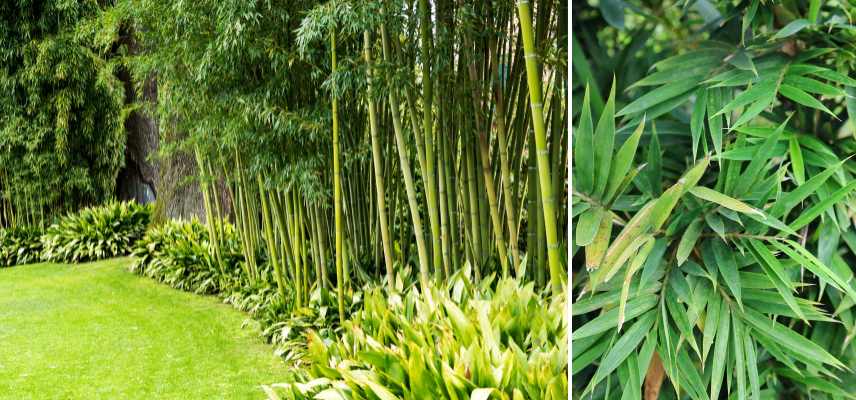 On the right, Fargesia murielae ‘Jumbo'</caption]
→ For inspiration: 6 non-running bamboos with rapid growth, How to water a bamboo in a pot properly, 6 non-running bamboos, and Bamboo hedge: which varieties to choose?
Further reading
There are indeed many other plants that can turn your small or large garden into an intimate refugium. Prioritise soft, pastel colours, and greyed and bluish foliage (which provide an immediate sense of calm, as with Stachys byzantina or bear’s ears) but also the green flowers blending into the foliage, and the textural effects. Some of your shrubs should ideally have evergreen foliage, especially if the environment requires it.
→ Read Virginie T.’s valuable tips in 7 shrubs with silver-grey foliage you should have in your garden, and those by Jean-Christophe in 7 perennials with grey or silvery foliage, but also our inspiration pages (White Garden, Blue Garden, Pink Garden…)
- Subscribe!
- Contents
Comments