





























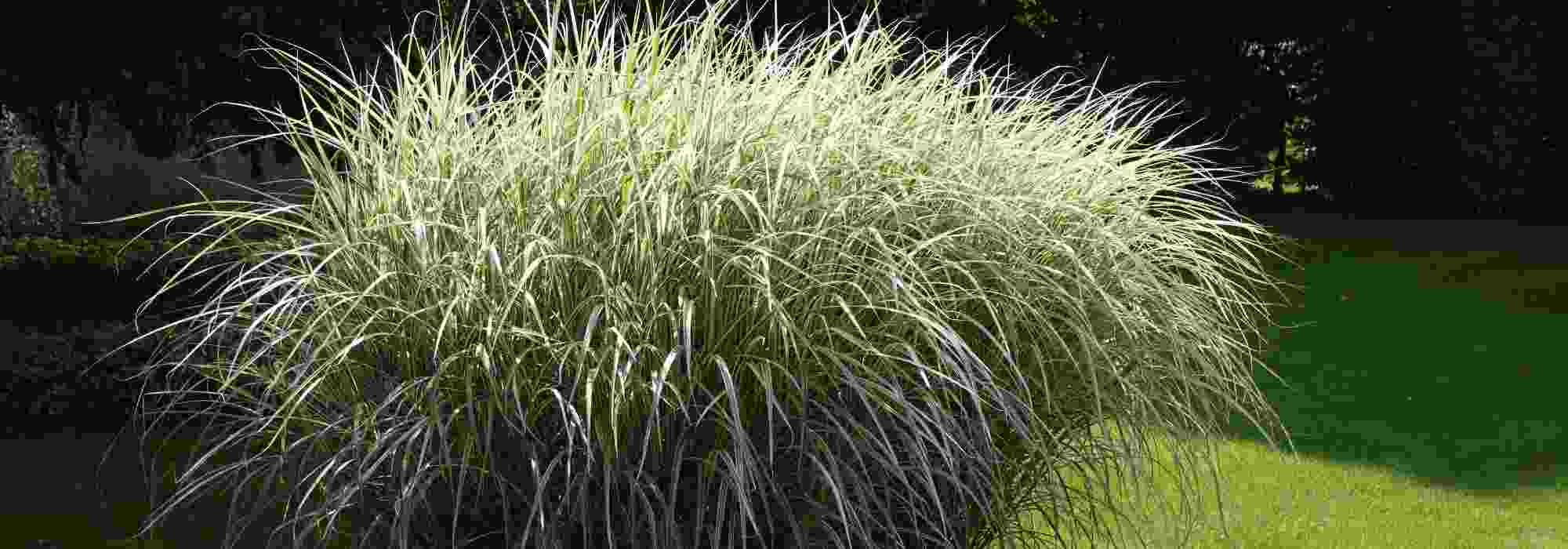
10 tall Miscanthus to discover
Selection of the tallest varieties of this architectural ornamental grass all year round
Contents
Often described as ‘herb’, miscanthus is a perennial grass that is particularly ornamental with its soft, upright culms that undulate and dance with the wind, bend in the rain and glitter in the sun. Between July and October, depending on the varieties, colourful spikelet inflorescences add extra charm to this herbaceous plant, one of the most elegant. And when the autumn frosts arrive, the highly decorative striped foliage takes on bright colours as it dries. The slender stems persist throughout winter to enliven gardens, from the most contemporary to the wildest.
Frequently referred to as Chinese reed, eulalia or elephant grass, miscanthus adapts to all situations. Some species or varieties can even form dense screens or majestic backdrops for borders, especially since they can reach substantial heights.
Discover our selection of the tallest miscanthus, perfect for creating living screens or an imposing backdrop for a border.
Further reading : Miscanthus: planting, growing and caring for.

Giant miscanthus, aptly named
A view from the neighbour opposite that’s a little too visible to mask, a street that’s too conspicuous, and a back border in need of bulk? The giant miscanthus (Miscanthus x giganteus) may address your issue. As its name suggests, this horticultural species of miscanthus, arising from a natural cross-breeding between Miscanthus sinensis and Miscanthus sacchariflorus, sets all height records. Indeed, during flowering, this hybrid grass reaches 3 to 4 m in height, with a spread of only 1 m. And all of this in a single season. Over the years, the clump tends to thicken, without becoming invasive. Not to mention that this giant miscanthus provides a dense, vigorous clump which, planted in groups, forms a very imposing vegetation screen. But it is also aesthetically pleasing, as its ribbon-like leaves, in a pale, softly blue-green, take on soft blond to brown tones as autumn arrives. The leaves partly drop in winter, but the clump of upright stems persists. However, you’ll need to wait until May to see the vegetation re-emerge, reaching, in a few weeks, one of the most imposing statures.
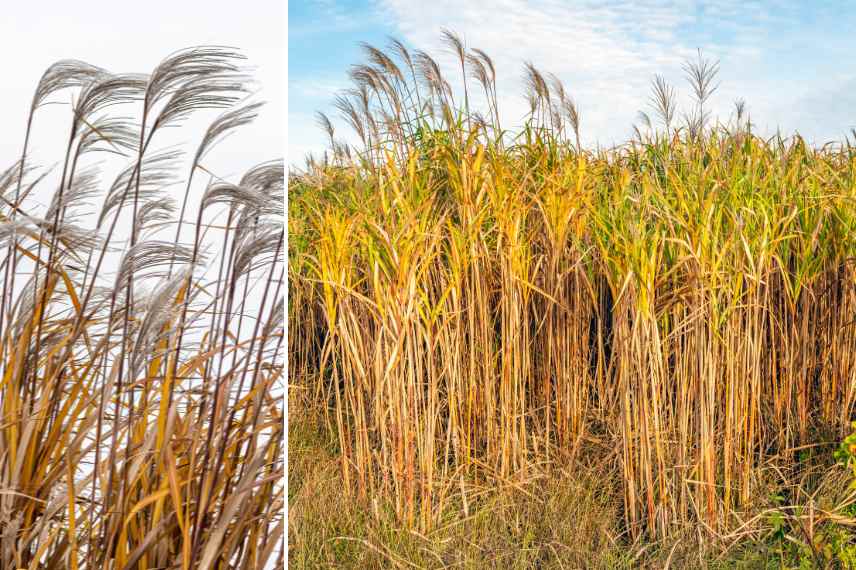
The Miscanthus giganteus can reach 3 to 4 m in height
This species of miscanthus also offers a flowering with long spikelets that pass from pink to silvery, lasting until autumn. Provided that summers are long and warm.
The imposing size of this miscanthus makes it a herbaceous plant with lush growth, ideal for creating visual screens. It is therefore a worthwhile alternative for forming a low-maintenance hedge. Quite bamboo-like, it does not have its drawbacks.
And to add a touch of whimsy, go for the hybrid variety Miscanthus x giganteus ‘Alligator’ which offers green foliage, broadly variegated and maculated with yellow. In late summer, from the imposing clump of foliage emerge slender, silky spikelets, which range from pink-brown to silvery-white.
If giant miscanthus is sought for its size and decorative appearance, it is also increasingly cultivated on a large scale. Its foliage can thus be used as mulch, ecological fuel, animal litter or standing crop.
How to plant it? This miscanthus favours deep soils, moderately fertile, well-drained, but moist. It also requires a sunny exposure if you want it to flower.
Read also
How to choose a Miscanthus?Miscanthus floridulus, another giant to favour
Among tall Chinese grasses, I recommend Miscanthus floridulus, sometimes referred to as Miscanthus japonicus. Native to northern China and Japan, this miscanthus can reach 2.5–3 m tall, with a width of 2 m at full maturity. With a sturdy, upright growth habit, this giant Chinese reed offers light-green, relatively narrow, arching and trailing foliage at the ends. Its strap-like leaves take on pretty coppery colours in autumn. However, it will require a particularly hot and long summer for this miscanthus to produce its silvery flower plumes, from September to November.
By its silhouette, stature and foliage, Miscanthus floridulus is quite close to Miscanthus giganteus. To the point of being often confused. Architectural, graphic, this Chinese reed remains decorative year-round. It has no equal for creating a stunning screen of foliage that sways at the slightest breeze.
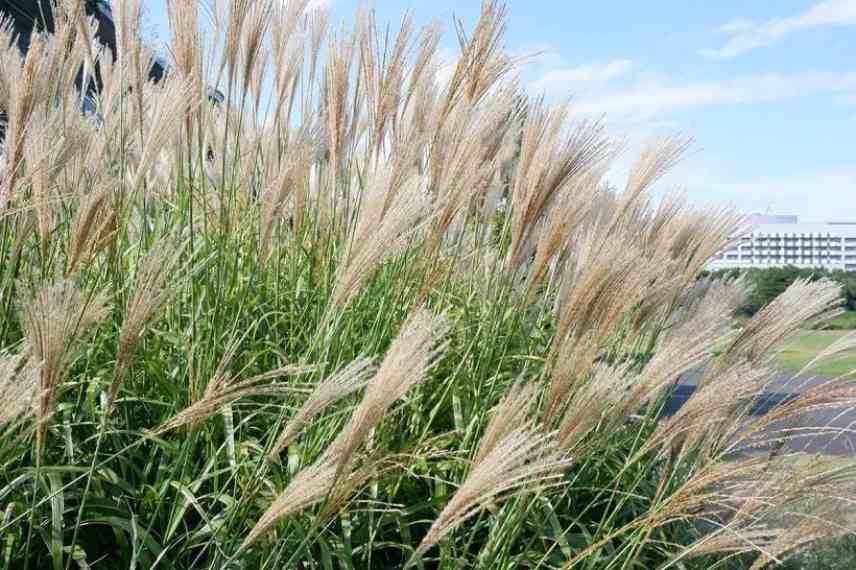
Miscanthus floridulus is often confused with giant Chinese reed
How to plant it? This miscanthus prefers neutral, deep, fairly rich and well-drained soils that retain some moisture in summer. It can tolerate a short dry spell if the soil is deep. Full sun is essential.
Miscanthus sacchariflorus, Chinese silver grass
Miscanthus sacchariflorus is a Chinese reed species that can reach 2 m tall, up to 1.6 m wide. That is to say, it occupies a substantial space, large enough to form a privacy screen, hide an unsightly view or fill the back of a border. Like other eulalias, this Chinese reed species offers highly ornamental foliage. Its ribbon-like, broad and pliant leaves display a glaucous green, highlighted by a fine brown-to-silvery stripe along their entire length. As autumn approaches, this foliage takes on a pretty brick-red tint. It also benefits from a fountain-like habit, outward-spreading and arching.
With long scaly rhizomes, this miscanthus tends to spread. But it makes up for this tiny drawback with abundant and very silvery flower plumes. The silky inflorescences appear in August and persist until winter. Beyond their aesthetics, these plumes reach a notable length of up to 35 cm. When mature, they colour copper-red. So you would choose this miscanthus not only for its size but also for its flowering in long plumes, recognised as one of the most spectacular.
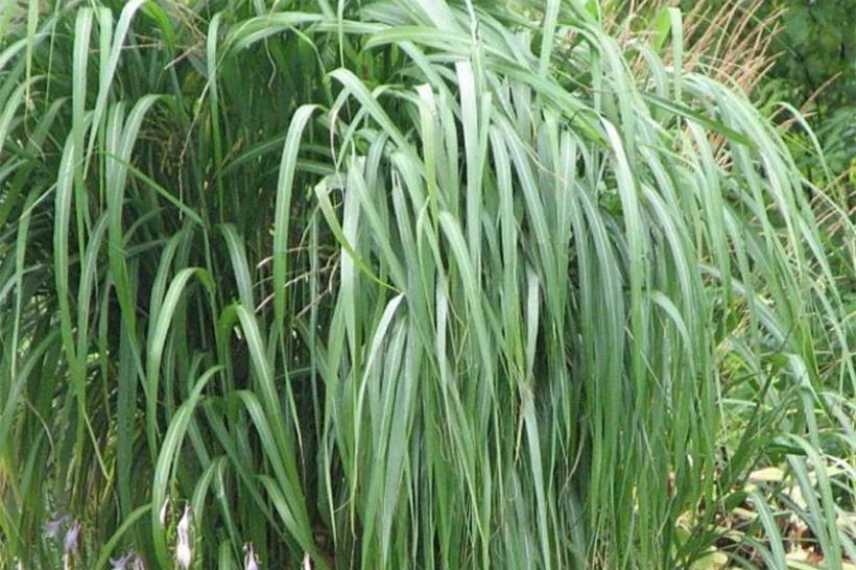
Miscanthus sacchariflorus, at 2 m tall, benefits from a fountain-like, outward-spreading and arching habit
How to plant it? This Miscanthus sacchariflorus will thrive in ordinary, deep, fairly rich and rather cool, damp soil. But it can tolerate lighter, drier soil for a short period. However, it does not tolerate shade and needs full sun.
Read also
How to grow Miscanthus in pots?Miscanthus transmorrisonensis, with semi-persistent to evergreen foliage
Originating in Taiwan, where it was discovered in 1979 by Americans, Miscanthus transmorrisonensis stands out mainly for its semi-evergreen to evergreen foliage in winter. However, it can also be classed among the large Chinese reeds, as it can reach up to 2 m in height with a relatively low spread of around 60 cm. This miscanthus benefits from an upward-spreading habit. It forms a dense clump, consisting of green ribbon-like leaves that persist through winter in milder climates. From -10°C, it tends to dry out. This Chinese reed, sometimes called Taiwan Miscanthus, is especially interesting for its winter foliage which evolves to tawny tones to varying degrees. It therefore offers a magnificent display in winter.
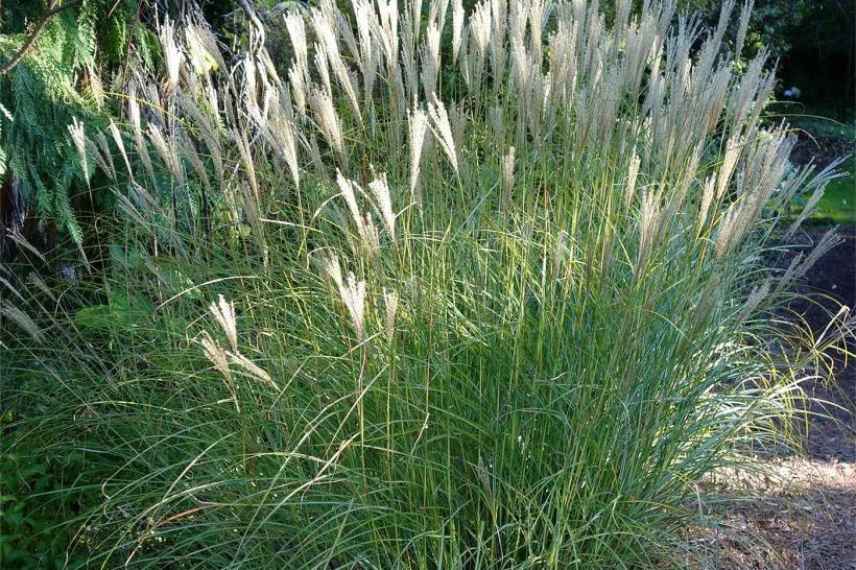
Miscanthus transmorrisonensis can reach 2 m thanks to its inflorescences
As for flowering, it occurs in mid-summer and continues until late January. Like other species, this elephant grass flowers in long panicles of silver to golden-beige.
How to plant it? Like all other species, Miscanthus transmorrisonensis prefers deep, fairly rich and well-drained soils. The soil should be cool to moist, but it can tolerate a short drought. Plant in full sun.
Miscanthus sinensis, the most cultivated species
Miscanthus sinensis is certainly the most common and widespread Chinese reed grass species. There are, in fact, a multitude of varieties ranging from 60 cm to 2 m in height. Some varieties offer variegated or striped foliage, others deliberately red in autumn. We have selected for you the most imposing hybrid varieties to meet your needs:
- Miscanthus sinensis ‘Sirène’ : the flowering clump of this variety reaches up to 2.5 m. Its foliage changes with the seasons, from bronze-green to orange-red. A long white vein runs along the entire length of the leaves. As for the feathery inflorescences, they emerge mahogany red before turning to silvery grey
- Miscanthus sinensis ‘Cabaret’ : this Chinese reed grass variety asserts its difference by its height of around 2.5 m and a width of 2 m. Beyond these dimensions, it also stands out for its bright foliage, white margins broadly edged with green. The panicles open pink and then become silvery
- Miscanthus sinensis ‘Sarabande’ : a variety with very fine foliage that can reach 1.8 to 2 m in height with a spread of 1 m. It benefits from an upright and compact habit and exceptional hardiness. It is distinguished by its green leaves with a white central vein that take on silvery highlights. The very open and trailing inflorescences emerge copper-red, finishing in golden yellow
- Miscanthus sinensis ‘Cosmopolitain’ : at 2 m tall in full bloom, this variety is distinguished by its broad leaves, green striped with white. Leaves are indeed crossed by a central vein and a white margin. The fine inflorescences, ranging from pink-silver to red, create a pleasing contrast with this variegated foliage
- Miscanthus sinensis ‘Silberspinne’ : beyond its size, which can reach 2 m under optimal growing conditions, this miscanthus variety is notable for its very compact tuft composed of fine leaves in a dark green that take on magnificent autumn colours. It is also interesting for its inflorescences, spider-like, ranging from burgundy red to silvery at maturity.
- Subscribe!
- Contents
Comments