





























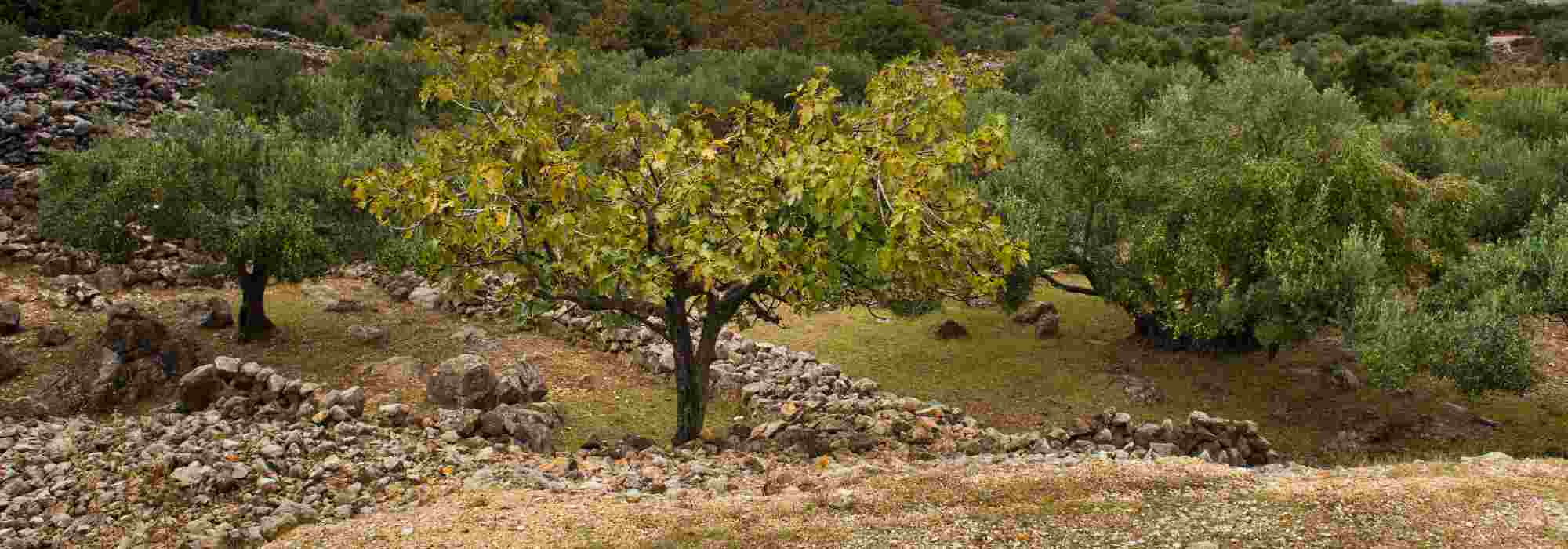
5 fruit trees for calcareous soil
Which fruit trees are best suited to chalky, dry and stony soils?
Contents
Specifically, calcareous soil contains between 15% and 30% calcium carbonate, i.e. chalk. It is therefore a soil with a pale, chalky appearance. It is very light and dry, often stony or rocky, even dusty. A permeable soil that does not retain water or nutrients. It is a soil that quickly becomes impoverished and must be improved by additions of organic matter that will not only supply nutrients but also improve its structure. Before planting a fruit tree in calcareous soil, it is therefore essential to provide a good supply of compost, potting compost or cattle manure. In addition, sowing green manures will subsequently provide organic matter, as will mulching.
Note also that, potentially, all grafted fruit trees can adapt to calcareous soils, provided the rootstock is tolerant.
Overall, calcareous soils are perfectly suited to southern fruit trees such as the apricot trees, the olive trees, the almond trees, the mirabelle plum trees, the fig trees, the true pistachio tree… but also the hazel trees and the walnut trees… But it is possible to plant and grow other fruit trees, of which we offer a selection of five species. All of them adapt very well to calcareous soils.

Sea buckthorn (Hippophae rhamnoides), the thorny tree bearing vitamin-rich berries
Sea buckthorn (Hippophae rhamnoides) is a small deciduous tree in the Elaeagnaceae family, reaching only 3 to 4 m in height with a spread of about 1.5 m. An indigenous species, this tree grows spontaneously in poor, sandy and calcareous soils, in the mountains or by the sea. In short, it is particularly hardy, vigorous and fast-growing, robust to climatic conditions. It is hardy to -30°C, drought-tolerant, resistant to salt spray, saline soils, wind and pollution… However, it absolutely requires full sun.
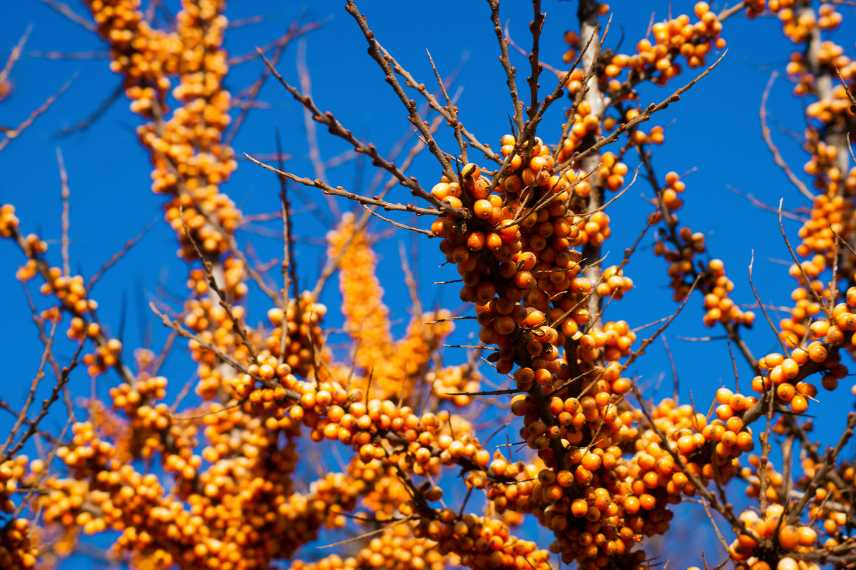
Sea buckthorn berries
It is a large shrub with elongated grey-green foliage and spiny shoots. With its upright habit, it is ideal for planting in a border or hedge, among other defensive uses. Flowering occurs between March and April on bare shoots.
As sea buckthorn is a dioecious species, it is essential to plant nearby at least a duo consisting of a male plant and a female plant. Pollination will be carried out by nectar-foraging insects, particularly bees, attracted by the very melliferous flowers. Some varieties such as ‘Friesdorfer Orange’ are self-fertile, but pollination is always better with two plants.
The female plants produce orange berries from September to December, particularly decorative. While they delight birds in winter, they are also edible. And especially rich in vitamins C, A, B, E, F and P and in minerals. The berries are also known for their antioxidant properties. They can be eaten fresh, juiced, dried, as marmalade or as jam.
For more information:
The jujube tree (Ziziphus jujuba), the tree bearing jujubes
The jujube tree (Ziziphus jujuba) is a member of the Rhamnaceae family, equally productive and ornamental. Although hardy to -15°C, it can only bear fruit in the south of France, because it needs long, hot summers. It is a tree that thrives very well in dry, poor, stony and calcareous soils, but it will require full sun and a well-sheltered position. With a twisted ramification and a rounded habit, this deciduous and leathery-leaved tree reaches 6 to 10 m in height with a spread of 3 to 4 m. It is best to plant it away from buildings, as it has a very extensive, deep and vigorous root system.
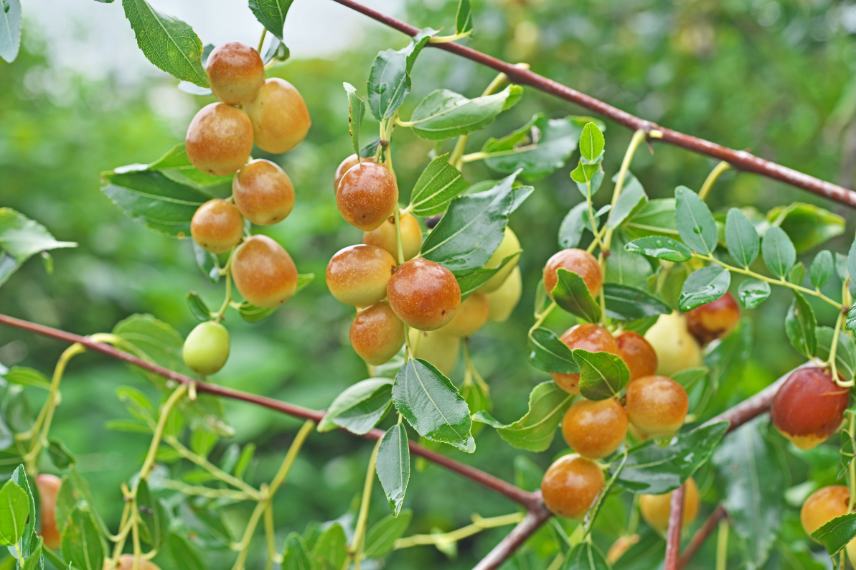
The fruits of the jujube tree
Its glossy green foliage is finely dentate and furnished with thorny stipules. The flowering is discreet and takes place in May–June. Not easily visible due to their greenish colour, the flowers smell delicious. They are particularly melliferous and nectariferous and attract swarms of foraging and pollinating insects. They are, moreover, responsible for the pollination of the jujube tree.
As for the jujubes, they are red fruits about the size and shape of olives that ripen between September and October. It is a fruit with a slightly gelatinous flesh, tart and sweet at once, which can be eaten fresh. It can also be eaten when over-ripe and withered. It then takes on a date-like flavour. It is a fruit very rich in vitamins A, C and B, with strong antioxidant properties.
For more information: the jujube tree: planting, pruning and care
The pomegranate tree (Punica granatum), the tree with orange flowering bearing pomegranates
The pomegranate (Punica granatum) is a small tree in the Punicaceae family, widely cultivated in the south of the country. It is a self-fertile fruit tree that benefits from fairly rapid growth, reaching 4 to 5 m tall and 2 to 3 m across. Fruit set occurs after 4 to 5 years. It has a relatively dense, bushy habit, ramified and rounded.
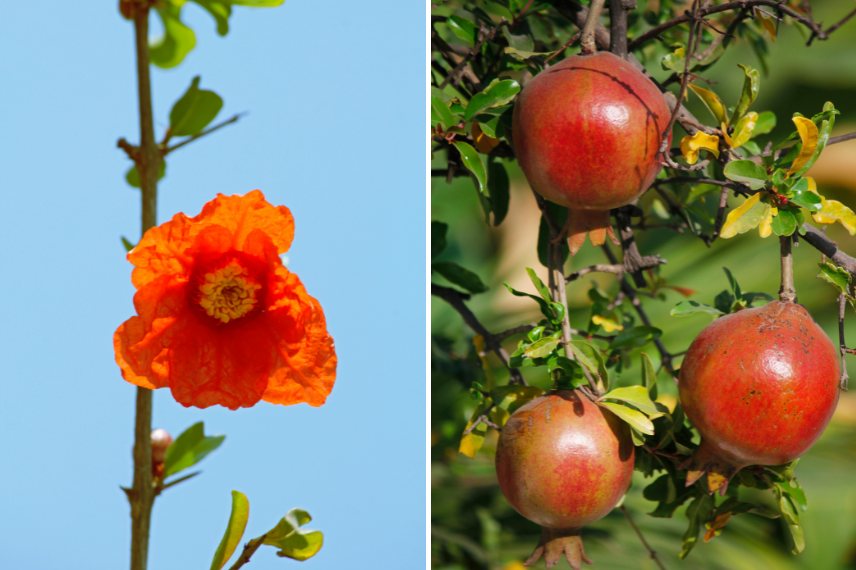
Flowers and fruits of the pomegranate
It is a tree with undeniable aesthetic value. Indeed, from bud burst period, new shoots take on a red colour. Then the foliage becomes glossy green before turning purple and orange in autumn. But the flowering is unsurpassed in beauty. From June to July, sometimes into August, large red-orange to bright red flowers open on two-year-old shoots. Then, from September to November, these flowers give rise to the famous pomegranates, 8 to 10 cm in diameter, most often red or orange, with a tough skin and juicy, tangy pulp.
To bear fruit, the fruiting pomegranate requires a long, hot summer. That is why the climate of southern France suits it. However, it can tolerate down to -15 °C, which allows planting it elsewhere (but fruiting is not guaranteed). It should be planted in a sheltered position, away from winds and cold draughts. Calcareous soils pose no problem, as do saline soils.
For more information:
The mulberry tree (Morus), the tree bearing mulberries (not those from brambles)
The mulberry (Morus) is a tree in the Moraceae family that comes in three species: the black mulberry (Morus nigra), the white mulberry (Morus alba) and the red mulberry (Morus rubra) which produce fruits, close to the blackberries of brambles, usually black, but also white, pink, purple or red. All remain medium-sized, as they hardly exceed 10 m in height. The mulberry prefers light, deep soils and dislikes damp or waterlogged soils. This is why calcareous soils suit it perfectly. They also require sun and warmth. Although hardy to -15°C, it remains susceptible to late spring frosts.
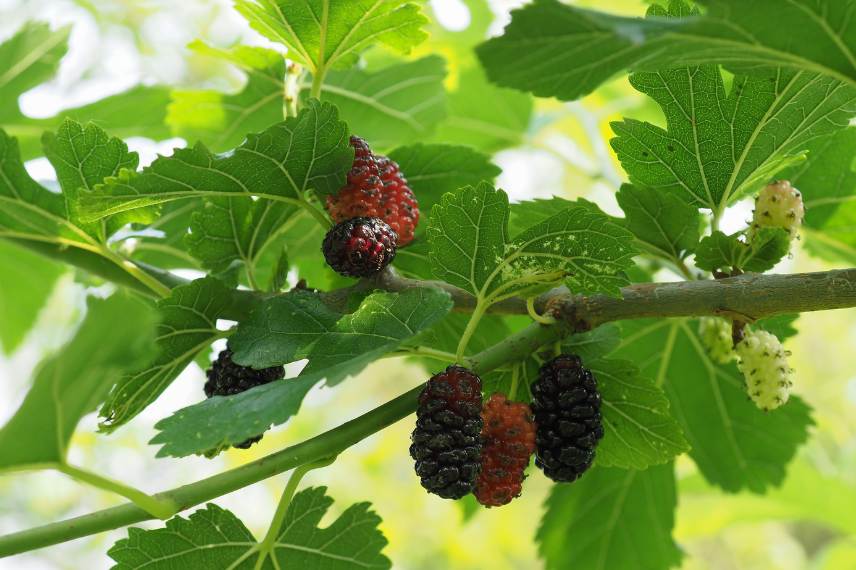 Mulberry fruits
Being monoecious, the mulberry bears both male and female flowers. Greenish in colour, they bloom from April to May. The fruits are harvested from June to September. They consist of numerous small globose drupelets that are tightly packed. They are juicy and very sweet. As for the heart-shaped, deciduous foliage, it turns golden-yellow in autumn, which makes it particularly decorative.
For more information :
The male dogwood (Cornus mas) with very sweet fruits, the cornels
The male dogwood (Cornus mas) is a large shrub that reaches 3–4 m in height with a spread of 2 m. Like all dogwoods, it belongs to the Cornaceae family. It is a native species that is hardy and undemanding. It grows very well on calcareous, dry and well-drained, poor soils, but it also adapts to more ordinary soils, even slightly acidic. It also needs a sunny position. It is hardy to -25°C, which means it can grow and fruit almost anywhere.
To those who might be surprised to see a male tree bearing fruit, note that the term “male” refers to its wood formerly used for weaponry.
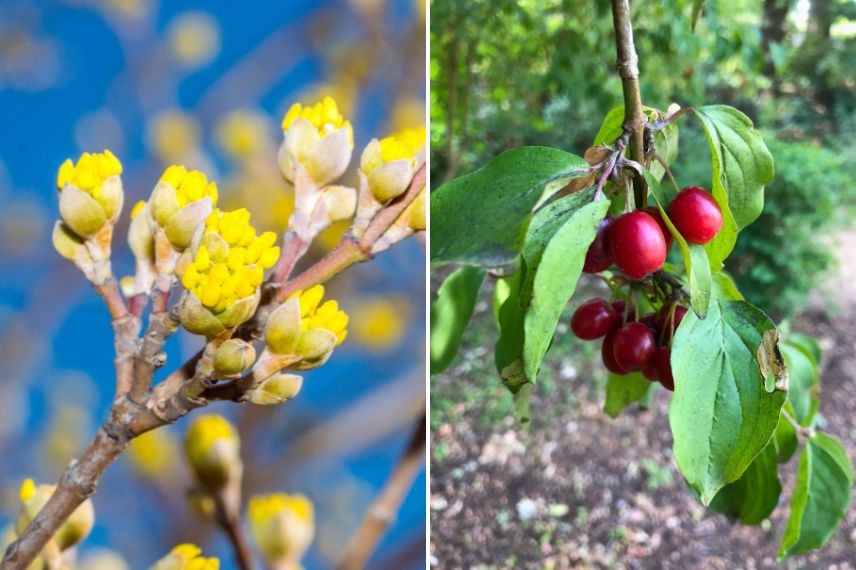
Flowers and fruits of the male dogwood
The male dogwood is distinguished by its erect form and its numerous shoots with scaly bark. From the end of winter, between February and March, its bare shoots are clothed in a pretty yellow flowering, reminiscent of mimosa. The glossy green foliage appears afterwards. Very veined, it falls late without changing colour. In September, red berries the size of a large olive begin to ripen. Their flesh is tart, sweet and fragrant. These fruits are best harvested when fully ripe, either fresh, dried, or for making jam. They resemble raspberry, redcurrant and cherry in flavour.
For more information :
- Subscribe!
- Contents
Comments