


5 hibiscus plants with mauve or blue flowers
to give the garden an exotic, refreshing ambience
Contents
Also known as Althea, hibiscus are hardy bushes appreciated for their generous summer flowering, which gives the garden an exotic air. Single, double, or even spectacular, hibiscus flowers display a wide range of colours, from red to white, including pink and purple. Easy to grow, hibiscus is hardy to -10°C to -15°C depending on the species, which makes it an interesting bush if you want a garden with a tropical vibe. Hibiscus prefers sun and cool, moist soil. It can be planted as a specimen, in a flowering hedge, and even in a pot on a terrace.
Discover our hibiscus selection with mauve or blue flowers, which will bring a fresh and distinctive look to your garden or terrace.

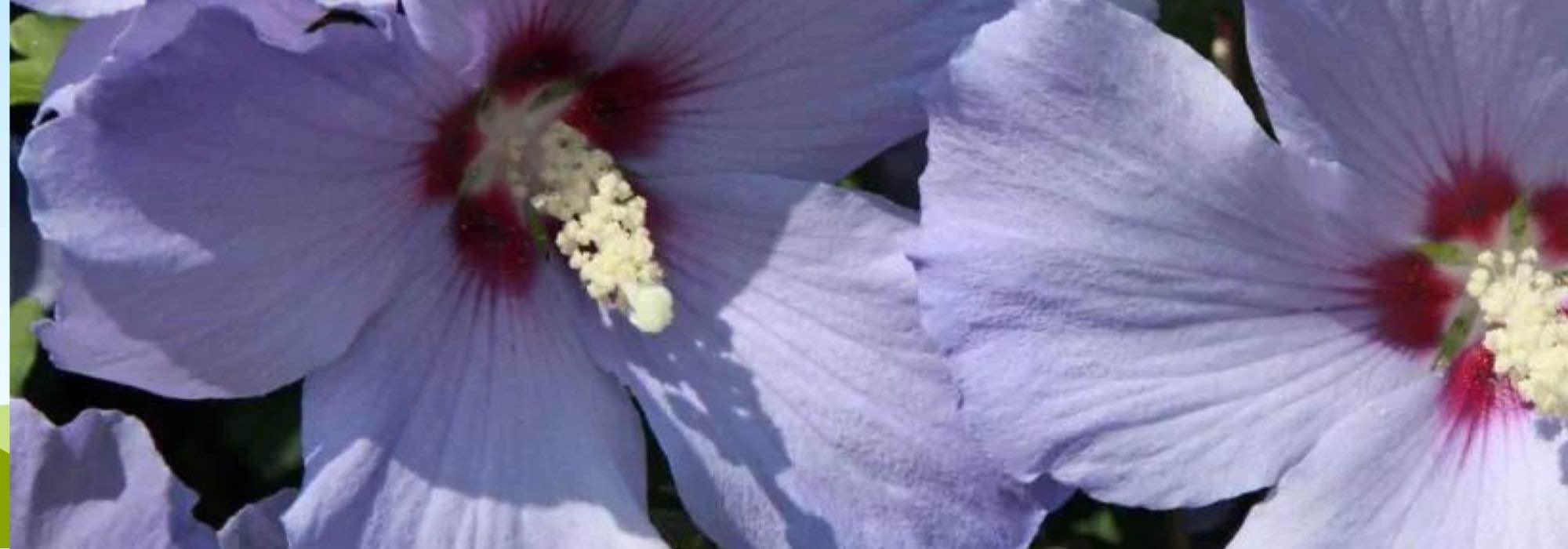
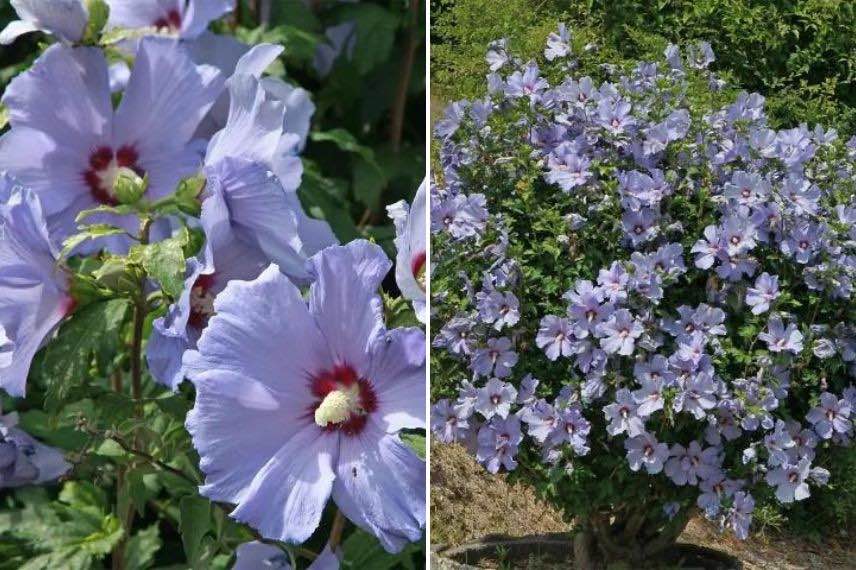
Hibiscus syriacus 'Blue Bird' (Marina) - Blue Rose of Sharon
Hibiscus syriacus ‘Blue Bird’ (Marina) benefits from abundant flowering and produces large blue flowers with a red centre for several months, from July to October. The trumpet-shaped flowers consist of five lanceolate petals and measure 4 to 8 cm in diameter. They bear in their centre a white tube formed by five stamens fused together and attract butterflies. Also known as Rose of Sharon, Hibiscus syriacus ‘Blue Bird’ (Marina) forms a shrub up to 3 metres tall at maturity. Its three-lobed leaves, more or less dentate, are deciduous.
Easy to grow, Hibiscus syriacus ‘Blue Bird’ (Marina) should be planted in full sun and sheltered from cold draughts. Plant it in fertile, cool, humus-bearing soil that is well-drained. It tolerates drought and calcareous soils. Hibiscus syriacus is very hardy and the ‘Blue Bird’ variety resists down to -23°C. Shrub can be grown as a specimen on a lawn, or as a hedge or in a container. Plant it in a flowering hedge with other hibiscus varieties such as Hibiscus syriacus ‘Sup’Heart’ – Rose of Sharon with large flowers and Hibiscus ‘Rose Moon’ – Rose of Sharon with a red heart.
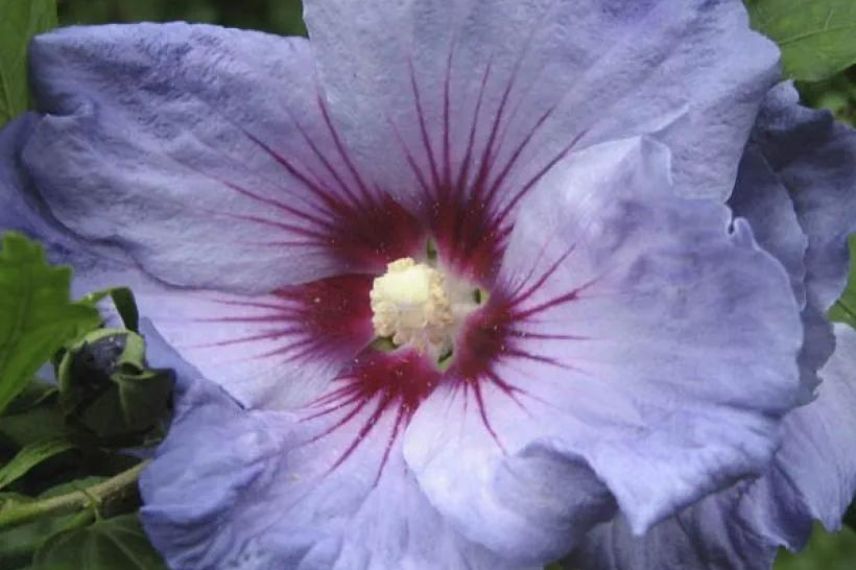
Hibiscus syriacus 'Blue Chiffon' - double-blue Althea
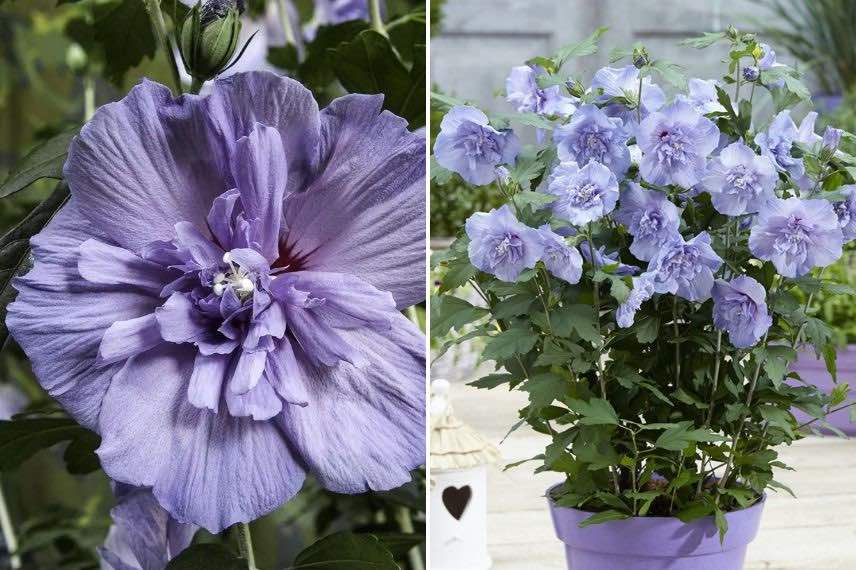
Hibiscus syriacus ‘Blue Chiffon’ offers generous lavender-blue flowering from July to September. The flowers look as if woven from crepe, and have a double centre accentuated by a subtle red. The deeply cut foliage is dark green, slightly glossy and deciduous. Hibiscus syriacus ‘Blue Chiffon’ is a bush of modest size with an upright, very bushy habit, reaching 1.7 m tall at maturity with a 1.5 m spread. It can be used in a border or hedge, or grown in a pot.
Very easy to grow, it thrives in full sun in well-drained, ordinary soil, and even chalky soil. It is hardy to -23°C. To achieve the best possible flowering, mulch the base to keep it cool in summer. In a medium-sized flowering hedge, Hibiscus syriacus ‘Blue Chiffon’ can be paired with other hibiscus from the Chiffon series, such as Hibiscus syriacus ‘Lavender Chiffon’ (pink to mauve) or Hibiscus syriacus ‘White Chiffon’ with flowers of immaculate white. You can also plant asters at its base to create a mauve-to-blue gradient.
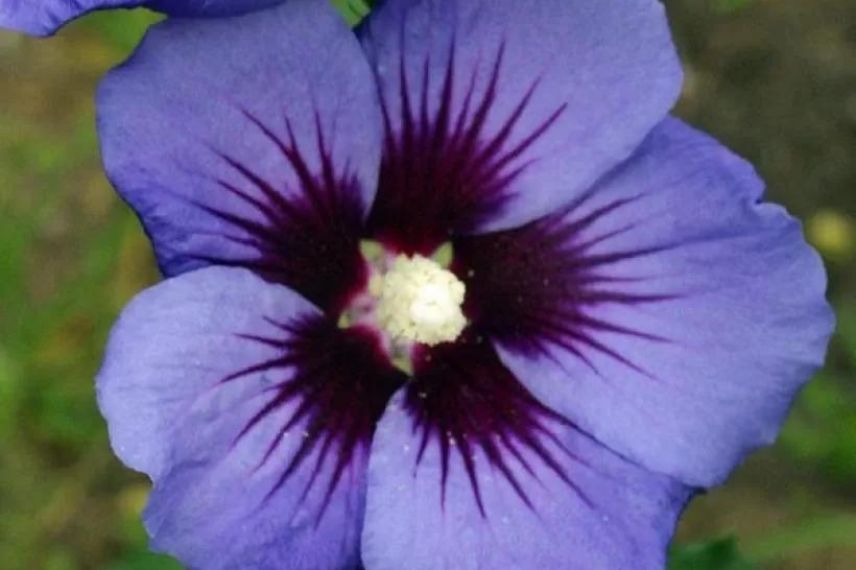
Hibiscus syriacus 'Ultramarine' - Blue hollyhock
The Hibiscus syriacus ‘Ultramarine’ stands out thanks to its large lavender-blue trumpet-shaped flowers. They measure 10 cm in diameter and bloom on green, lobed foliage from July to October. Solitary or in pairs, they feature a maculated and purple-streaked centre, from which large white stamens emerge. This bush with an upright habit reaches 2 metres high by 1.5 metres wide at maturity.
Very vigorous and hardy down to -23°C, Hibiscus syriacus ‘Ultramarine’ thrives in full sun and in soil that is cool, humus-rich but light and well-drained. It is able to withstand drought and calcareous soils. To optimise its flowering, prune it hard in late winter, leaving 3 to 5 buds on the branches. It can be planted as a hedge or in a border beside perennial plants and tall grasses. Try pairing with gaura and Stipa.
Hibiscus syriacus 'Azurii' – Rose of Sharon
Hibiscus syriacus ‘Azurii’ is a large-flowered Althaea variety that does not produce seeds. This peculiarity allows it to continue flowering without exhausting itself throughout the summer. From July to September, this bushy shrub bears flowers 11 cm in diameter, forming an open cup 6 cm deep. The blue of the petals is enhanced by a red centre and a cluster of white stamens. It forms a medium-sized shrub about 2.2 metres tall and 1.5 metres wide.
Easy to grow, the Hibiscus syriacus ‘Azurii’ enjoys a sunny position, or light shade in southern regions. It thrives in a soil that is somewhat moist and stays cool in summer during the flowering period, from July to September. The soil should also be well-drained and fertile. In a garden, it can be paired with tree mallows or crape myrtles to create a colourful, flowering display from summer to autumn.
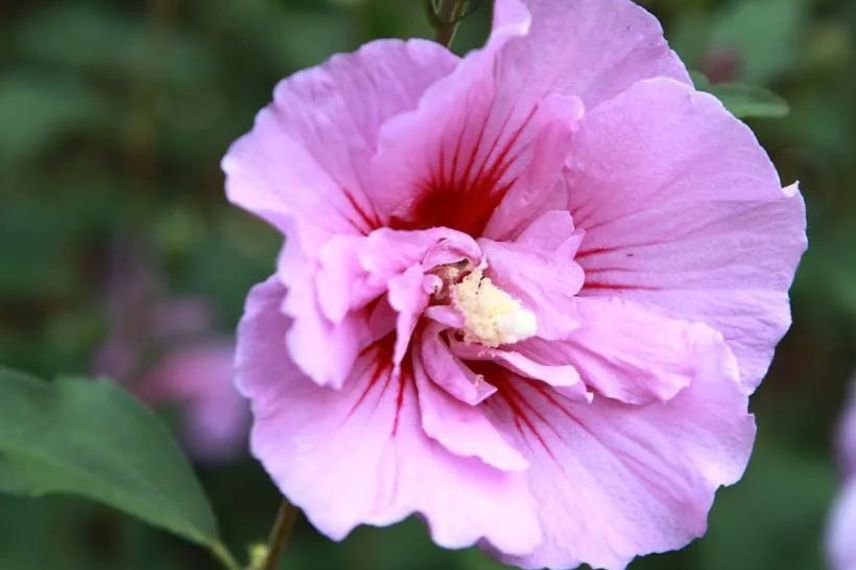
Hibiscus syriacus 'Purple Pillar' – Althea
Hibiscus syriacus ‘Purple Pillar’ bears flowers in mauve-pink with a purple centre throughout the summer, from July to September. Semi-double, they present a crepe-like, crumpled appearance that is very romantic. They display dark green, trilobed and dentate foliage. The shrub has an original, architectural columnar habit, growing up to 4 metres tall with a width of 90 cm. Its silhouette makes it suitable for a hedge, and with regular pruning, for growing in a container.
Hibiscus syriacus ‘Purple Pillar’ is easy to grow and thrives in full sun, in any soil type, including chalky soils, provided the substrate is not too damp or too dry. In a garden, it can be paired with other shrubs with staggered flowering, such as Forsythia intermedia ‘Week-end’ – Parisian Mimosa, which bears golden-yellow blooms in March and April, and Weigela florida ‘Alexandra’ – purple-leaved Weigela, which bears pink flowers in May and June.
Further reading
- Other Hibiscus with blue or mauve flowers will brighten your garden like Hibiscus syriacus ‘Summer Ruffle’ – Althea variegated
- Discover our full Hibiscus range to help you choose.
- You can also read our complete Hibiscus guide to learn more about planting, varieties and how they pair with other plants.
- Subscribe!
- Contents
Comments