


5 late-spring flowering bulbs
Bulbous plants to brighten gardens, balconies or terraces from May to June
Contents
Among the many species of spring bulbs, there are some that bloom as soon as winter ends, to poetically announce the imminent arrival of spring. But others prefer the temperatures to be less chilly and wait until the end of spring to reveal themselves. They thus form a beautiful transition to summer, a period of abundance in the garden.
Their colours, silhouettes and even, at times, their fragrances accompany us through May and June, in beds, borders, rockeries or pots. Discover here our selection of five late-blooming bulbs that flower at the end of spring.

Alliums
We love ornamental Alliums for their strikingly architectural flowering, which provides a strong structural touch. They indeed produce astonishingly large, colourful globes made up of a multitude of small star-shaped flowers. Unlike culinary species (garlic, onion, shallot, chives…), these Alliums are grown solely for their decorative character. Their size varies by species, from 20 cm for the smallest to more than 1.5 metres for the largest.
In these bulbous plants, the foliage appears from early spring and sometimes disappears before flowering.
Among the varieties that flower between May and June, the following are worth noting:
- Allium ‘Ambassador’ (1 metre in height), which produces large mauve-lilac pom-poms;
- Allium caeruleum (80 cm in height), with blue-violet umbels with green reflections;
- ‘Mont Blanc’, with its flowers in white spheres;
- Allium karataviense ‘Red Giant’ (20 cm in height), which flowers in red-violet globes;
- ‘Red Eye’ (60 cm in height), with fragrant, multicoloured flowers, blending white-cream, red and purple.
Ornamental Alliums are quick to establish, making them appealing to gardeners keen to see the results of their cultivation.
These spring bulbs, hardy, will readily thrive in full sun, in well-drained soil (no standing damp), even when quite dry. They look wonderful in all garden styles, whether rustic, romantic or contemporary. Plant them in borders or in pots. And remember to include their beautiful flowers in your late-spring bouquets!
To learn more: Allium, ornamental garlic: planting, growing, and care.
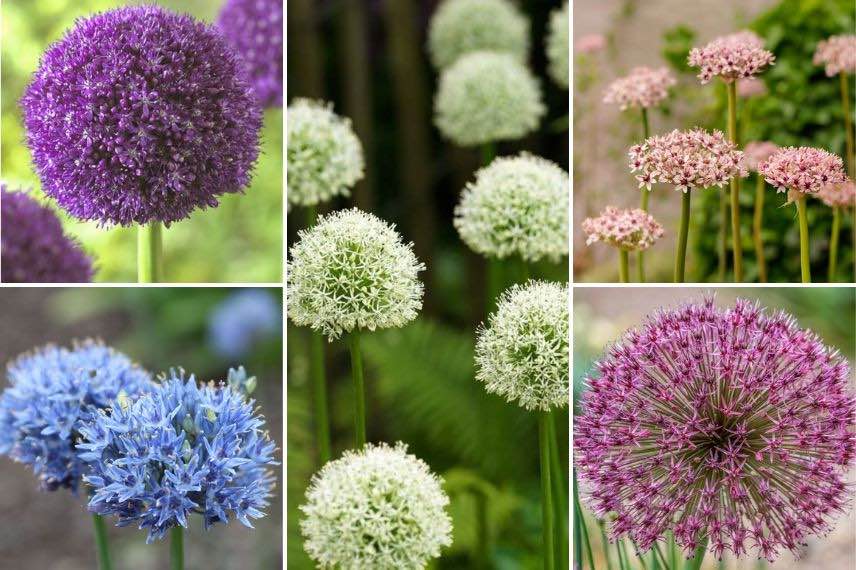
In clockwise order: Allium ‘Ambassador’, Allium ‘Mont Blanc’, ‘Red Eye’, ‘Red Giant’ and Allium caeruleum
Read also
Spring bulbs: the depths guideCamassias
Camassias, also poetically known as the ‘Indian hyacinth’, are perennial bulbous plants that thrive in all kinds of soil, even heavy clay soils. They bring cheer and light to the end of spring, thanks to their large spikes of star-shaped flowers. Their tall, sturdy flowering stems, which can reach up to 1.2 metres in height, also help to add verticality and structure. These late-spring bulbous plants would undoubtedly deserve to be more widely grown in our gardens or containers!
Choose, for example, the Camassia leichtlinii ‘Sacajawea’ with its ivory-white flowers, or ‘Semiplena’ with its double white-cream flowering. For a more colourful touch, turn to the Camassia quamash ‘Blue Melody’, with mauve-blue spikes, or the variety ‘Orion’, with a more vivid lavender-blue flowers.
Hardy, easy to grow and to naturalise, they will return year after year and form lovely colonies over time. Plant them in partial shade or in sun that is not scorching, in a cool to moist substrate. The Camassias will work wonders beside other perennials and grasses in a mixed border, but also at the edges of a water feature.
For more information: Camassia: planting, care and pairing in the garden.
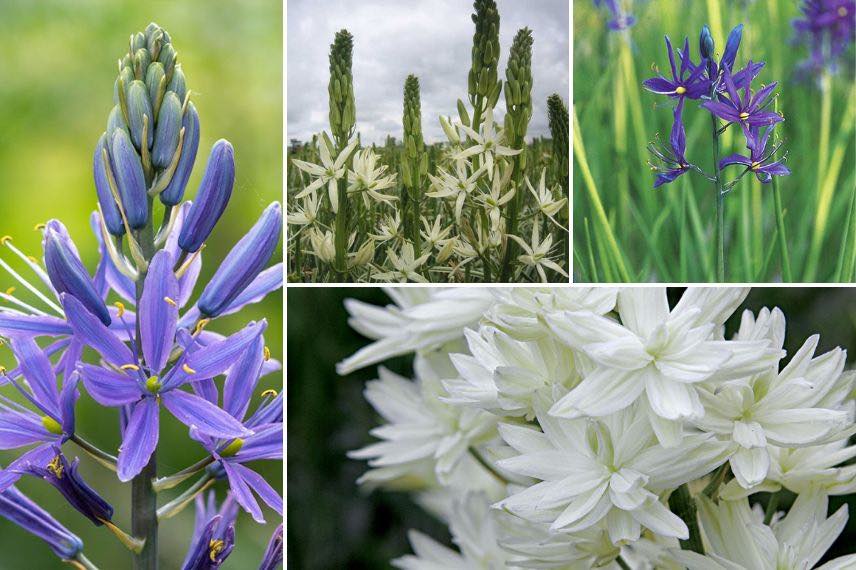
Camassia quamash ‘Blue Melody’, Camassia leichtlinii ‘Sacajawea’, Camassia quamash ‘Orion’ and Camassia leichtlinii ‘Semiplena’
Eremurus
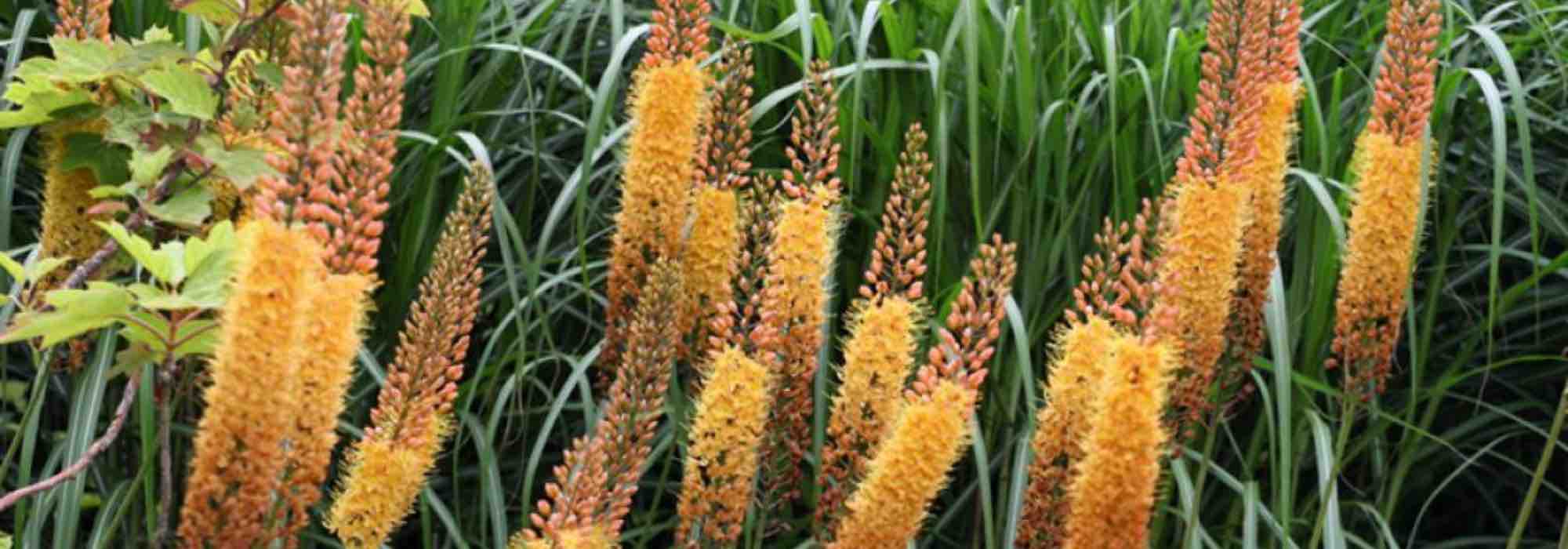
Eremurus, also known as ‘steppe lilies’ or ‘Cleopatra’s needles’, cannot fail to attract attention. Their flowering, which occurs from late spring to early summer depending on the varieties, unveils spectacular upright and colourful flowering spikes. They are composed of numerous flowers that open from the base upwards for almost a month.
The tallest varieties can exceed 2 metres in height, making them even more impressive.
For flowering between May and June, choose, for example:
- the tall Eremurus bungei (2 metres in height), featuring bright clusters of golden-yellow flowers;
- ‘Cleopatra’ (1.3 metres in height), which produces yellow-orange flowers ;
- the imposing Eremurus robustus (2.5 metres in height), which flowers pale pink ;
- the Eremurus himalaicus (60 cm in height), with its clusters of white flowers.
Eremurus bring as much architectural presence as exotic charm. Fairly hardy (to about -15°C on average), they will thrive in the sun. Plant their tuberous roots in fairly rich soil, but well-drained to prevent any dampness. Protect them from prevailing winds to prevent the flowering spikes from being damaged. They are ideal for the back of borders or large containers.
For more information: Eremurus: Planting and care.
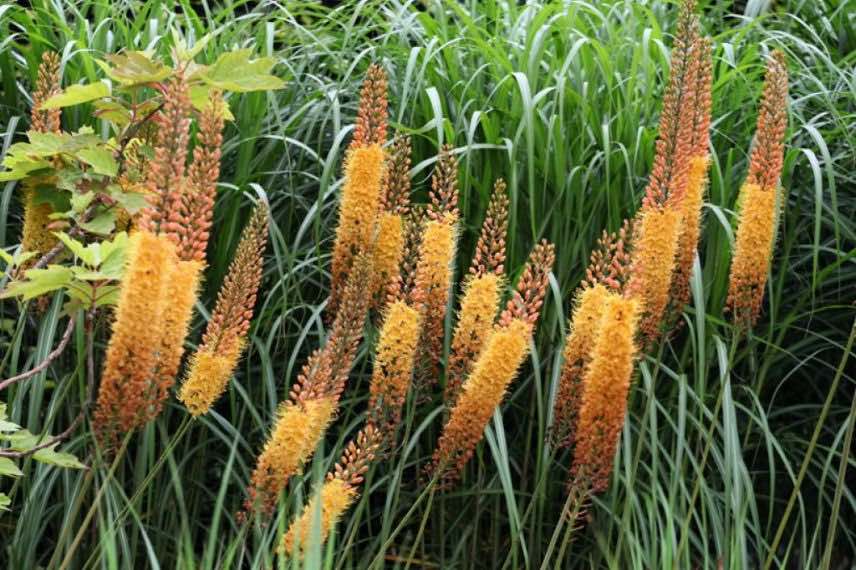
The very beautiful Eremurus ‘Cleopatra’
Read also
5 easy spring bulbs for beginnersDutch Irises
Dutch Irises, or florist’s Irises, are perennial bulbs that flower from April to June. Like other Irises, they reward us with a flowering that blends style and refinement. The flowers are composed of three upright petals, surrounded by three horizontal or pendulous sepals. Always brightly coloured, they often blend several shades and feature spots or halos.
You’ll be spoilt for choice among the different varieties. For example, try ‘Bronze Perfection’, which blends yellow, bronze and mauve to perfection. Also try ‘Miss Saigon’, which produces flowers combining blue, mauve and golden yellow. Very refined, the variety ‘White Excelsior’ features pure white, simply enhanced by a golden-yellow spot.
Easy to grow, hardy and versatile, the Dutch Iris should be planted in light, well-drained soil, even dry, where it will have a good chance of naturalising. In borders, in rock gardens, on a bank or in a pot to brighten terraces and balconies: this bulb will find a place anywhere!
For more information: Dutch iris: planting, growing.
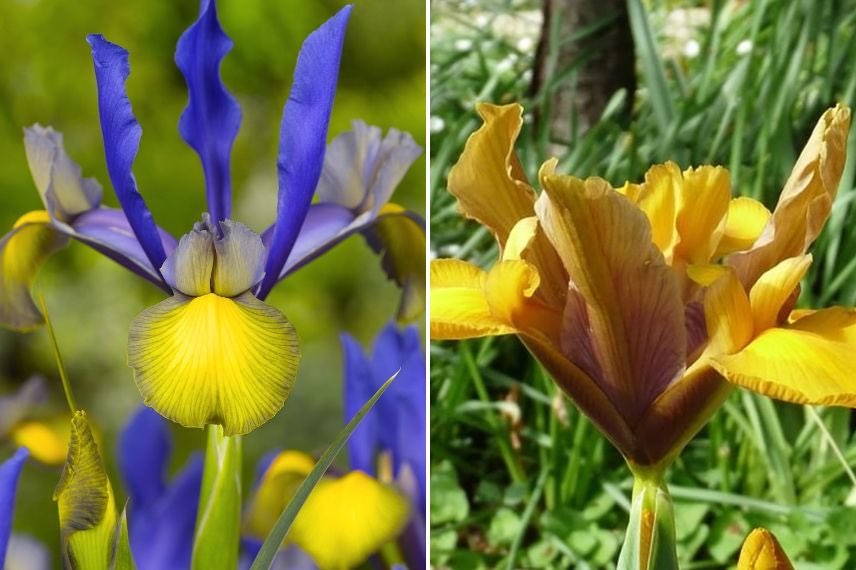
‘Miss Saigon’ and ‘Bronze Perfection’, proud representatives of Dutch Irises
Daffodils
Narcissi hardly need introducing, being among the essential spring-flowering bulbs. Their flowering, in yellow or white tones, can be intensely scented, giving us another reason to include them in the garden or in a container.
Their flowering period ranges from early to late spring. Here, of course, it is Narcissus flowering in April–May and June that interests us. This is the case for the sophisticated Narcissus ‘Double Beauty’, with its bi-colour yellow and orange flowering.
The Poet’s Narcissus ‘Albus Plenus Odoratus’ offers a very fragrant double bloom, white with a subtle yellow tint.
Also worth noting is Narcissus ‘Camelot’, with its single flowers in a handsome bright yellow.
Hardy, not very prone to disease and easy to naturalise, these bulbs will look wonderful planted in groups, for example to create splashes of colour on a lawn that is a little too monotone.
For more information: Daffodils or jonquils: planting, growing and care.
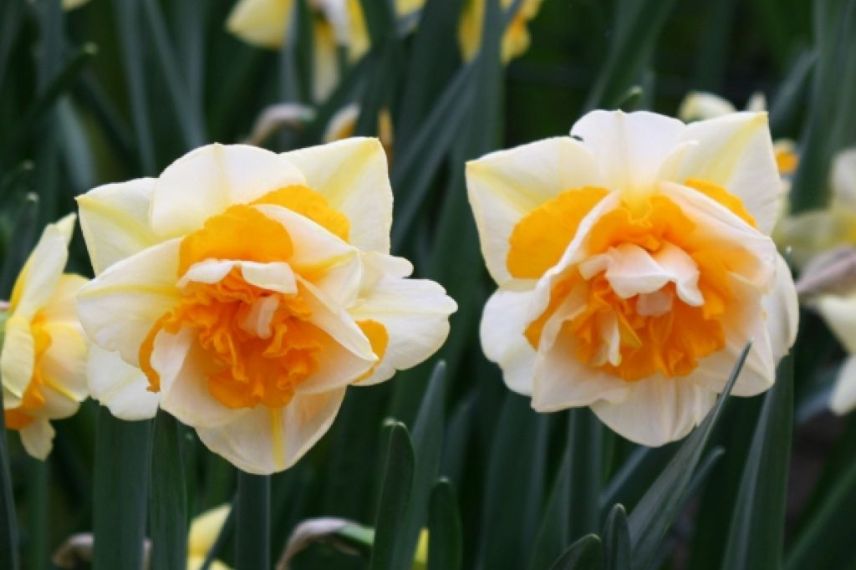
Narcissus ‘Double Beauty’
- Subscribe!
- Contents

Comments