


5 pink-leaved shrubs
Unusual plants to grow in the ground or in pots
Contents
Pink is one of the must-have colours for the garden. Whether romantic or dynamic, pastel or vivid, it fits into any outdoor style.
Another advantage: pink pairs effortlessly with almost any other colour, from the lightest to the most intense colours.
If we are used to pink-flowered plants, it is less common to encounter shrubs whose foliage bears this colour.
These unusual beauties won’t even need to bloom to put on a display and draw the eye in the garden, on the terrace or balcony.
Discover our selection of five shrubs with pink leaves to adopt for a touch of originality.

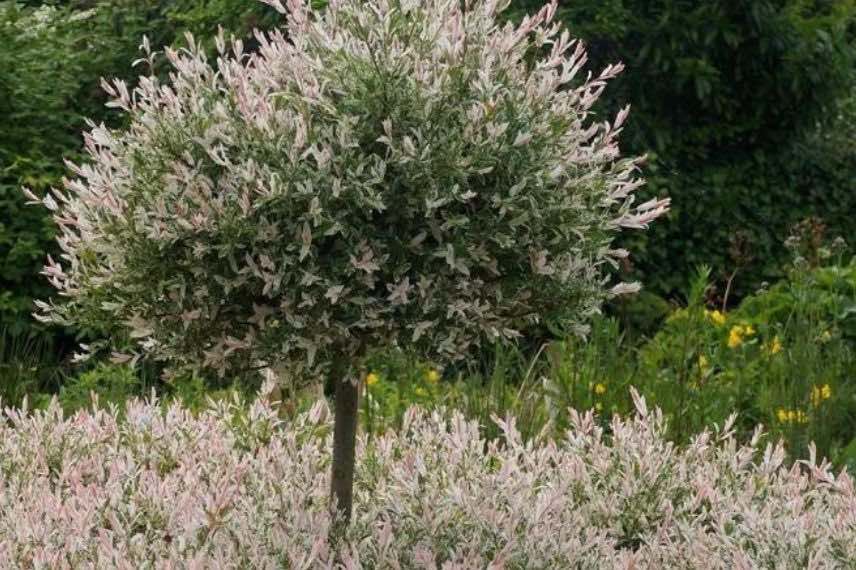
Salix integra 'Flamingo': pink-variegated leaves
This Flamingo willow leaves little doubt about its dominant colour: pink! This shrub has many ornamental qualities. First, its variegated foliage blends pink as the dominant colour with notes of green and white. But its young shoots are also red, giving the plant decorative interest even in winter, once the leaves have fallen.
Its flexible and graceful silhouette, moved by the wind, forms a lovely ball that does not exceed 1.5 m in diameter. These compact dimensions make it easy to fit anywhere: in the garden of course, but also in a pot on the terrace or balcony. In a border, the display of its colours will pair very well with the evergreen and glossy foliage of camellias.
Hardy, fast-growing and easy to care for, the Flamingo willow will mainly require a rich and consistently moist soil, even damp. Plant it in full sun or in a lightly shaded position in hot-climate regions.
For more information: Willow, Salix: planting, pruning and care.
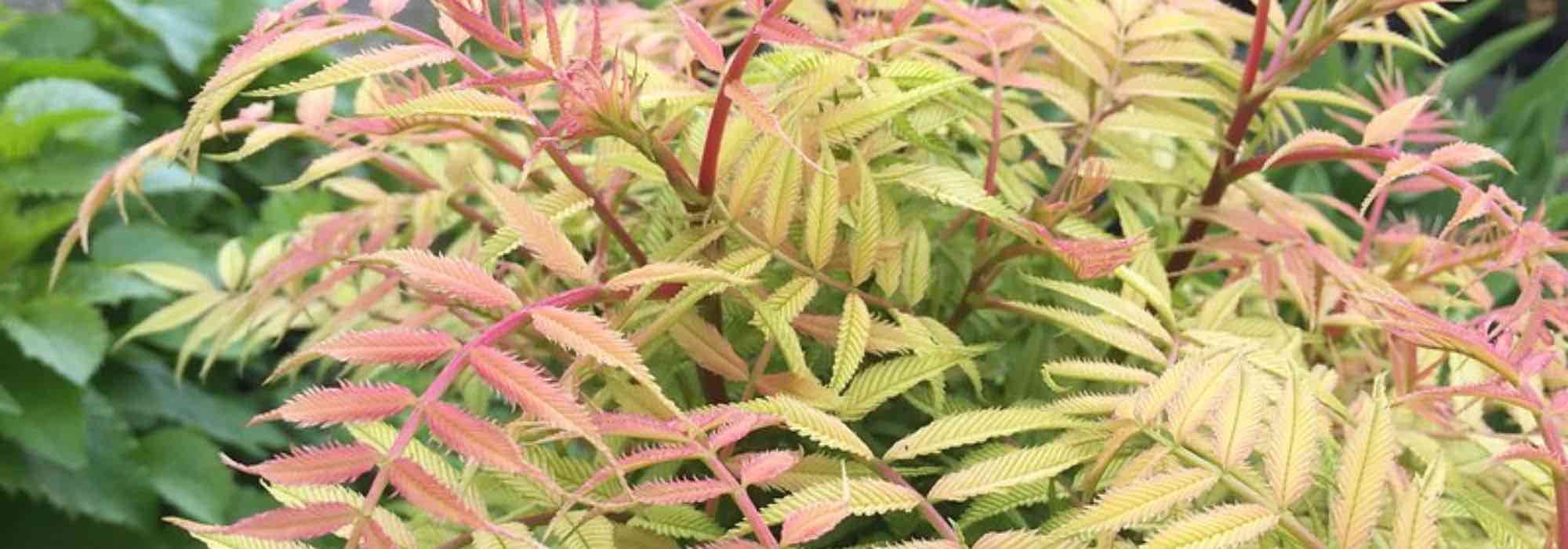
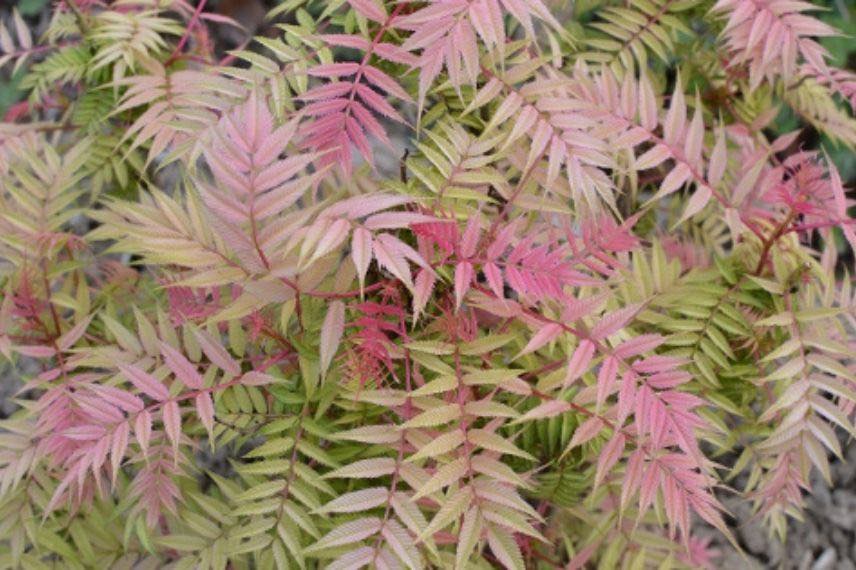
Sorbaria sorbifolia 'Pink Hopi': pink-coloured foliage in spring
‘Pink Hopi’ is a dwarf variety clearly less invasive than the false spirea with Sorbaria leaves (Sorbaria sorbifolia). It grows to just 1.6 metres tall with a 1 metre spread and is less prone to suckering. But its foliage is just as interesting: in spring and for almost three months, this Sorbaria graces us with a particularly colourful display. Young shoots are initially pink-purple. Its leaves then display chartreuse green, broadly tinged with pink, highlighted with cream, bronze and purplish-red. They are pinnate, slightly dentate, recalling pretty fern fronds. In autumn, the foliage takes on purplish hues before dropping, providing a display that is regularly renewed.
In summer, the flowering graces us with white, mossy panicles, bringing a lovely lightness and brightness.
Hardy, robust and easy to care for, this Sorbaria will thrive in fairly rich, cool, even damp soil. It fears only drought and scorching sun. This shrub will look wonderful at the edges of water features, paired with perennials that also enjoy damp conditions, such as Astilbes and Aruncus.
Also discover the cultivar ‘Sem’, with a subtler rose-purplish colour.
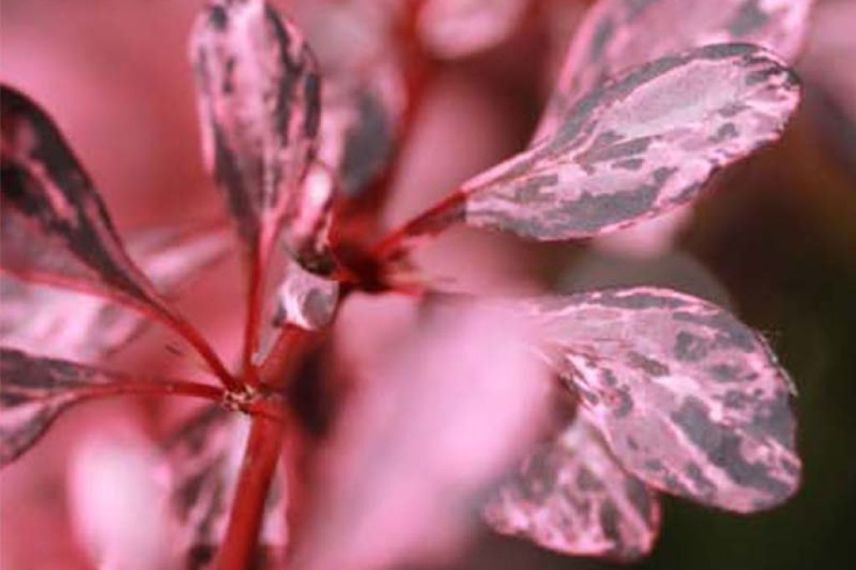
Berberis thunbergii ‘Harlequin’: leaves with evolving colours
‘Harlequin’ is a Berberis you’ll never tire of. Its foliage is in constant evolution; it changes colour over the weeks. Its new shoots are initially pink-purple. The leaves then take on a purple hue generously splashed with pink and silvery-white in spring. In summer, it reddens further, before displaying a fiery red in autumn. The foliage can be evergreen in mild frosts.
Spring flowering is melliferous, but discreet. It consists of small yellow-orange flowers. It gives way at the end of summer to decorative red fruits, which will stay on the plant for part of the cold season.
This Thunberg’s barberry has a compact, bushy habit of around 1.2 metres across, neat and dense. It will settle easily on a terrace or balcony, but will also be an ideal candidate for creating low thorny hedges, for example with gorse or Japanese quinces.
Rusty, hardy and tolerant of soil type, it’s a pink-leaved plant easy to grow that will enjoy sun or partial shade.
Discover also the cultivars ‘Rosy Rocket’ with leaves splashed with red, pink and white, as well as ‘Rosy Glow’ with purple foliage turning pale pink.
Pour en savoir plus : Berberis, barberry: plant, prune and maintain
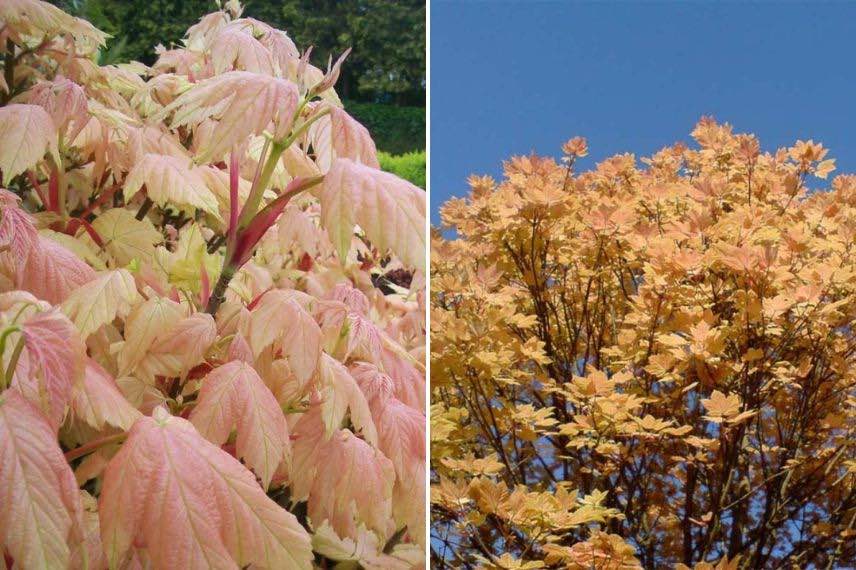
Acer pseudoplatanus 'Brilliantissimum': delicate, atypical shrimp-pink foliage
The sycamore maple ‘Brilliantissimum’ is as elegant as it is original. Its foliage consists of the palmately lobed leaves typical of the genus, very veined, divided into pointed and dentate lobes. In spring, they display a distinctive salmon-pink foliage, which earns the shrub its nickname ‘shrimp tree’. The colouring is progressive, turning green in summer, before taking bright golden-yellow hues in autumn.
Mid-spring flowering is rather understated, allowing the foliage, already very decorative, to take centre stage. It consists of small clusters of yellow flowers that attract pollinating insects. In older specimens, it will then bear samara fruit, these fruits resembling helicopter blades when they fall.
This slow-growing shrub or small tree will reach 7 metres in height with a 5-metre spread at maturity. Its silhouette is fairly pyramidal.
Hardy, wind-resistant and easy to live with, it is a long-lived species that will only fear overly hot and dry conditions. It will establish in cool, rather calcareous soil, and in a position of partial shade. In cooler regions of our country, this pink-leaved maple will look splendid as a specimen. Near a border with summer flowering, its foliage will provide an ornamental effect from spring, then again in autumn.
Also discover Acer conspicuum ‘Red Flamingo’ or snake-skin maple, equally beautiful and original with its green leaves splashed with pink and white.
For more information: Maples: planting, pruning and care
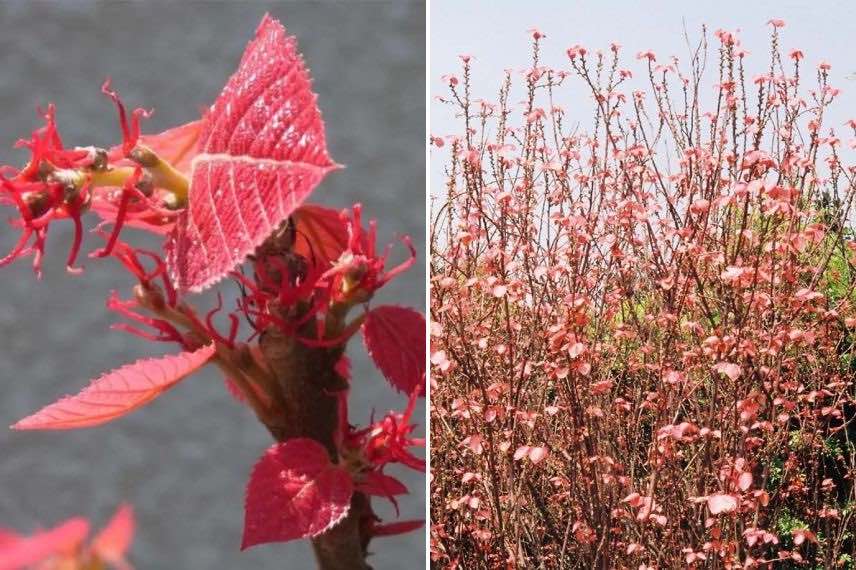
Alchornea davidii: festive foliage from spring to autumn
The Alchornea davidii is an astonishing deciduous shrub native to China, cousin of the euphorbias. It is the foliage that provides all its ornamental interest. New shoots are initially fuchsia pink during the bud burst period in spring. The young leaves then take on pink, and, once opened in heart shape, take salmon-yellow hues, before turning green in summer. In autumn, the foliage also graces us with brilliant colours, for an interesting shrub that changes almost all year round. The shades will vary according to exposure and climate. For its qualities, the Alchornea davidii was awarded at the Saint-Jean-de-Beauregard Plant Festival in 2017.
This shrub has a relatively ramified, upright and fairly stiff habit. It reaches 2 metres in height with a 1 metre spread in our regions. It can therefore be grown in the ground as well as in a fairly deep pot.
Provide it with partial shade, in rich, well-drained soil that stays moist. It will tolerate chalk. Prefer a sunny exposure north of the Loire and partial shade in the warmer regions. Despite its subtropical origins, our shrub will be able to survive frosts down to -20°C, resprouting from the stump.
To showcase it in a clean, minimalist setting, pair it with shrubs with white spring flowers, such as Abelia mosanensis ‘Sweet Emotion’ or ‘Monia’, an Aronia or an Amelanchier.
Other pink-leaved shrubs
If you feel like falling for pink foliage, also discover other shrubs or small trees.
- The Cordyline australis ‘Cherry Sensation’ (2 metres high by 1.5 metres wide), with its palm-like appearance. It produces ribbon-like leaves variegated pink to cherry red, striated with bronze and green. A variety to grow in the ground in mild regions and in a pot in areas that experience frosts down to -7°C.
- Exotic Phormium or New Zealand flax also reward us with pink foliage in some varieties. This is the case with ’Jester’, with its leaves pink to red, tinged with bronze and pale green. ‘Rainbow Sunrise’ for its part sports a pink-centred foliage, edged with olive to bronze green. In its turn, ‘Margaret Jones’ prefers ribbons blending pink and brown tones. Finally, ‘Pink Panther’ offers pink foliage margined with bronze, brown and red. These Phormiums can be grown in the ground in mild regions (frosts down to -10°C to -7°C), but will of course look wonderful in pots in other regions.
- Chinese mahogany or Toona sinensis ‘Flamingo’ (10 metres high by 1.5 metres wide) is a small columnar tree that would deserve more space in our gardens. It produces in spring long pinnate leaves of a magnificent bright pink, evolving over time. The foliage becomes cream-coloured, then bright green in summer. In autumn, it dresses in golden and coppery hues. Chinese mahogany thrives in a bright exposure, in rich and cool-moist soil.
- Photinia fraseri Photinia fraseri ‘Pink Marble’ (3 metres high by 2 metres wide) produces, like its peers, beautiful coloured leaves. It is the young growth that is purple marbled with pink, before turning green variegated with white. It is one of the rare evergreen shrubs to offer touches of pink in its foliage.
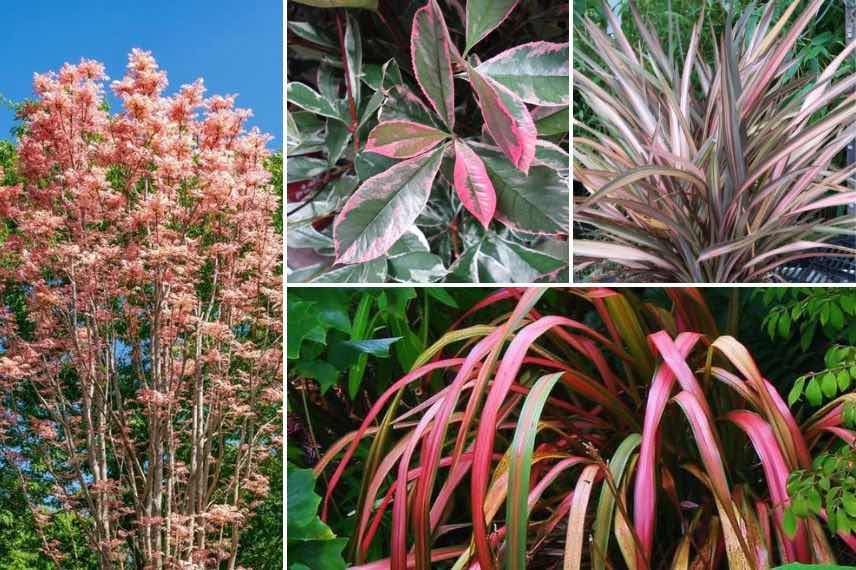
Toona sinensis ‘Flamingo’, Photinia fraseri ‘Pink Marble’, Phormium ‘Rainbow Sunrise’, Phormium ‘Jester’
- Subscribe!
- Contents
Comments