


5 White Achilleas to have in your garden
Discover our most beautiful white varieties
Contents
Achilleas are valuable perennials in the garden, robust and floriferous. With numerous colours, most prefer well-drained soils in full sun and tolerate drought well. Common Yarrow or Achillea millefolium, white, is the most widespread species found throughout the territory. Other species or varieties with white flowering exist. At first glance, there may seem to be little to distinguish two white Achilleas from one another. However, beyond differences in height depending on the species and varieties, and flowering periods that range from spring to summer, there are also differences in foliage, flower shape, and growing conditions.
Let’s explore the various white-flowered Achilleas in our catalogue.

Achillea millefolium 'White Beauty'
Achillea millefolium ‘White Beauty’ is a finely detailed variety with a delicate appearance, distinguished by particularly flat umbels of pure white with a butter yellow eye. It flowers from July to September, producing a multitude of small heads gathered in corymbs, held well above the foliage. Its foliage is semi-evergreen, highly dissected, aromatic, with a camphor-like scent and green colour. The plant forms a compact tuft, with a light and feathery silhouette, reaching 60 cm in all directions. In full sun and well-drained soil, it reaches its mature size by the third year after planting. The flowering is very repeat flowering if care is taken to regularly cut back the faded flowers.
Plant it in a natural-looking scene with grasses such as Pennisetums or Panicums. Add perennials like Geum Cosmopolitan, with peach-white flowers, harvest Gladioli, Gladiolus italicus, or Dierama ‘Pink Rocket’ for a lovely contrast in shape between the flat corymbs of Achillea and the elongated silhouettes of Gladioli or Angel’s fishing rods. You might also add Echinaceas or lighter Gauras.
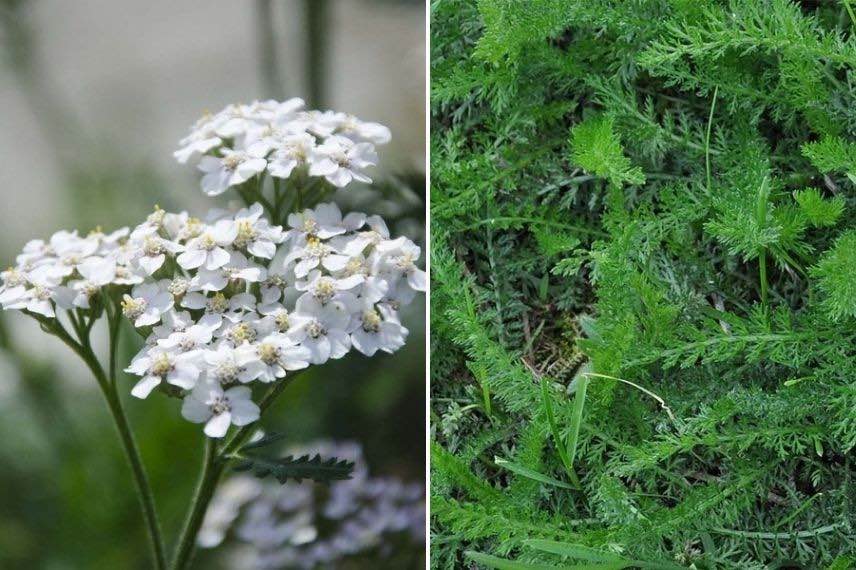
Achillea millefolium ‘White Beauty’
Read also
Achillea : planting, growing and careAchillea ptarmica 'Snowball'
Achillea ptarmica ‘Boule de Neige’ is a charming variety with pure white double flowers. It forms a rounded clump that appears covered in small pom-poms. It blooms vigorously throughout the summer, from July to September. With a bushy and carpet-like habit, it reaches 60 cm in height and 40 cm in width at ripeness. Its leaves are fine and lanceolate, dark green in colour. Its 1 cm flower heads, grouped in corymbs, are adorned with a small cream-yellow centre. Notably, as a representative of the ptarmica species, it prefers cool to moist soils, even in summer, that are non-calcareous and well-drained, unlike other species of Achilleas.
Deciduous, it thrives in full sun or partial shade, paired in a border with perennials of similar conditions, in cool soil or near water features. Take the opportunity to plant beautiful Filipendulas, a Lysimachia ephemerum. Dot with a few Cirsium rivulare ‘Atropurpureum’ and Japanese primroses.
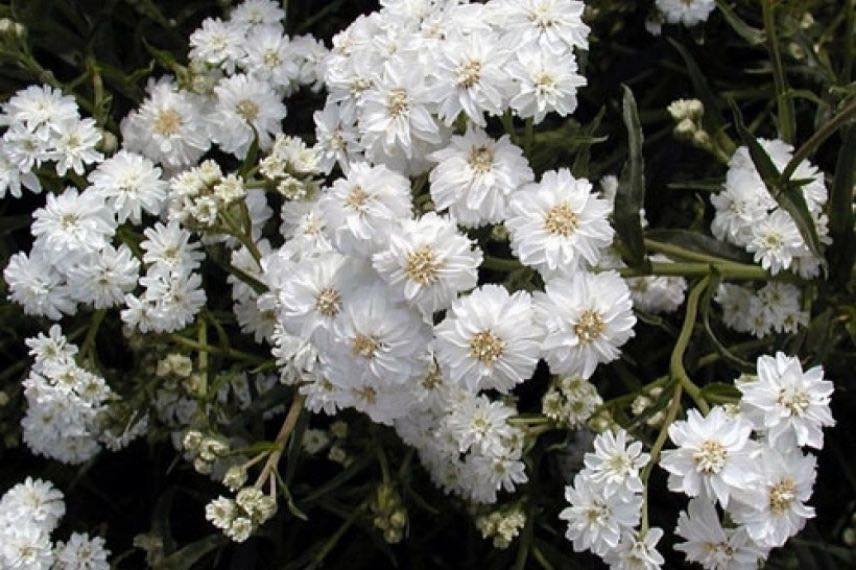
Achillea ptarmica ‘Boule de Neige’
Discover other Achillea
View all →
Available in 0 sizes
Available in 1 sizes
Available in 1 sizes
Available in 2 sizes
Available in 1 sizes
Available in 2 sizes
Available in 2 sizes
Available in 1 sizes
Available in 1 sizes
Available in 2 sizes
Achillea ptarmica 'Weihenstephan'
One of the tallest yarrow and the tallest of the white varieties: Achillea ptarmica ‘Weihenstephan’. Also derived from the species ptarmica, it prefers moist soil unlike other species of yarrow, which are true drought-tolerant plants. This variety has an upright clump habit, reaching 1.20 m in height when in flower, with a spread of 60 cm. The flowering, which is very abundant, extends from July to September. As with other yarrows, the white heads with a cream centre form corymbs, which are appreciated by pollinating insects. The heads are slightly larger in this variety, measuring about 2 cm. The foliage is deciduous or semi-evergreen depending on the region. The lanceolate and narrow leaves are dark green in colour.
You can also happily associate it in moist soil, but be aware that Achillea ptarmica tolerates drier soils once established. For example, plant it in a fresh soil border with a large Phlox such as Phlox paniculata ‘David’. Add bulbs of large Siberian Iris and fresh soil grasses like certain Carex or Deschampsia.
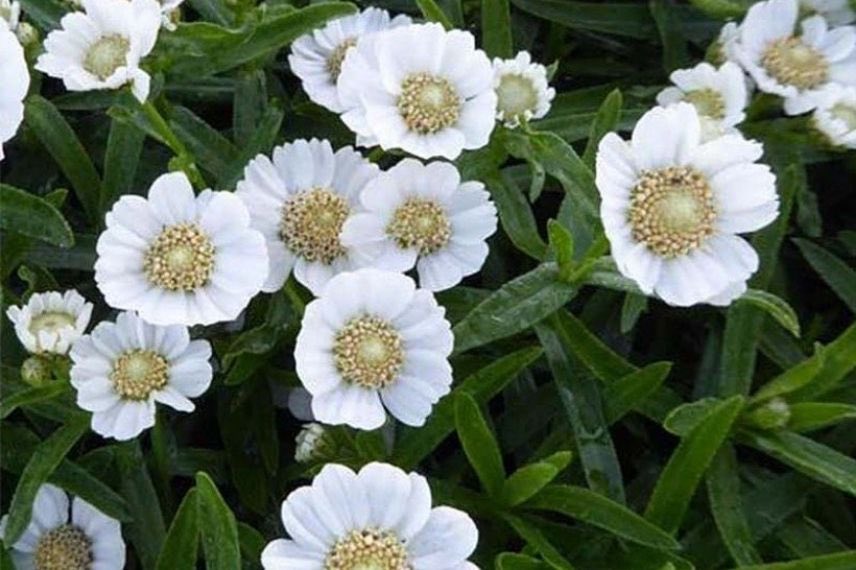
Achillea ptarmica ‘Weihenstephan’
Achillea crithmifolia
Let’s focus on a species that holds significant ecological interest: Achillea crithmifolia. This low-growing, carpet-forming variety can serve as an alternative to lawn in moderately trampled areas. This type of plant has recently gained popularity as it allows for the avoidance of the resource-intensive and time-consuming lawn, which we are learning to replace for obvious reasons. Its ability to spread quickly through its suckers (over an area of approximately 75 cm for a young plant) and to withstand drought makes it valuable. Similar to dry-soil yarrow but in miniature form, it features silvery-grey foliage that is soft to the touch and is adorned with small white umbels in summer.
Plant this white yarrow in full sun or partial shade alongside plants of similar use but differing qualities, which will take turns covering the soil throughout the year. You can also use it in a border among perennials, as its allelopathic properties help limit the proliferation of adventive plants.
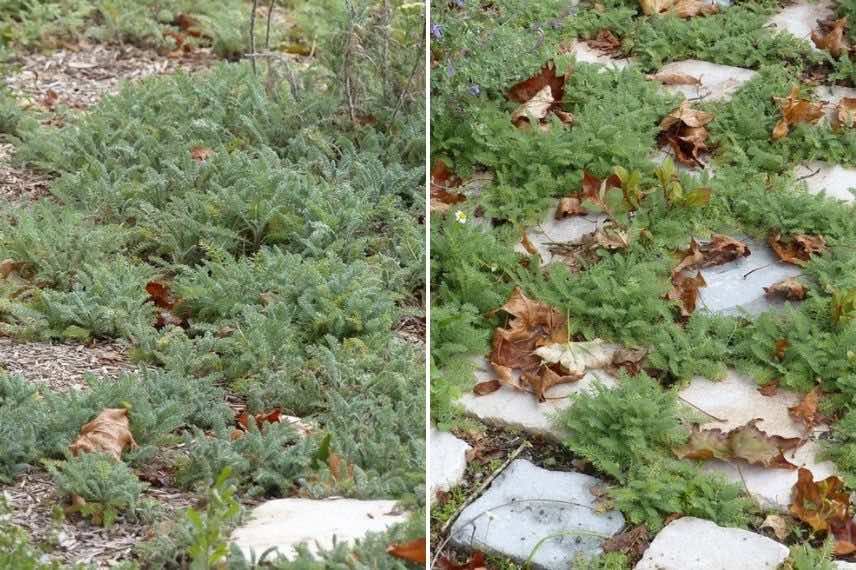
Achillea crithmifolia
Achillea kellereri
Perfect for rock gardens and dry borders, Achillea kellereri forms a low, carpet-like tuft of 25 cm with flowers in all directions. It develops long, finely cut foliage that is very bright. Evergreen, it is silver-grey in winter and lightens in summer to become almost white under the sun’s onslaught. The leaves are narrow, downy, and soft, with finely dentate edges. Flowering occurs in spring, in April-May, with flat umbels of pure white and a creamy yellow centre.
Grow it in full sun at the edge of borders and appreciate its undemanding nature alongside plants with similar needs, such as Teucrium ackermanii, the lovely Serratule de Galice, which is close to Centauries. Also consider Nepeta faassenii Cat’s Pajamas with its indigo blue flowers, and Erodiums, relatives of Geraniums, typical of Mediterranean flora.
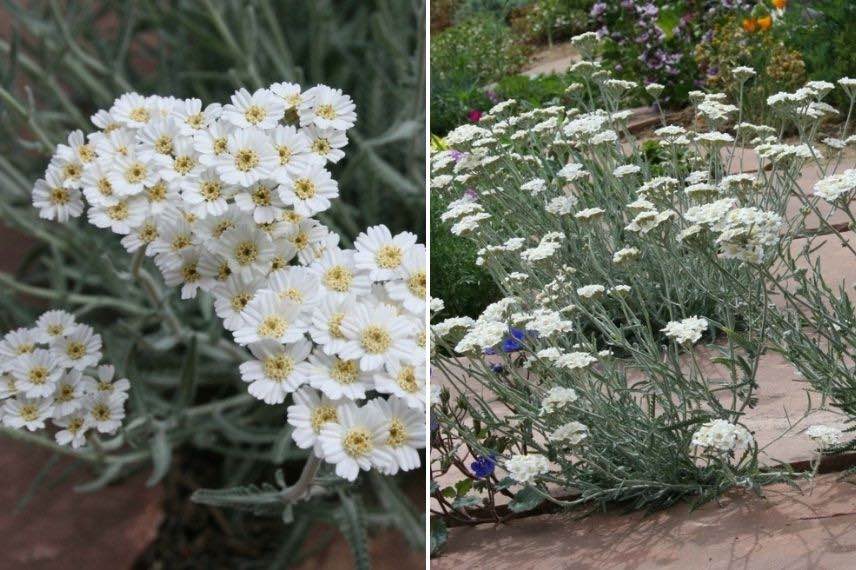
Achillea kellereri
- Subscribe!
- Contents
Comments