





























6 shrubs for late winter flowering
To flower the garden, terrace, or balcony even during the cold season
Contents
We love winter-flowering shrubs, which have the advantage of bringing colour and life to a season when the garden is sorely lacking. While some choose to reveal themselves at the beginning of winter, others wait until the end of the shortest days. They are true harbingers of spring’s arrival!
Here is our selection of 6 shrubs in flower between mid-February and the end of March.

Prunus nipponica ‘Brillant’: a flowering of softness and delicacy
Ornamental cherry trees or Prunus are generally considered spring-flowering shrubs, but some early varieties show the tips of their petals as early as the end of winter, between February and March. This is the case with Prunus nipponica ‘Brillant’, which is one of the first ornamental cherry trees to bloom. It reveals an abundance of small single flowers measuring 2 cm in diameter, which appear on still bare branches. Their white-pink colour is enhanced by a dark pink centre, serving as a cradle for fine stamens. These flowers are slightly fragrant and melliferous, highly appreciated by foraging insects. This generous flowering is of great delicacy, enchanting the short winter days. It is followed by small ornamental berries, consumed by birds.
The evolving foliage is also part of this shrub’s decorative assets: coppery at bud burst, it turns green in summer, then takes on flamboyant orange and red hues in autumn before falling.
The modest dimensions of this prunus (2.50 m in height and 1.50 m in spread at maturity) , along with its slow growth and upright silhouette, allow it to be grown anywhere. Plant it easily in a pot on the terrace or balcony. In the ground, integrate it into a free hedge with spring and summer flowering shrubs, or as a backdrop for a perennial bed.
‘Brillant’ enjoys sunny exposures, in rather cool (moist but not excessive) and well-drained soil that does not retain too much water. Easy to care for, it requires little maintenance and withstands frosts of around -20 °C to -25 °C.
To learn more, discover our complete sheet “Japanese cherry trees: planting, pruning, and caring for.”
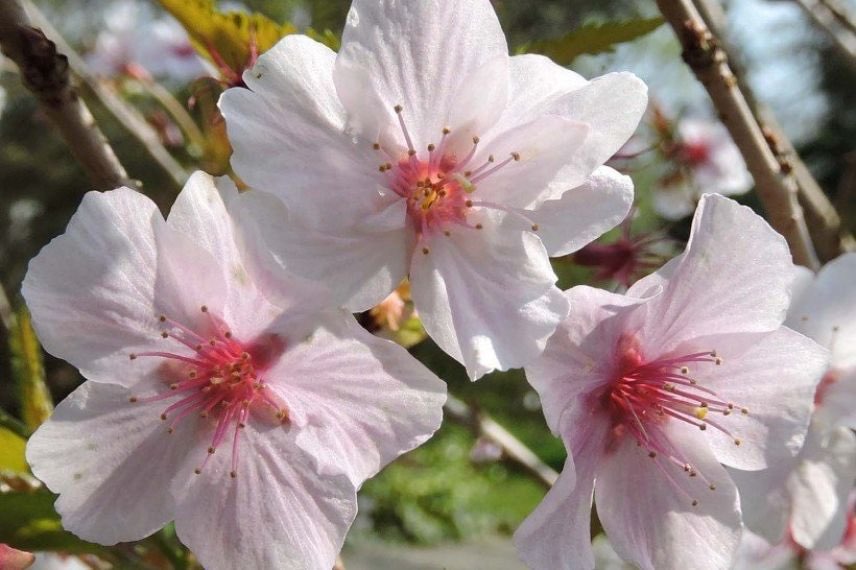
Prunus nipponica ‘Brillant’
Read also
Winter-flowering shrubsKorean white forsythia: refined flowers that brighten winter
Forsythias are among the first shrubs to reveal their flowers at the end of winter. Abeliophyllum distichum, or Korean white forsythia is no exception, as it blooms between February and March.
While we are familiar with yellow-flowered forsythias, this variety stands out with its refined flowering of white-pink, highlighted by an orange centre. These are small flowers composed of four petals, grouped in bouquets and appearing on branches that are still bare of leaves. At the end of flowering, they take on light brown hues. Delicately scented, they emit a sweet almond fragrance.
The foliage then appears in spring. Dark green, it turns reddish-purple in autumn before falling.
This shrub offers a bushy silhouette, reaching only 1.5 m in all directions at maturity, after several years of growth. It will brighten the last days of winter both in pots and in the garden.
Provide it with a sunny or partially shaded location, but sheltered from prevailing winds. Tolerant and hardy, it is content with all types of well-drained soil and withstands frosts down to -20°C.
For more cultivation tips, discover our guide “Forsythia: planting, pruning and maintenance.”
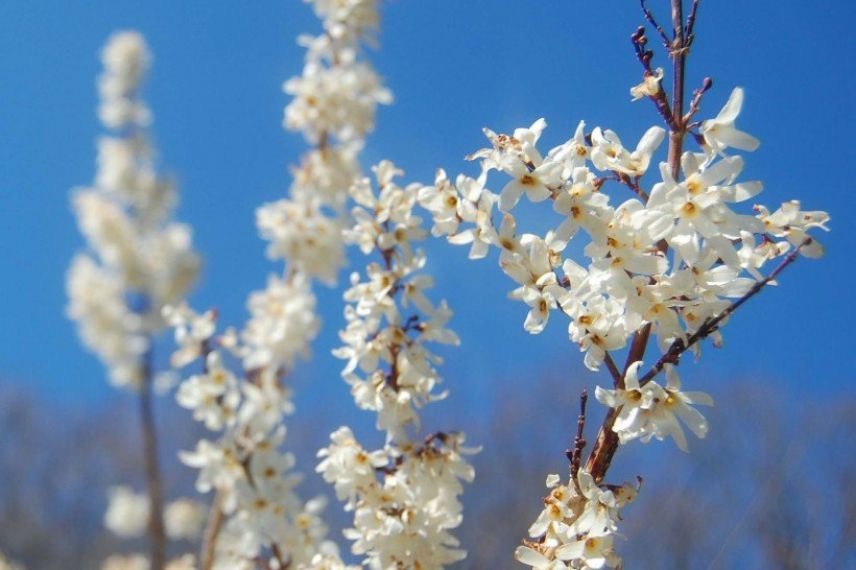
Abeliophyllum distichum
Discover other Winter-flowering shrubs
View all →
Available in 1 sizes
Available in 2 sizes
Available in 1 sizes
Available in 1 sizes
Available in 1 sizes
Available in 2 sizes
Available in 1 sizes
Available in 1 sizes
Available in 1 sizes
Available in 1 sizes
Edgeworthia chrysantha: an underrated bush with astonishing fragrant flowers
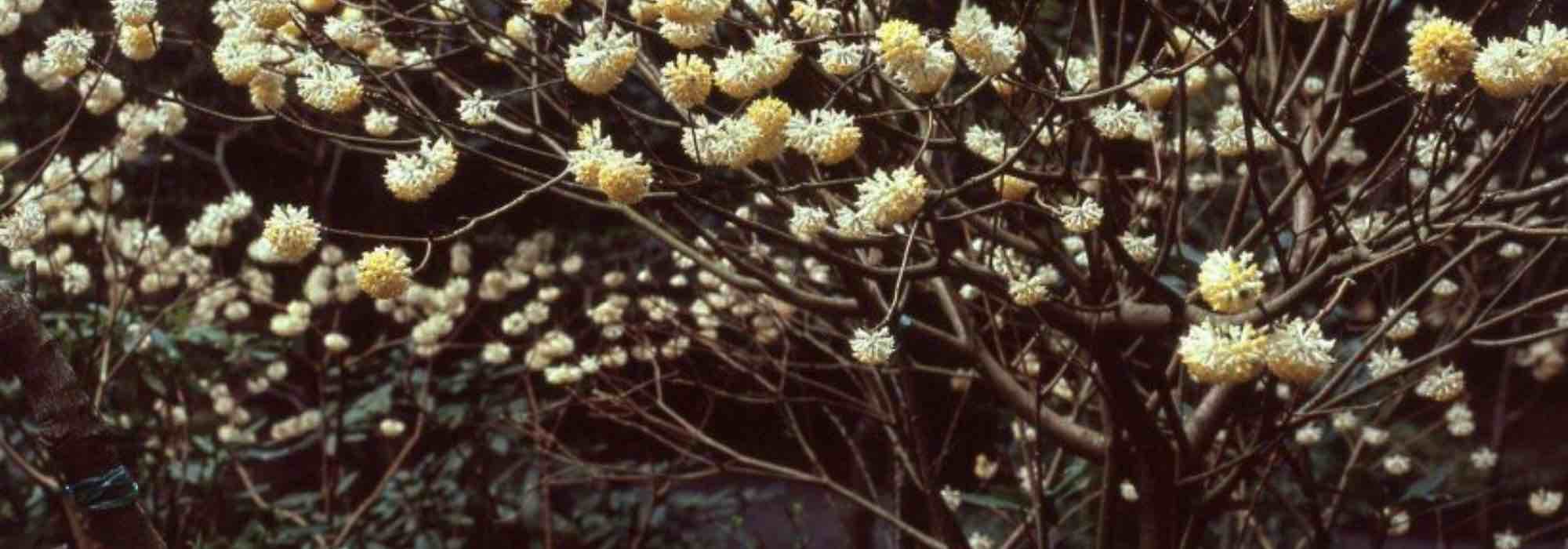
The Edgeworthia chrysantha, also known as the “paper bush”, is a striking shrub that captures attention. Native to China, it astonishes with its exotic flowering, which occurs at the end of winter between February and March. The tiny flowers shaped like small cones are gathered into delightful coloured pom-poms, providing a spectacle in the absence of foliage. Fragrant, they exude heady, spicy, and floral notes reminiscent of jasmine, clove, or honeysuckle.
The typical species of golden-flowered edgeworthia offers us yellow and white blooms, but there are other colours available. The variety ‘Red Dragon’ produces stunning red-orange flowers, while ‘Nanjing Gold’ prefers a bright golden yellow.
Foliage appears after flowering and remains until autumn.
It is near pathways that you will best appreciate the qualities of this winter-flowering shrub. Grow it effortlessly in a pot or in the garden. Its bushy silhouette, slow growth, and small dimensions (1.5 m in all directions) allow it to fit in anywhere you wish to break the monotony of winter. This still relatively uncommon shrub truly deserves a place in more gardens!
Its only drawback? A hardiness limited to -10°C at most, which makes it more suitable for regions south of the Loire. In areas with harsh winters, bring your Edgeworthia chrysantha indoors to a frost-free room, where it will fill the space with its powerful fragrance.
Provide it with a sunny position, sheltered from cold winds. As for soil, avoid limestone and overly heavy substrates (clay).
If you would like more information, check out our article “Edgeworthia chrysantha, paper bush: planting and care.”
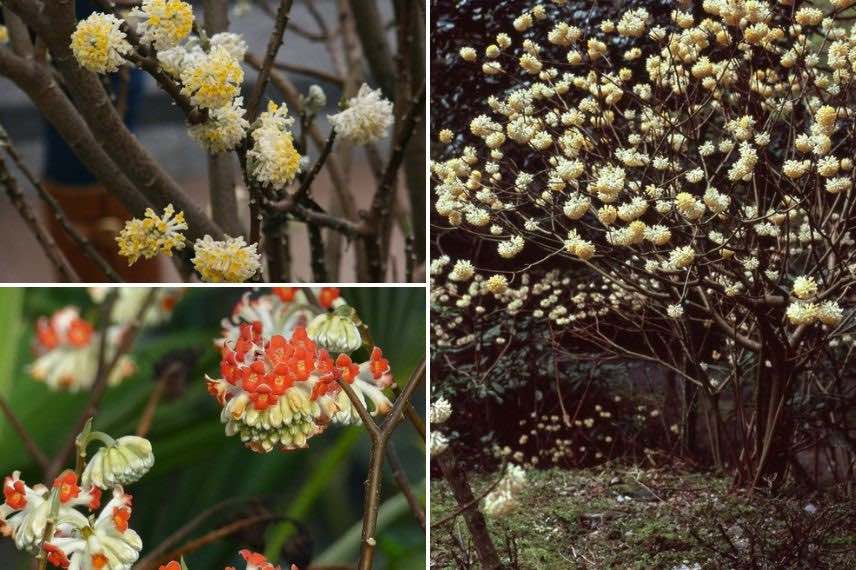
Edgeworthia chrysantha: typical species and variety ‘Red Dragon’
Read also
9 autumn-flowering shrubsThe Snowy River mimosa: a sunny flowering in pom-poms
Here is another shrub that transforms into a true sun at the end of winter: the Acacia boormanii or Snowy River mimosa! Its name refers to the watercourse near which it can be observed in large numbers, in the south-east of Australia.
In February, it is covered with a multitude of small lemon-yellow flowers, gathered in airy pom-poms like little clouds (this is referred to as a globular inflorescence). Their typical floral fragrance wafts through the air with every passing moment.
The Acacia boormanii also has evergreen foliage that remains on the shrub all year round. Its fine, linear leaves display a lovely blue-grey-green colour. They are covered with a fine silver down, making them particularly bright and ornamental.
This bushy shrub, small in comparison to other mimosa relatives, reaches 3 metres in height in all directions. Due to its relatively low hardiness (-5°C to -8°C once well established), this mimosa will only be grown in the ground in the mild regions of the Mediterranean coast or the Atlantic facade. Elsewhere, it can be cultivated in a large container, stored away during the cold season.
Easy to grow, it can even become a bit invasive due to the natural production of suckers (shoots appearing on the roots). Provide it with a sunny location, in soil that is occasionally dry or exposed to sea spray.
Learn more about cultivating mimosa with our guide “Mimosa: planting, pruning, and care”.
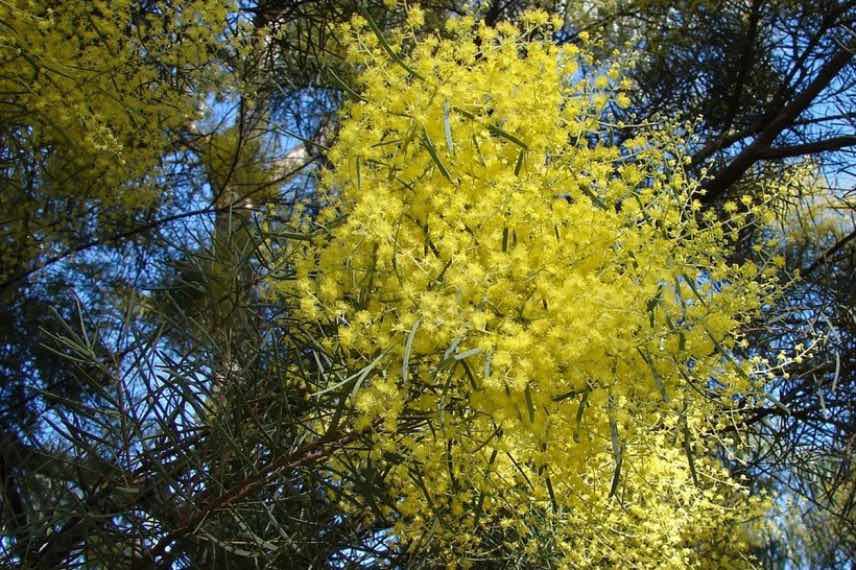
Acacia boormanii
The goat willow: adorable silver aments at the end of winter
The goat willow (Salix caprea) offers a late winter flowering that is quite different from that of the previous shrubs. From February to March, the male specimens delight us with adorable little velvety aments, resembling mini rabbit tails. They initially display a silvery colour, then reveal golden yellow anthers, whose pollen brings joy to insects. These flowers develop on the naked, yet beautifully glossy, branches. It is worth noting that the flowering is different and more subdued in female specimens.
Like all willows, this Salix caprea is easy to cultivate. It is very hardy (down to -30°C), offers rapid growth, and tolerates all types of soil, even occasionally dry ones in summer. Plant it in a sunny location, sheltered from strong winds.
Its flexible, rounded silhouette can reach several metres in height at maturity, depending on the growing conditions. Enjoy the elegant flowering of this shrub either as a standalone feature or in a hedge, accompanied by shrubs with evergreen foliage.
To learn everything about cultivating willows, check out our guide “Willow, salix: plant, prune and maintain.”
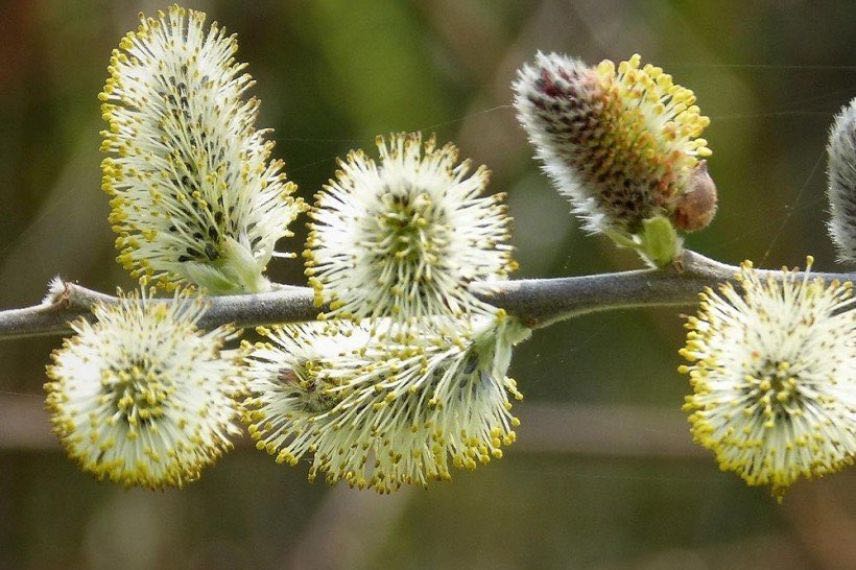
Salix caprea
Daphne odora ‘Marianni Rogbret’: highly fragrant flowers from February onwards
Difficult to choose between the different varieties of fragrant daphnes! We have selected here ‘Marianni Rogbret’ for the originality of its variegated light yellow foliage, which beautifully complements the flowering at the end of winter. Between February and March, our shrub reveals light pink, waxy flowers, gathered in rounded clusters. Of course, they are highly fragrant, spreading their floral scent reminiscent of carnation, jasmine, or hyacinth, with spicy notes.
This daphne will undoubtedly brighten up partially shaded or shaded areas. With a small growth habit (1.50 m in all directions) and a compact silhouette, it can be grown in a pot or in the garden. Quite hardy and tolerant, it will thrive in even poor soil and occasionally dry conditions in summer, but must be free of lime.
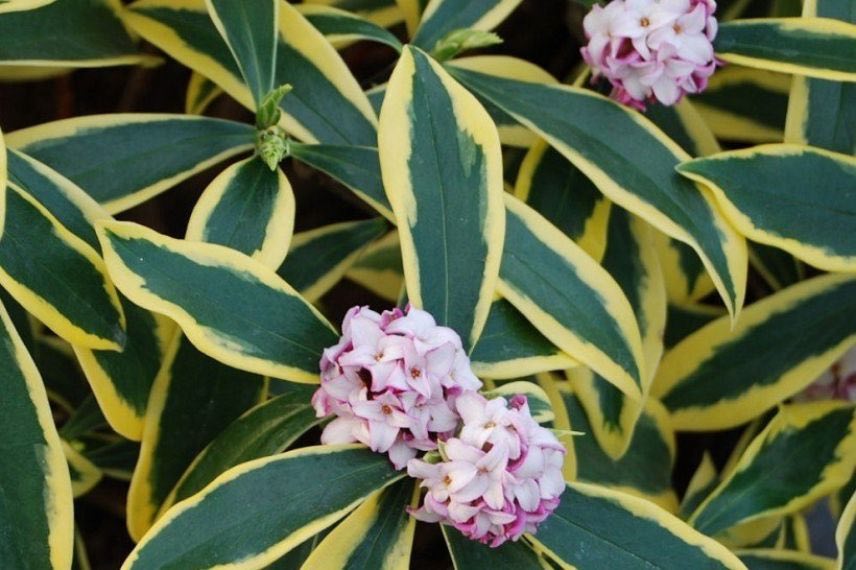
Daphne odora ‘Marianni Rogbret’
Find more growing tips in the section “The daphne: how to plant, grow, and care for it.”
- Subscribe!
- Contents

Comments