





























6 pink-flowered Delosperma
Grow these perfect perennials for dry soil
Contents
Delosperma is a creeping perennial, groundcover, with succulent and evergreen foliage, native to South Africa, East Africa and Madagascar. It is covered with flowers like small daisies, bright and striking. They come in orange, yellow, white, purple or pink. The origins of Delosperma give it excellent adaptation to hot, dry climates in well-drained soil.
Discover our selection of pink-flowered Delospermas, which also include cousin plants: Ruschia, Drosanthemum and Lampranthus, rarer in cultivation, with very similar characteristics and similar growing conditions.

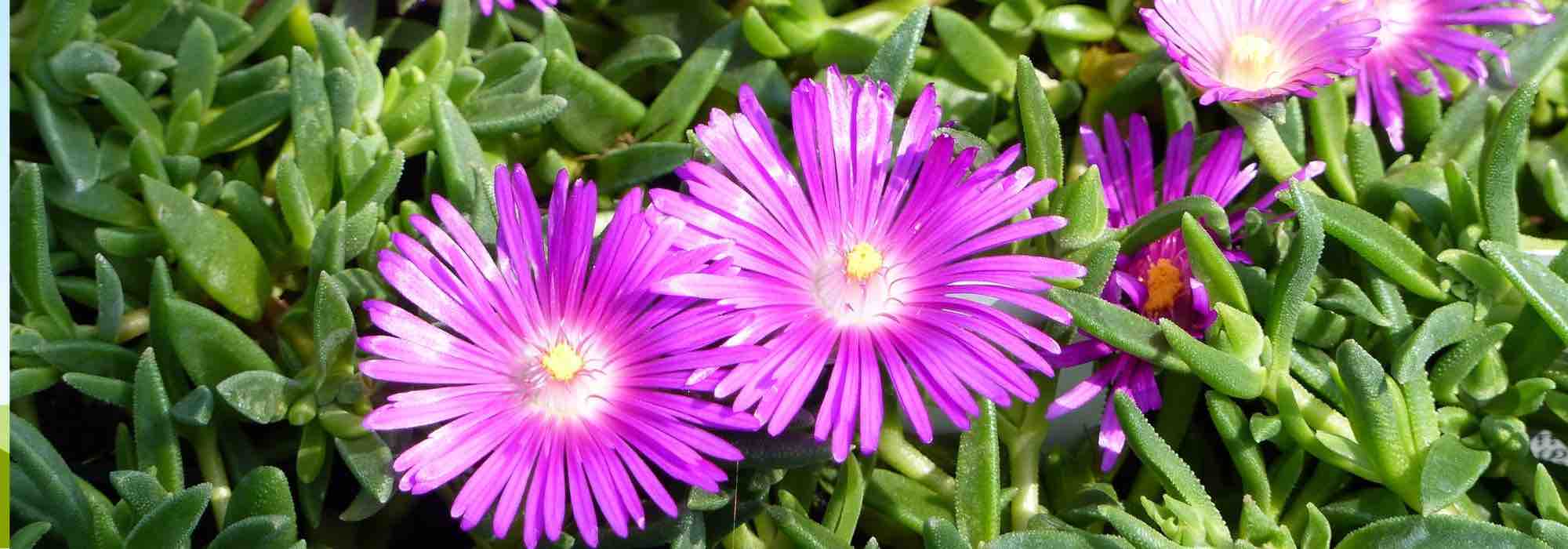
Delosperma cooperi
Delosperma cooperi, or Cooper’s ice plant, is the most widespread species of Delosperma. It is named after Cooper in honour of the 19th-century English botanist, Thomas Cooper. This perennial bears very fleshy, succulent leaves, ranging from pale green to white-tinged, hence its nickname the Ice Plant. It forms a small, low tuft about 10 cm high that in summer is covered with small cymes of bright mauve petals, surrounding a centre of white filaments, The plant has creeping, branched stems that root easily, thereby colonising space up to 50 cm wide.
Delosperma cooperi thrives in well-drained soil and full sun. It is a quintessential rock-garden plant, pairing with Sedums and carnations, or it can be planted at the base of garden valerian or Centranthus ruber.
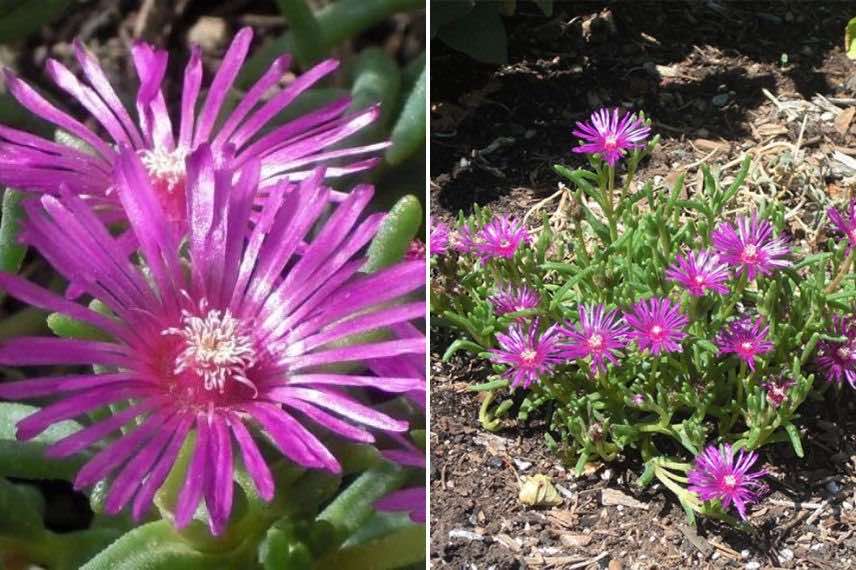
Delosperma Wheels of Wonder 'Hot Pink'
Delosperma Wheels of Wonder ‘Hot Pink’ is a perennial ice plant hybrid from Japan, with vibrant, bi-coloured and highly contrasted flowers. The outer edge of the petals is a warm, vivid pink, surrounding a broad yellow centre. The yellow and pink blend into an intermediate shade that is almost red. It flowers from June to October and forms beautiful carpets of small succulent leaves. This variety was selected at the Innovert 2014 competition at the Plant Show. It is part of a series that offers flowers twice as large as the standard variety. It forms a small tuft 10–15 cm tall, which can spread to around 1 m across in good conditions.
Install this plant in a hanging basket, in a window box or in a pot, from which it will cascade. This will allow you to bring the pot indoors in winter to protect it from frost. You can combine it with many succulents sharing the same growing conditions, such as houseleeks, and sedums.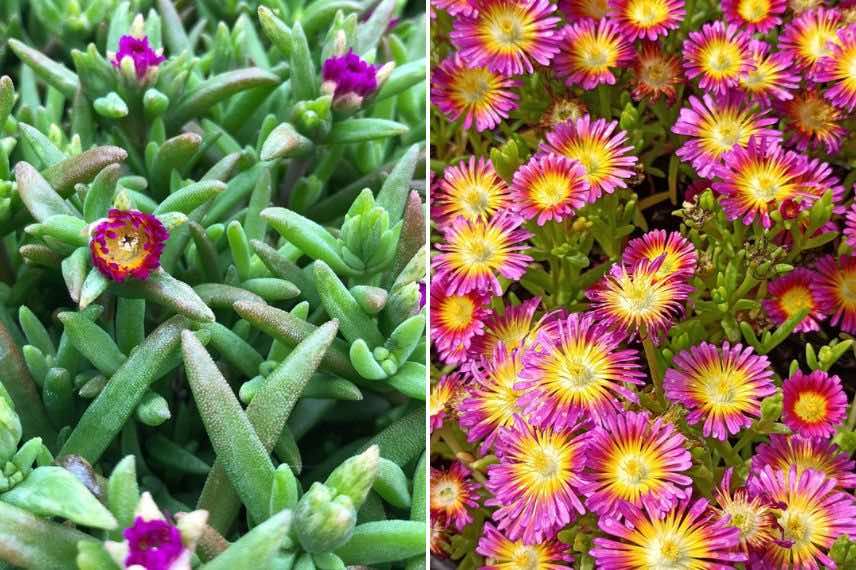
Ruschia prostrata
Ruschia prostrata or Antimima prostrata belongs to the group of Mesembryanthemum, Lampranthus, Drosanthemum. They are closely related to Delospermas in their geographic origin, South Africa, and in their characteristics: prostrate habit, succulent leaves, flower heads, cultivation requirements. Ruschia prostrata is rare on the market and less well known; its hardiness is more uncertain, but it is rated at around -5°C. It bears flowers about 2 cm in diameter, with fine, elongated petals, pale pink in colour and veined with pink, over a very long flowering period under the conditions it favours. They only open in the sun. It begins flowering in spring, around March–April, in mild climates, continuing until July–August.
It reaches about 15 cm in height and 50 cm across; its leaves are bluish-green and redden under the influence of sun and drought. A Mediterranean rock garden plant par excellence, it naturally settles among stones and rocks, on walls, in sandy, dry soil. Pair it with South African daisies such as Osteospermum. Outside mild coastal climates, cultivate it as an annual or plant it in a pot to bring indoors in winter.
Read also
Choosing a DelospermaDrosanthemum candens or floribundum
The Drosanthemum candens, also known as Drosanthemum floribundum was formerly called Mesembryanthemum. Like Ruschia, it is a member of the Aizoaceae family, native to South Africa. It bears flowers about 3 cm across, pale pink with a silvery, metallic sheen, very bright, with very fine petals. Its flowering lasts over an extended period, from March–April to the end of September. Its leaves are small, measuring approximately 4 cm, covered with silvery bristles, glaucous in colour; they redden in cold weather. They persist through winter in their hardiness zone, where frost does not exceed -5 to -6°C.
It develops a creeping clump that does not exceed 15 cm in height by 60 cm wide, and up to 1 m in spread in its preferred conditions. Pair its flowering with the silvery-grey, velvety foliage such as that of Stachys byzantina, with a velvety texture. It also enjoys sun and a dry, well-drained soil.
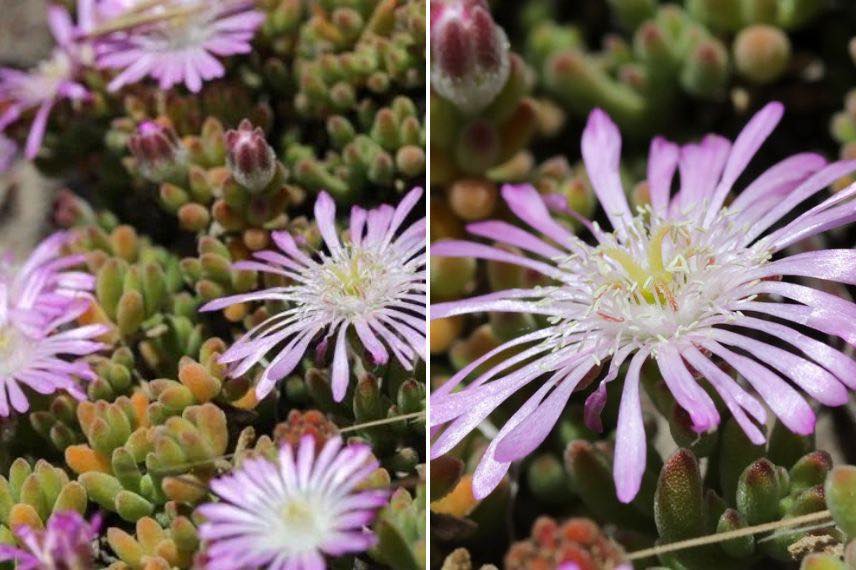
Lampranthus aurantiacus 'Pink flowers'
Lampranthus aurantiacus ‘Pink flowers’ is a pink-flowered variety of this plant, also known as orange ice plant or Lampranthus. This other cousin of Delospermas shows here flowers of a bright pink, about 1.5 cm in diameter, with glossy and slender petals surrounding a pale yellow centre. In spring flowering, this perennial can bloom from March to April for several weeks. However, during prolonged drought, flowering will fade. The Lampranthus forms a tuft that can reach 30 cm in height. It spreads 50–60 cm wide.
Not hardy, Lampranthus aurantiacus ‘Pink flowers’ will be damaged by frost at -2°C. Grow it in a pot to be brought indoors in winter, alongside Delospermas in varied colours, to form colourful combinations with long, spreading flowering and almost maintenance-free.
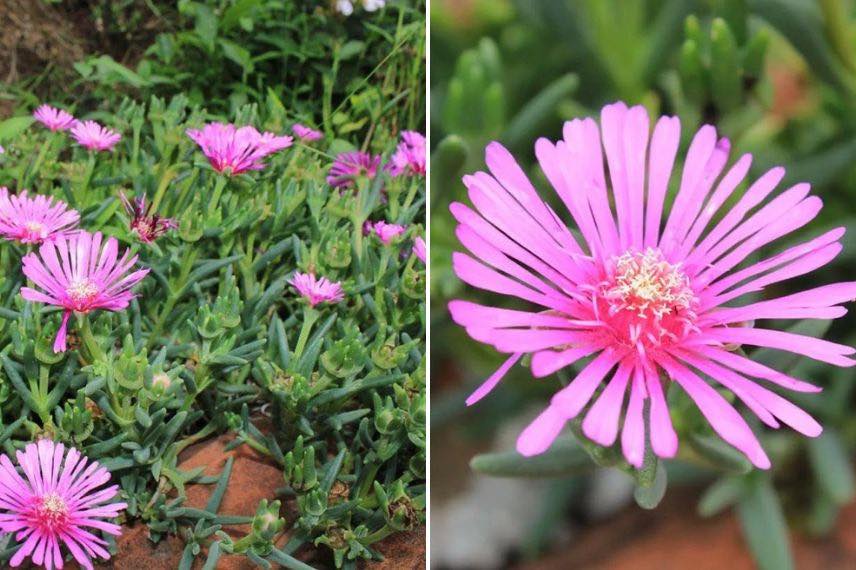
Drosanthemum hispidum
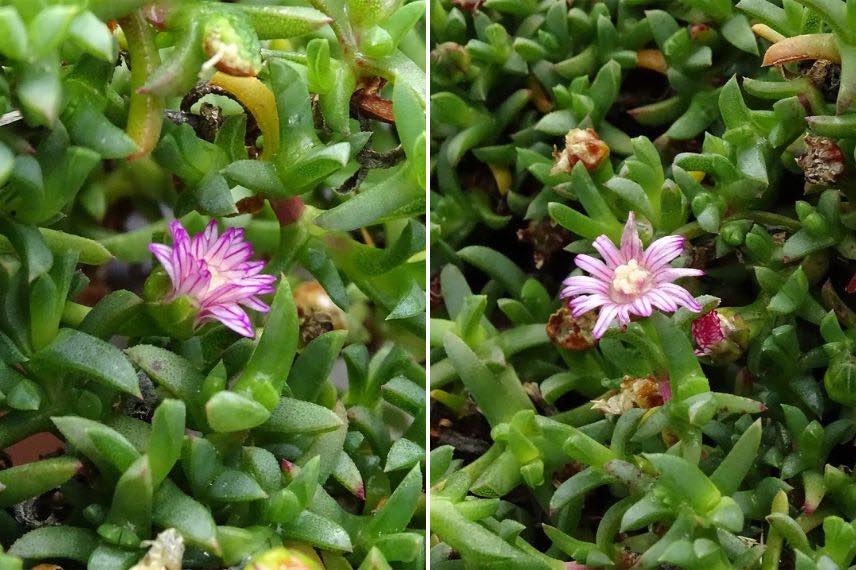
The Drosanthemum hispidum is also known as Rice-grain ficoid, or sometimes simply Rice grain. Its vegetation made up of tiny succulent leaves, covered with papillae filled with water, is very dense and compact, bright green in colour during the growing season. It flowers in spring, between April and June depending on the region, with numerous bright flowers, pink-purple to purplish, with a yellow centre, about 2.5 cm in diameter. The flowering lasts approximately six weeks. It covers an area of 70 to 80 cm under suitable conditions, at a height of 20 cm.
This Drosanthemum is hardy to about -8°C. Its foliage persists in winter below this hardiness threshold, but may disappear in summer if conditions are very dry. Plant it on a low wall lined with pockets of soil, from which it cascades gracefully, alongside a Campanula portenschlagiana or muralis.
- Subscribe!
- Contents
Comments