





























6 pretty spring-flowering flowers
Our selection of prized jewel plants, valued for their beauty and delicacy, that flourish between March and June
Contents
Some plants reward us with flowers so beautiful that they could be admired as works of art. These little treasures touch us with their delicate graphics, unique colours, astonishing textures, or intoxicating scents.
True botanical jewels, sometimes appearing fragile, these plants will bring delicacy and poetry to the garden, balcony, or terrace. Discover here our selection of 6 beautiful and precious flowers to brighten up spring.

Iris germanica ‘Petit Bijou’: a flowering full of refinement
Iris are known for the elegance of their flowers, and theIris germanica ‘Petit Bijou’ is no exception. If these plants have inspired painters like Van Gogh and Monet, it is due to their unique graphic form and their varied, intense colours.
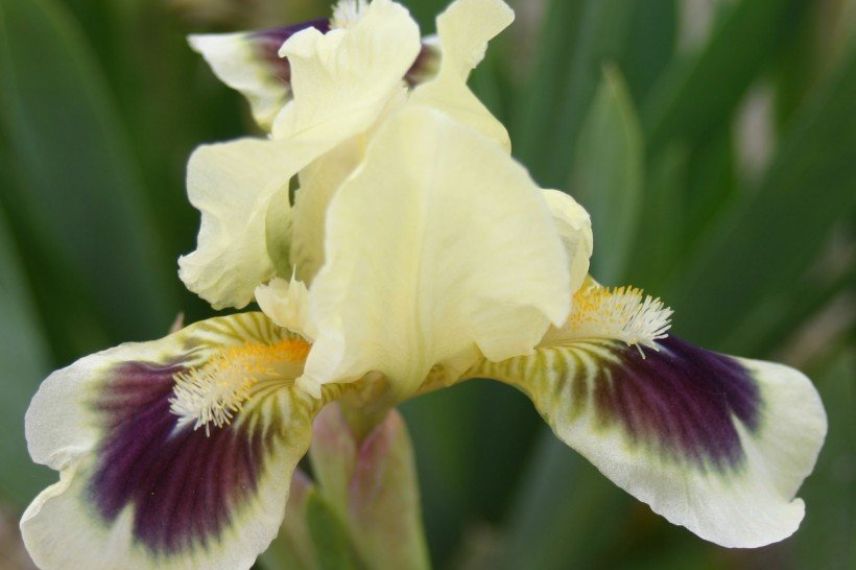
‘Petit Bijou’ perfectly lives up to its name: it is a small perennial plant (about 30 cm in all directions), with delicate flowering. This variety blooms early in spring, for several weeks between April and May. It reveals sophisticated flowers, fully open. In terms of colour, the plant offers us bicoloured petals of cream-yellow, highlighted by a brown area with contrasting orange beard. This flowering is beautifully complemented by a linear foliage, consisting of sword-shaped, veined leaves, adding a lovely verticality.
Very floriferous, this Iris germanica will gracefully adorn rockeries, borders, or the front of flower beds. It will quickly form a lovely clump. Hardy down to about -15°C, it is particularly sensitive to winter moisture, which can be fatal to its rhizomes. Plant it in full sun, in even dry but well-drained and light soil.
Pair this Iris with Helianthus with sunny summer flowering, or Nepeta or lavender. Drought-tolerant and appreciating soils that do not retain water, they will thrive in a dry garden or a mineral bed.
For more information: Garden iris, bearded iris: planting, care
Read also
9 rare and collectible perennialsCurcuma alismatifolia ‘White’: highly ornamental flowers with an exotic appearance
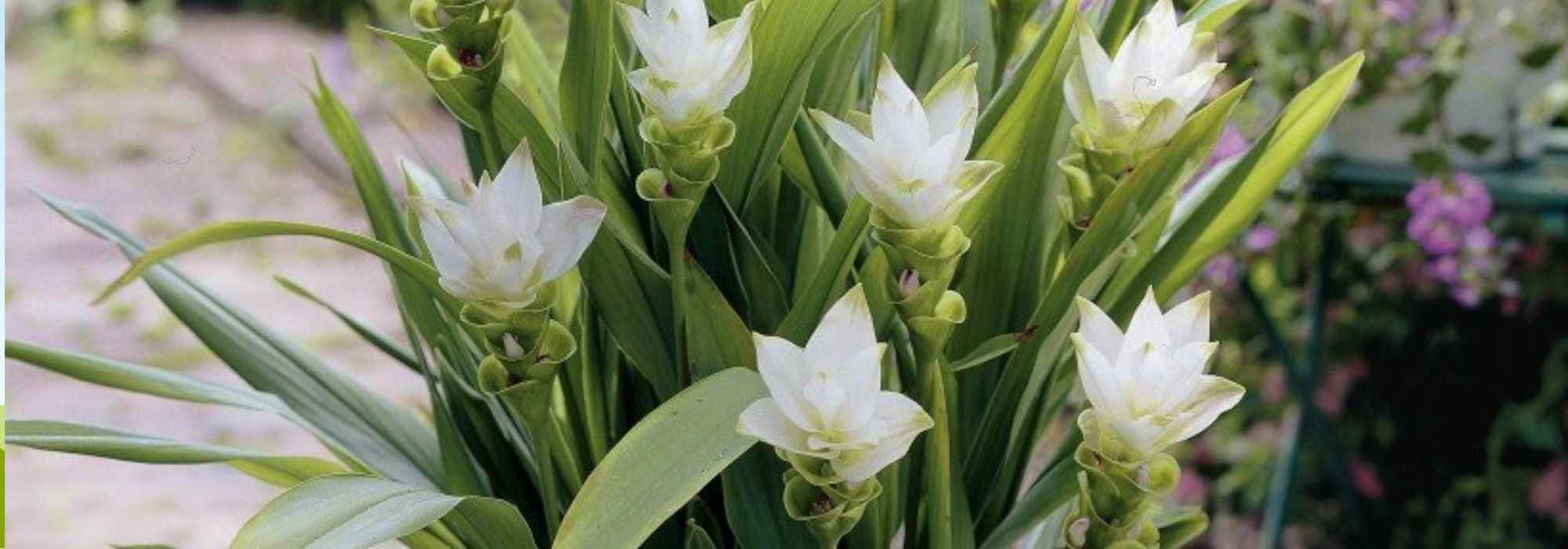
The Curcuma alismatifolia ‘White’ is a rather rare bulb in cultivation. We are well acquainted with Curcuma longa, the culinary and medicinal plant that produces the famous orange powder. However, the species alismatifolia is a non-edible plant, used solely for its ornamental qualities. It is also known as Siam tulip, referring to the delicacy of its beautiful flowers and its natural growing area, which is primarily in Thailand.
This is a rhizomatous plant that flourishes at the end of spring, around June. It then reveals flowers with a design that is both delicate and remarkable. They consist of green and white bracts tipped with bronze, imbricate like scales. These serve as a backdrop for tiny, fragrant mauve flowers measuring 2 cm, true little gems!
There are also varieties with other colours: ‘Pink’ has green and pink bracts, while ‘Red’ features red bracts flamed with green.
This Curcuma offers an upright silhouette, structuring and graphic, thanks to its vertical spike inflorescences and sword-shaped foliage. It reaches about 60 cm in height and 30 cm in spread.
Not very hardy, our rhizomatous plant can only be grown in the ground in the privileged Mediterranean regions where it does not freeze. Elsewhere, pot cultivation will allow the plant to be wintered safely. Otherwise, dig up the bulbs to keep them dry during the cold season.
Place this beautiful plant in a sunny or slightly shaded position, in soil rich in organic matter but well-drained to avoid standing water. Position it alongside spring-flowering bulbs, such as spring snowflakes, fritillaries or Amaryllis.
To learn more: Turmeric: planting, harvest, benefits
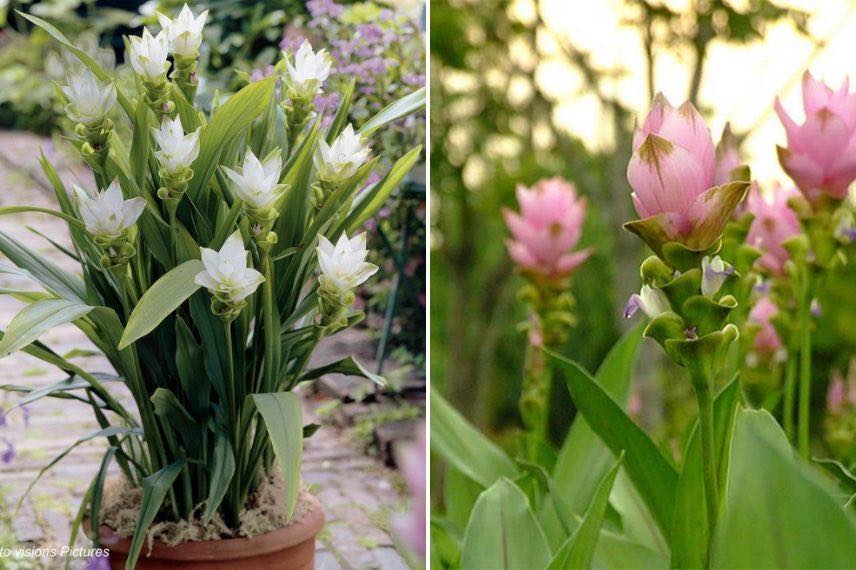
Curcuma alismatifolia ‘White’ and ‘Pink’
Calanthe ‘Red Sunset’: an orchid with colourful and sophisticated flowers
The Calanthe ‘Red Sunset’ is a hardy terrestrial orchid that blooms in mid-spring, between April and May. It has the advantage of being more hardy than tropical species (down to -10°C in dry soil and protected by mulch), making it suitable for gardens in several of our regions. It is also easier to grow, although handling it remains delicate due to its reduced root system.
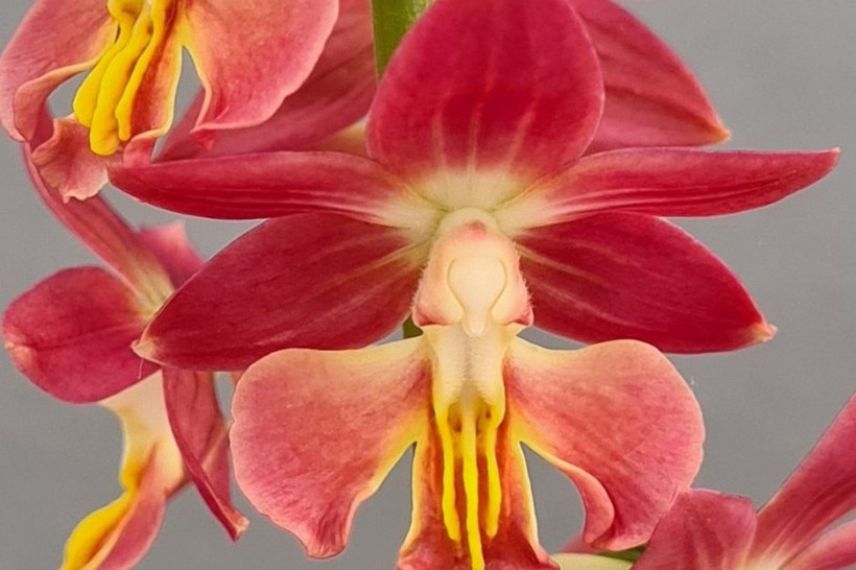
This is a rare species, but one of great beauty, enjoying the same refinement as other orchids. It produces floral spikes about forty centimetres tall, at the top of which large flowers with remarkable patterns bloom. They are composed of reddish-pink petals and sepals, along with a lighter lip enhanced with bright yellow. True sunset hues, which give it its name!
The deciduous foliage emerges in spring, forming a clump of about 40 cm in all directions. The leaves are plicate, ovate, and deeply veined.
This Calanthe is a woodland plant. It enjoys warmth and humidity, in rich soil and partial shade. It can be grown both in the garden and in pots. Pair it with ferns from the same regions, such as Athyrium niponicum ‘Red Beauty’, or opt for the essential ornamental foliage of Hostas.
To learn more: Calanthe: planting and growing
Read also
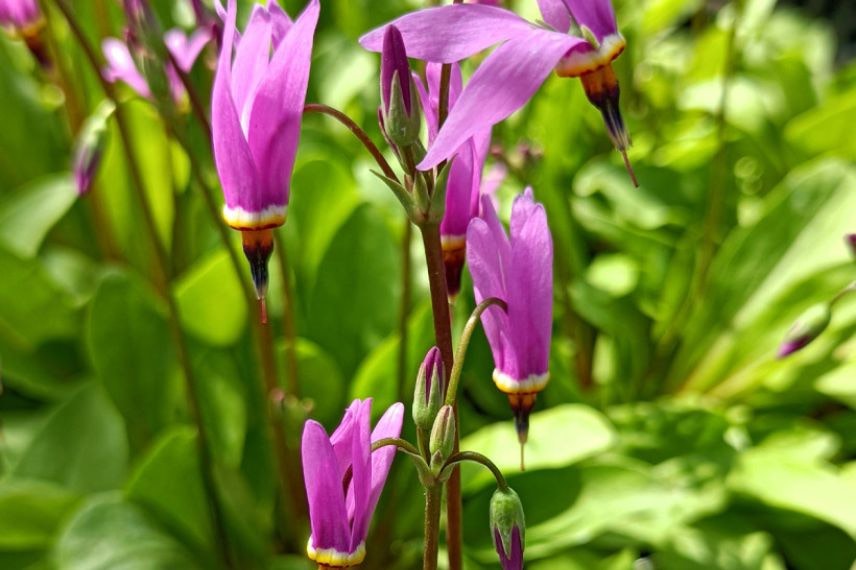
7 rare and unique bulbsThe Dodecatheon jeffreyi ‘Rotlicht’: graceful and delicate flowers
Dodecatheon are among the most beautiful spring flowers. Delicate and seemingly fragile, their pendulous flowers with reflexed petals resemble small cyclamens. They are actually cousins of primroses, native to North America.
This is a perennial plant with somewhat demanding cultivation and a short growing cycle (about 3 months), making it suitable for the experienced gardener or passionate collectors. A true gem of a plant to pamper!
The genus comprises only about ten species, and Dodecatheon jeffreyi ‘Rotlicht’ is still one of those rarely offered. At the end of spring, between May and June, its floral spikes can reach up to 40 cm in height and unveil beautiful flowers that resemble turned-up bells. They hang gracefully and display a lovely reddish-purple, highlighted by a white base and a golden yellow centre. They emerge amidst a rosette of foliage. At maturity, the plant reaches about 30 cm in all directions.
Quite hardy (down to -20°C), Dodecatheon has some cultivation requirements: a soil rich in organic matter, preferably acidic, remaining cool during the growing season (moist but not waterlogged), and well-drained to prevent water stagnation. It enjoys semi-shaded locations, making it a perfect candidate for woodland edges, cool rockeries, alpine meadows, or the vicinity of water features. Consider its placement carefully, as this plant does not like to be moved.
Plant ‘Rotlicht’ in a natural setting alongside Epimedium and a Fuchsia magellanica, which will take over the flowering. Also create a scene with spring bulbs, such as snowdrops or scillas.
For more information: Dodecatheon, Virginia shooting star: planting, growing.
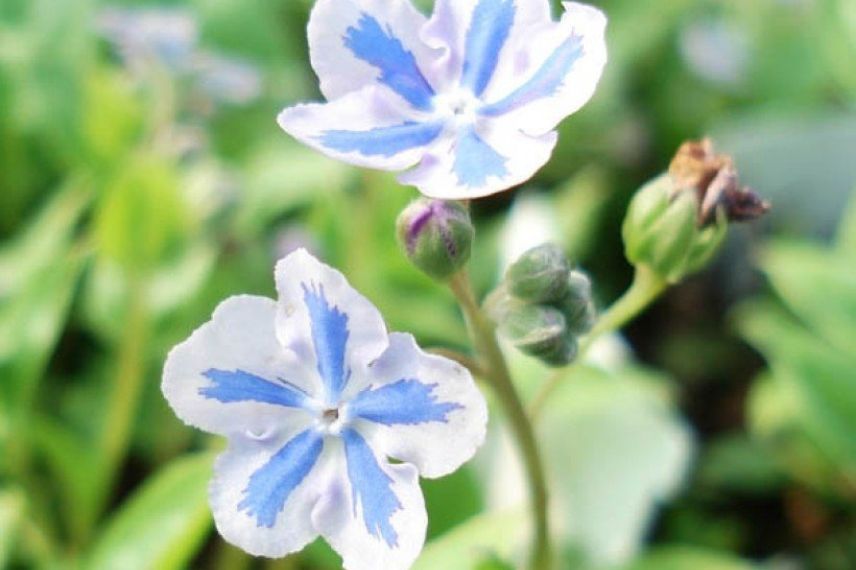
Omphalodes cappadocica ‘Starry Eyes’: a spring flowering of charming bicolour stars
Omphalodes is a hardy perennial groundcover plant appreciated for its small clusters of spring flowers. It is a cousin of the melliferous borage and the charming forget-me-nots, originating from Western Asia.
The Omphalodes cappadocica ‘Starry Eyes’ graces us with a truly charming flowering between April and May-June. It consists of star-shaped flowers that appear simple at first glance, but have a delightful pattern. They showcase indeed a bicolour colouration, an immaculate white enhanced by porcelain blue, which seems almost painted on. These small corollas measure about 1 cm and are gathered in clusters of up to ten flowers.
Its silhouette barely exceeds twenty centimetres in height with a spread of 40 cm. Its lanceolate foliage is deciduous: it disappears in winter to re-emerge in spring.
With a slow growth rate, this herbaceous plant will take some time to develop, but will then become a lovely low-maintenance green carpet, spreading through its stolons. Quite hardy, it will adorn light woodlands, the bases of deciduous shrubs, borders, or the front of semi-shaded flower beds in many regions.
Easy to care for, it will only require fresh, rather humus-bearing, and light soil. Place it alongside a woodland hyacinth and mini daffodils in yellow or orange tones, which will contrast beautifully.
For more information: Omphalodes: planting, growing, and care.
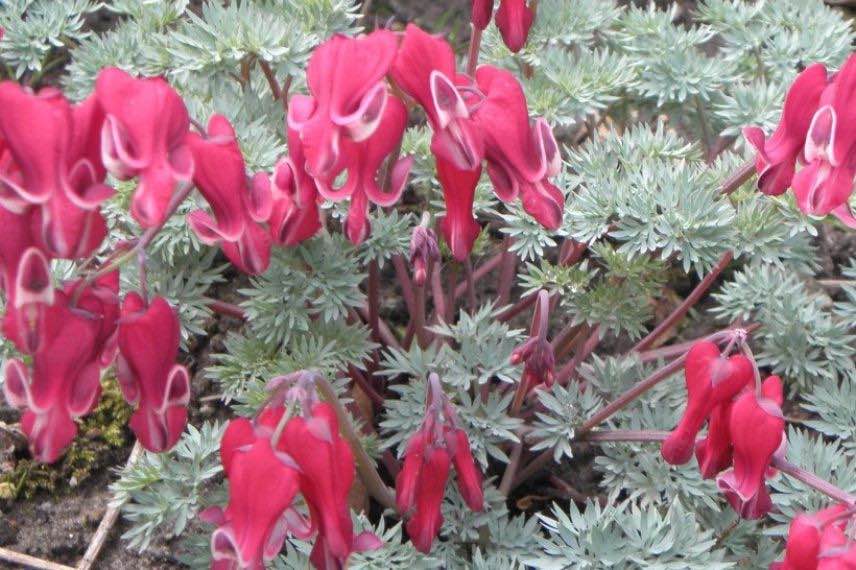
Dicentra ‘Burning Hearts’: adorable heart-shaped flowers
The Dicentra ‘Burning Hearts’ is undoubtedly one of those beautiful spring-flowering plants. It produces curved stems that bear pendulous flowers forming small red hearts edged in white. Its demanding cultivation makes it a precious gem that will reward the most experienced gardeners.
The foliage is equally ornamental, consisting of finely cut leaves displaying a lovely grey-green-blue hue.
With a compact habit, this perennial will reach about 40 cm in all directions. It will dress the shaded and moist areas of the garden.
Quite hardy, it appreciates deep, organic-rich soils that remain cool during the growing season. Grow it alongside a creeping bugle and foxgloves in white or pink tones.
To learn more: Bleeding heart: planting, cultivation, and companion planting
- Subscribe!
- Contents

Comments