





























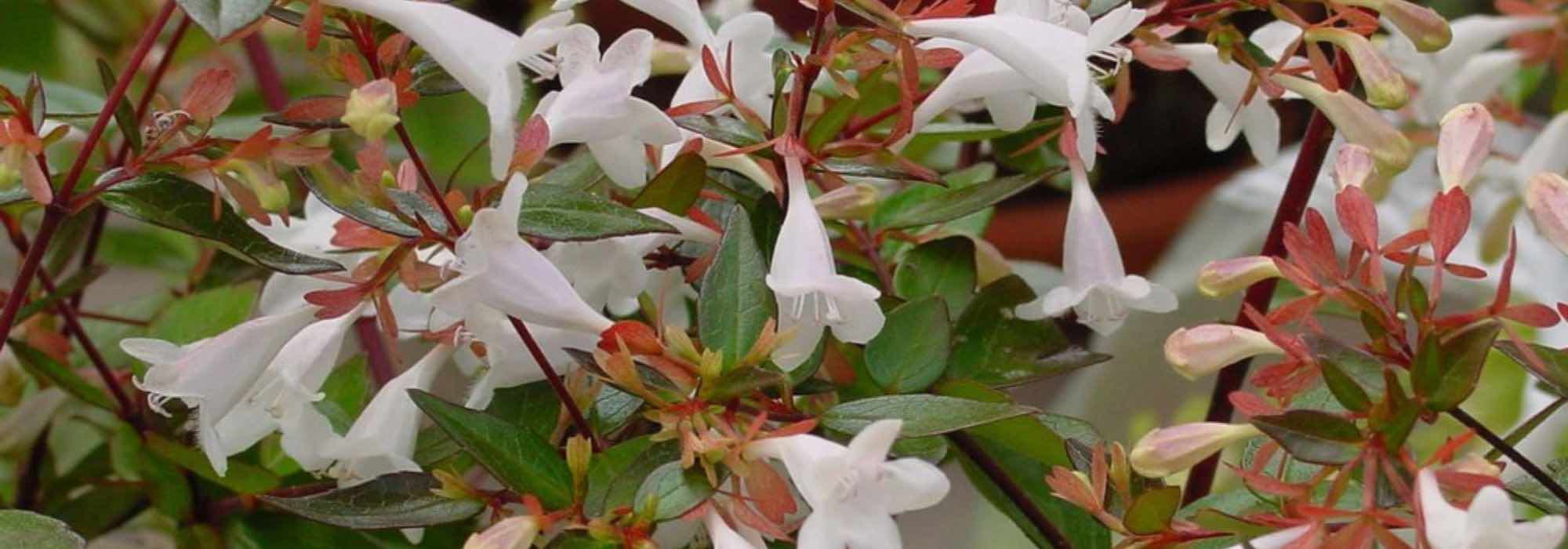
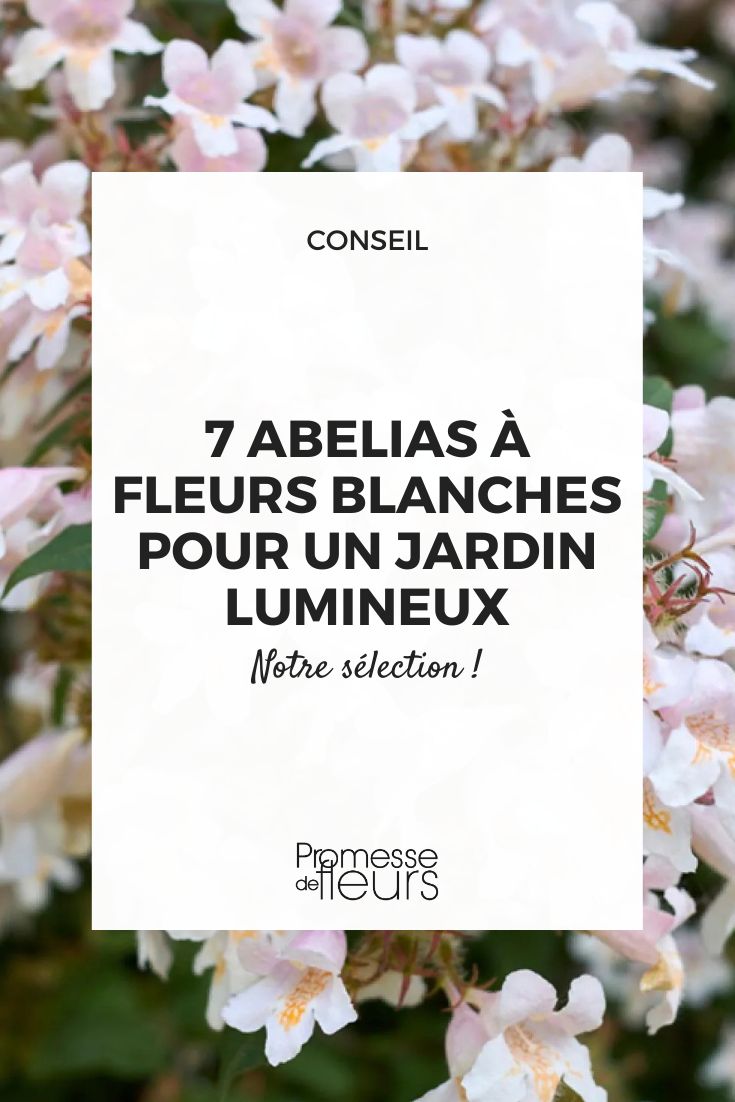
7 Abelias with white flowers for a bright garden
Our selection
Contents
Add brightness and lightness to your garden with White-flowered Abelias, elegant shrubs that captivate with their long flowering and easy maintenance. Versatile, they are suitable for both small and large spaces, ideal for creating flowering hedges, structuring planting beds or brightening a terrace. Discover seven notable varieties, with green or variegated foliage, each offering an abundance of small, fragrant white corollas, perfect for lighting up your garden or terrace.

Abelia grandiflora 'Semperflorens'
This Abelia grandiflora ‘Semperflorens’ is an improved variety, more vigorous and floriferous than the type species, with a dense, rounded and pliant habit to elegantly arching branches. Ideal for containers or the garden, this shrub diffuses a delicate fragrance all summer, thanks to clusters of pale pink-white flowers that attract pollinators. From July to October, flowering extends, adding undeniable charm to sunlit or semi-shaded spaces. Its glossy foliage, initially pale copper-green, evolves to a dark green before turning purple in autumn, and sheds leaves only if winter is particularly harsh.
Hardy to -12°C, ‘Semperflorens’ is easy to grow in healthy, well-drained soil, and tolerates drought once well established. In cold climates, place it in a sheltered spot away from winds, near a south-facing wall, and protect it with a frost protection fleece. With its moderate growth, it reaches 2.5 m in all directions, ideal for structuring small gardens or unpruned, free-form hedges.
The Abelia ‘Semperflorens’ blends harmoniously with medium-sized shrubs. For a contrasting effect, pair it with more robust evergreen foliage such as Distyliums or viburnums, or play with fine, glaucous foliage like that of spiraeas. In pots, it is a decorative asset, perfuming terraces with its subtle fragrance.
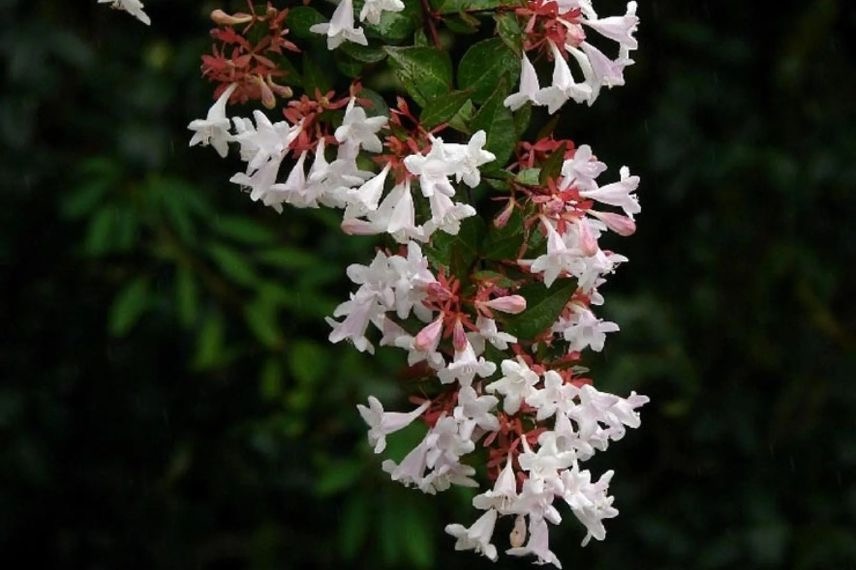
the Chinese Abelia or Abelia chinensis
Abelia chinensis, also known as Chinese Abelia or Abelia rupestris, is a botanical species native to temperate regions of China, where it grows in deciduous woodlands.
This bushy, dense shrub with a soft-growing habit reaches up to 2 m high and wide at maturity, with moderate growth. Its flowering period extends from July to October, bearing small tubular white flowers with pink-tinged backs, grouped in panicles at the ends of the young shoots. The old-rose calyxes, decorative, persist after the flowers have fallen. The abundant flowering releases a strong fragrance that attracts pollinating insects. The reddish ramure bears ovate, green and glossy leaves that turn bronze in autumn and persist in mild climates.
Hardy to −12/−15°C in well-drained soil, Abelia tolerates poor soils and withstands summer drought. It finds its place in a flowering hedge, with buddleias, kolkwitzias, mock oranges or in autumn borders. In a pot, it perfumes terraces and balconies.
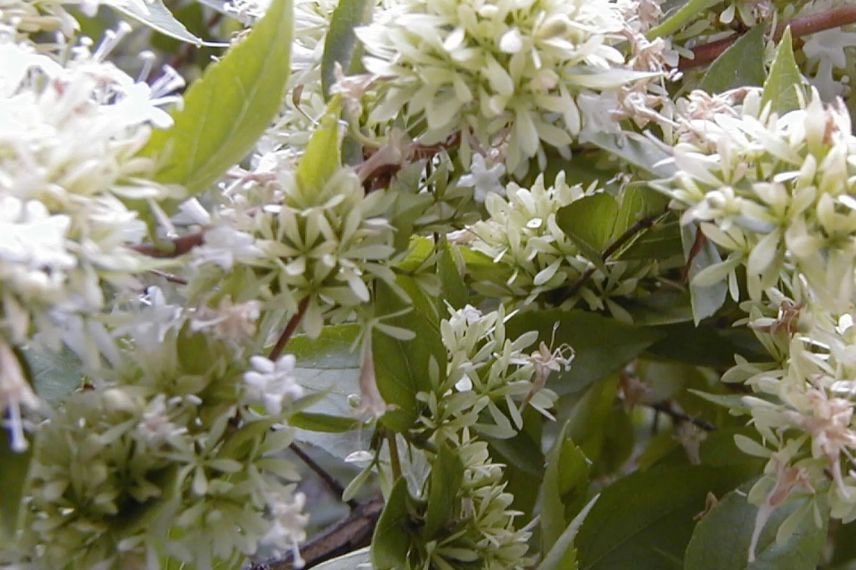
Abelia grandiflora 'Caramel Charm'
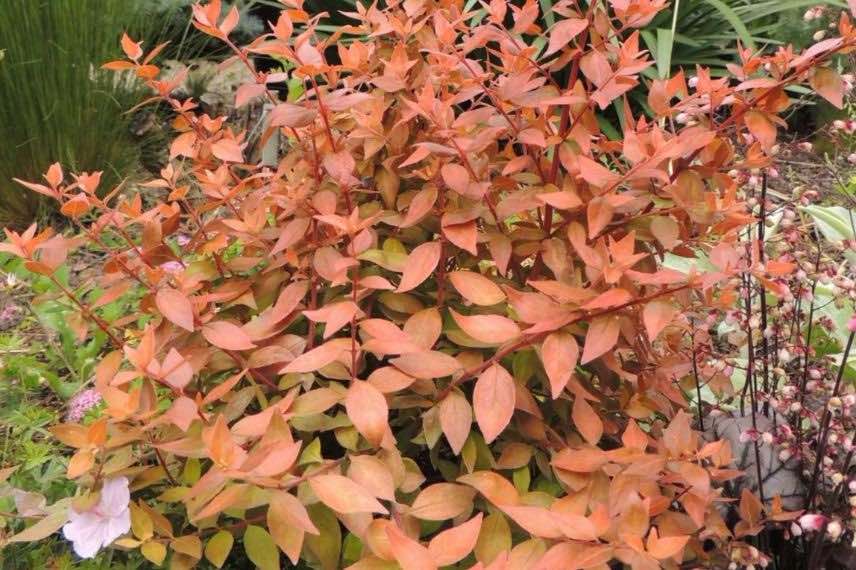
The Abelia grandiflora ‘Caramel Charm‘ captivates with its young coppery, glossy foliage, which develops to golden tones before turning green, offering a colourful display throughout the summer.
This new hybrid, derived from Abelia chinensis and Abelia uniflora, features a dense, compact habit, slightly wider than tall, reaching 1.20 m in height by 1.50 m in width, with slow growth. It is a very ornamental shrub, ideal for small gardens or large pots. It flowers from July to October, producing small funnel-shaped corollas, white to pink, in fragrant panicles. In autumn, the spent flowers give way to rust-coloured calyces with bracts, nicely contrasting with the leaves taking on purple-toned hues.
Hardy to -15° C in well-drained soil, it prefers a sunny position and tolerates drought well once established. In a border, pair it with low shrubs such as Berberis thumbergii ‘Atropurpurea Nana’ or Ceanothus repens. In colder climates, grow it in a pot, sheltered over winter.
Read also
Abelia: 5 varieties to grow in potsLarge-flowered Abelia 'Sparkling Silver'
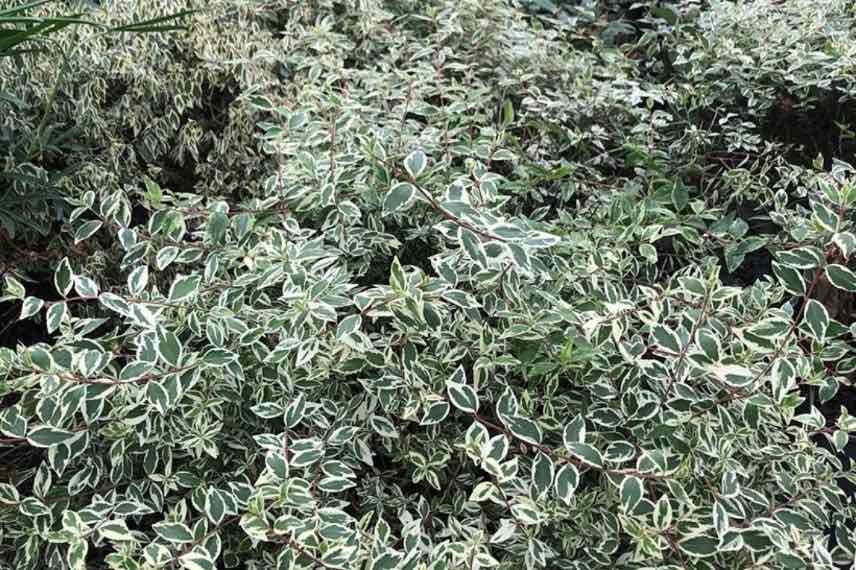
Variegated form of Abelia grandiflora, the cultivar ‘Sparkling Silver’ stands out for its dense cushion habit. This variety is a recent release from Minier Nurseries. It grows to 50 cm tall and 75 cm wide, with slow growth. Its semi-evergreen, glossy foliage develops pink-tinged hues in autumn, providing year-round interest.
From July to October, it produces a long-lasting, fragrant display of small pink-tinged white bell-shaped flowers. After flowering, attractive rust-coloured calyces linger on the foliage.
Perfect for small gardens, it sits well in a border, in a low hedge, or in a pot on a patio. Hardy to -12°C, place it in full sun, in ordinary but well-drained soil, and protect it from cold winds. It pairs well with low shrubs such as Euonymus fortunei ‘Emerald Gaiety‘ or the Genista lydia, and is drought-tolerant once established.
Zander's Abelia 'Little Richard'
L’Abelia zanderi Little Richard® is a charming novelty, suited to small gardens and terraces. It has a compact, spreading, rounded habit and reaches 60 cm in height and 90 cm in width at maturity. Growth is moderately rapid, and its arching shoots give it a graceful appearance. From July to October, it bears numerous white, slightly pink-tinged flowers, arranged in fragrant panicles, highly attractive to pollinating insects. Once faded, these flowers give way to rust-coloured bracts that decorate the foliage until autumn. The young shoots in spring emerge red, becoming glossy light-green foliage, which bronzes in response to cool nights, remaining semi-evergreen or evergreen in mild climates.
This cultivar originates from the Abelia zanderi, a little-known hardy Chinese species with a compact and spreading habit, whose flowers are remarkably fragrant.
This abelia integrates well into perennial borders, low hedges, or as a standalone specimen. Perfect for container growing, it can brighten terraces or balconies. Pair it with landscape roses, Chinese lilacs, and Spiraeas for a harmonious display.
Large-flowered Abelia 'Magic Daydream'
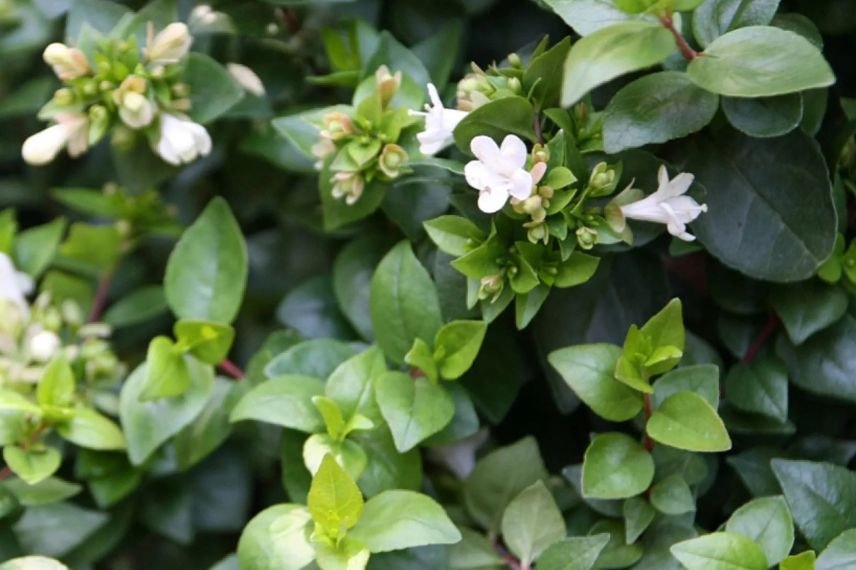
Abelia grandiflora ‘Magic Daydream’ is a remarkable dwarf shrub, awarded the silver medal at Plantarium 2017 for its decorative foliage and its hardiness. With a compact, dense habit, it forms a bright, rounded shrub 60 cm high by 80 cm wide. Its glossy semi-evergreen leaves are distinguished by evolving shades: very pale yellow in spring, cream and white in summer, then pink on a green-grey background from the first cool nights of autumn.
In summer, from July to October, this hardy shrub, hardy to -15°C in well-drained soil, is adorned with small, fragrant flowers, white to pink-tinged, in terminal panicles. After flowering, pretty rust-coloured bracts adorn the shrub throughout autumn. Growth is slow, but it offers colour all year round.
Suitable for small gardens and large pots, ‘Magic Daydream’ is perfect as groundcover, at the front of borders or along a path. It is also superb among autumn borders, paired with Caryopteris and shrubby salvias.
Abelia large-flowered 'Tricolor Charm'
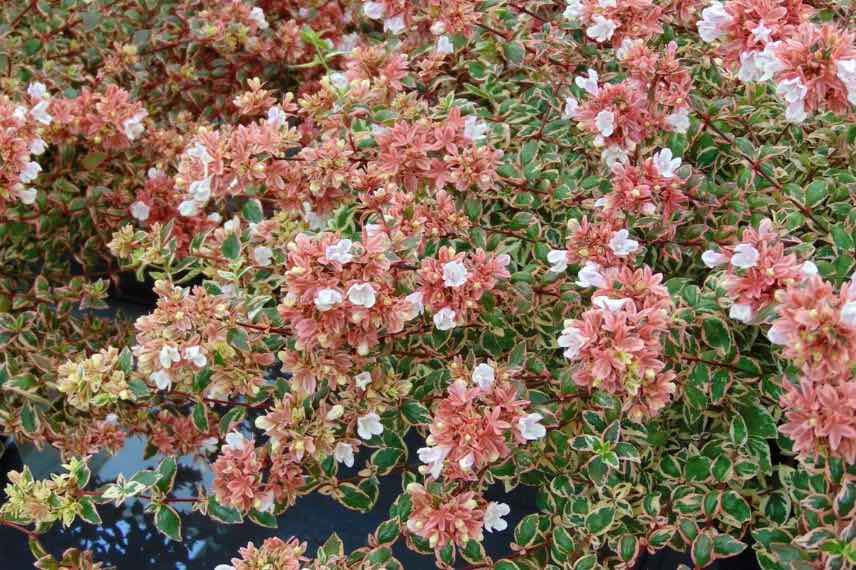
Abelia grandiflora ‘Tricolor Charm’ seduces with its unique tricolour foliage, combining green, cream and pink. At the start of spring, its new leaves display yellow-bronze tones, gradually turning green edged with cream, with touches of pink that brighten the shrub all summer. This Italian variety with a compact, dense habit reaches about 1.50 m in height by 1.25 m wide, and its growth is slow. Its long flowering, from July to October, produces small fragrant bell-shaped flowers, white or pink, borne in panicles. In autumn, the spent flowers give way to pretty rust-coloured bracts, contrasting with the foliage that takes on rust to purplish tones as the first cool nights arrive.
This semi-evergreen abelia often retains its leaves in winter, especially in mild climates. Drought-tolerant once well established, it is hardy to -15°C, provided it grows in well-drained soil and is sheltered from cold winds. Ideal for small gardens, large pots or borders along paths, it adds a splash of colour and elegance to the garden. Pair it with a Berberis thunbergii ‘Rosy Glow’ with purple and pink foliage, or with Choisya ‘Apple Blossom’. Suitable for ordinary soils, it fits just as well in a low hedge as in a ground cover, offering an attractive presence all year round.
- Subscribe!
- Contents
Comments