





























7 affordable trees to landscape your garden on a budget
Ornamental trees offering excellent value for money
Contents
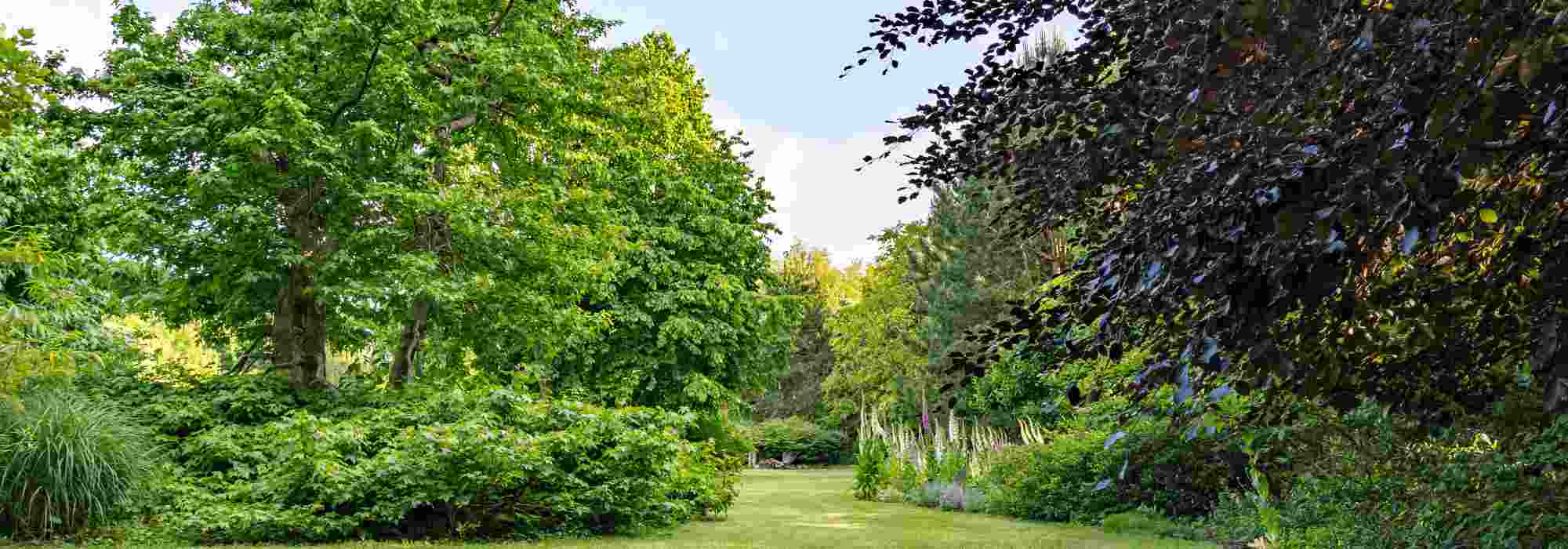
Trees are the centrepieces of a garden, providing height and structure as well as the essential shade in summer. They are among the most expensive plants you will put in, requiring several years of work at the nursery. Planting trees in your garden therefore has a cost, especially if you need to develop bare ground, and if you choose mature trees. To cut the bill, you can choose tree species that are cheaper to buy, and opt for rapid-growth trees that will quickly make an impact in a garden. Bare-root trees and young trees are another way to plant cheaply, especially as they establish very well once planted.
We guide you on these affordable trees, often leafy, deciduous trees, for a lower-cost garden.

What type of tree should I choose to save money?
To plant out a very large garden, or when your budget is limited, it’s best to seek out affordably priced trees. Not only will you find an interesting selection among the native trees, those species adapted to the climate and to our country’s soil conditions, but you will also plant with trees that will be more resilient and require less maintenance since they are well suited to sun exposure and soil. A small bonus: these trees are often melliferous. Note too that these typical species will always be more affordable than trees resulting from hybridization and with numerous varieties.
The least expensive trees are generally deciduous, dropping their foliage in winter and, for some, taking on a beautiful autumn colour. Trees with evergreen foliage (conifers, some Magnolias, mimosas, etc.) that grow more slowly are generally much more expensive.
It is also important to choose trees with rapid growth, which, if bought small, will make an impact in just a few years. In this category we include trees with rapid growth when they are young (the first five years); there are many of them!
Finally, the type of container will greatly affect the price of a tree. The larger it is, the more costly. But bare-root trees, selected in reasonably large sizes (150 to 200 cm), will be very competitive for a quick result (they cost two to three times less than in a 3L pot, for example).
Finally, we recommend that you include a few particularly ornamental trees for the shape of their foliage, their silhouette or their flowering. Here is a small selection of trees to rediscover that possess all these qualities, for a beautiful tree-filled garden on a budget!
→ Also read: Native plants: let’s take stock! and Nursery measurements: how to make sense of them?
The willow
Among the great diversity of willows, trees such as the weeping willow (Salix babylonica or Salix alba ‘Tristis’) and the white willow (Salix alba) are good, affordable choices to plant in the garden. Both prefer moist soil and a fairly sunny position. The weeping willow, majestic, lets its long, supple branches droop in a very romantic way, while the white willow has a more upright, spreading silhouette. Standing respectively 6 to 10 m and 15 to 25 m tall, they are trees known for their rapid growth. Willows have the advantage of being attractive all year round, their bare twigs a golden-yellow that brighten spaces in mid-winter. The underside of their leaves gives them a superb silvery-green colouring!
→ Read more in our comprehensive guide: Willow, Salix: planting, pruning and maintaining.
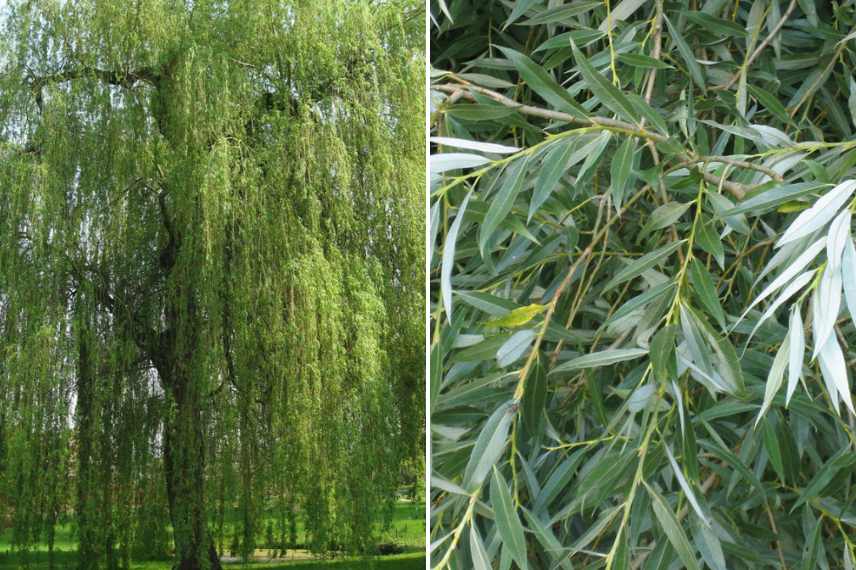
Weeping willow and white willow
The hazel
Some hazels, such as purple-leaved and contorted varieties or the Turkish hazel, which is very tall, are a little more expensive to buy. But if you favour the typical species, such as Corylus avellana or Corylus maxima, you can find inexpensive trees that make a great impact in the garden. Often regarded as large bushes, hazels, fairly identifiable by their ramified habit from the base, reach about 5 to 10 m. They are trees well known for their hardiness and their ability to grow in all soil types. Besides their attractive dentate and very veined foliage, evergreen for a long time on the tree and turning yellow in autumn, they delight us in late winter with their flowering in the form of aments… And of course in autumn by producing hazelnuts! You can really enjoy a hazel at little expense. Use them as specimens or in a country hedgerow.
→ Find out more in our complete guide: Hazel, Corylus: plant, prune and maintain, and Choosing the right hazel: our buying guide.
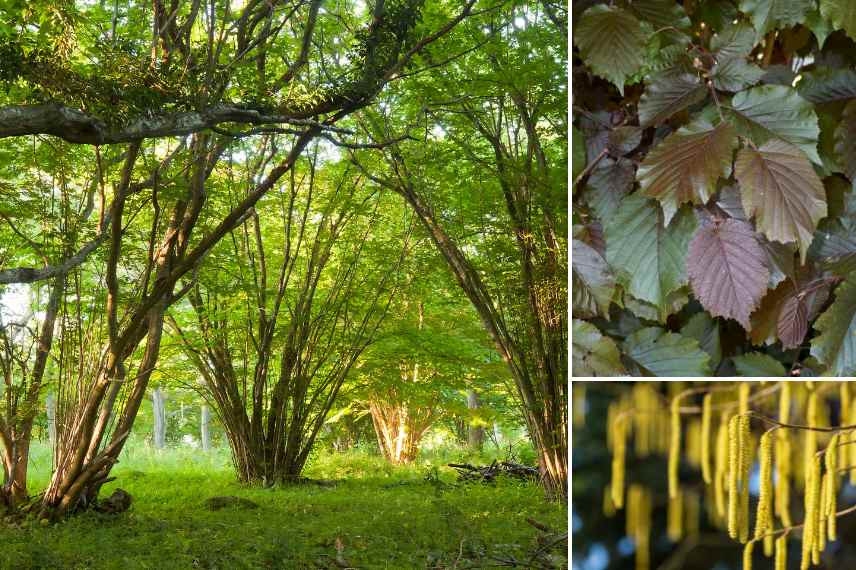
Corylus avellana, Corylus maxima, winter flowering of the common hazel
The black locust
Under its Latin name Robina pseudoacacia, here is a very handsome tree not to be missed in the garden. Its rapid and vigorous growth is one of its major assets for our budget-friendly, tree-filled garden, but it also has the advantage of being ornamental for its habit, its foliage and its flowering. The black locust reaches at maturity between 15 and 20 m in height with a smaller spread of around 10 m. Its abundant, melliferous and very fragrant flowering takes place in June, consisting of clusters of white flowers typical of the Fabaceae. It is a trouble-free tree, with beautiful compound foliage and thorny shoots. It adapts very well to dry, poor soils.
→ Read more in our comprehensive guide: Black locust, false acacia: planting, pruning and care.
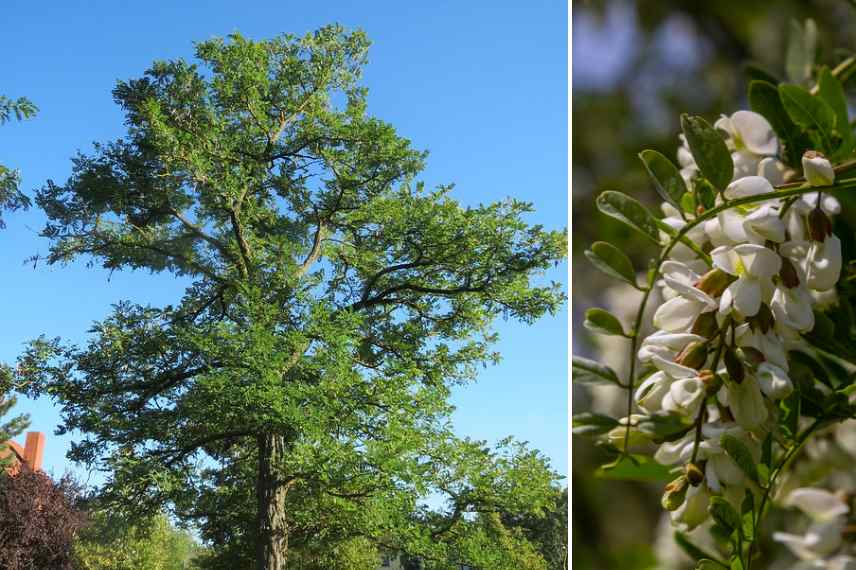
Robina pseudoacacia (© Andreas Rockstein)
Scots pine
Well-known forest tree, the Scots pine is one of the fastest-growing conifers, and therefore of interest, especially since, with its evergreen foliage, it provides a strong presence in the garden. It is particularly ornamental with its umbrella-shaped form after a few years (when young, it adopts a rather pyramidal habit, then loses its lower branches). Its scaly bark, gradually becoming ochre-orange, and its glaucous (grey-green) foliage give a particular charm to this pine suited to large gardens. The Pinus sylvestris grows up to 20 m tall. Hardy, and with no particular soil requirements, it can be planted throughout mainland France. Like all conifers, it will need a sunny position.
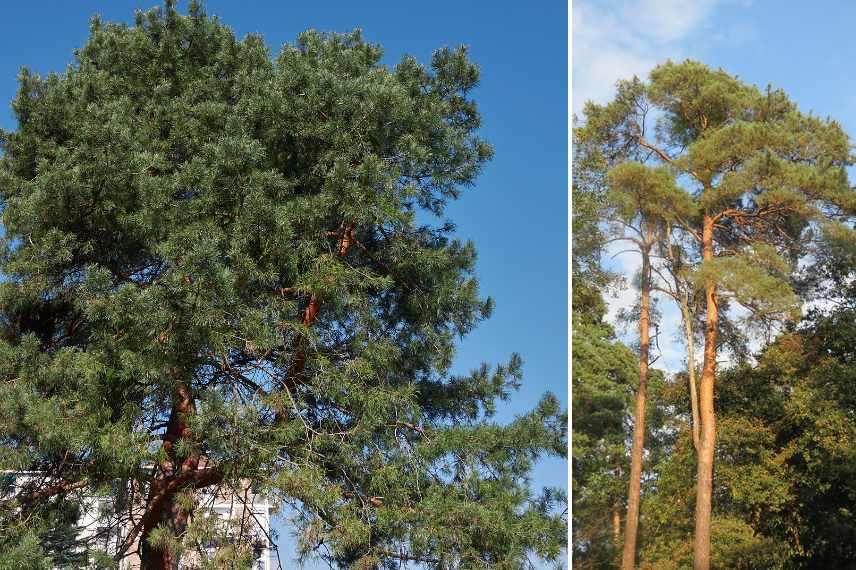
Scots pine (© Andreas Rockstein)
The sycamore maple
The type species, the Acer pseudoplatanus, has given rise to many varieties with variegated or coloured foliage, but it is itself a very fine tree, from about fifteen metres in height up to 25 m. With rapid growth in its youth, this inexpensive tree quickly fills out and adorns a large garden with its very beautiful palmate foliage, green in colour, turning orange‑yellow in autumn. The sycamore is a particularly melliferous tree, attracting bees for the pollen and nectar contained in its flowers, which are nevertheless inconspicuous, in April–May. Very hardy, tolerant of sea spray and all exposures as well as windy sites, it is truly one of the most ornamental affordable large trees.
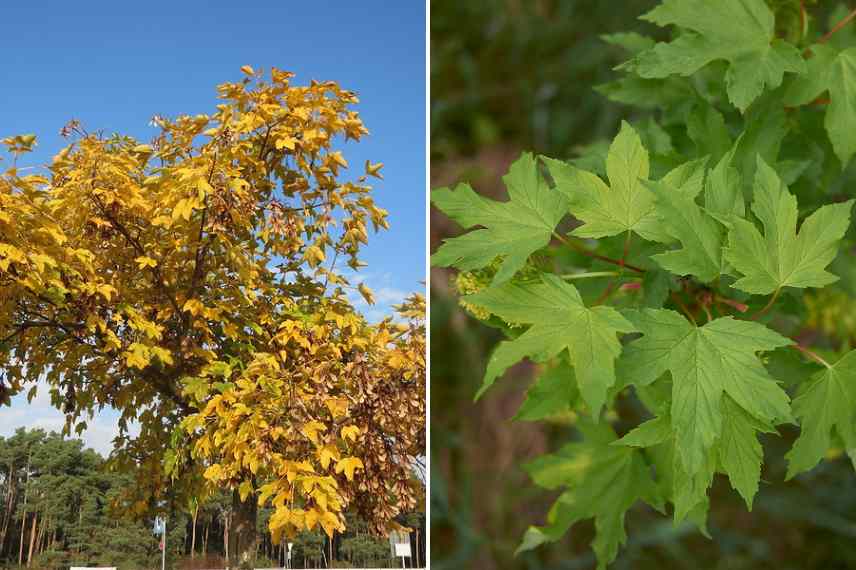
Acer pseudoplatanus (© Andreas Rockstein)
The horse chestnut
Majestic tree, the horse-chestnut readily finds a place in large spaces. It is also called the common horse-chestnut, but it is rather singular with its elegant flowering in upright white panicles, marked with red and yellow, attracting bees.
Reaching 15 to 20 m in height, it forms a very handsome tree with a broad, rounded habit, whose shade is appreciated in summer. Flowering occurs in April–May, and the deciduous foliage, light green and crinkled, formed of large palmate leaves, turns golden yellow in autumn. It will tolerate full sun, partial shade or even light shade. Its fruits, the conkers, appearing in autumn, are not edible, but can be used to create beautiful decorations for Christmas.
Red-flowering horse-chestnuts (Aesculus x carnea) are slightly smaller with a superb red flowering (but more expensive and slower to grow). Note that the chestnut also offers a sublime flowering in June–July, and will form a focal point (but it grows more slowly).
→ Also read: Horse-chestnut, Aesculus hippocastanum: planting, growing and care,
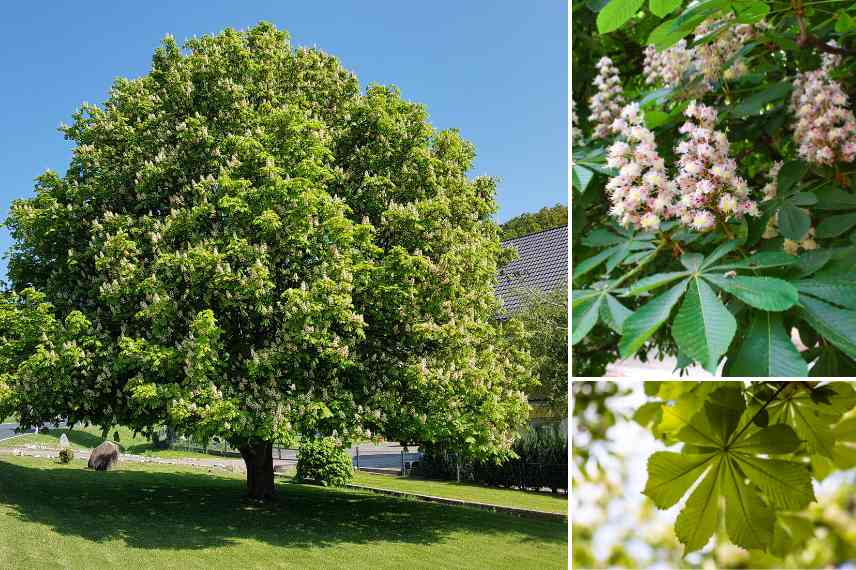
Aesculus hippocastanum
The Paulownia tomentosa
Its spectacular flowering is its main asset, but its XXL foliage, the largest among trees, guarantees a decidedly exotic look! Le Paulownia tomentosa is the only one in this selection not to be a European species. It actually comes from China and Japan, where it earned its nickname of imperial tree. But it is truly interesting for its unbeatable ornamental value-to-price ratio, and for its rapid growth in its early years. The blue tubular flowers that appear in spring are fragrant; it can reach up to 12 metres in height. In light shade or in sun, plant it in a well-drained, cool soil, protecting it from cold winter winds.
→ Learn more in our comprehensive guide: Paulownia, imperial tree: planting, growing and care.
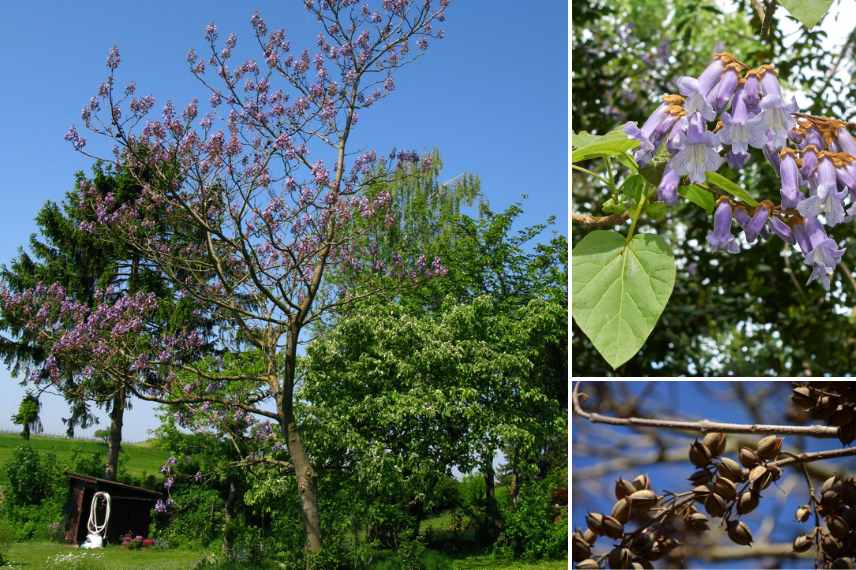
A recently planted Paulownia. To the right, the flowering and the fruits.
But also...
The wych elm (Ulmus glabra), the ash, the Catalpa bignonioides, the small-leaved lime (Tilia cordata), the common hornbeam (Carpinus betulus), the glutinous alder, ideal for damp soils, the poplar, the aspen…
Buying and planting advice
To save money, we mentioned above bare roots: they are made available during the autumn, so plan ahead and think about identifying the trees you want, then buy them from nurseries or online sites (they sell the most), ideally between October and November, to have plenty of choice. (N.B.: at Promesse de fleurs, these trees can be ordered in late August/early September for delivery in mid-November).
We recommend that you plant these trees immediately after purchase, during their period of dormancy, in autumn or winter, to encourage good establishment and reduce costs associated with watering and maintenance. If you buy trees with bare roots, here are all our tips for planting them properly: Planting trees and bushes with bare roots.
All trees require vigilance regarding watering during the first three years and in periods of drought. Don’t forget it! A good mulch is necessary to keep the soil cool.
→ Also read: The best times to plant.
- Subscribe!
- Contents
Comments