


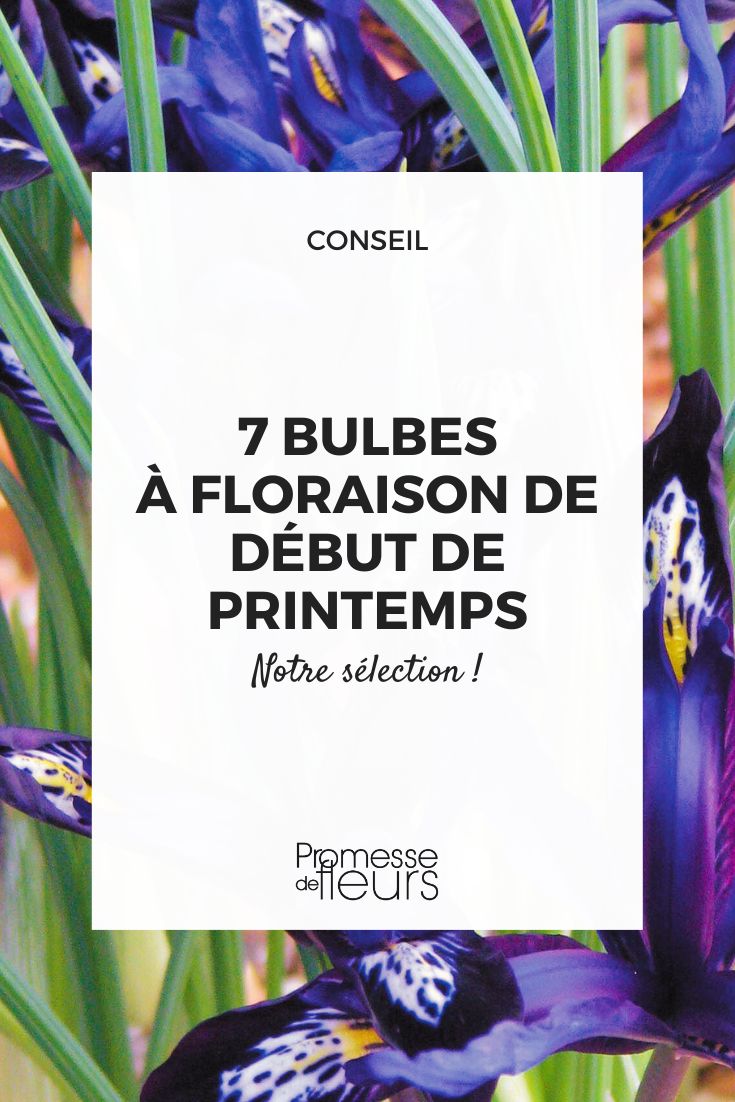
7 early spring-flowering bulbs
Early bulbous plants
Contents
Spring bulbs are among those plants that cheerfully announce the approaching end of winter and the return of warmer days. They reward us with their colours, their delicate silhouette or even their scent. Often very easy to grow in well-drained soil (which does not retain stagnant moisture), they can naturalise and come back of their own accord each year, to faithfully brighten our gardens or containers. If some bulbous plants wait for temperatures to warm up, others have no trouble showing the tips of their petals right at the very start of spring.
Discover our selection of 7 early-flowering bulbs, which bloom from February to March.

Crocuses
Spring crocuses are certainly among the most popular bulbs, and among the very first flowers to enliven the garden at the end of the cold season. The first rays of the sun will coax their cup-shaped flowers into bloom, even when there is still snow on the ground.
You’ll be spoilt for choice among varieties that bloom early in spring, from February–March. For example, opt for the Crocus botanical tommasinianus, whose flowers come in mauve, pink (‘Roseus’) or immaculate white (‘Ivory Princess’). For a bi-colour bloom, choose the C. chrysanthus ‘Advance’ or the rarer C. angustifolius. On its part, the C. vitellinus will reveal in early spring sun-loving flowers, slightly scented.
Don’t be fooled by their apparent fragility: crocuses are easy bulbs to grow, not very prone to disease, hardy and able to tolerate soils even when poor. They are especially dislike damp, stagnant moisture, which can cause their corm (a storage organ) to rot.
They are suitable for numerous uses: these perennials will brighten a lawn that is a little too monotonous, will make pretty spring-flowering pots, and will fit into borders, rockeries or edging. As they naturalise easily, they will return each year and, over time, form carpets of flowers that grow ever larger. Plant them in bulk, in a mix of colours or to create subtle splashes here and there, which will inevitably catch the eye.
For more information: Spring crocus: Plant, grow and maintain
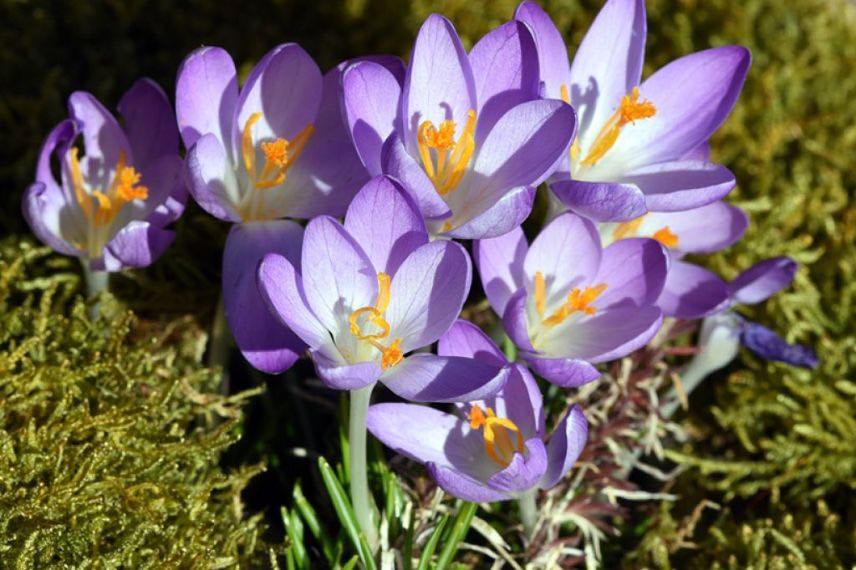
Crocus tommasinianus
Read also
5 easy spring bulbs for beginnersCyclamen coum
Among cyclamens, the flowering period varies by species. Between the end of winter and the start of spring, it is the Cyclamen coum (or Cos Island Cyclamen) that braves the last frosts to bring us cheer.
Flowering runs from February to March–April, revealing adorable little flowers with petals curved backwards. The variety ‘Rose’ naturally produces delicate flowers blending pale pink and fuchsia pink, accented by a purple throat. The cultivar ‘Blanc’ reveals delicate white flowers, with a purplish base providing strong contrast.
Hardy and low-maintenance, these bulbs are easy to grow in light, well-drained soil. They will be perfect for brightening the bases of trees on the woodland edge, for creating container plantings or integrating into a border in shade or partial shade. They will bring a welcome touch of light to a time of year when flowers are scarce. They can form over time large colourful carpets, which return each spring.
For more information: Cyclamen: plant, grow and care.
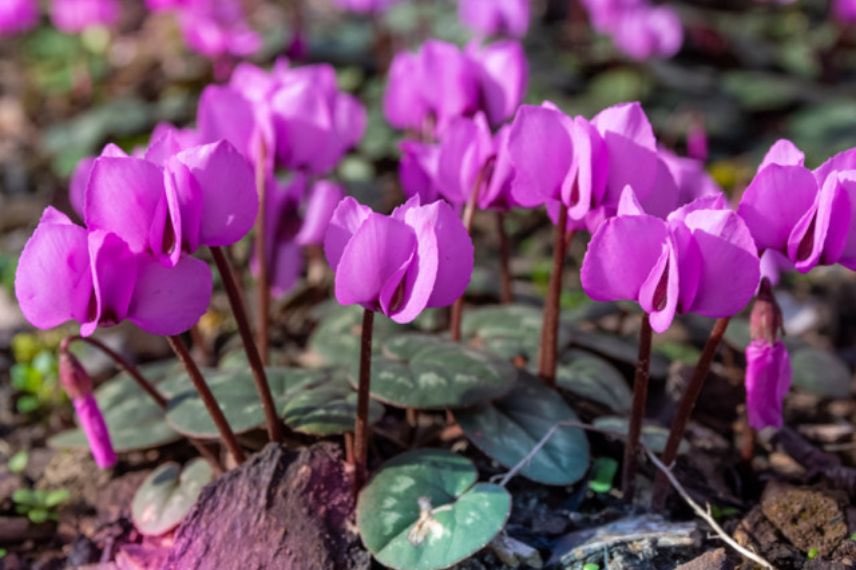
The pink Cyclamen coum
Chionodoxa
If Chionodoxa are also nicknamed the glory of the snow, it is in reference to their early flowering, heralding the end of winter and the start of spring. It consists of delicate star-shaped flowers, with a white centre.
Opt for Chionodoxa forbesii, in pink form (‘Pink Giant’) or blue (‘Blue Giant’). Also try Chionodoxa luciliae, which bloom blue, or white (‘Alba’).
Hardy and easy to grow, Chionodoxa will multiply to form real little flowering colonies over the years. They are ideal for dressing the bases of deciduous trees or brightening a windowsill. These bulbs truly deserve a place in more gardens! Give them light, consistently moist soil (which never dries out completely), in a sunny or partly shaded position. They are well suited to mountain gardens or cool winters, as they dislike drought.
For more information: Chionodoxas: planting, cultivation and care.
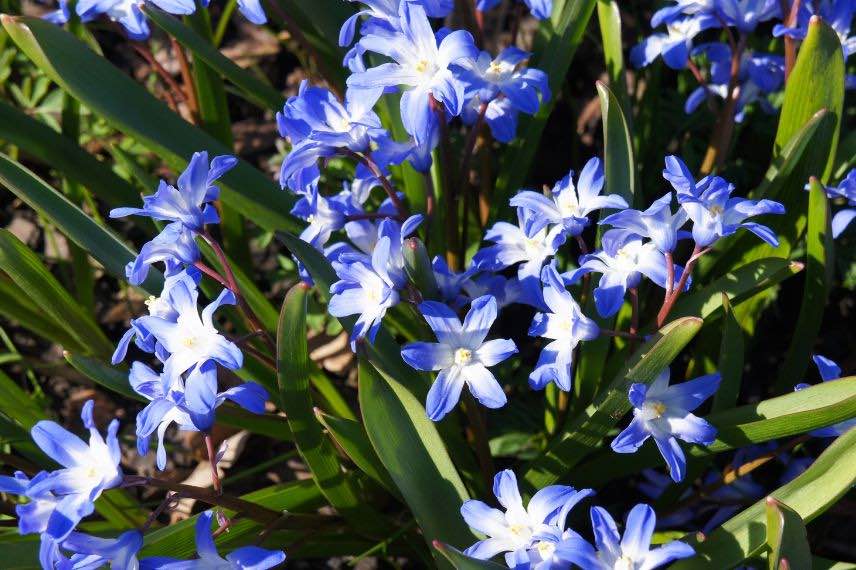
Chionodoxa forbesii
Read also
9 fragrant spring bulbsIris reticulata
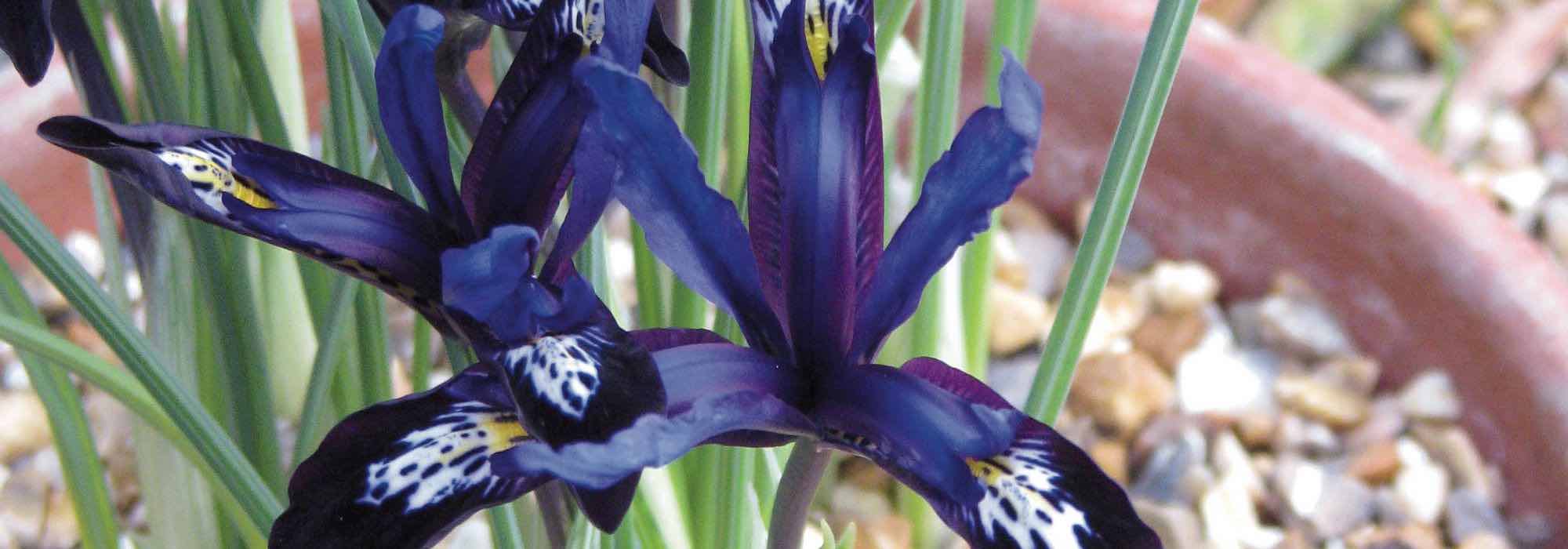
Among the irises, the reticulata are the first to bloom in early spring. They are dwarf irises, measuring around 15 cm tall. As with the other irises, they produce beautiful flowers with a striking, refined form. They consist of six tepals, half reflexed and directed toward the ground, while the other half rises toward the sky. In terms of colour, they often display spotted or mottled patterns with strong contrast. To top it off, the flowering is delicately scented.
Choose from:
- The Iris reticulata ‘Blue Note’, with flowers of a deep blue-violet splashed with white;
- ‘Dijt’, which flowers in purple speckled with yellow and mottled with black;
- ‘Natascha’, with its flowers of pure white, warmed by yellow stripes;
- ‘Orange Glow’, a sunny variety with its yellow flowers speckled with orange and flecked with black;
- ‘Eyecatcher’, which is hard to miss with its flowers blending white, blue and yellow.
These bulbous plants are easy to grow, hardy and disease-resistant. They have the advantage of being drought-tolerant. Grow them in full sun, in well-drained soil, for example in a rockery, a pot or a well-exposed border.
For more information: Iris reticulata: Planting and growing.
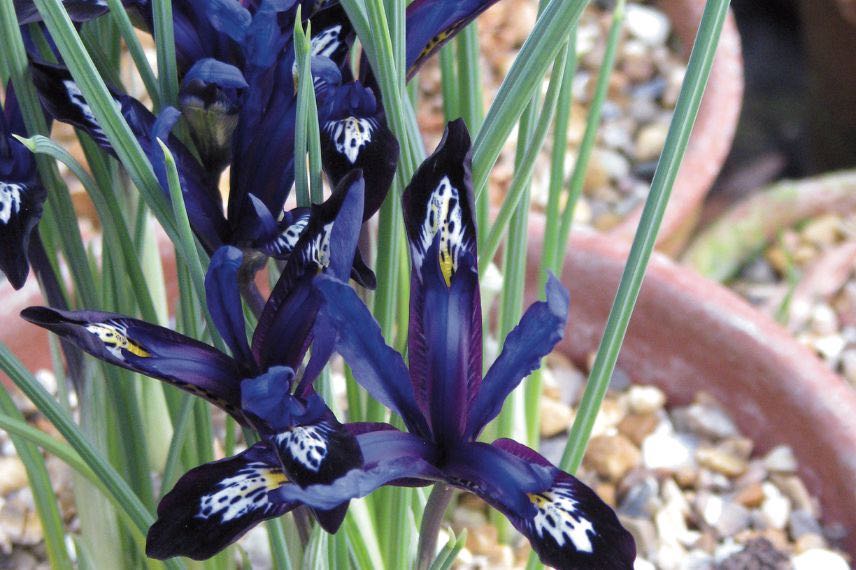
Iris reticulata ‘Blue Note’
Hyacinths
We love them for their beautiful clusters of star-shaped, fragrant flowers: they are hyacinths! These plants offer a lovely diversity of colours to suit all tastes.
If they are among the first to bloom in spring, some varieties are earlier than others. They will also stand out for their size, as they are larger than most spring bulbs that flower as early as February.
To enjoy the display early in the season, turn to:
- the Hyacinthus orientalis ‘Atlantic’ with blue-violet spikes;
- ‘Delft Blue’, with very fragrant blue flowers;
- ‘Fondant’, pink-flowering with delicate pink blooms;
- ‘Jan Bos’, which favours a vibrant raspberry-pink colour;
- ‘Top White’, a double variety of pure white.
Ne demandant quasiment pas de soins, elles se naturaliseront facilement en sol léger et bien drainé. Offrez-leur une exposition ensoleillée ou légèrement tamisée. Utilisez les jacinthes pour constituer de belles jardinières ou potées, même en intérieur.
For more information: Hyacinth: planting, growing and care.
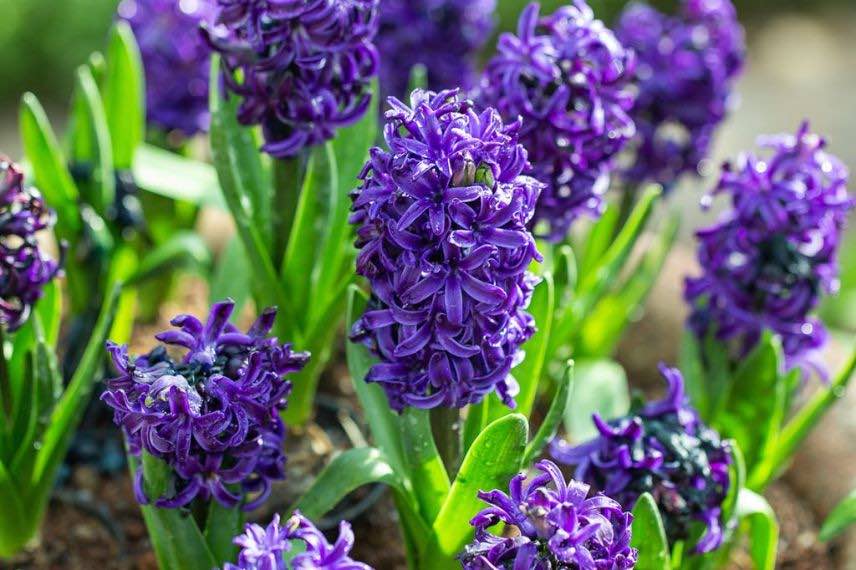
Hyacinthus orientalis ‘Atlantic’
Siberian squills
Among the different species, the Siberian squill are the hardiest.
These early bulbs bloom from the start of spring, between February and March. They reveal small trailing bell-shaped flowers, elegantly.
In addition to the blue-flowering form, discover the white flowering of ‘Alba’, or that of the aptly named variety ‘Spring Beauty’.
Plant them in partial shade or in sun that is not scorching, for example in woodland shade. With no particular requirements, vigorous and frost-tolerant, these bulbous plants will delight you year after year and form beautiful flowering carpets that will spread over the years. They will only struggle in regions that are too hot and dry.
For more information: Scilla: planting, growing and care.
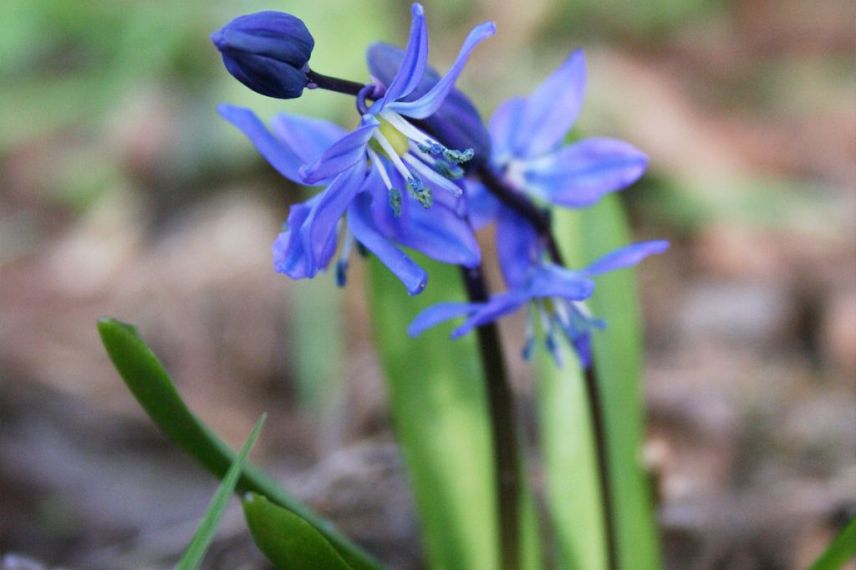
Scilla siberica
Eranthis
Eranthis have several evocative nicknames: “winter aconite”, “yellow hellebore” or “winter hellebore”.
This small tuberous plant, measuring only 10 cm, is indeed a real little ray of sunshine at the end of winter. Between February and March, it reveals its unpretentious flowers, which recall buttercups, belonging to the same family. With a bright and vivid yellow, they bring light and warmth as they herald the start of spring.
In the garden, plant Eranthis cilicica, Eranthis hyemalis, or its cultivar ‘Schwefelglanz’ with a paler yellow.
Their flowers will pair beautifully with blue blooms in a complementary colour. Plant them in cool, well-drained soil, even if calcareous. This easy-to-grow, hardy perennial will form pretty coloured groundcover.
For more information: Eranthis or hellebore: planting, cultivation
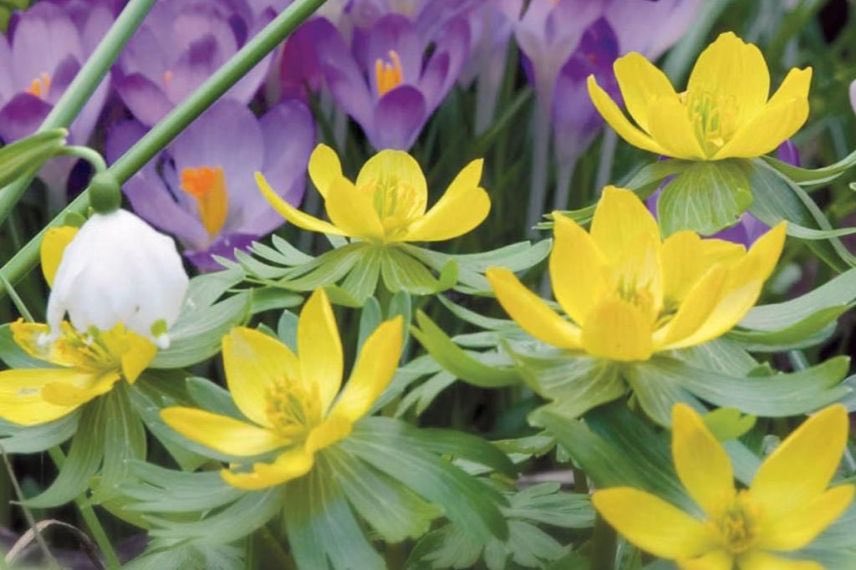
Eranthis cilicica
- Subscribe!
- Contents
Comments