





























7 Mahonias flowering in autumn
Our selection of early flowering Mahonias
Contents
The yellow flowering clusters of Mahonia are a ray of sunshine in the garden from November. Some varieties even bloom earlier, as soon as early autumn, or even late summer. This somewhat retro bush is making a comeback in gardens for its great ornamental qualities, thanks to its unusual foliage made up of large, glossy, thorny leaves… or all light with new cultivars available on the market. Mahonia also proves to be a valuable melliferous bush at a time when the garden begins to shed its flowers.
Hardy, evergreen, tolerant of various exposures, able to withstand urban environments, and slightly fragrant, it has everything to charm gardeners. We present the most beautiful varieties of Mahonia with autumn flowering. Fall under its spell and give it all the space it deserves in your garden!

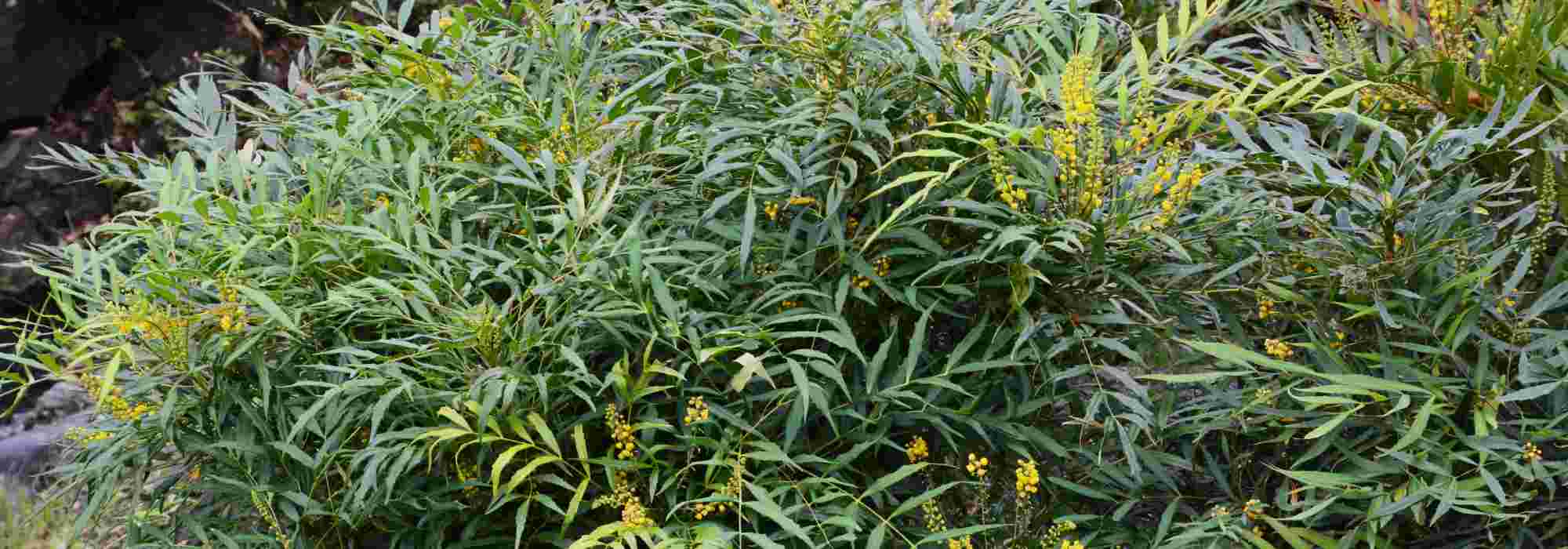
Mahonia eurybracteata 'Soft Caress'
The Mahonia eurybracteata ‘Soft Caress’ is starting to make a name for itself among Mahonias! It appeared in garden centres about ten years ago. It is very different from the image one might have of this bush, as its foliage resembles that of a fern, slender, soft, and very light. This species of Mahonia eurybracteata, also known as Mahonia confusa ‘Soft Caress’, flowers well in both shade and partial shade, producing lemon-yellow flowers in short spikes that rise from the centre of the leaves, typically between September and October. The foliage is a lovely olive green, slightly glaucous. As with other Mahonias, the flowering transforms into small bluish-black berries, edible once cooked, for example in jellies.
Its graceful habit, taking the form of a low, spreading bush (it measures just over 1 m tall), is exotic. With this unusual and graphic silhouette, it fits well in a contemporary garden. Its small size also allows it to fit into a garden bed or urban patio, as well as in a pot on a shaded terrace, sheltered from cold winds. ‘Soft Caress’ received the Plant of the Year award in 2013 from the RHS.
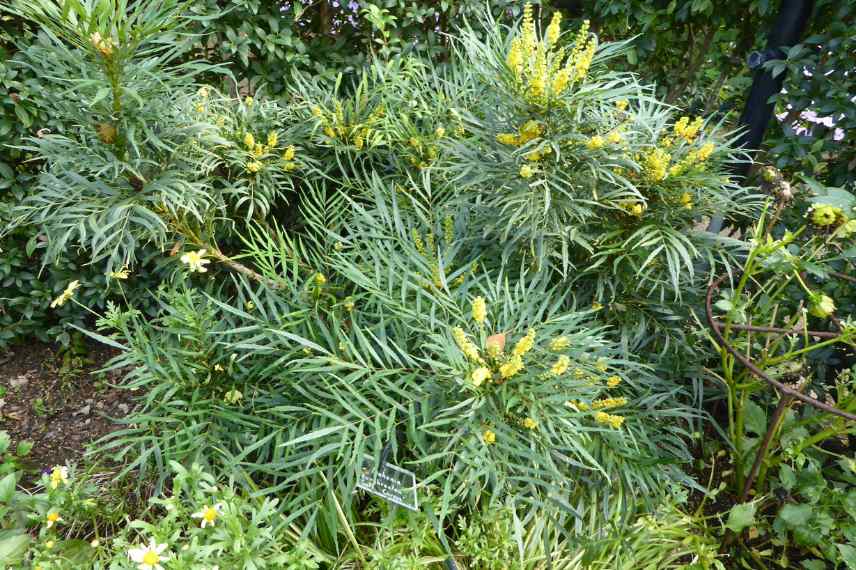
Mahonia eurybracteata ‘Soft Caress’ (© Gwenaëlle David Authier)
Read also
Mahonia : planting, pruning and careMahonia eurybracteata 'Narihira'
In the same vein as ‘Soft Caress’, also part of the Mahonia eurybractaeata, ‘Narihira’ (also known as ‘Nara Hiri’ or by the name Mahonia confusa), is another variety of Mahonia with a much less rigid habit than winter Mahonias. Its foliage of a beautiful, particularly glossy green gives it this flexibility, as it is also devoid of spines. This Japanese cultivar has a low habit (often a maximum of 1 m high) and a dense silhouette, reminiscent of a fern or certain bamboos. The flowering, appearing between October and November, is lemon yellow.
Full of exoticism, this Mahonia deserves a lovely spot in a shady or partially shaded border. As with other Mahonias, ensure that the substrate remains well-drained, as it cannot tolerate waterlogged soil in winter. This Mahonia has a rather slow shoot.
Discover other Late-flowering shrubs
View all →
Available in 1 sizes
Available in 2 sizes
Available in 1 sizes
Available in 1 sizes
Available in 1 sizes
Available in 1 sizes
Available in 2 sizes
Available in 1 sizes
Available in 1 sizes
Available in 1 sizes
Mahonia eurybracteata 'Sweet Winter'®
Here is another autumn-flowering Mahonia: Mahonia eurybracteata ‘Sweet Winter’. This new variety from 2005 resembles Mahonia ‘Soft Caress’, but its leaves, just as soft, are slightly wider. They are also more deeply lobed on their margin. This Mahonia flowers well in autumn, contrary to what its small name might suggest: it brightens up the shaded corners of the garden with its vibrant clusters of yellow flowers from November onwards. With a modest height, as it will not exceed 1 m in spread, it serves as a small focal point on a terrace, in a pot, and also in a small garden with cool soil, where its evergreen and elegant foliage will enhance other mid-shade flowers or foliage throughout the year.
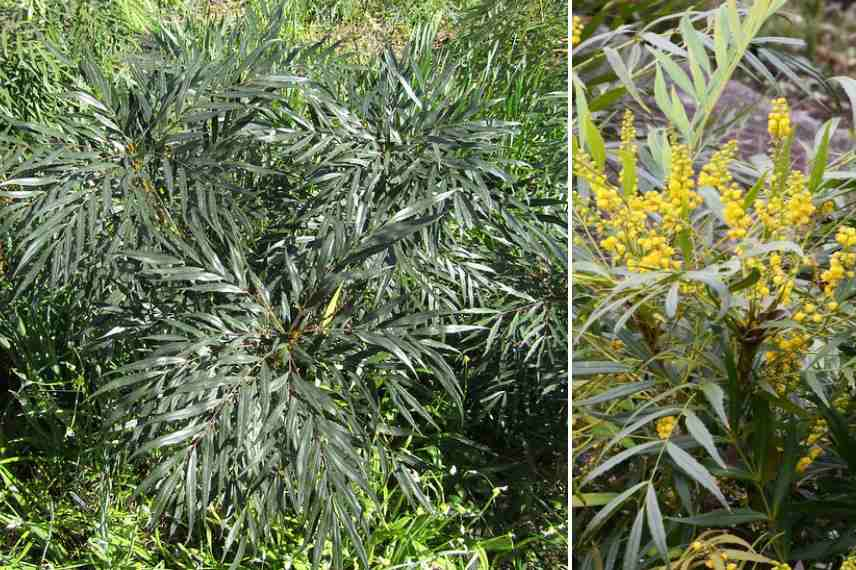
Mahonia ‘Sweet Winter’ (© Leonora Enking)
Read also
Mahonia: 7 companion planting ideasMahonia 'Cabaret' and 'Volcano'
Among the early-flowering Mahonias, there is also a hybrid, Mahonia x nitens, of Chinese origin. It is distinguished by a darker flowering, with reddish-orange buds, evolving as the flowers open into a yellow-orange, almost coppery colour. This rare colour among Mahonias gives it all its autumnal brilliance! It also flowers from late summer to early autumn. Its leaves, bronze at the bud burst period and then a beautiful olive green, can take on a more or less red hue in winter due to the cold.
The variety ‘Cabaret’ reaches about 1.50 m in height at maturity, while ‘Volcano’ is slightly more compact, generally not exceeding 1 m. These two varieties are distinguished by their foliage: fine and non-spiny in ‘Volcano’, it is spiny, resembling that of holly, in ‘Cabaret’.
They also adapt to any soil, ideally acidic, and a shaded position, knowing that, like the others, they will flower a bit more in partial shade.
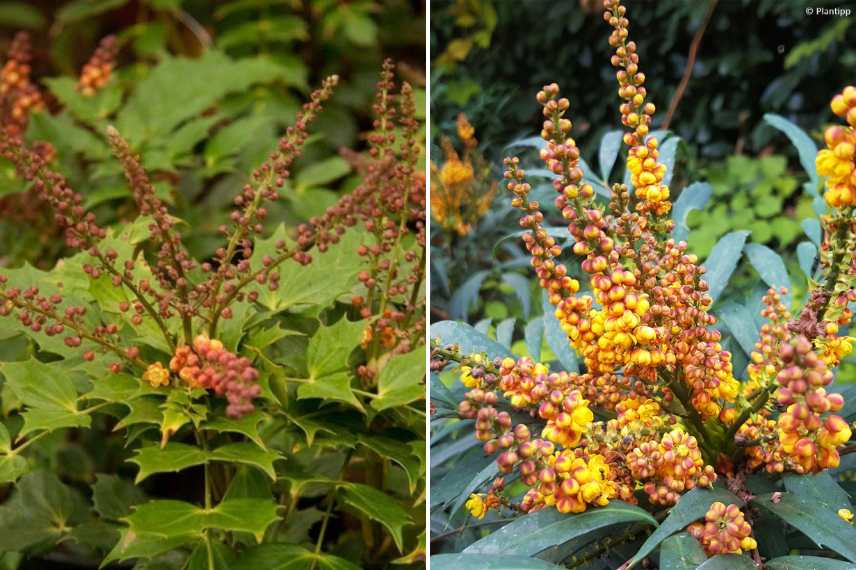
Mahonia nitens Cabaret and Volcano (© Plantipp)
Mahonia lomariifolia
Many Mahonia with leathery, spiky leaves are associated with winter flowering; however, depending on the region, the mildness of the climate, and the benefit of an extended Indian summer, many bloom as early as November. This is especially true if they are planted in a sunny position.
This is the case with Mahonia lomariifolia (or Mahonia oiwakensis, also known as Burmese Mahonia), which flowers in late autumn, around November. Growing between 2 and 3 m, it features bright yellow flowers in long racemes (forming clusters in bouquets) at the tips of the stems, which will turn into small bluish clusters throughout the winter. This Mahonia has particularly long leaves, up to 60 cm, composed of numerous leaflets, and beautifully arch as flowering progresses.
This Mahonia tolerates more sun than the previously mentioned Mahonias, but it will suffer from excessively hot sun. It will also require well-drained soil.
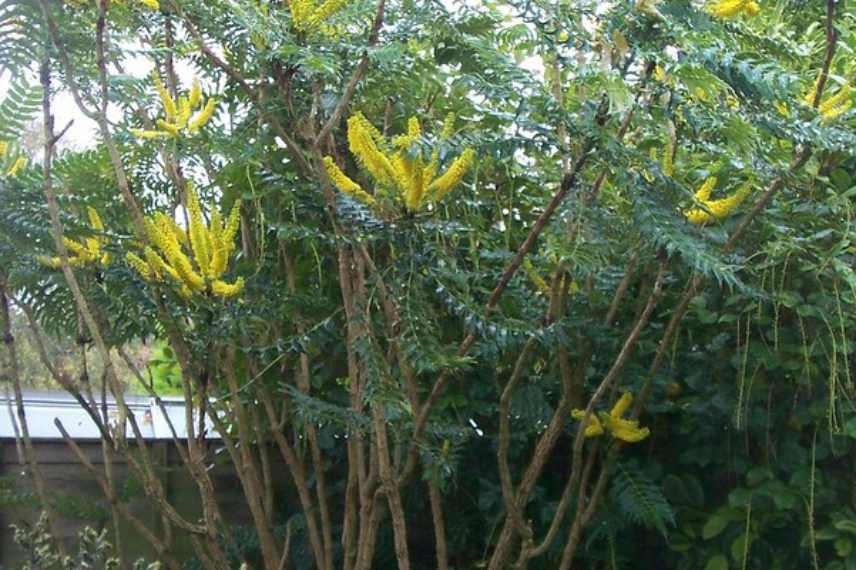
Mahonia lomariifolia (© Leonora Enking)
Mahonia gracilipes
With its beautiful glaucous green leaves, composed of 7 to 9 oblong leaflets, the Mahonia gracilipes is still rarely seen and marketed. Native to China, it is also one of the species of Mahonia that flowers in autumn, sometimes even in late summer, often between September and October. Its flowers are very small and atypical as they have the unique characteristic of being bicoloured, with red petals and a bright yellow centre. They will also turn into small, glaucous blue berries. Another characteristic of this species lies in its leaves, which have a silvery white underside. It withstands temperatures down to -15°C and will suit a Mahonia enthusiast looking to complete a collection of rare specimens!
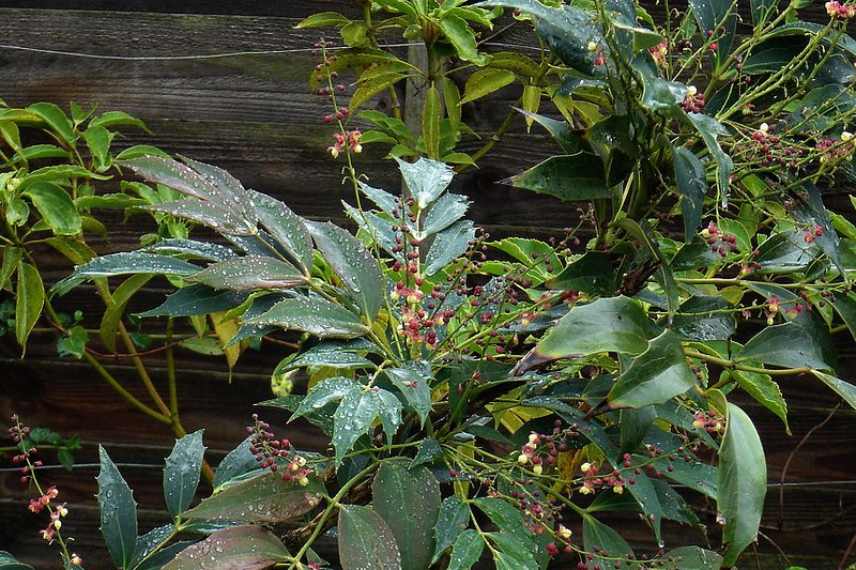
Mahonia gracilipes at the end of flowering in November (© Peganum)
Mahonia russellii
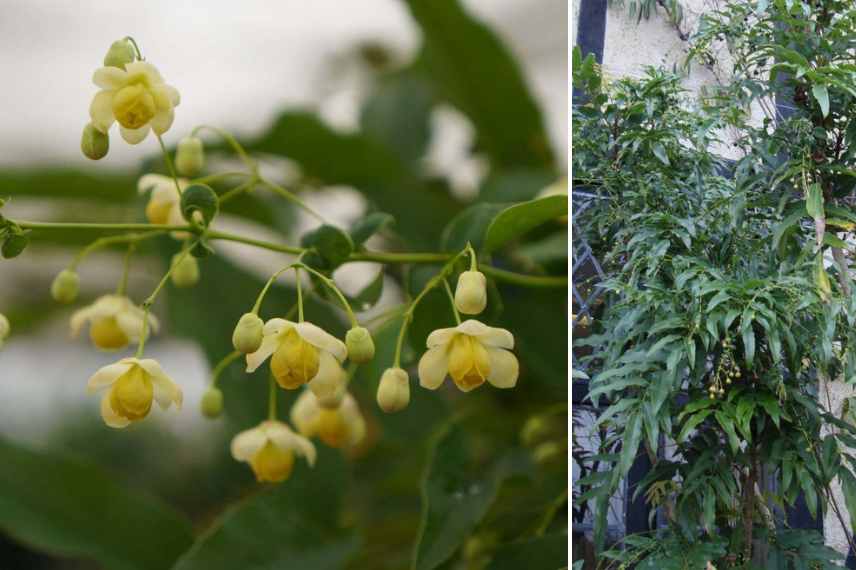
Here is finally a Mahonia that comes from across the Atlantic, specifically from Mexico, where James Russell, in charge of the plant collection at Howard Castle in England, discovered it in 1984: the Mahonia russellii, also known as Russell’s Mahonia. Still rare in our region, it deserves our attention for its ability to often flower again in October, while its main flowering occurs in March. Much larger than the Mahonias in this selection, it will grow, quite slowly, up to 3 m tall with a lesser spread of 1.50 m.
Its inflorescences are quite different from other Mahonias: of a paler yellow, almost cream, they are trailing, in much lighter clusters. Its leaves are flexible and fairly large, slightly leathery and finely dentate.
This large bush presents a beautiful originality with its bushy habit and will enhance a hedge or a shrub border in the shade. Despite its origins, it has good hardiness down to -10°C.
Mahonia russellii
- Subscribe!
- Contents
Comments