





























7 pink-flowered water irises to brighten wet areas
A colour that will suit these delicate irises
Contents
Our Water Iris category groups together species that grow in moist soil, on the banks, or submerged under a maximum of 10 to 20 cm of water. Among them, the water irises with pink flowers bring a touch of softness and elegance to aquatic gardens and damp areas. In this care guide, we invite you to explore seven exceptional varieties of iris from Japan or Siberia, each bearing delicate pink hues that suit them beautifully. To create a romantic corner or to liven up the banks of your pond, these irises will offer you a beautiful floral display. Discover the unique characteristics of each variety and practical tips for growing them successfully in your garden.

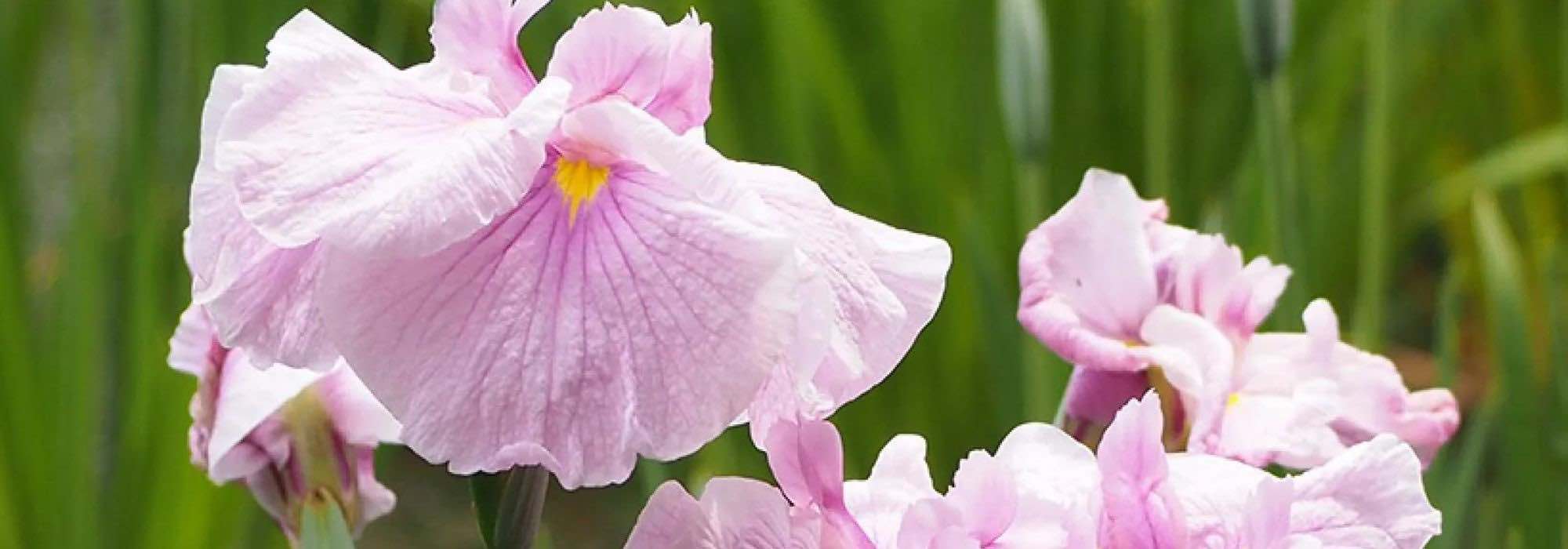
Japanese iris - Iris ensata 'Rose Queen'
Iris ensata ‘Rose Queen’ is a small jewel of riverbanks whose large flowers, in two shades of lavender and bright pink, are accented by a golden signal at the base of each petal.
‘Rose Queen’ grows to a height of 80 cm in flowering, with ribbon-like mid-green foliage reaching about 60 cm. From June to August, its 12–15 cm diameter flowers, comprising pendulous sepals and petals, brighten the garden for about three weeks. Each flower is also adorned with small petaloid styles standing erect from the centre.
Iris ensata differ markedly from ordinary garden irises. Originating from damp areas of Asia, including Japan, the Himalayas and Siberia, they require acidic, peat-rich, heavy soils and are very water-loving during their growth and flowering period. They, however, tolerate slightly drier conditions in winter. Ideal for pond margins and the edges of basins, Japanese irises can tolerate partial immersion in summer, but their rootstocks do not tolerate stagnant water in winter, especially in colder climates. In your garden, plant them in soil enriched with potting compost that stays cool during the summer.
Pair the Darmera peltata and some astilbes for example.

Read also
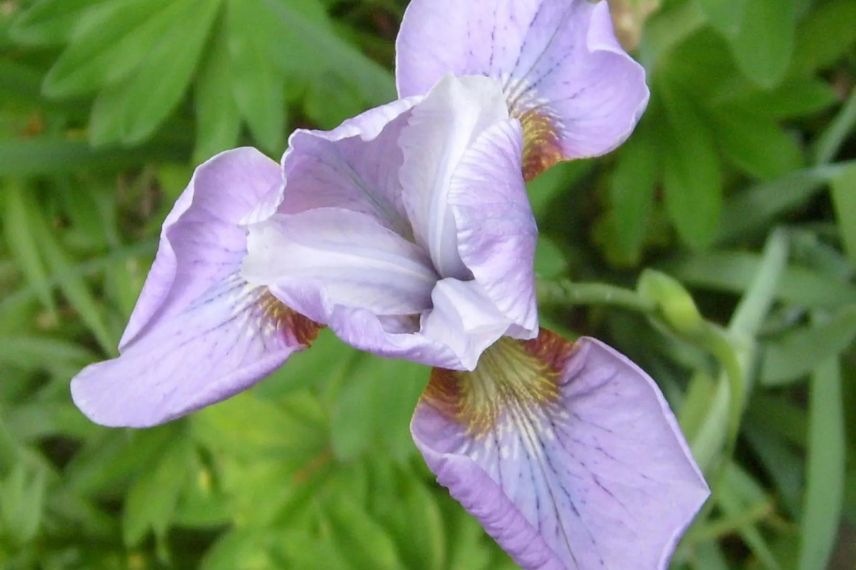
Japanese iris: to grow and care forSiberian Iris - Iris sibirica 'Rikugi Sakura'
Iris sibirica ‘Rikugi Sakura’ is a Japanese variety with large six-petalled, pendulous flowers, reminiscent of the form of Iris ensata. Delicately tinted with pale lavender-pink and marked with brown-green at the base, they add a touch of grace to the spring garden. The bold, architectural foliage, in bright green, forms a tall, slender tuft that remains attractive for several months. Ideal for damp, sunny banks, this plant adapts well to well-prepared garden soil that does not dry out in summer.
Honourable Mention in 1992, ‘Rikugi Sakura’ reaches about 60 cm in height and spreads 50 cm, with slower growth than Iris germanica. In May–June, the flowering stems, 80–90 cm tall, bear flowers 10 cm in diameter. It tolerates sun well, but a partly shaded position will prolong its flowering. Although it is hardy to cold and damp, its rootstocks should not be submerged in winter. Plant it at the edge of a pond, avoiding flood-prone areas, or in a cool, damp border, in rich, moist and slightly acidic soil. Pair it, not too close to flood-prone areas, or in a consistently cool, damp border, with blue-leaved hostas and Japanese primroses, for example.
Japanese iris - Iris ensata 'Darling'
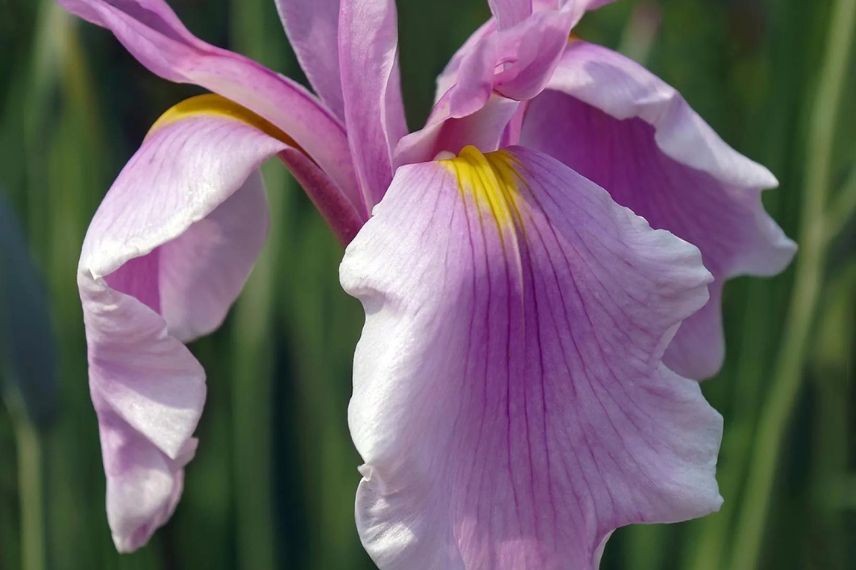
Iris ensata ‘Darling’ is a very elegant Japanese water iris variety, repeatedly awarded for its beauty. In summer, this plant bears very large flowers of a lovely soft pink, slightly lilac, fairly uniform, though veined with deeper pink, adorned with a small bright yellow signal at the base of each petal. Its flowers are sometimes described as double due to the bouquet of petaloid styles and smaller, upright petals that ornament their centre.
The cultivar ‘Darling’ forms an upright clump about 90 cm tall when in bloom, and 50–60 cm wide. Its deciduous foliage, a medium green, consists of long, strap-shaped leaves with a prominent central vein. From May to August, flowering stems emerge from the leaf clumps, bearing 2–3 large flowers of 15 cm in diameter.
Japanese water iris - Iris laevigata 'Rose Queen'
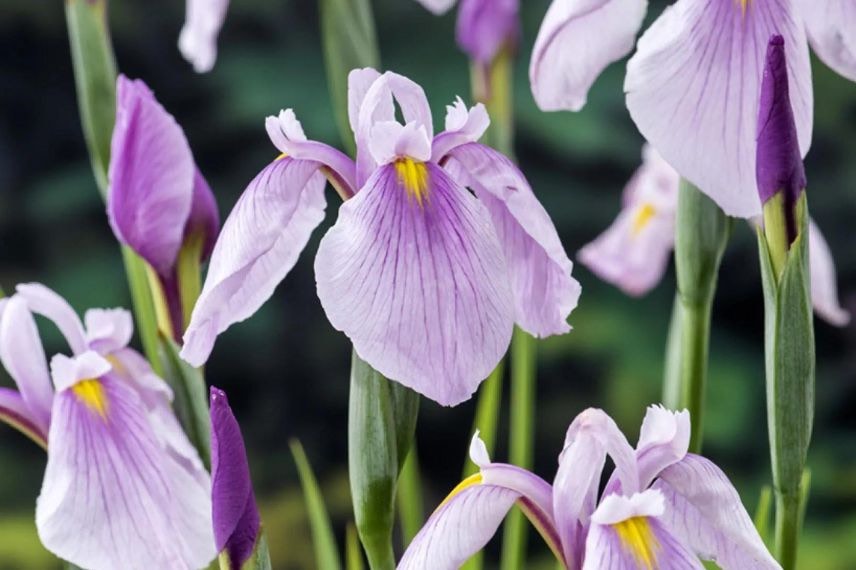
Same cultivar name as the first iris in our selection, but this time for a more aquatic species. Iris laevigata ‘Rose Queen’ is appreciated for the delicate soft lilac-pink hue of its flowers, which pairs perfectly with their graceful form. In spring, this variety forms dense tufts of bright green foliage, a touch stiff, which set the stage for the summer flowering of the blooms. In July and August, from dark violet buds, it bears splendid flowers with erect and drooping petals, in a soft colour, accentuated by deeper veins and a yellow marking.
Originating in Japan, this iris is particularly prized for its hardiness and its ability to thrive with its roots in water year-round, unlike Iris ensata. Iris laevigata offers flowers of smaller size than the Iris ensata, but of great finesse.
‘Rose Queen’ grows in dense tufts, reaching 50 to 80 cm in height. Its flowering, which extends from June to August depending on climate conditions, features flowers of 8 cm in diameter, each sepal bearing a yellow crest on a more pronounced violet background. The linear, deciduous leaves are bright green, adding a graphic texture to the garden.
Iris laevigata ‘Rose Queen’ thrives in full sun on rich, consistently damp clay soil, lime-free. It is ideal for pond margins or planted in large groups in submerged pots. With aquatic plants such as Caltha palustris or other water irises, it creates a harmonious visual display.
Siberian iris - Iris sibirica 'Imperial Opal'
Iris sibirica ‘Imperial Opal’ is an enchanting variety of Siberian iris, recognised for its double flowers in a unique colour, blending shades of pink and lavender mauve. These exquisite flowers, finely veined and speckled, unfurl in spring and dominate a dense, erect clump of foliage that remains attractive for many months. Appreciated for its elegant flowers and structured foliage, this hardy and adaptable iris thrives in moist soils and romantic or English-style gardens.
‘Imperial Opal’, in full bloom, can reach around 90 cm in height, with foliage 50–60 cm tall and a similar spread. The grey-green foliage supports flowering stems bearing a profusion of petals from early summer.
Perfect for damp areas or pond margins, ‘Imperial Opal’ can be harmoniously paired with camassias, and daylilies.
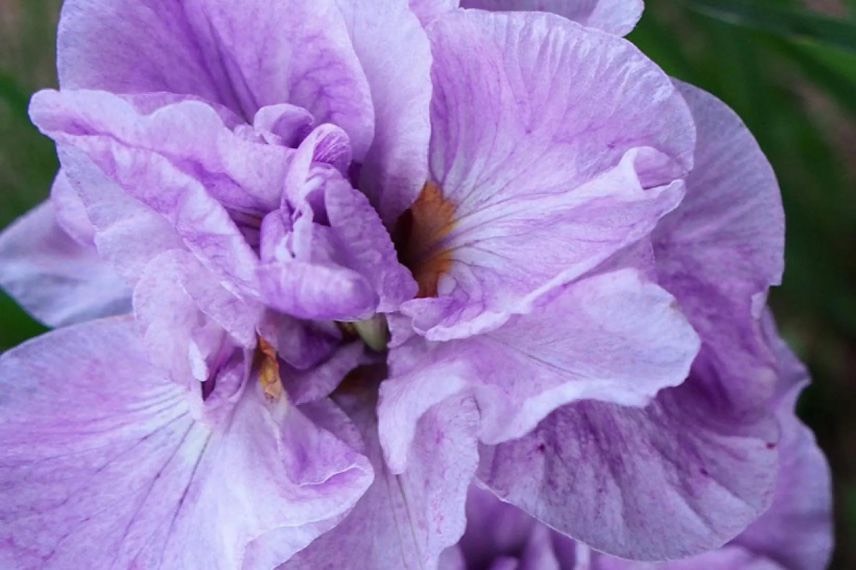
Japanese iris - Iris ensata Dinner Plate 'Tub Tim Grob'
Splendid Japanese water iris, the Iris ensataDinner Plate ‘Tub Tim Grob’ stands out for its impressive, large, double, flat flowers bearing a soft pastel pink. This floral jewel blooms in midsummer, from June to July, adding a delicate touch to cool, damp gardens.
Belonging to the Dinner Plate series, known for its exceptionally large flowers of 15 cm in diameter, ‘Tub Tim Grob’ forms a dense clump of green, structured foliage, reaching about 60 cm tall when flowering. It offers a striking contrast between its pale lavender-pink petals, veined with purplish pink, and the bright yellow markings at their centres.
Iris ensata, like ‘Tub Tim Grob’, unlike the more commonly grown garden iris, thrives in non-calcareous, moist soils, ideal for waterlogged areas such as banks along the water during the warm season, while requiring less wet and well-drained soil in winter to prevent the rhizomes from freezing. For a charming garden display, pair it with other Dinner Plate varieties, as well as plants such as Anemone rivularis, the Darmera peltata.
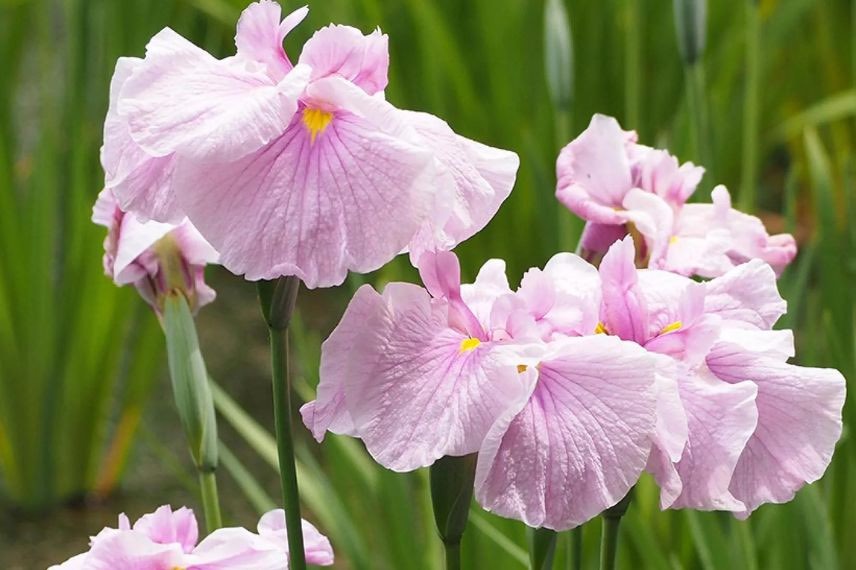
Japanese water iris - Iris laevigata 'Queen Victoria'
Iris laevigata ‘Queen Victoria’ is a charming variety that bears beautiful pale lilac-pink flowers. Flowering in spring or early summer, its tall flower spikes rise above clumps of bright green, dense and slightly stiff foliage. Its delicate flowers, with three upright petals surmounting three broader, trailing petals, make this hardy perennial an ideal choice for beautifying pond banks or for planting in areas where the water is shallow.
‘Queen Victoria’ is particularly prized for its ease of cultivation, tolerating well the complete immersion of its rootstocks year-round. It forms from spring a dense, linear tuft that can reach 50–80 cm in height when flowering, spreading over time with no practical limit. Its flowering period generally extends from May to July, depending on climate. Each flowering spike can bear two to four flowers, each measuring about 8 cm in diameter.
Planted in full sun in clay soil, but without lime, Iris laevigata ‘Queen Victoria’ lends itself well to mass planting on pond banks or even in large submerged pots. It harmonises well with other aquatic plants such as Caltha palustris or the Euphorbia palustris which echo its yellow or chartreuse tones.
- Subscribe!
- Contents
Comments