





























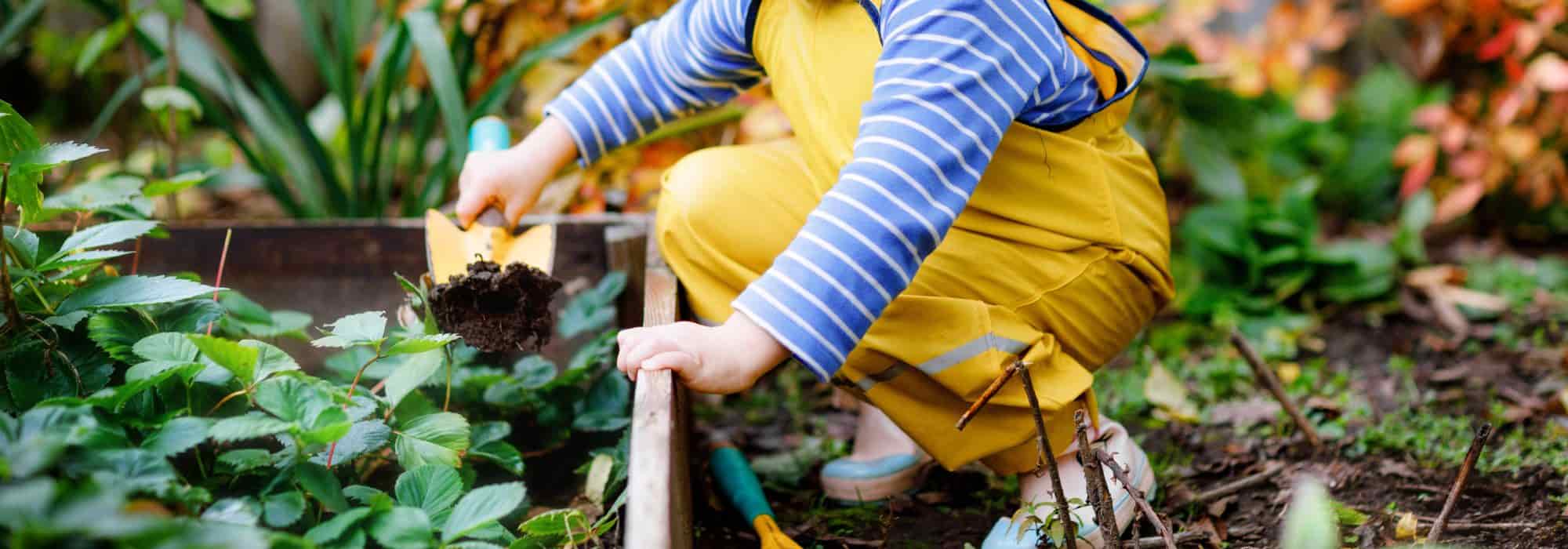
7 tips for starting a garden with children
Learn and share the passion for gardening while having fun.
Contents
If you enjoy spending time gardening with your hands in the soil, you likely want to share your passion with your children or grandchildren. This is even truer if you also experienced your childhood in the garden. Perhaps a family member passed on their knowledge to you when you were young? Moreover, children are just waiting for the chance: to dig in the soil with their little hands, observe insects, and taste with their eyes, as well as with their mouths the fruits and vegetables from the vegetable garden (and sometimes even the lawn or soil against our wishes). But how can you playfully pass on your knowledge? Where should you start?
Discover our tips and tricks for starting a garden with children!
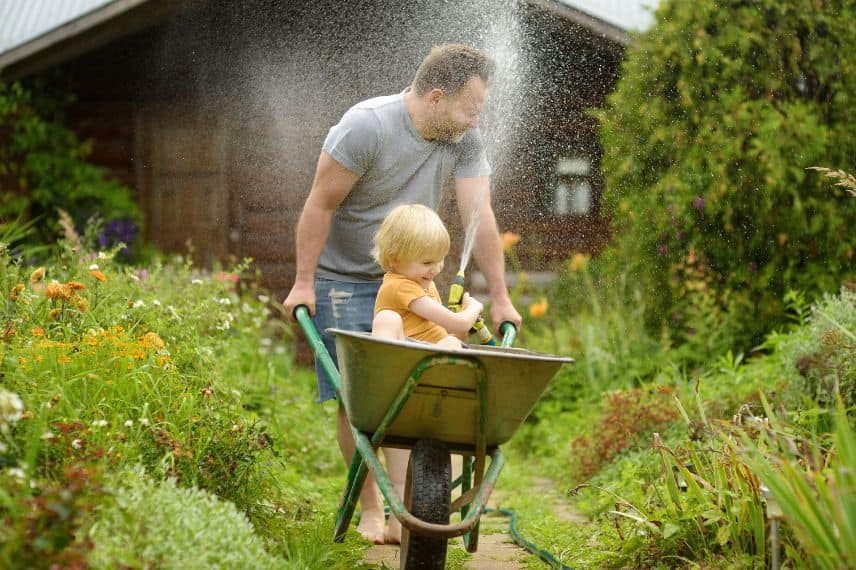
Gardening with children should primarily be fun
Create a space for your child
To start, create a small space in the garden for your child, where they can experiment with gardening. This will prevent them from digging holes wherever they please, including in the middle of your salad rows or in a bed of petunias. Depending on their age, involve them as much as possible in its construction and explain that this is THEIR garden. You will then see their face light up, suddenly thrilled by this new responsibility.
You can, for example, define their little garden with wooden planks or with a border made of woven branches. The space should be small enough to avoid overwhelming them and discouraging your child too quickly. I suggest starting with a square of 1 m by 1 m, then expanding it if needed or as your little one grows.
You can also dedicate other small spaces in the garden for them, such as a bean teepee or a willow hut.
→ Discover more examples of borders to create in the garden
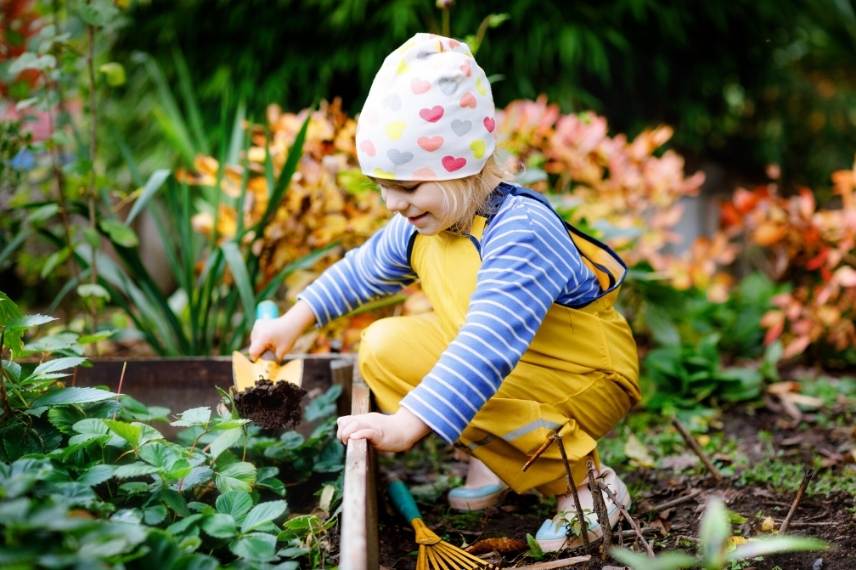
A child and their little garden corner
The right equipment
Gardening should primarily be a pleasure! So, accept that your child will likely end up covered in soil from head to toe. Dress them in suitable clothing, preferably soft, comfortable, and not afraid of stains. You might also equip them with boots and gardening gloves appropriate for their age. Touch is also part of their learning, so let them experience the feel of bare toes in the lawn.
Provide them with gardening tools suitable for their age. For toddlers, generally under the age of 3 to 4 years, plastic tools are preferable, as they are lighter and less dangerous to handle. This will give a second use to the bucket, watering can, and beach spade!
If your child is over 4 years old, you can gradually offer them “real” working tools (hoe, spade, rake, etc.) that are suitable for their size.
From 9-10 years old, you can proudly entrust them with your own gardening tools, perhaps with a small tear in your eye. After all, it’s not just the vegetables that grow quickly!
→ Discover our range of gardening tools for children
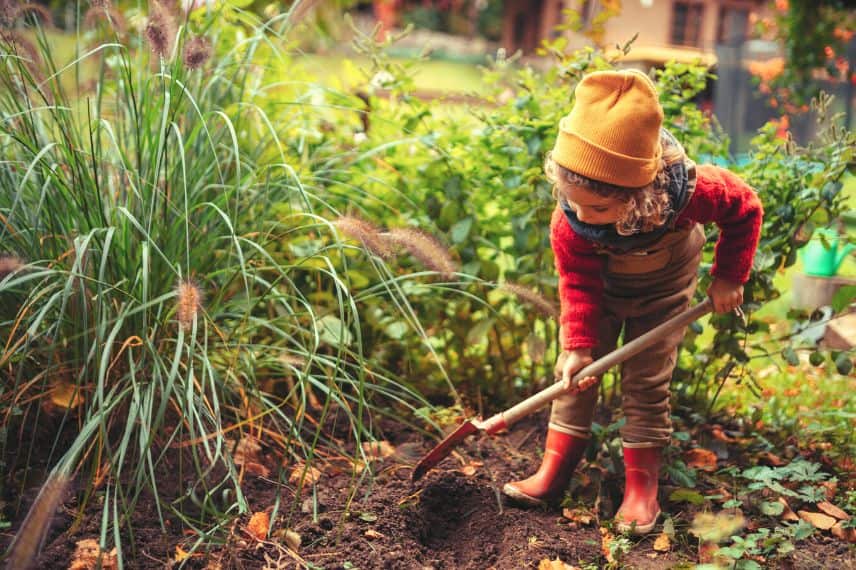
Boots, clothing, and a spade suitable for learning to garden well
Hold workshops
Involve your little gardener in every action you will teach them through small gardening workshops. Depending on their age, these workshops should be very short, as young children cannot focus their attention for more than fifteen minutes. And because even older children won’t enjoy turning over the lawn for an hour.
Explain these actions to your child. Why do we remove the lawn? Why do we need to water the plants? Why should I put my tools away? In short, share your knowledge with them! At this age, they are curious and eager to learn. Don’t hesitate to repeat the explanation of an action several times.
Make fun and creative workshops, such as building an insect hotel, creating a leaf mandala in autumn, painting terracotta pots, planting tomato plants, sowing seeds, making a herbarium, creating colourful labels for each plant variety, observing and discovering beneficial insects in the garden, etc. If you’re short on ideas, don’t hesitate to borrow books from the library! You will surely find several suitable for children about life in the garden, how plants work, nature activities, or the famous story of the very hungry caterpillar.
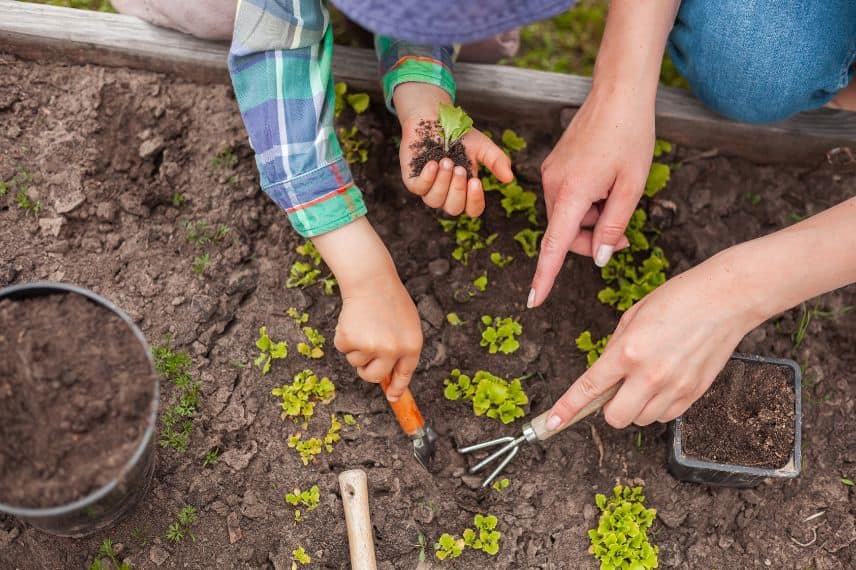
Workshop for thinning and replanting salads in the garden
Sowing fast-growing plants and vegetables
Handling seeds, sowing them, and being able to observe the growth of plants is a wonder for children. Through this experience, they learn the vegetative cycle of plants. However, children, especially the younger ones, often struggle to project themselves into the future. We will choose to sow annuals or fast-growing vegetables, either in pots or directly in the soil. For example, certain varieties of radishes can be harvested 21 days after sowing. We can also sow beans and peas directly in the soil or in pots. For annuals, we will choose seeds of edible flowers such as Calendula, nasturtium, marigolds, and sunflowers.
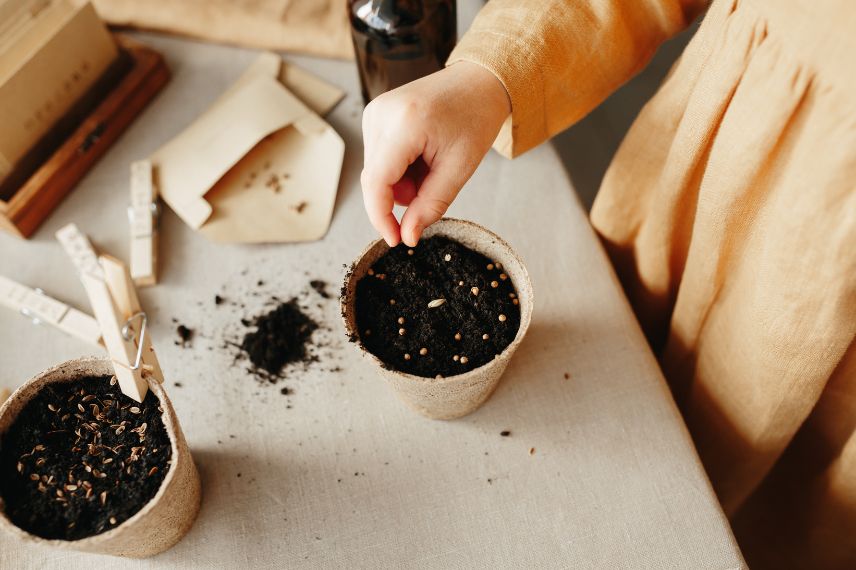
Easy and fast-growing seedlings for children
Observe the insects
Which child hasn’t been amazed by the flight of a butterfly? Observing insects is perfect for teaching your children the names of each of these little creatures. You could even create an insect hotel to admire them more closely. Depending on their age, you can teach them about the role of certain pollinators or beneficial insects, earthworms, their importance in the garden, and how to protect them. You can also teach them which insects are harmless and which should be avoided. This could even help some children overcome fears that are often unfounded. Don’t hesitate to ask your library for children’s books about ladybirds and other insects that inhabit your garden.
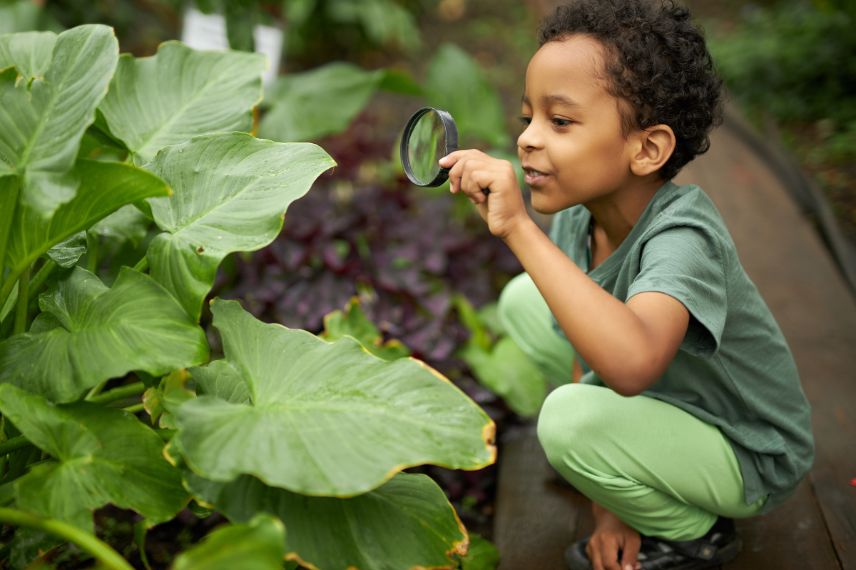
Observing insects can be exciting for children
Eat what you grow
After touching the soil, observing insects, sowing and waiting for seeds, it’s time to smell the aroma, then taste the fruits and vegetables from the garden. Accompany your child for their first harvest. Show them, for example, how to pick strawberries without (too much) squashing them or how to pull on the tops of radishes to lift them from the ground. Berries, such as raspberries or redcurrants, as well as cherry tomatoes, are generally easy to harvest independently. Teach them how to recognise a fruit or vegetable at ripeness. Then, show them how to clean the fruits from their harvest, before moving on to tasting and discovering flavours.
There are also many recipe ideas to make with children from the age of 6-7, such as raspberry jam or mint syrup, for example.
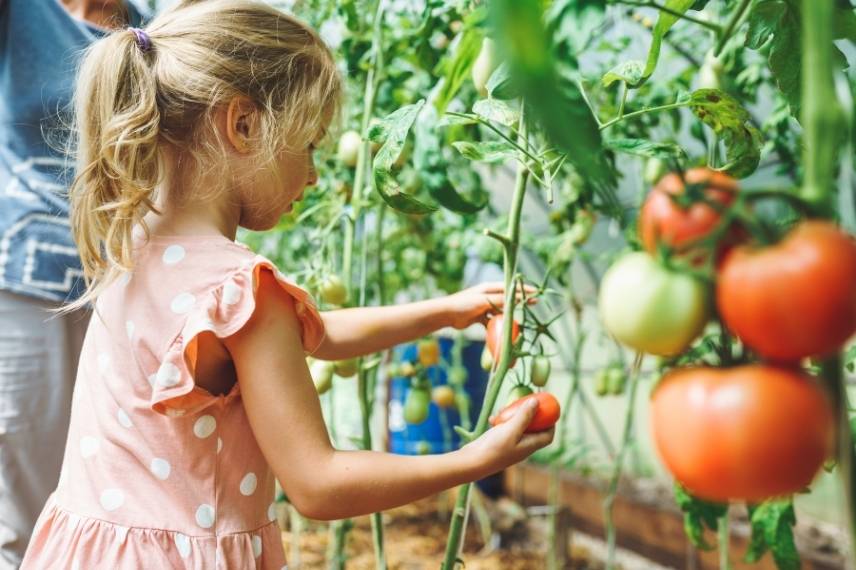
From harvest to plate, everything is a discovery for children
Don't forget the safety rules.
Here, you can proudly watch your offspring discover nature and experience gardening. However, some safety rules seem essential to avoid unfortunate little accidents:
- Never leave young children unsupervised in the garden.
- Explain to your children that some tools should be handled gently to avoid injury.
- Set some rules with them: where they are allowed to walk, what they can touch and pick.
- Be cautious if you have any fruit bushes or toxic perennials. Especially if your child is allowed to pick and consume certain edible fruits in the garden. You can either remove (or give away) the nasty plant or its fruits, isolate it by installing a fence, or warn your child to raise their awareness of the risk. Also, remember that very young children, under 6 years old, do not understand negation. For example, do not say: “don’t eat that, it’s toxic,” as the child will remember the word “eat,” but rather say “this plant is dangerous and can hurt you.” Of course, you should adapt your speech according to their age.
- Define and secure ponds.
- Keep chemicals and fertilisers out of reach of little ones.
- Subscribe!
- Contents
![[start_garden_with_kids]](https://en.promessedefleurs.eu/blogwp/wp-content/uploads/2022/09/demarrer-un-jardin-avec-les-enfants.jpg "[start_garden_with_kids]")
Comments