





























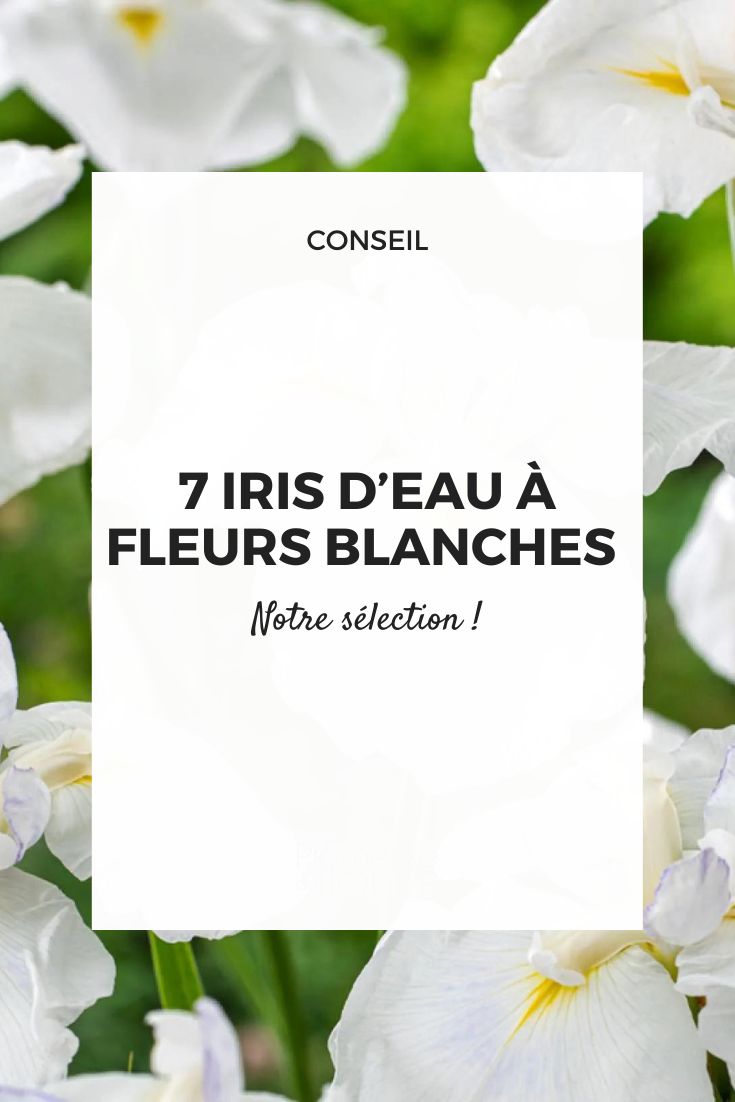
7 white-flowered water irises to brighten banks or moist soils
Our selection
Contents

Japanese iris – Iris ensata Dinner Plate 'Cupcake'
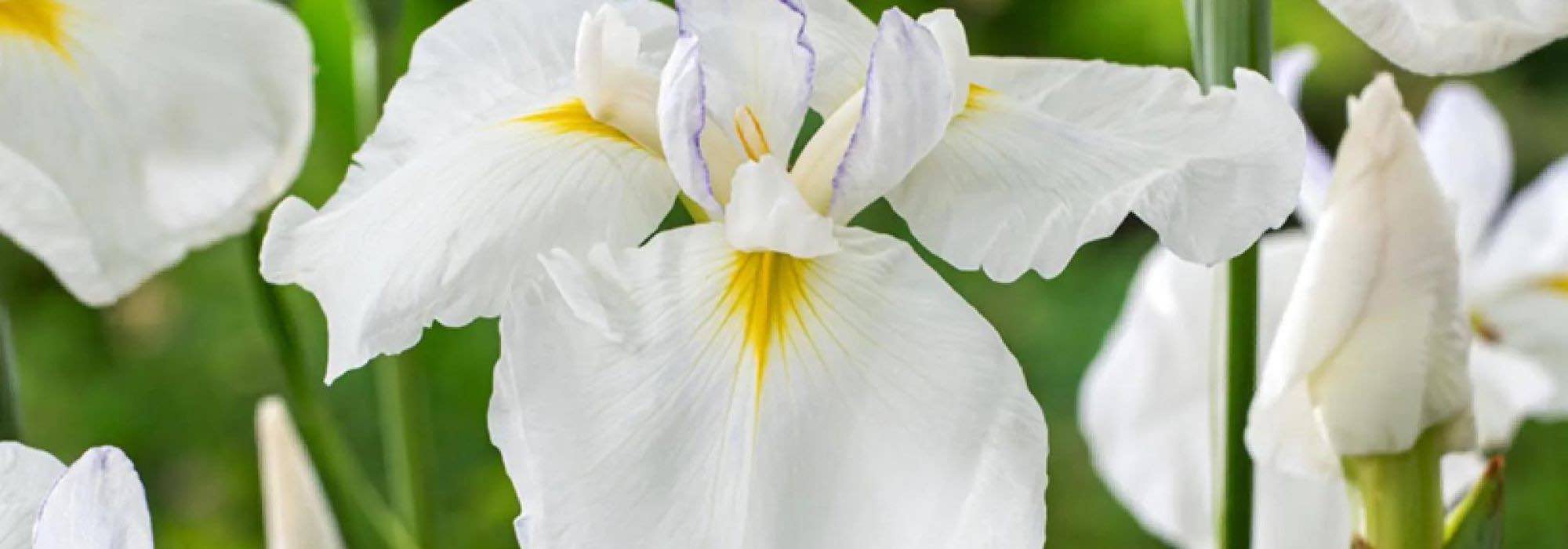
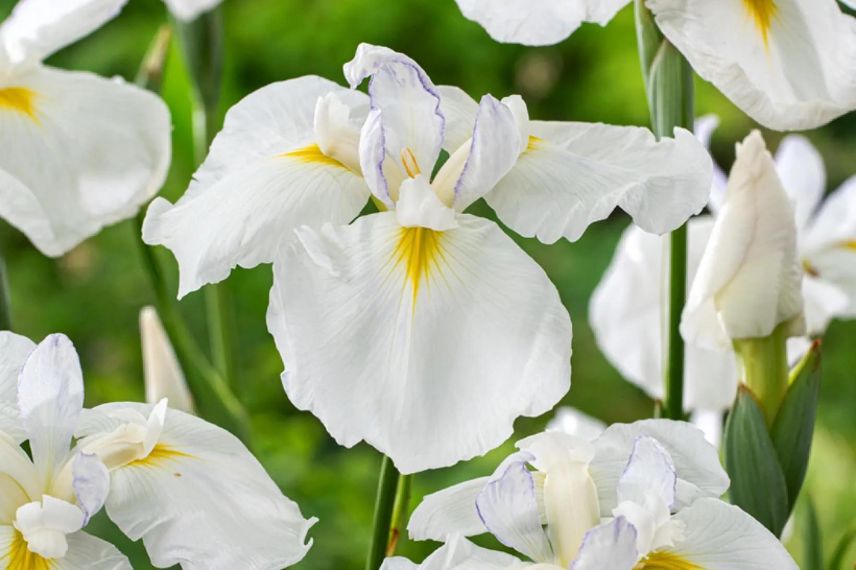
Iris ensata Dinner Plate ‘Cupcake’ is part of a series of very large plate flowers, 15 cm in diameter, dessert-plate sized! The flowers ripple gently in milky-white with a hint of violet-tinged pink on the central petals and accents of bright yellow to chartreuse. Flowering between May and June, this variety grows in non-calcareous soils that stay cool even in summer.
Originating from Asian wetlands, from Japan to the Himalayas via Siberia, Japanese irises prefer acidic and peaty soils, thriving with regular watering during their active growth period and preferring slightly drier soil in winter.
‘Cupcake’ is a relatively recent horticultural introduction that stands out for its exceptionally large flowers. This plant reaches about 60 cm in height when in bloom, with a spread of 50 cm. Its deciduous foliage of a mid-green consists of long strap-like leaves that disappear in winter. Each flowering stem bears 2 to 3 flowers with flattened, undulated sepals topped by slightly smaller petals and erect styles. At the heart of the flowers, bright yellow markings illuminate the whole.
Iris ensata, perfect for riverbanks, can be slightly submerged during summer, but their rootstocks do not tolerate winter immersion well, especially in freezing weather. ‘Cupcake’ pairs well with Anemone rivularis or with astilbes, for example.
Read also
Japanese iris: to grow and care forJapanese water iris - Iris laevigata 'Snowdrift'
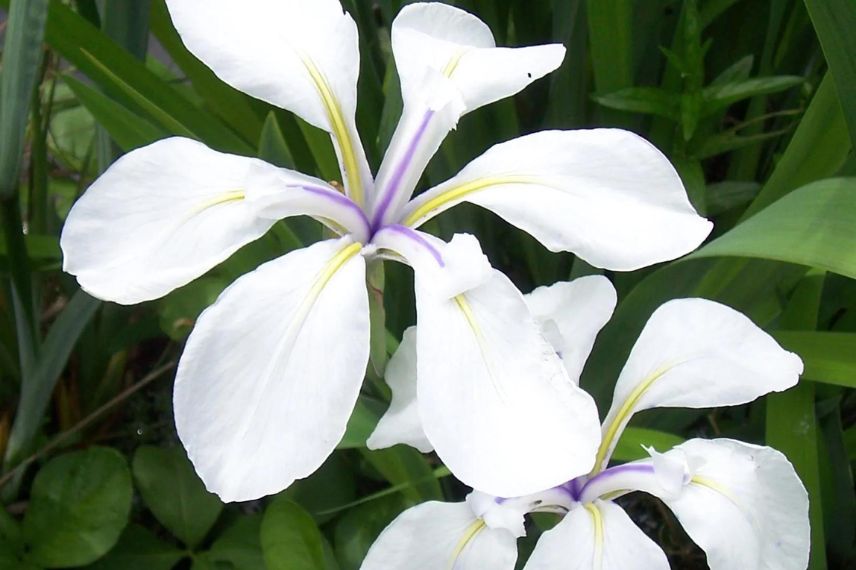
Iris laevigata ‘Snowdrift’ stands out for its flowers of immaculate white, marked with violet and yellow, which bloom on sturdy flowering stems in summer. The petals are very fine at the base and then widen into a spoon-shaped form. This Japanese iris, with a slender habit and sword-shaped leaves, thrives particularly in well-irrigated areas and at the edges of water features where it can even be partially submerged.
Originating from East Asia, notably Japan, l’Iris laevigata prospères in full sun or light shade, provided it has a consistently cool and moist soil. This plant is particularly suited to life along the edge of ponds or streams, where it can even be grown with an immersion of 10 cm.
Growth of ‘Snowdrift’ generally reaches 80 cm in height, making it an excellent choice for adding verticality to the garden. It prefers soils rich in organic matter with a slightly acidic pH.
Iris laevigata ‘Snowdrift’ is capable of bringing brightness and elegance to any wet area. Pair it, for example, with Lobelia cardinalis for a striking contrast.
Marsh iris - Iris pseudacorus 'Crème de la Crème'
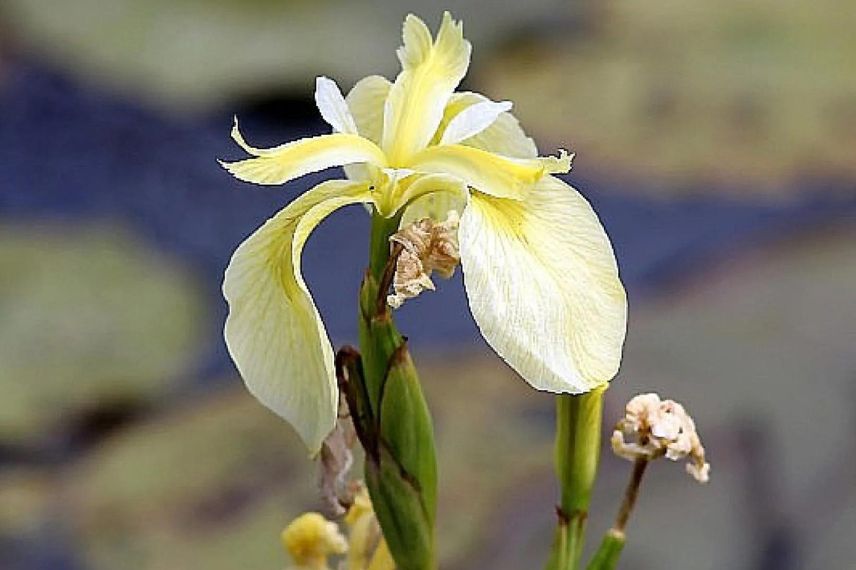
Iris pseudacorus ‘Crème de la Crème‘ offers creamy-white flowers with pale yellow speckles, lightly edged with purple. Iris pseudacorus is a marsh iris that grows in submerged conditions year-round or at least in waterlogged ground, where it can stabilise the banks of water bodies or be used in lagooning for its purifying properties.
The type species is widespread in marshes and very wet habitats across Europe, North Africa and the Middle East. From spring, ‘Crème de la Crème’ develops a tuft of narrow, upright leaves, reaching 50 to 60 cm in height, with sword-shaped leaves measuring 1 to 3 cm wide. Flowering occurs from May to July depending on climate. Cylindrical flowering stems of 90 cm rise from the clump, bearing 2 to 3 flowers. Each flower comprises three large reflexed sepals surrounding three small narrow upright petals and three large petaloid stigmas in the shape of a crest. The foliage persists through winter.
‘Crème de la Crème’ stands out for its hardiness and great adaptability. It thrives in semi-aquatic medium, whether on a bank or in a damp ditch. In full sun, it pairs well with other marsh irises, Typha, and Salicaria.
Read also
How to plant and care for water irises?Siberian iris - Iris sibirica 'Not Quite White'
Iris sibirica ‘Not Quite White’ reveals, at the end of spring, subtly veiled and veined with pale lavender on a white background. Hardy and adaptable, Siberian irises thrive in well-prepared garden soil, provided they stay fairly cool in summer. Ideal around water features, as long as the rootstocks are not submerged in winter, they fit perfectly in romantic-style gardens as well as more contemporary ones.
In bloom, this iris reaches 80 cm, with foliage 45 cm high and a clump spreading to about 50 cm. Its growth is moderate, slower than that of Iris germanica. ‘Not Quite White’ develops foliage consisting of long, narrow leaves in a slightly grey-green.
From May to June, the flowering stems rise above the foliage, bearing solitary flowers of 12 cm, each with 3 sepals and 3 petals, appearing successively from the tip of the stem to the lower branching. This iris spreads by rootstocks, and its foliage dies back in winter.
The Siberian iris ‘Not Quite White’ is indispensable around the edge of a water feature or a stream, or simply in very damp or moisture-retentive soil. It can be paired in damp ground with plants such as Hemerocallis and delphiniums, for example.
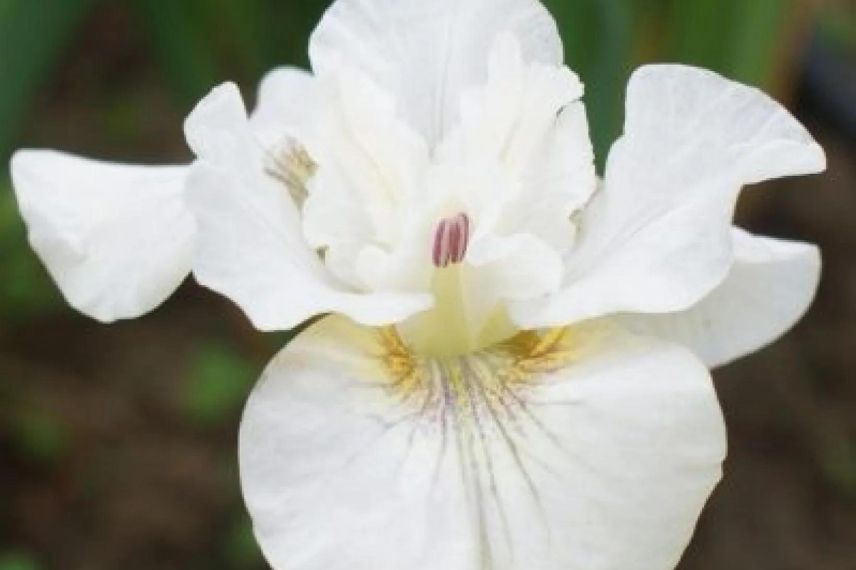
Siberian iris - Iris sibirica 'Moon Silk'
Iris sibirica ‘Moon Silk’ offers delicate, yet refined flowers of pure white, punctuated at the centre by a touch of slightly chartreuse yellow.
The outer, drooping sepals are the same yellow, a touch of gold and a touch of green. Like other Siberian irises, this variety prefers rich, moist soils.
Although it tolerates full sun, its flowers will retain their splendour longer in shade.
‘Moon Silk’ offers three weeks of flowering from May to June, with flowers measuring up to 10 cm in diameter, smaller and often more colourful than those of the Japanese iris. The flowering stems rise proudly to 70 cm and bear flowers above a fine, dense foliage reaching 60 cm.
Hardy and resistant to cold as well as humidity, Iris sibirica ‘Moon Silk’ shares with its Japanese cousin a dislike of winter waterlogging. It is best planted along a pond border, away from areas prone to flooding, or in borders that remain cool and moist, even in summer.
‘Moon Silk’ pairs perfectly with hostas, Japanese primroses and Japanese irises, creating elegant displays in shaded, moist gardens.
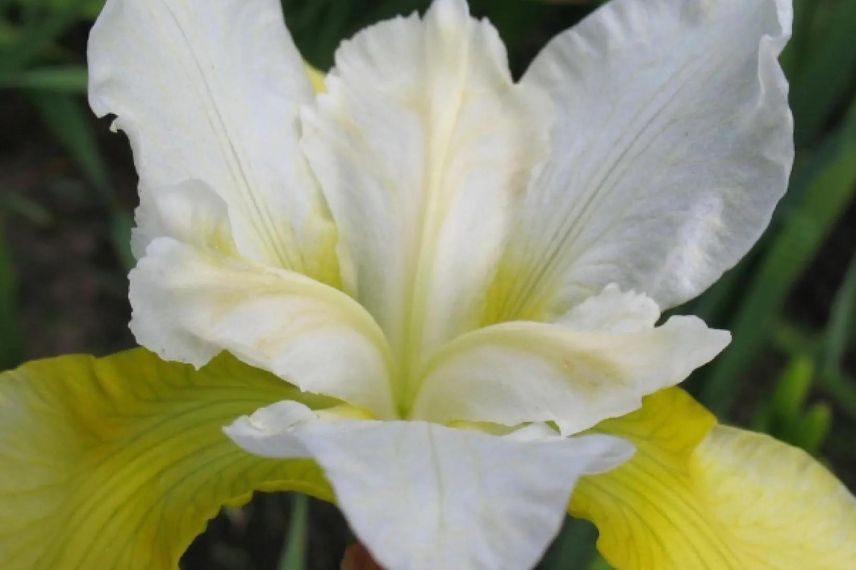
Japanese iris - Iris ensata 'Diamant'
Iris ensata ‘Diamant’ captures attention with its vibrant, flat flowers in immaculate white, accented by a discreet yellow maculation. This Japanese water iris variety combines elegance and brightness, markedly different from traditional garden irises by its preference for non-calcareous soils that stay constantly damp during the summer. This iris is particularly spectacular when planted in mass along banks or in damp areas.
The cultivar ‘Diamant’ forms a robust, upright clump, reaching about 80 cm tall in bloom and 40 cm across. With its deciduous foliage of a medium green and its long, slender, ribbon-like leaves, the plant gradually expands via its rootstock. From June to July, it flowers for three consecutive weeks. The flowering stems bear 2 to 3 large flowers of 12 cm in diameter, each adorned with three large, flattened outer sepals and three smaller petals, all topped by a bright yellow signal.
For successful cultivation in the garden, choose a rich and well-drained soil that stays cool during the summer. Plant ‘Diamant’ in heavy soil forming a depression, at the base of a slope or on a damp bank. This variety pairs well with Caltha palustris or Euphorbia palustris, which echo the yellow or chartreuse signals of the iris.
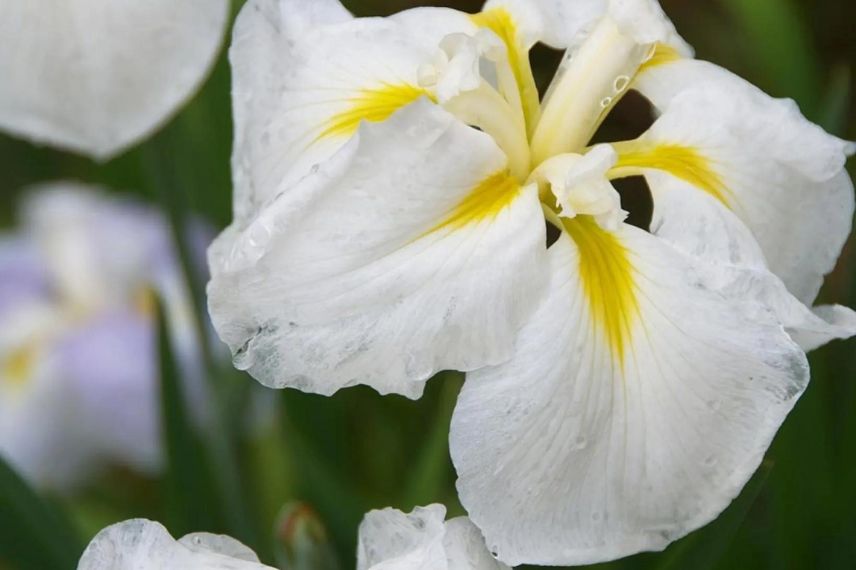
Siberian iris - Iris sibirica 'Snow Queen'
Iris sibirica ‘Snow Queen’ lights up the garden with its bright, pure-white flowers, the throat highlighted with golden-yellow. This Siberian iris, known for its graceful habit and fine foliage, forms vigorous clumps. It has earned a prestigious Award of Garden Merit from the Royal Horticultural Society.
The ‘Snow Queen’ variety grows to 50 cm in height when flowering. From spring, it forms a dense clump of narrow green-grey leaves. The flowering occurs in June and July, when flower stems, slightly taller than the foliage, emerge from the clump. Each stem bears 2 to 3 flower buds, reddish at the base, which open into flowers 6–7 cm in diameter, composed of three large drooping outer sepals topped by three smaller upright inner petals.
Siberica-type irises are excellent for planting around water features, but require precautions to avoid soils that are both waterlogged and prone to freezing in winter. An alternative is to grow them in pots, submerge in spring and lift in autumn. In the ground, they thrive in soil that stays cool all year round. For a visually striking mass effect, mix different iris colours, or pair them in soil that remains constantly cool, with lysimachias and ligularias, for example.
- Subscribe!
- Contents
Comments