





























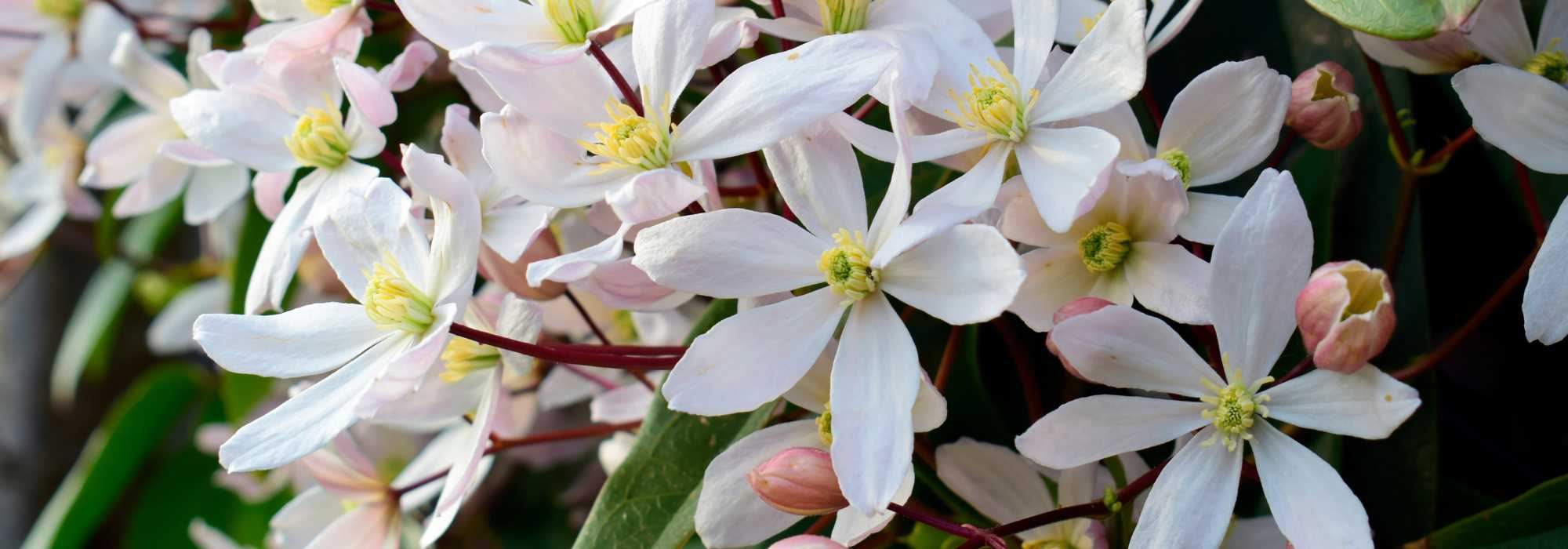
9 climbing plants with early spring flowering
We can't wait for them!
Contents
We eagerly await them each year: the early spring climbers return in March to brighten the garden and trellises with their graceful flowering. While many clematis bloom as early as the end of winter, let’s not forget the wisteria and jasmine, along with a few lesser-known climbers that deserve a little spotlight.
The climbers are ready to celebrate the arrival of the beautiful days! We present to you some of their most radiant representatives, in order of appearance in the garden…

Hardenbergia violacea
Often seen in gardens in the south of France, along the Mediterranean coast, Hardenbergia violacea is a beautiful climbing plant of Australian origin that does not appreciate the cold (it is hardy only down to -3°C, fearing frost episodes). It begins to flower in late winter, delighting southern gardens for several weeks with its pendulous clusters of mauve to purple flowers and long, evergreen, leathery leaves with a slightly bluish green hue. Its flowering is particularly nectariferous.
This legume, like the wisteria we will describe later, has the typical flowers of this family and does not like calcareous soil. Hardenbergia violacea should be planted in well-drained soil that remains cool and in a sunny position to ensure abundant flowering. Here is a lovely, highly ramified climbing plant with a trailing habit, growing to about 2.5 m with a similar spread, which offers a refreshing change from other spring-flowering climbers, making it suitable for the milder gardens of the hexagon, including coastal gardens by the sea.
⇒ Hardenbergia has a white version ‘Alba’ (or ‘White Crystal’) and a pink one ‘Rosea’.
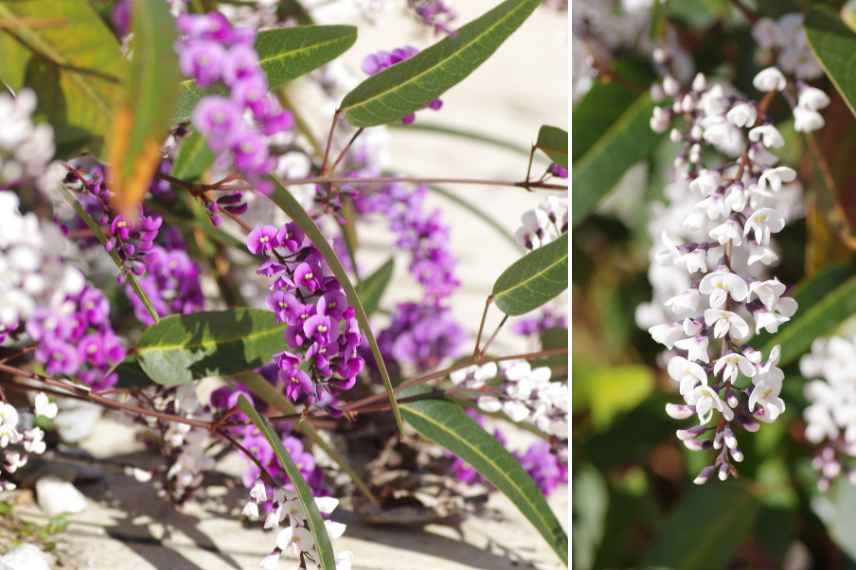
Hardenbergia violacea and to the right the cultivar ‘Alba’
Read also
6 climbing plants for winter floweringClematis armandii
Marvel of marvels at the very start of spring, Clematis armandii are among the first to bloom. The type species was discovered by Father Armand David in 1900 in China, which is why it is often referred to as Father Armand’s clematis. It boasts a good hardiness due to its origins and is one of the few clematis with evergreen foliage. The thick leaves are composed of three leaflets of glossy dark green, with one measuring 15 cm long, while the new shoots emerge in a purplish green.
Clematis armandii stands out for its spectacular flowering, in the form of clusters of white to pale pink flowers, starting in March, and its interesting size—between 4 and 6 m in height and 3 m in width—making it ideal for climbing on well-exposed walls and trellises in sunny situations. Their fragrance is more or less intense, reminiscent of orange blossom.
⇒ Among the noteworthy cultivars, Clematis armandii ‘Apple Blossom’ features exceptional flowering, with pink flowers forming lovely cups as they open (5-6 cm), and is very hardy, while ‘Snowdrift’ has larger flowers (8 cm) distinguished by its elongated pure white sepals.
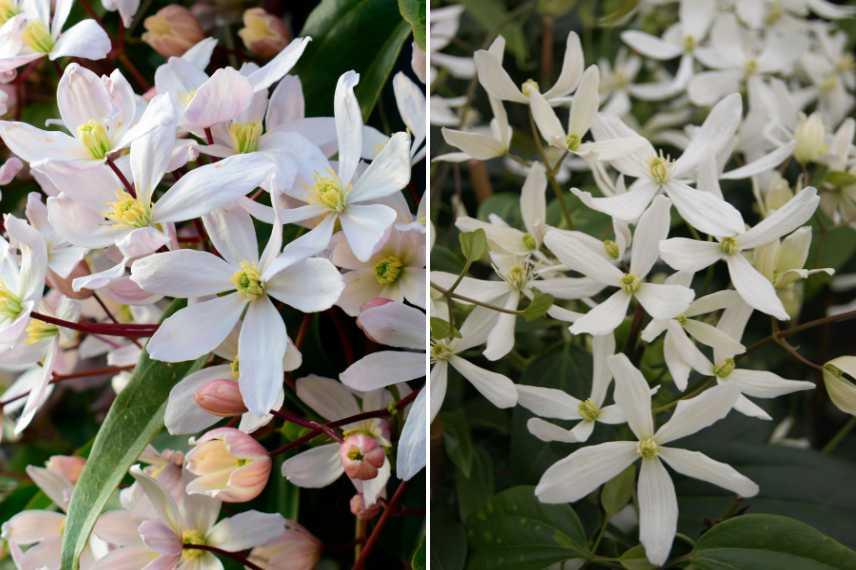
Clematis armandii ‘Apple Blossom’ and ‘Snowdrift’
Clematis macropetala
Here is a lovely early clematis, with the shape of its flowers and its exquisite blue colour. While its Latin name might suggest a clematis with large flowers, this is not the case, as the bell-shaped, campanulate flowers measure 5 to 8 cm in diameter. Much of its charm lies in this soft colour that falls between blue and lavender. The flowers appear at the same time or just before the foliage. The inside of the flowers features cream-coloured staminodia (stamens).
Very floriferous from March, or from April in colder regions, Clematis macropetala will transform its flowers into feathery fruits, which remain decorative throughout winter. With its lovely light green foliage and slender silhouette, this botanical clematis can grow up to 3 m in height. Completely hardy, it can be planted anywhere in the hexagon. Choose to let it run along the ground, crawl up a tree, or climb on a wall or pergola, in a pot or in the ground, in full sun or partial shade.
Clematis macropetala is somewhat similar to the Clematis alpina, which follows closely in the flowering calendar.
⇒ While the type species, Clematis macropetala, is itself very graceful, also succumb to the charm of the Clematis macropetala ‘Markham’s Pink’, a beautiful pink cultivar, more vigorous than the type species, ‘Maidwell Hall’, with dark blue, indigo flowers, or the Clematis macropetala ‘Purple Dream’ with large double flowers, rose-purple.
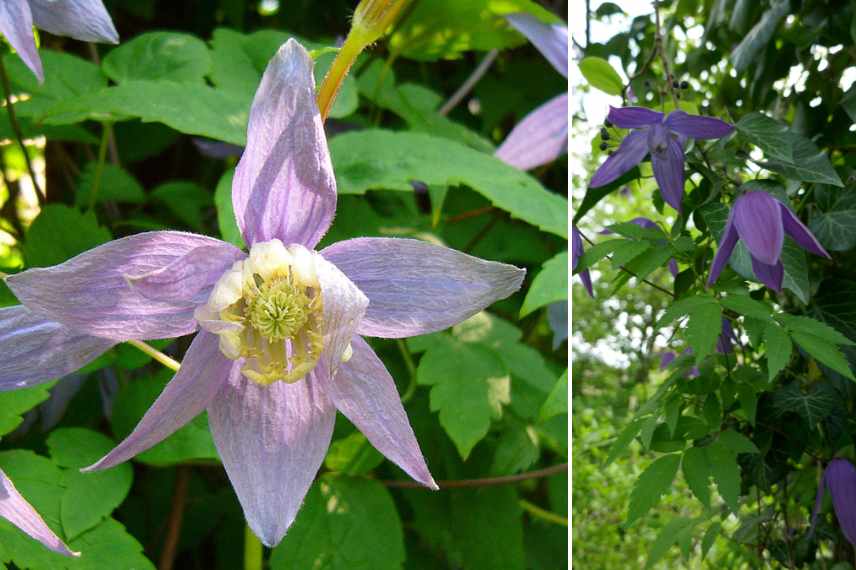
Clematis macropetala (© Wikimedia Commons, Magnus Manske and Wilrooij)
Primrose Jasmine
Less well-known than winter jasmine, which resembles it and blooms between December and April, the primrose jasmine also deserves its place in the garden in mild regions, as it is slightly less hardy.
This beautiful jasmine reveals its yellow attire composed of a myriad of flowers, larger than those of the Jasminum nudiflorum, measuring between 3.5 and 5 cm. The flowers, often semi-double, are bright yellow, a little darker at their centre. It sometimes produces repeat flowering, meaning it can bloom again in autumn, given warm temperatures. Jasminum mesneyi is also slightly shorter than Jasminum nudiflorum, often reaching 2 m. Its foliage, also evergreen, is broader.
It also cascades down in a full yellow display, providing a lovely silhouette in the garden, and even in a pot if one lives in a region with harsh winters.
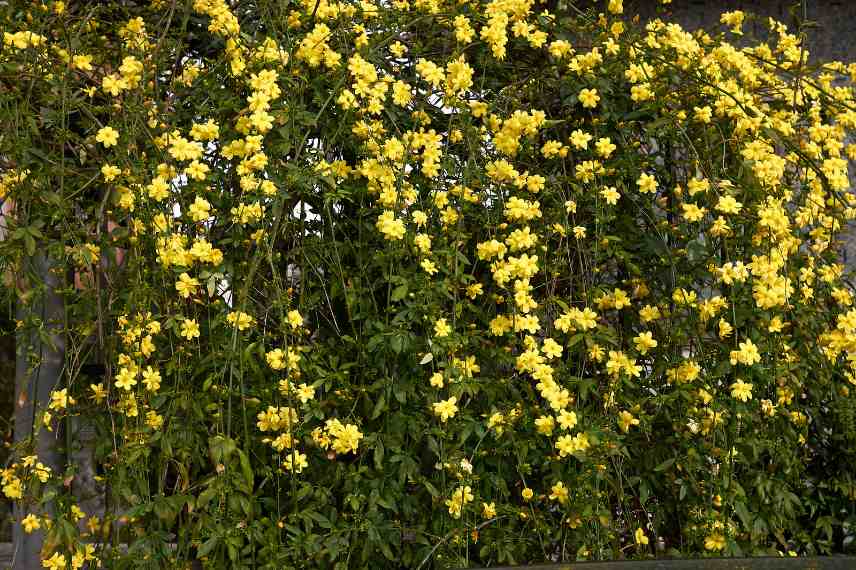
Jasminum primulinum or mesneyi
Jasminum polyanthum
Curiously called winter white jasmine, the Jasminum polyanthum actually blooms rather in early spring, from March to May, and into summer depending on the regions. This sublime jasmine is covered in star-shaped white flowers, with mauve-pink buds, very delicate and delightfully fragrant. It will bloom profusely earlier in regions with a mild climate and when planted in a well-sheltered position against a wall, for example—this is what it needs in addition to sunlight to flower abundantly and for a long time. The Jasminum polyanthum is known to be—rightly so—rather tender, as it suffers from temperatures below -4°C. Its lanceolate foliage remains evergreen during mild winters, and semi-evergreen in more temperate regions. This climbing plant easily reaches heights of 5 to 6 m with a beautiful spread of at least 2 m. It is perfect for covering a large pergola or climbing on walls and trellises in the sun. It can also be grown in a pot, but it will not develop its incredible floral mass as readily.
⇒ Read also: Growing winter white jasmine in the garden or in pots.
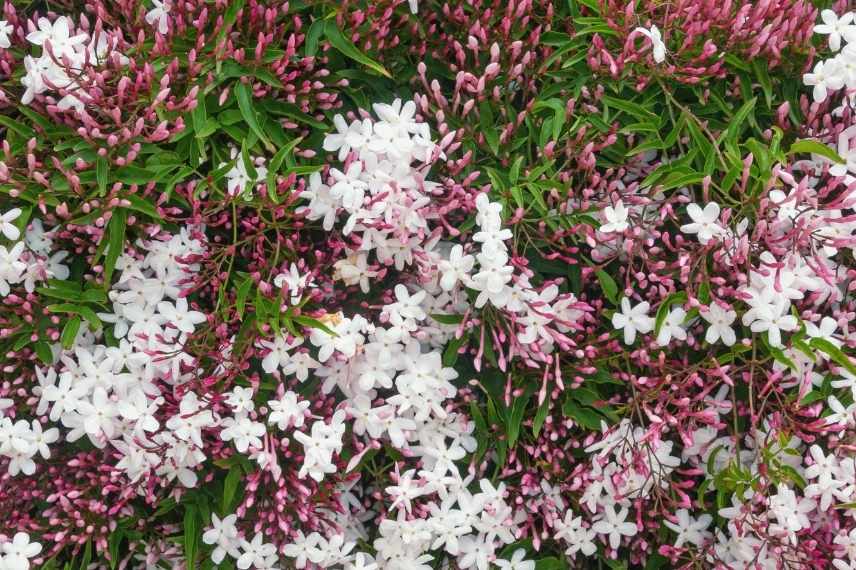
Jasminum polyanthum
Akebia quinata
Akebia is a charming climbing plant that blooms in early spring, appreciated for its very unique flowering from March to April, as well as its ability to thrive in more shade than most climbers. Known as chocolate vine by English speakers, Akebia quinata produces lianas up to 8-10 m long, which do not respond well to pruning, making it a boon for busy gardeners.
It stands out from other spring climbers with its numerous small flowers with 3 petals, gathered in trailing clusters, of burgundy colour for the typical species. The flowering is fragrant, with a scent reminiscent of vanilla and orange blossom, and is also nectariferous. Its Latin name quinata refers to its foliage composed of 5 leaves, ovate and evergreen in mild climates. Another feature of this highly ornamental climber in early spring is that female plants transform their flowers, during warm summers, into surprising elongated violet fruits. Lastly, it is not as frost-sensitive as one might think, withstanding temperatures down to -15°C, and is not particular about soil conditions.
Adopt this graceful climber trained against a wall, trellis, or to hide an unsightly fence.
⇒ The variety ‘Cream Form’, lovely, features cream-white flowers with purple stamens, while the variety ‘Alba’ is completely white. Akebia x pentaphylla (a hybrid of Akebia quinata and Akebia trifoliata) is another beautiful Akebia, with larger and darker flowers, exhibiting excellent vigour.
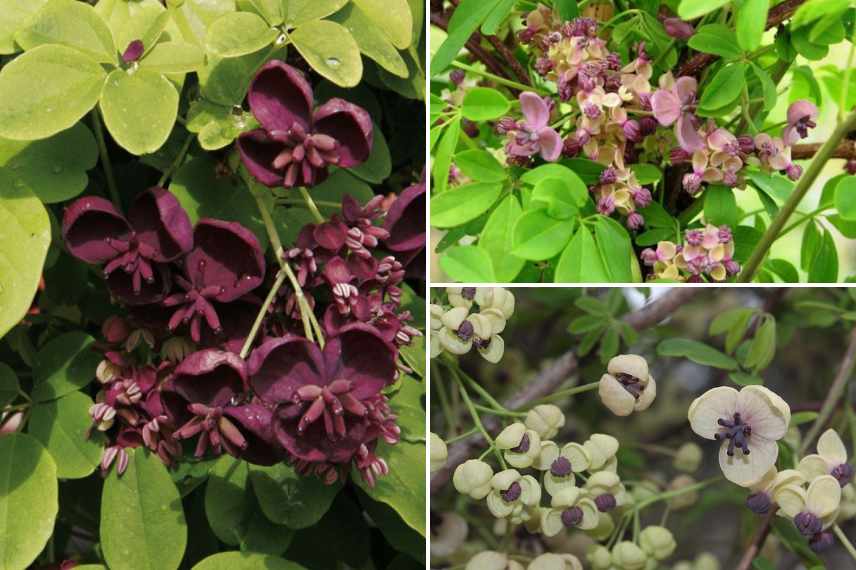
Akebia quinata, Akebia ‘Silver Bells’ and Akebia quinata ‘Cream Form’ (© Wikimedia Commons)
Holboellia
Not yet widely known, here is another climbing plant from the family Lardizabalaceae, a close relative of Akebias, which it somewhat resembles.
Holboellia is very voluble, growing quickly in light shade, making it an interesting plant for less sunny locations. Its foliage is more elongated than that of Akebia, and its bell-shaped flowering is just as graceful, whether it is Holboellia latifolia with its pink female flowers and white male flowers, or the Holboellia coriacea with its discreet greenish-white flowers, but very fragrant (the male flowers are purplish).
These beautiful lianas are known to be somewhat tender, but they can withstand a few frosts as long as they are not repeated and the plant is protected from cold winds. It generally retains its highly ornamental foliage down to -15°C. Growing up to 5-6 m high, Holboellia is truly attractive for its dense, covering foliage, even after flowering.
⇒ Holboellia latifolia is slightly earlier than the coriacea species.
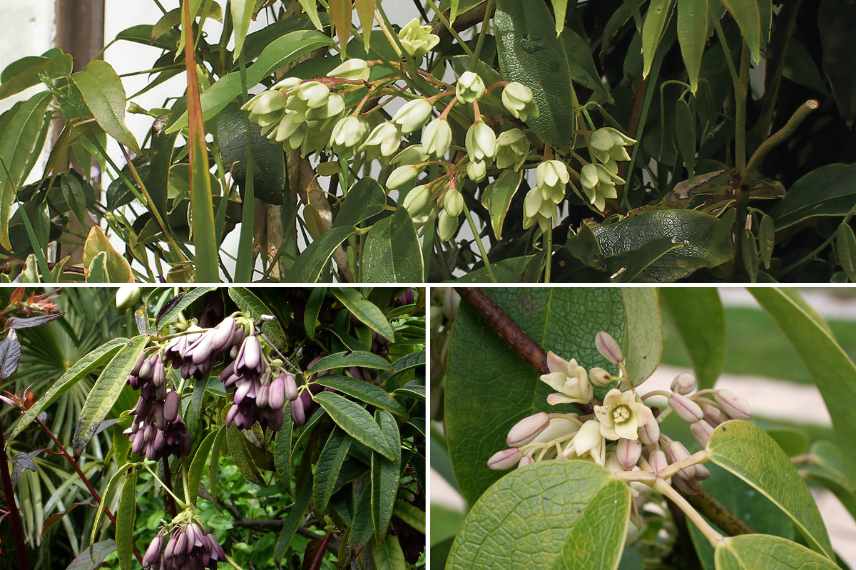
Above, Holboellia latifolia; below left, Holboellia angustifolia; and on the right, Holboellia coriacea (© Peganum)
Chinese wisteria or Wisteria sinensis
A spring without wisteria would lack charm for all those fortunate enough to have a support and space to accommodate its voluble extension (it can climb and spread up to 10 m, or even more).
While wisterias bloom spectacularly across the territory in April, Chinese wisteria or Wisteria sinensis is a bit earlier, with some blooming as early as the end of March in regions with a mild climate. Romance is assured by a multitude of clusters of light blue to bluish-purple flowers, measuring 15 to 30 cm, vibrant against the still naked wood.
Several years are needed for their magnificent display, but once established, Chinese wisterias are irreplaceable for their beauty, the duration of their flowering, their hardiness, their enchanting fragrance, and their repeat flowering throughout the summer. Even their compound foliage is of interest, emerging in a golden hue and remaining in place for a long time in autumn with its yellowing colours.
However, be careful to train Chinese wisteria on a sufficiently sturdy support, as it has incredible vigour, capable of compressing or twisting the strongest materials. Finally, this Chinese wisteria does not like limestone too much, which causes its foliage to yellow. It prefers well-drained soil that remains cool and rich, ranging from acidic to neutral.
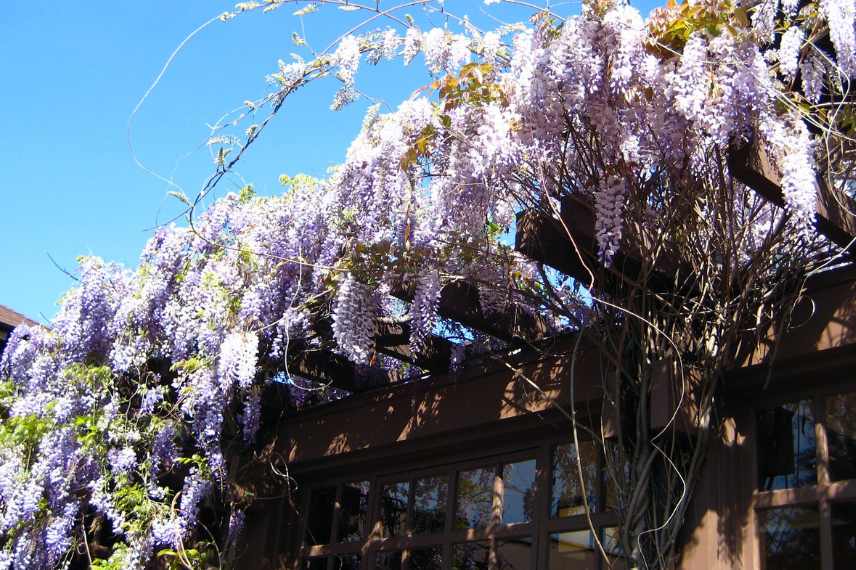
Wisteria sinensis (© Bri Weldon)
Banks' rose
Let’s finish this festival of early climbers with the bold beauty of the famous Banks’ rose, or Rosa Banksiae. This medium hardy climbing rose begins to flower as early as April, much earlier than other roses.
The spectacular type species is literally covered in small 3 cm flowers, gathered in pompom-like clusters of a very fresh pale yellow in the early days of spring.
Originating from China, Lady Banks’ rose is an inermous rose (thornless), which can grow over 10 m long with a spread of 3 m to 6 m. It is a vigorous liana that grows quickly in full sun or partial shade. Of course, it is not repeat flowering like most climbing roses and is not fragrant, but it proves to be very resistant to diseases, urban pollution, and sea spray, as well as drought once established.
⇒ Also discover the pink varieties of the botanical species, Rosa banksiae ‘Rosea’ and its white version ‘Alba Plena’.
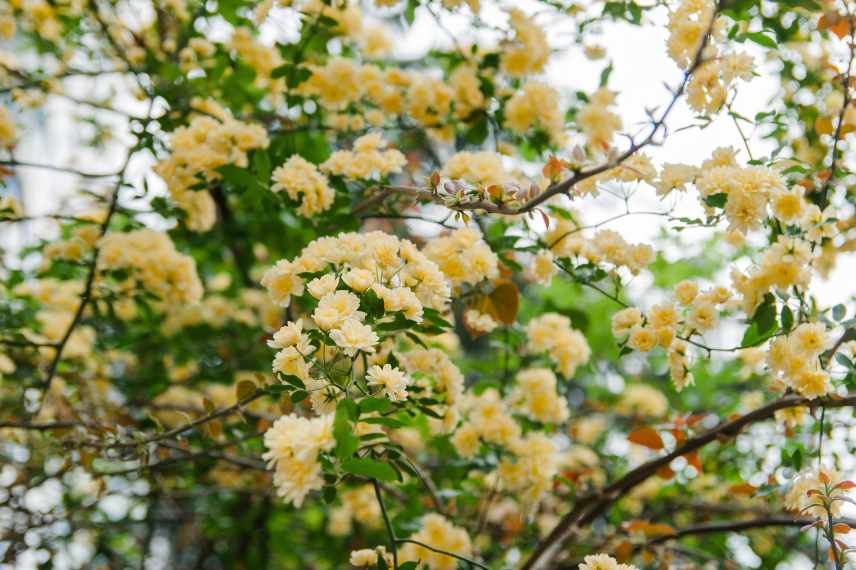
Rosa banksiae at the beginning of flowering in late March
- Subscribe!
- Contents
Comments