


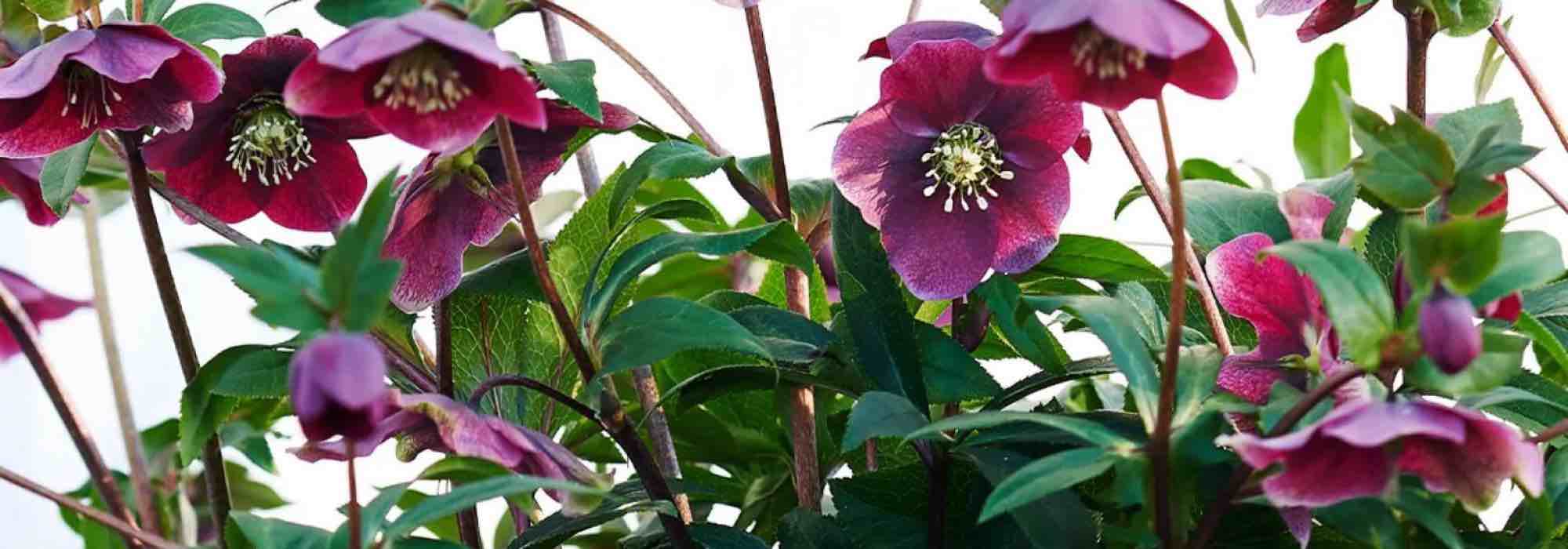
Adopt purple-flowered hellebores to brighten up winter!
Perennials with refined and elegant flowering, for the garden, terrace, or balcony.
Contents
If hellebores are also known as “Christmas roses,” it is because they delight us with their winter flowering. They are indeed among those plants capable of bringing life and comfort during the cold season, while the garden is at rest. Moreover, these perennials have the advantage of being easy to care for and resistant to diseases.
Oriental hellebores offer single or double flowers in a variety of colours: pink, white, yellow, green… as well as purple. A colour that adds depth and is imbued with mystery, while being very refined. It provides a wide range of shades, from dark violet to almost black purple.
Discover here our favourite purple-flowering hellebores, based on different criteria: flowering period, flower shape, or foliage. They are sure to make a statement in borders, at the feet of deciduous bushes, and also in bouquets for the home.
To learn more about growing hellebores, check out our dedicated section Hellebores: planting and cultivating them.

Early flowering purple hellebores
Hellebores are winter-flowering plants, but some are more precocious than others and will even bloom as early as autumn.
This is the case with the Oriental hellebore ‘ViV Victoria’. Very generous, this variety blooms for almost half the year, from autumn to spring. Its flowers follow one another from September to March. Few plants are capable of such a long flowering period. This hellebore rewards us with beautiful purple flowers, speckled with deep purple. The petals surround a heart of prominent yellow stamens, providing a striking contrast. Small in size (40 cm in height and 50 cm in spread), this variety forms a dense and compact clump. It fits in anywhere, both in the garden and in pots to brighten up the terrace or balcony for many months. It is a plant suited to the majority of our metropolitan regions.
Next, we have ‘ViV Batista’, a variety that blooms rather in autumn, between September and November. It accompanies the garden during its transition to the cold season. Its single flowers are a purple veined with violet. They are well-spread in shape, revealing a centre of very visible stamens. In terms of measurements, expect around 40 cm in all directions.
‘ViV Halina’ prefers to wait until the beginning of winter to show us its magnificent flowers, a purple so dark it seems to have black reflections. This colour is perfectly highlighted by the yellow of the prominent stamens. Well compact and floriferous, this hellebore ensures a spectacle from the end of November for several weeks. It measures 40 cm in all directions.
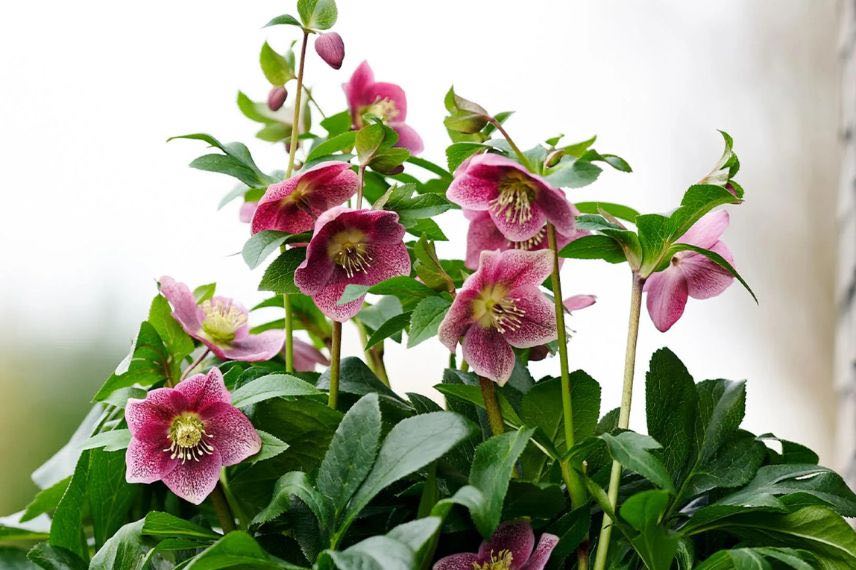
Oriental hellebore ‘ViV Batista’
Read also
7 hellebores with green flowersPurple late-flowering hellebores
These hellebores will require a bit more patience before you can enjoy their beautiful purple flowering. They will certainly capture our attention, as they reveal themselves in the heart of winter, when competition is at its lowest.
This is the case with theOriental hellebore ‘ViV Milana’, which will wait until January to bloom. It will then unveil simple flowers of a beautiful intense purple, opened to a heart that appears even darker. Compact and dense, it measures 40 cm in all directions.
Let’s also mention ‘Early Purple’, a much rarer cultivar that produces flowers with shades ranging from dark garnet red to intense violet. This late winter flowering beautifully accompanies the first spring bulbs, between February and March.
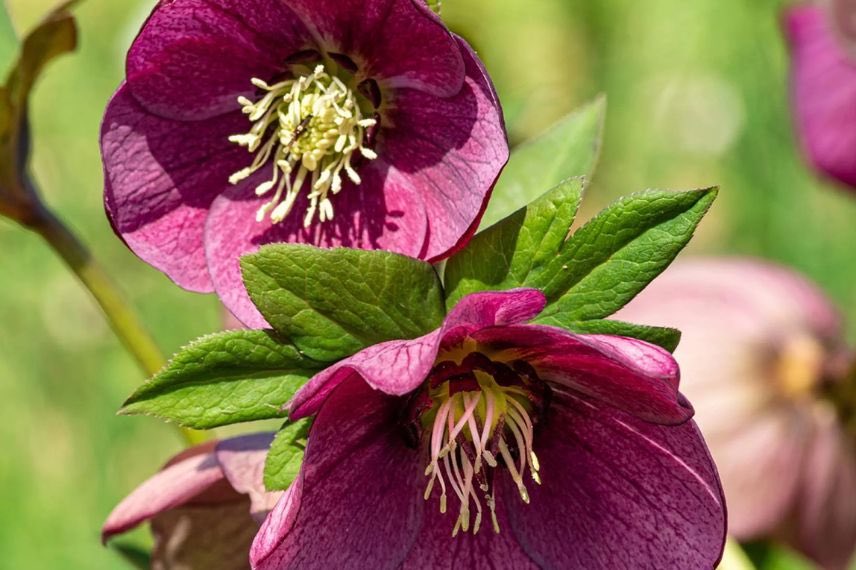
Hellebore ‘Early Purple’
Purple double-flowered varieties
‘Double Aubergine’ showcases its colour from the moment its name is mentioned. This hellebore produces magnificent flowers with numerous petals, giving it a resemblance to water lilies. They display a purple to aubergine hue, perfectly enhanced by a white edge on the outer side of the petals, as well as by the very light stamen at the centre. This small variety reaches a height of no more than 40 cm and a spread of 30 cm. It flowers late, from the end of winter to early spring, between February and April.
The ‘ViV Laura’ variety also offers a double flowering, with a very romantic appearance. Its petals have a slightly crumpled look that adds to their charm. The flowers feature a purple speckled with deep crimson. The bouquet of yellow stamens emerging from the centre creates, once again, a beautiful contrast with this dark and intense colour. The flowering occurs at the very beginning of winter, between November and December.
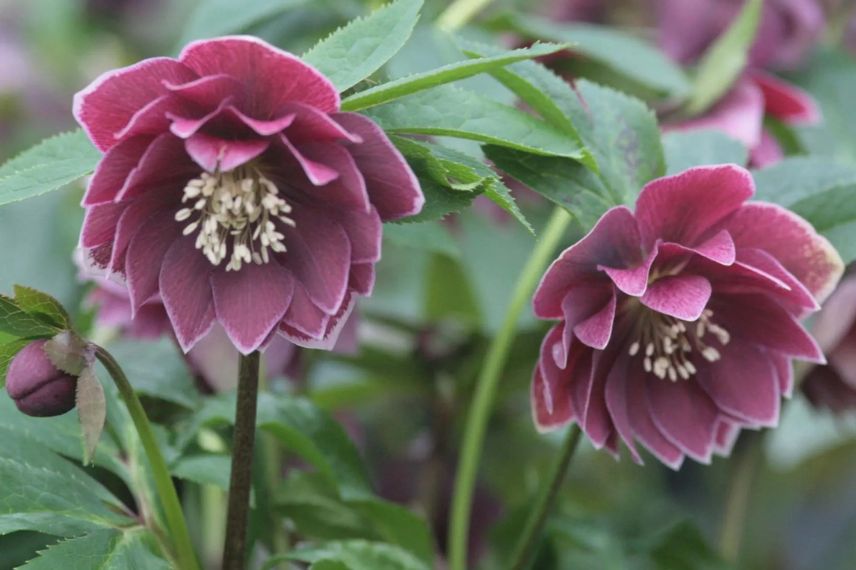
Oriental hellebore ‘Double Aubergine with White Edge’
Read also
Oriental Hellebores: the darkest onesBicoloured purple flowerings
If the colour purple can sometimes seem a bit dark, it can be perfectly enhanced by lighter shades in certain hellebores. This is the case with ‘Magic Aubergine liseré’, whose colour varies from one young plant to another, even from one flower to another. While they all have a dominant purple, the distribution of colours occurs randomly, mixing dark red edged with white and pale pink. An original flowering, perfect for dressing borders, beds, or pots during late winter.
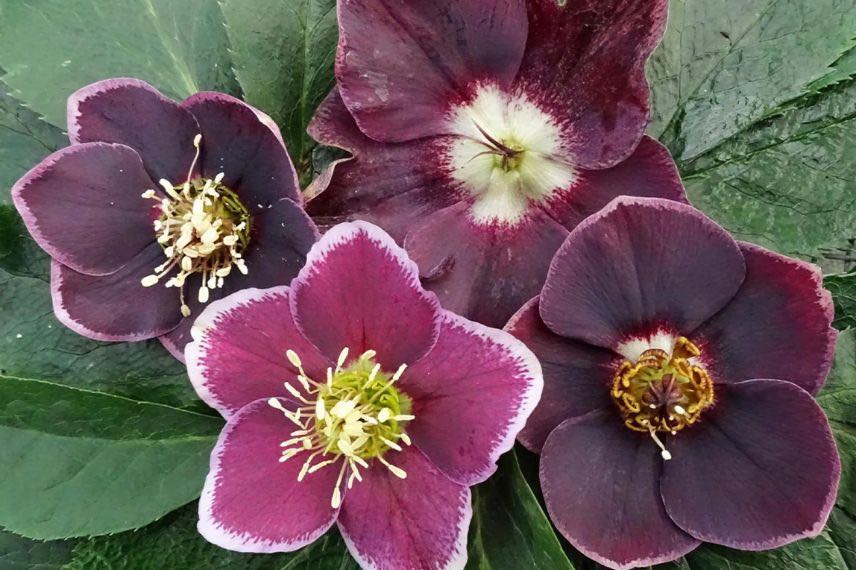
Oriental hellebore ‘Magic Aubergine liseré’
Ornamental foliage
There is more to hellebores than just their flowering. The foliage is also ornamental. It varies in density and shape depending on the variety.
In the case of the oriental hellebore ‘ViV Eloisa’, the autumn flowering is beautifully complemented by a clump of dark green leaves. They are deeply cut, adding an extra graphic touch. Evergreen, this foliage remains decorative in all seasons. It is a variety that adapts perfectly to pot cultivation. Its silhouette does not exceed 40 cm in all directions.
‘ViV Victoria’ is equally interesting. This variety forms a clump of glossy, well-cut leaves in a beautiful intense dark green. Evergreen, they remain in place for many months before being replaced by new ones.
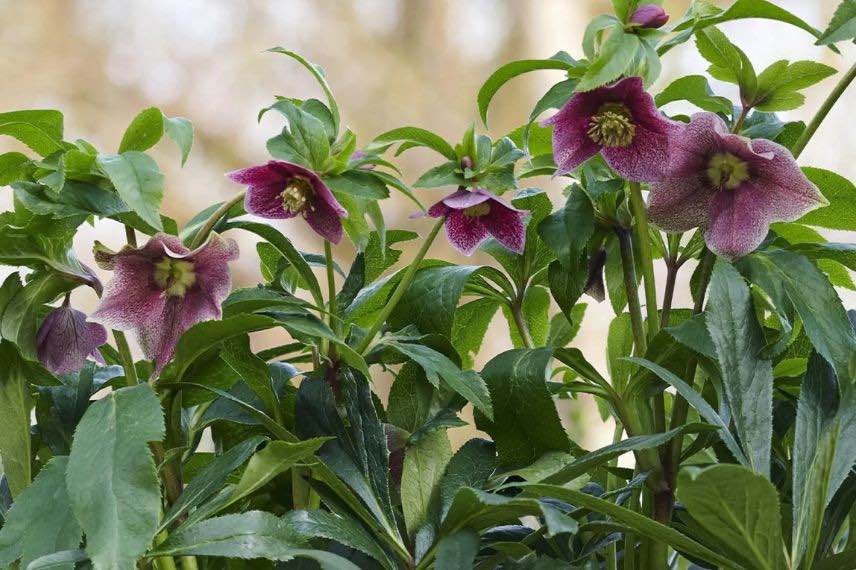
Oriental hellebore ‘ViV Eloisa’
The hardiest purple-flowered hellebores
Hellebores are known for their good cold resistance. However, if you live in an area with really harsh winters, choose varieties that can withstand temperatures below -20°C. This includes ‘Double Aubergine’, ‘Magic Aubergine’, and ‘Early Purple’.
- Subscribe!
- Contents
Comments