





























Almond tree: the best varieties
Discover the safe bets among the different almond varieties
Contents
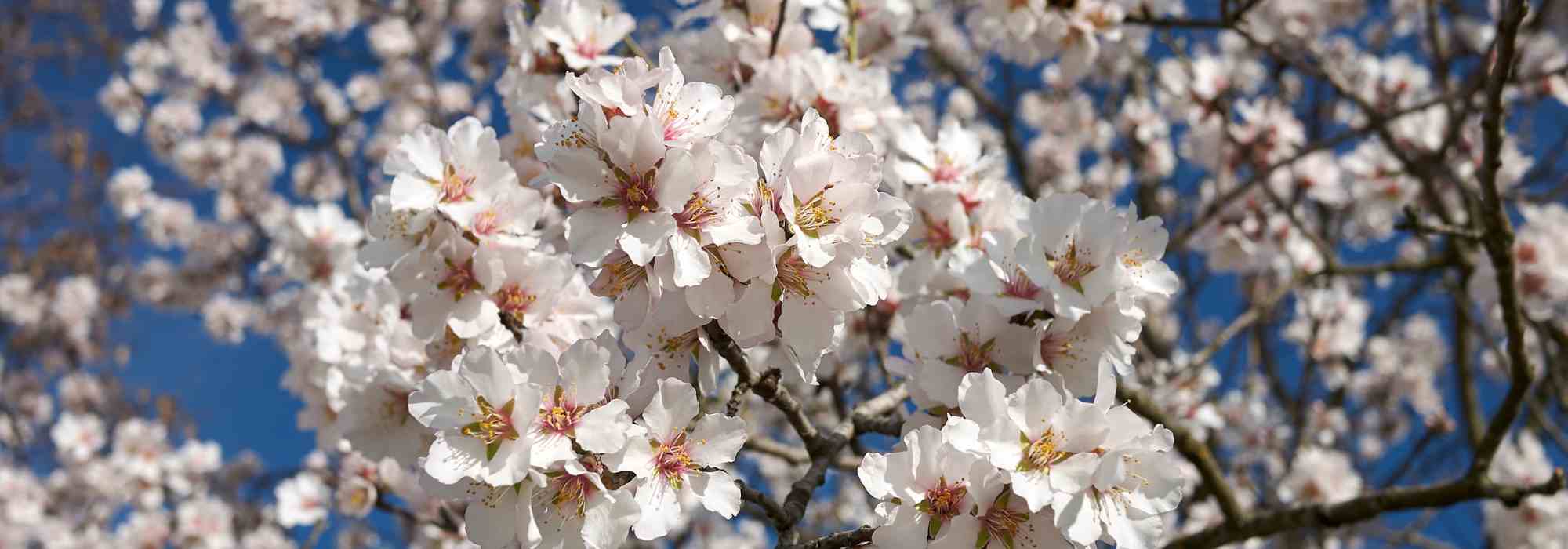
If there is a fruit tree steeped in symbols and myths, it is certainly the almond tree. In turn, a symbol of love and virginity, of imprudence and fragility, of divine vigilance, of immortality and the eternity of the soul… the almond tree has long been known and cherished by peoples around the Mediterranean since ancient times. It must be said that the almond tree (Prunus dulcis), a fruit tree in the Rosaceae family, is the first tree to awaken as winter ends, while frost still grips. With its splendid and highly fragrant white or pink flowering that appears before the foliage, the almond tree reminds us that spring is on its way back.
Unfortunately this magnificent fragrant flowering is vulnerable to late spring frosts. That is why it is essential to choose the variety best suited to the climate of your region. However, if you live in the southern zone, all horticultural varieties can be grown to produce almonds. The different varieties mainly differ in the hardness of their shell, which can be fine, soft, semi-hard or hard.
Discover my selection of the five best almond varieties to help you choose for your garden or your orchard.
For all you need to know: Almond tree: planting, pruning, harvesting

Almond tree 'Princesse' for very tender in-shell almonds
If there is a sure-fire choice when it comes to almond trees, it is certainly the old variety Princesse. A vernacular name of the most elegant kind, simply referring to the tenderness of its shell. Shells so tender that they could be broken by the delicate hands of a woman. This quality can have a drawback: birds that enjoy these drupes, such as magpies and jays, have no trouble cracking the shell with their beaks. This can give the harvest an unsightly appearance.
Thanks to the flavour of its kernels, this almond tree variety is also known as the pistachio almond tree. Simply because its almonds contain a light pistachio flavour. The almonds of this variety are also reputed for another characteristic. Traditionally, they form part of the famous and delicious calissons from Aix-en-Provence. The almonds of this variety are very white in colour, highly fragrant and with a sweet flavour. Their ripeness is relatively early, as they can be eaten green, i.e. fresh, from June, and dry between August and September.
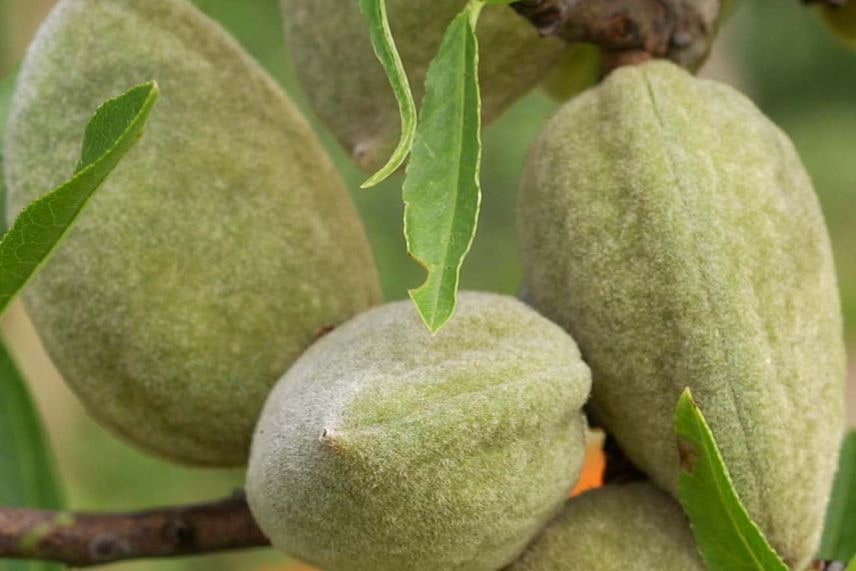
The ‘Princesse’ variety produces almonds with a tender shell
Already mentioned in 1809, this almond tree variety, native to Provence, forms a vigorous tree with a vertical habit. At maturity, it will reach a height of 7 m with a spread of around 5 m. Fruit set occurs from five years of age. Its flowering occurs relatively early, on average around 20 February, with the large flowers lasting for about twenty days.
Partially self-fertile, this almond tree will have much better fruiting if planted near a pollinator such as the variety ‘Texas’ or ‘Ardéchoise’. It can be susceptible to pests.
Almond tree 'Aï' for a very late harvest
The Ai almond variety is also of Provençal origin, having been grown around Aix-en-Provence and in the Vaucluse and the Bouches-du-Rhône since the 19th century. It is therefore an old French variety, long regarded as the most interesting among soft-shell almonds for its productivity. This variety benefits from excellent vigour and offers a tree with an open, slightly trailing habit, very ramified and bushy, with an erect framework and spreading branches. This almond tree thus displays a certain aesthetic appeal that makes it a handsome ornamental tree. It will reach 5–7 m in height with a spread of 4–6 m. This habit is particularly suited to free-form cultivation on a half-standard form or goblet form. It is not prone to alternate bearing.
With fairly rapid fruiting, this variety bears fruit on one-year-old shoots. They thus reach maturity by mid-September, but can be harvested fresh from mid-July. With a shell tender to semi-soft, the Ai almonds are fairly broad and flat, very fleshy, and of medium weight. They are renowned for their flavour and their sweet taste. This is why they are often used by confectioners in many desserts. As it is a late-flowering variety, the flowers appear in March, which makes them less susceptible to frost.
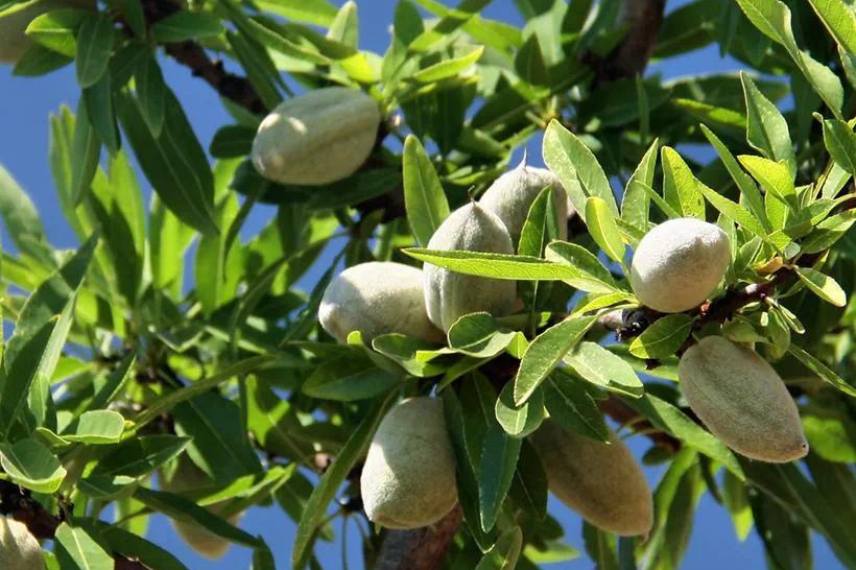 Ai almond tree
This variety is also recognised for its resistance to cryptogamic diseases such as Monilia. By contrast, it is susceptible to scab. It is also self-sterile, so it must be planted near a late-flowering pollinator variety such as Ferraduel®, Ferragnes® or even Texas.
The Ferragnès® almond tree, a large-fruited variety
Just like ‘Ferraduel®, ‘Ferralise®’ or ‘Ferrastar®’, the variety ‘Ferragnès®’ is a creation of INRA (National Institute for Agricultural Research), developed by Mr Grasselly in 1960 in Bordeaux. It is a vigorous, moderately ramified variety, bearing trailing shoots at the base of the tree. Recognised for its high to very high productivity, ‘Ferragnès®’ is little prone to alternate bearing. Its habit is slender and erect, making it an easy almond tree to train.
With a very late flowering in March, this variety proves particularly frost-hardy. The flowers yield large-fruited fruits, rather elongated, with a soft shell. The kernels are exceptionally tasty, with a sweet flavour nuanced with cocoa and pepper. Light in colour, these kernels are fairly thick, slightly rough to the touch. This is why they are widely used in confectionery or processing. The almonds reach maturity between mid-September and early October.
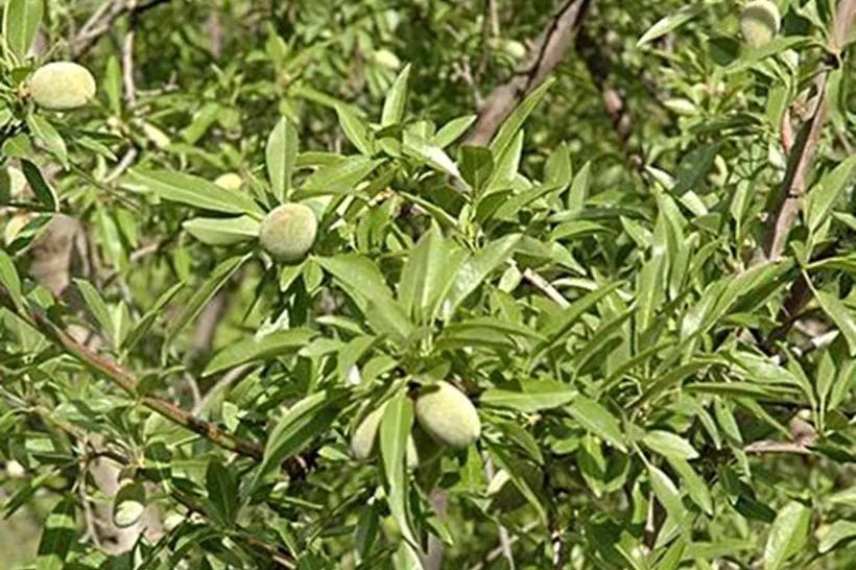
The almond tree ‘Ferragnès®’
Because it is self-sterile, this almond tree must be planted near pollinating varieties such as ‘Ferraduel’ or ‘Aï’ to bear fruit. It can be susceptible to Fusicoccum, but it appears to be little susceptible to scab and very resistant to Monilia.
Read also
Diseases and Pests of the Almond TreeThe Garden Prince® almond tree ideal for pots
The Garden Prince® variety is a compact almond tree, ideal for container growing on a balcony, terrace, in a courtyard or on a patio. It can also be grown in the ground in a small garden. This almond tree of American origin will not exceed 1 m in height, with a 50 cm spread at maturity. That means the harvest of almonds on this dwarf almond tree will be accessible to everyone, including young children. Thanks to its size, it can be grown almost anywhere in France, provided it is placed at the foot of a south-facing wall and well sheltered from winds and cold air currents. It features an erect, compact habit and very rapid fruiting. Its flowering is highly decorative and pink. Although highly ornamental, this almond tree is also very productive.
This dwarf-growing almond variety flowers fairly early, between February and March. It produces almonds of medium size with a tender shell that can be harvested fresh in July. However, these almonds mature quite late, in October.
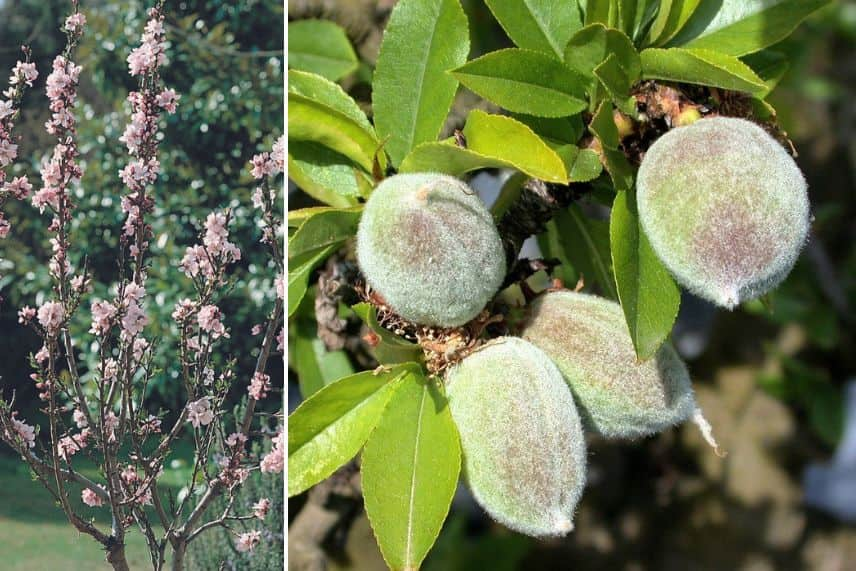
The Garden Prince almond tree can be grown in a pot on a balcony or terrace
Like most fruit tree varieties designed for pot cultivation, this almond tree is self-fertile. It does not therefore require a pollinator to bear fruit.
The almond tree 'Fruit me® Almond me', a semi-dwarf variety
Here is an almond tree variety that should appeal to a wide audience, as it offers numerous advantages. almond tree ‘Almond me’ from the ‘Fruit me®’ range can be regarded as an innovation, given how many qualities it combines.
This semi-dwarf, self-fertile almond tree is grafted onto a frost- and disease-resistant rootstock, which helps it tolerate cold better than other varieties. Likewise, this almond tree can adapt its size to the soil or container provided. Thus, in the ground, it can reach about 3.50 m in height with a spread of around 3 m. By contrast, if grown in a pot on a balcony or terrace, in a courtyard or patio, it will not exceed about 1.50 m in height and about 1 m in width. All in all, it’s the almond tree for every situation.
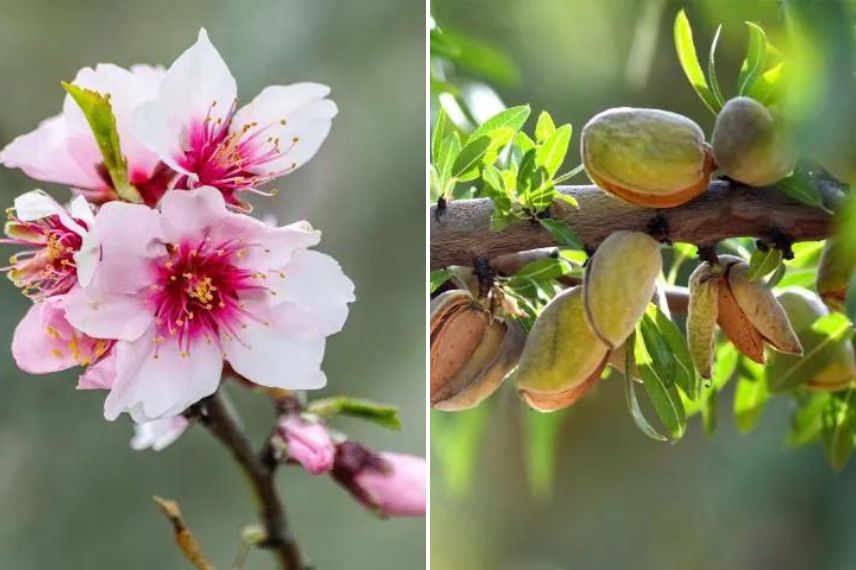
The semi-dwarf ‘Almond me’ almond tree from the ‘Fruit me®’ range
Originating from Spain, this relatively new almond tree produces medium-sized almonds, highly fragrant, with a tender shell. However, to produce the best yields, this almond tree needs a long, hot summer. The harvest of almonds at ripeness will take place between August and September. If you like them fresh, harvest is possible from July.
You can choose this small tree for its beautiful white-pink flowering.
- Subscribe!
- Contents

Comments