





























Pairing ideas with Houttuynia
5 ideas to showcase this beautiful groundcover
Contents
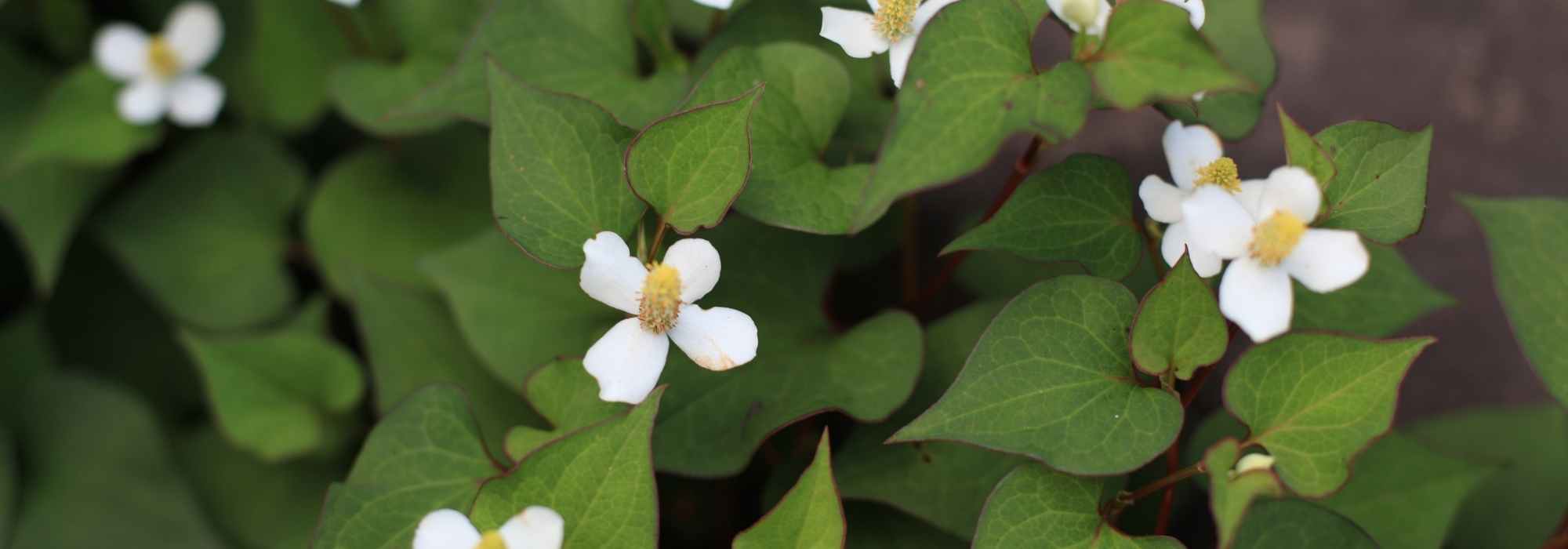
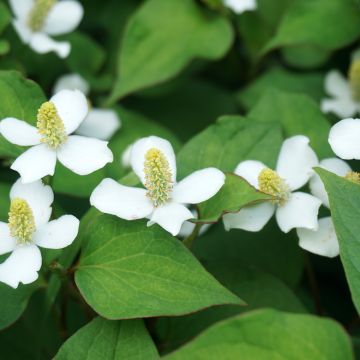
A still relatively unknown plant, the Houttuynia cordata, also known as Chinese Pepper or wood coriander, is a semi-aquatic perennial thriving in damp gardens, ideal for enhancing a shaded or partially shaded area with its lovely heart-shaped foliage and long flowering period. A fast-growing perennial that requires little maintenance, its carpet-like character is a valuable ally for those looking to quickly dress up unattractive areas of the garden. However, care should be taken regarding its invasive nature in particularly wet zones.
From varieties with solid foliage to variegated leaves, discover some ideas to showcase Houttuynia in very fresh scenes.
→ Learn more about Houttuynia or wood coriander in our comprehensive guide.

Around a pond
Houttuynia cordata thrives in cool or moist, even waterlogged, soil. It makes an ideal groundcover or the perfect border for a pond or water feature. It can even be slightly submerged in shallow pools. The standard species with uniform foliage is very attractive, complementing the intense greens of the marginal plants you will place alongside it, but you might prefer the Houttuynia cordata ‘Chameleon’, which features cream, yellow, and red variegation on its margin.
To accompany it, broad or unusual foliage will be welcome, such as that of Darmera peltata, which takes on bronze hues in autumn, exotic-looking Farfugiums, or a few Rodgersias that also offer their creamy yellow summer flowering. Some more slender foliage and beautiful blooms in soft shades will create a stunning effect, such as those of Sagittaria sagittifolia, Iris versicolor, and in milder regions, you could even invite a Papyrus with its light and exotic umbels. Also consider the verticality and bright pink colour of loosestrifes, the pastel umbels of flowering rush or Butomus umbellatus, and the striking form of a water rush like Juncus effusus spiralis.
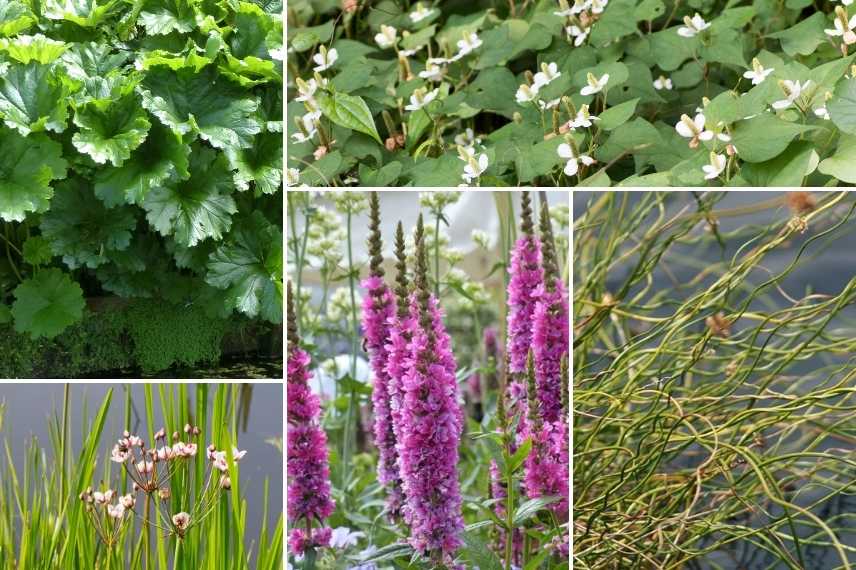
Darmera peltata, Butomus umbellatus, Lythrum salicaria, and Juncus effusus spiralis
Beneath trees
In a drier area such as the base of trees, Houttuynia may seem an incongruous choice, but it proves to be somewhat less invasive than when planted in very wet soils where it can become quite invasive. It enhances perfectly a bare area where too many weeds proliferate, providing a groundcover that is not only dense but also flowers for many weeks.
In this context, often of woodland or wild spirit, pair it with a few young plants of Pachysandra terminalis ‘Variegata’ with more finely cut, contrasting leaves and earlier white flowering, and some slightly taller perennials that will stand out from the carpet formed by the Houttuynia: a generous variegated Hosta like Hosta ‘Sagae’ or ‘Saint Paul’, an upright frond fern like the ostrich fern Matteuccia struthiopteris, and a smaller fern with greyish hues to punctuate the scene like Athyrium niponicum ‘Pictum’. For a beautiful summer flowering that remains in this woodland spirit, insert a few bulbs of Anemone multifida ‘Major’, with pale yellow flowers.
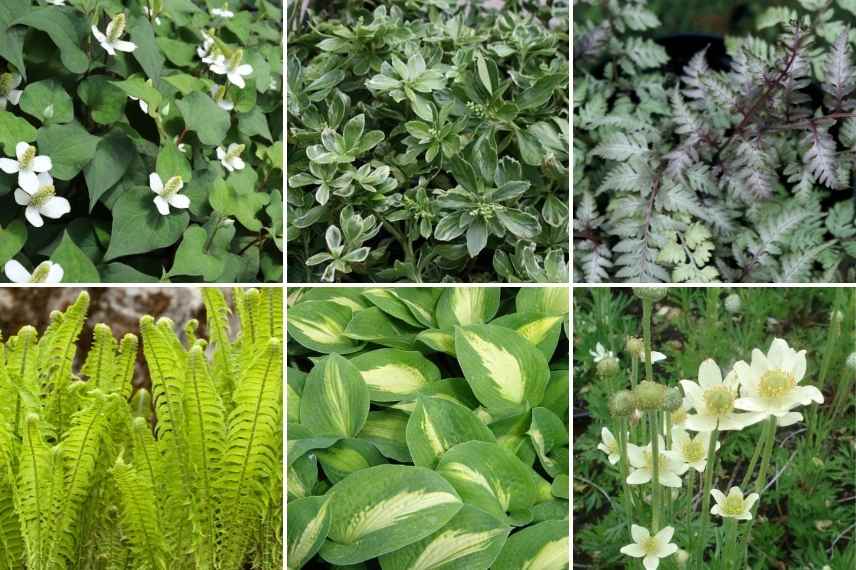
Houttuynia cordata, Pachysandra terminalis ‘Variegata’, Athyrium niponicum ‘Pictum’, Matteuccia struthiopteris, Hosta ‘Saint Paul’, and Anemone multifida ‘Major’
Discover other Houttuynia
View all →
Available in 1 sizes
Available in 1 sizes
Available in 1 sizes
In a large planter or pot
Rhizomatous perennial with a tendency to spread more than desired, Houttuynia is perfectly contained in an appropriate pot where its creeping stolons can be controlled. To benefit from its spreading habit and allow it to spread minimally, choose a large container such as an old zinc or enamel bathtub, or for a more urban style, a tall contemporary XXL planter. Plant around it a horsetail that will bring beautiful verticality and graphic interest, an ornamental rhubarb (Rheum palmatum) or arum for exuberance, a few Astilbes or Persicarias for a splash of colour, and a fern of the Asplenium type to further play with contrasts in foliage.
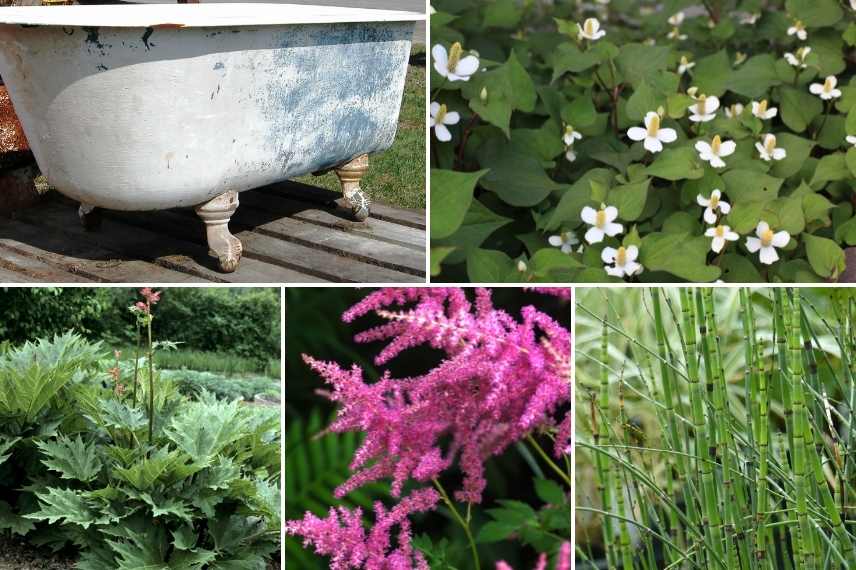
Houttuynia cordata, Rheum palmatum, Astilbe and Equisetum hyemale
You can also, in the spirit of an aromatic pot garden, plant your Houttuynia in a separate container – ensuring to water it to keep the substrate consistently moist – next to your pots of mint, parsley, and coriander! Set up this mini aromatic garden near your kitchen window, on your balcony exposed to partial shade: you will easily harvest and incorporate Houttuynia leaves into your Asian-inspired recipes: they wonderfully flavour certain Vietnamese dishes.
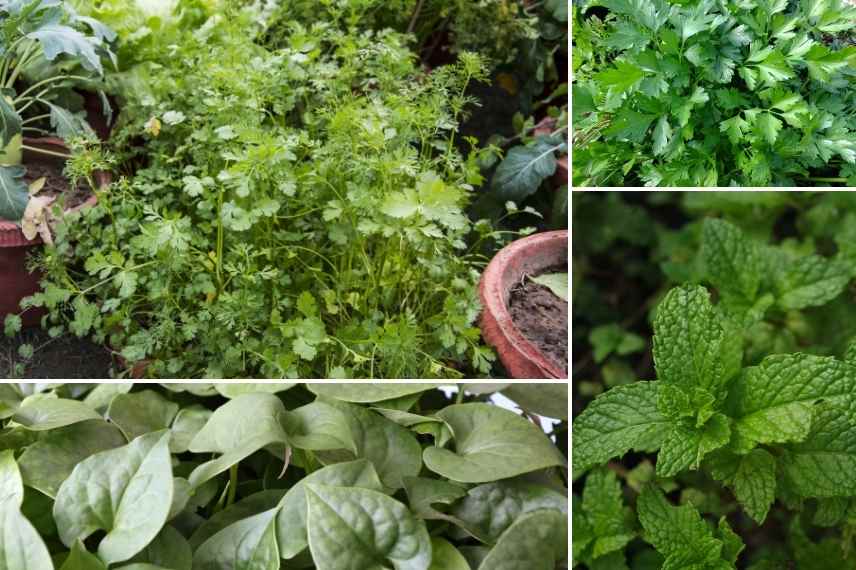
At the bottom left, Houttuynia cordata, in a pot garden with coriander, parsley, and mint
Read also
Growing Houttuynia in potsIn a white garden
The freshness of the white flowering of Houttuynia is a lovely excuse to invite it into a shaded summer scene. It will brighten up a border in a semi-shaded bed with its charming all-white flowers tinged with yellow at the beginning of summer, complementing the green and white hues in a white garden.
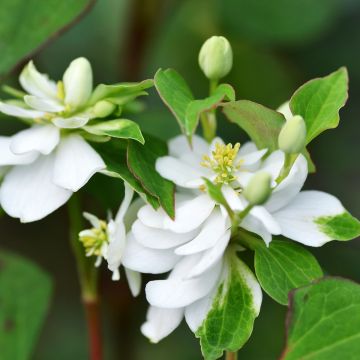
Use it as groundcover in harmonious company with a few plants that flower at the same time and require, like it, moist soil: Chinese Lysimachia or Lysimachia ‘Candela’, white Eupatoriums, Tradescantia (andersoniana or ‘Domaine de Courson’), lovely fluffy Filipendula or a few white Persicaria. If you have space, add some beautiful bushes like a Japanese maple or a Sorbaria sorbifolia. Don’t forget a few perennials that flower in spring to extend this refined bed: the innocent charm of Japanese primroses or Primula denticulata ‘Alba’ and the lungwort ‘Sissinghurst White’, as well as a few Astrantia. This ornamental configuration for Houttuynia is even more successful when choosing a variety with double flowers like Houttuynia ‘Flore Pleno’.
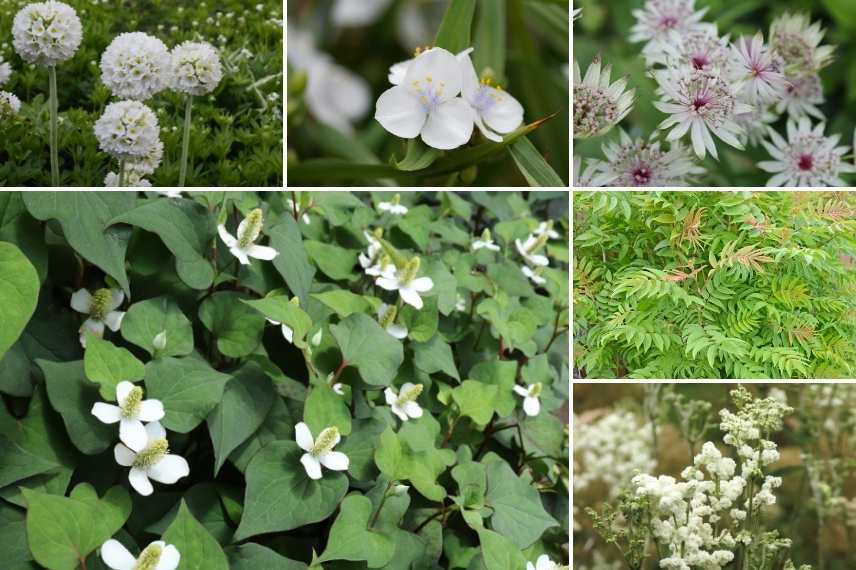
Houttuynia cordata as groundcover, accompanied in a white garden by Primula denticulata ‘Alba’, Tradescantia andersoniana, Astrantia, Sorbaria sorbifolia, and Filipendula ulmaria ‘Plena’
In a Japanese-inspired border
The cream and red variegations of the variety ‘Chameleon’ will harmoniously integrate into a Japanese-style border, where they will pair well with the reddening foliage of many plants within it. Just be careful not to overemphasise the red colours, which should serve as punctuation, complemented by other more subdued foliage and a few graceful flowers, particularly in spring.
You have numerous options to create this elegant border, such as a Pieris (Andromeda) ‘Forest Flame’ or ‘Flaming Silver’, which turns red in spring, or a Nandina domestica (heavenly bamboo), also reddening after winter, a Japanese maple that is simply essential, one or two dwarf conifers, ferns, and a Fatsia japonica with beautiful palmate leaves, along with a dwarf bamboo (Shibataea kumasaca) or Hakonechloa in clumps for greenery. Pair the groundcover created by Houttuynia ‘Chameleon’ with a few discreet pink to red flowers: azaleas and Kalmias, Prunus incisa (dwarf Japanese cherry), tiarellas, and later in the season a Camelia sasanqua. Finally… a few rockeries covered in moss, helxine or sagina, and simple small borders made from bamboo canes will transport you to the land of the rising sun!
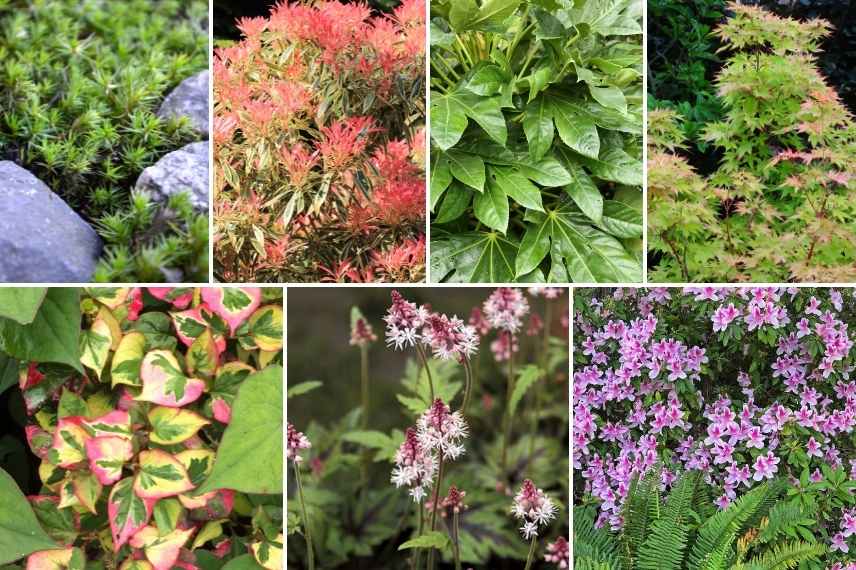
Houttuynia cordata ‘Chameleon’ in the bottom right, associated with sagina, a Pieris ‘Forest Flame’, a Fatsia japonica, an Acer palmatum ‘Sangokaku’, Tiarellas ‘Sugar and Spice’, Japanese azaleas, and a few ferns
- Subscribe!
- Contents
![[houttuynia_cordata]Houttuynia Association in the Garden[/houttuynia_cordata]](https://en.promessedefleurs.eu/blogwp/wp-content/uploads/2022/05/Associer-lHouttuynia.jpg "Associate the Houttuynia")
Comments