


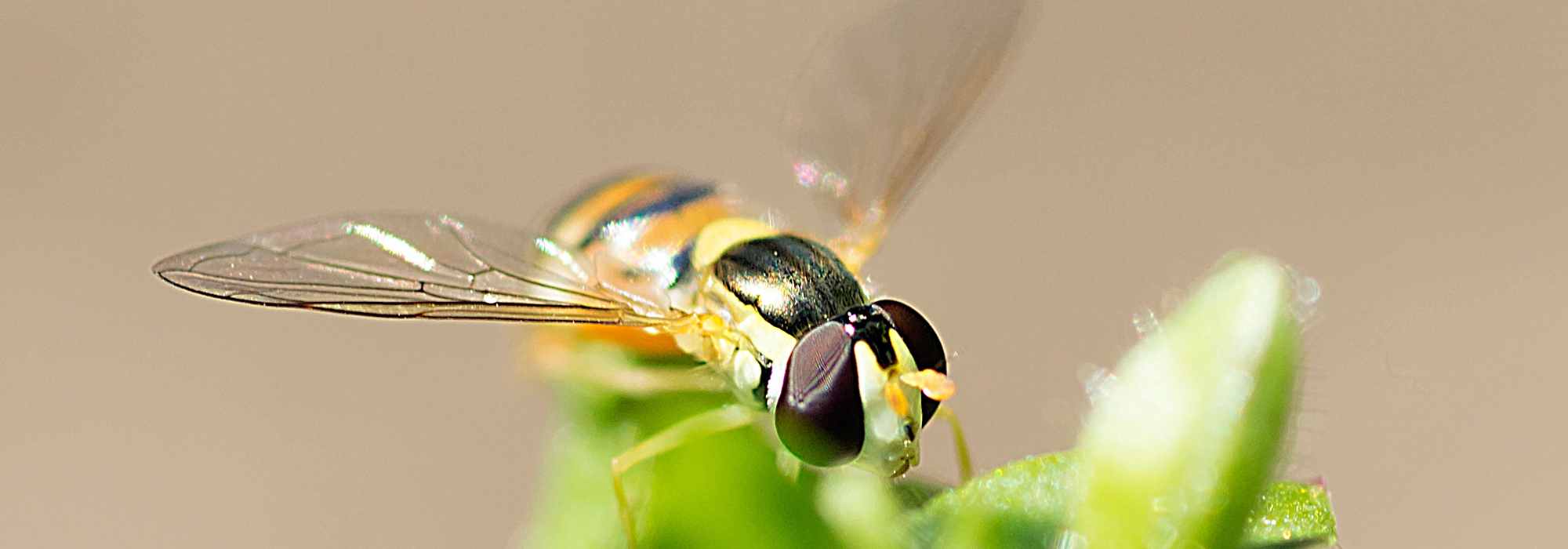
Auxiliary insects: hoverflies
a friendly ally for the gardener
Contents
In the world of gardening, not all insects are pests, quite the opposite! Some, like hoverflies, play a crucial role as garden allies, helping with the pollination of plants and regulating aphid populations. Often confused with bees or wasps due to their deceptive appearance, these harmless and fascinating creatures are, in fact, valuable allies for any environmentally conscious gardener.
In this article, we will explore the world of hoverflies: their biology, behaviour, their role in the garden ecosystem, and how you can encourage their presence to maintain a healthy and thriving garden.

What are hoverflies?
Hoverflies, also known as flower flies, belong to the family Syrphidae and the order Diptera, like flies and mosquitoes.
They are often confused with bees and wasps due to their similar appearance. This is a defence strategy known as Batesian mimicry (“Boo, look at me, I look dangerous!“) thanks to their bright colours, often yellow and black, which allow them to masquerade as bees or wasps. However, hoverflies are completely harmless to humans, as they have no stinger or anything else that could bite or sting us.
Hoverflies generally measure between 1 and 2 cm and have only two true wings, unlike bees and wasps which have four, and their eyes are often large and shiny. In short, they are flies that seem to have dressed up as bees.
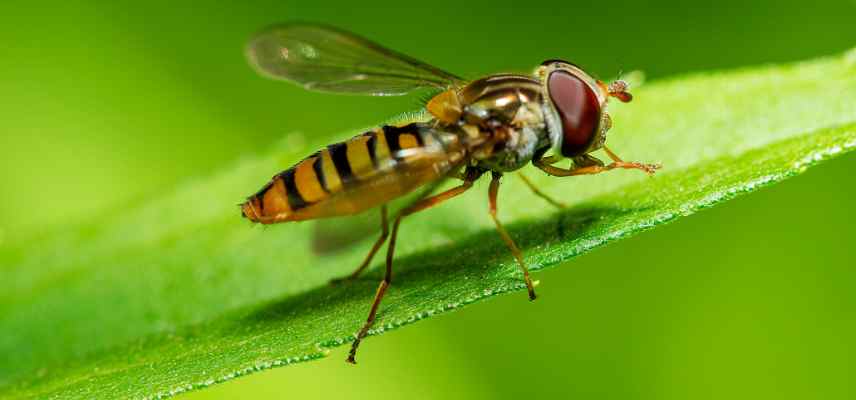 A resemblance to their cousins, the wasps
Read also
Auxiliary insect in the garden: AphidiusHow can hoverflies help us in the garden?
Hoverflies can be found all over the world, except in extremely dry deserts and polar regions. They are particularly abundant in meadows and our gardens where flowers are plentiful.
Hoverflies have a distinctive flight pattern: hovering in place and/or moving quickly from one flower to another. Moreover, they are excellent pollinators, transporting pollen from one flower to another as they feed on nectar.
Females lay their eggs near colonies of aphids, as hoverfly larvae are significant predators of aphids, making them valuable for gardeners and in the context of biological control in crops.
In summary, hoverflies are valuable allies for gardeners by participating in pollination and regulating aphid populations.
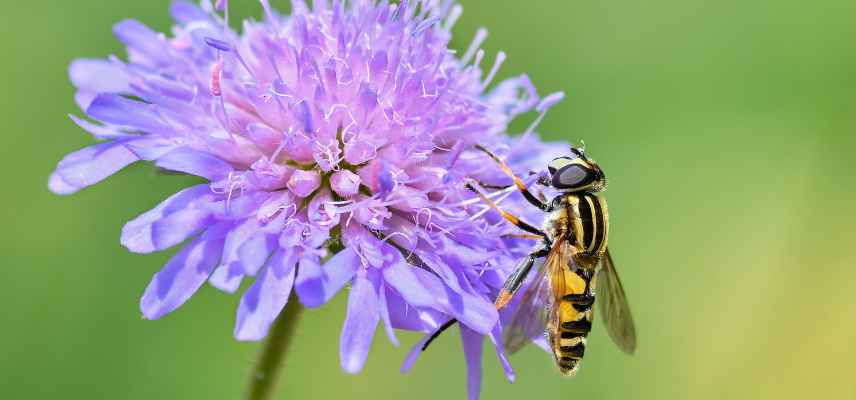 The hoverfly is an excellent pollinator</caption]
How to attract hoverflies to our gardens?
By creating a diverse and environmentally friendly garden, you can attract a variety of beneficial insects, including hoverflies.
Hoverflies are attracted to flowering plants, as they feed on their nectar and pollen. Planting a wide variety of flowering plants to achieve flowering at different times of the year, particularly those with an open corolla, will ensure a constant food source for these insects. Additionally, remember that the native plants in your area are often the most beneficial for local wildlife, including hoverflies. Moreover, hoverfly larvae feed on aphids, so if you plant vegetation that attracts aphids (roses, elderberries, broad beans…), hoverflies will be delighted.
Hoverflies also need certain areas of natural habitat to reproduce, such as compost heaps, wood piles, and hedges. Insect hotels serve more of an educational purpose than being truly beneficial to wildlife. However, even though hoverflies generally do not lay eggs in these structures, they can use them as shelter during adverse weather conditions or simply to spend the night.
And finally, completely ban any form of pesticides, even so-called organic or natural ones! Instead, let nature take its course!
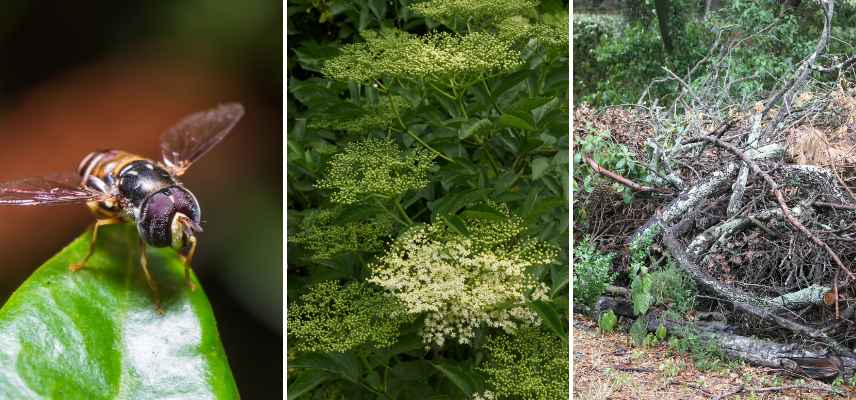 Attract hoverflies to your garden by planting melliferous hedges and bushes and maintaining wood piles and wild areas.</caption]
Life Cycle of Garden Hoverflies
The life cycle of hoverflies, like that of many other insects, includes four stages: the egg, the larva, the pupa, and the adult.
- Egg: The female hoverfly lays her eggs near colonies of aphids, as these serve as the main food source for the upcoming larvae. The eggs are typically elongated and white or light yellow in colour.
- Larva: Once hatched, hoverflies enter their larval stage. The larvae are elongated, often white, grey, or green in colour, and they do not resemble the adults at all. They are voracious and primarily feed on aphids, thus playing an important role in biological control against these pests.
- Pupa: After going through several growth stages, the larva transforms into a pupa, a transitional phase during which it metamorphoses into an adult. The pupa is usually attached to a leaf or another surface and resembles a small cocoon or capsule.
- Adult: Once metamorphosis is complete, the adult emerges from the pupa. Adult hoverflies feed on nectar and pollen, thus playing an important role in the pollination of plants. They have a similar appearance to bees or wasps, with a body that is generally yellow and black, but they are harmless to humans.
This life cycle can vary in duration depending on environmental conditions and the specific species of hoverfly. Generally, several generations of hoverflies can succeed each other during the same season.
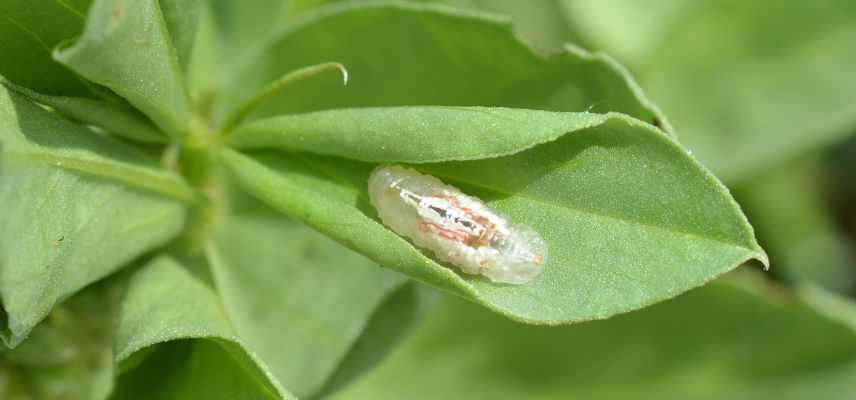 Hoverfly larva
Some of the most commonly found species in our gardens
- Eristalis tenax (the hoverfly with plume): This is one of the most common species, particularly notable for its ability to hover in place. Adults resemble a bee or wasp and feed on flower nectar.
- Episyrphus balteatus (the banded hoverfly): This species is very common in both countries. It is identifiable by the black and yellow bands on its abdomen.
- Syrphus ribesii (currant hoverfly): This hoverfly is very common throughout Europe. It is easily recognisable due to its yellow and black bands and elongated body.
- Eupeodes corollae or Eupeodes luniger: These species are commonly observed in many gardens. They are recognisable by their yellow abdomen with black bands.
- Volucella pellucens and Volucella zonaria: These species are larger and mimic the appearance of hornets.
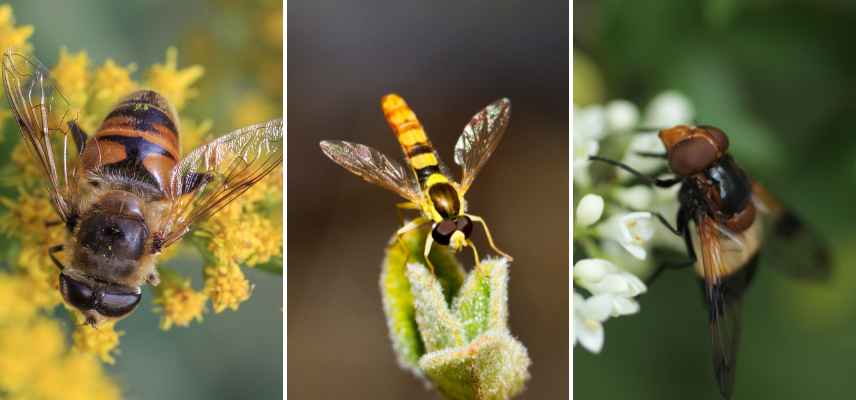
Eristalis tenax, Eupeodes corollae and Volucella pellucens
- Subscribe!
- Contents

Comments