





























Beaucarnea diseases and parasites: identification and solutions
Our tips for preventing and treating elephant's foot
Contents
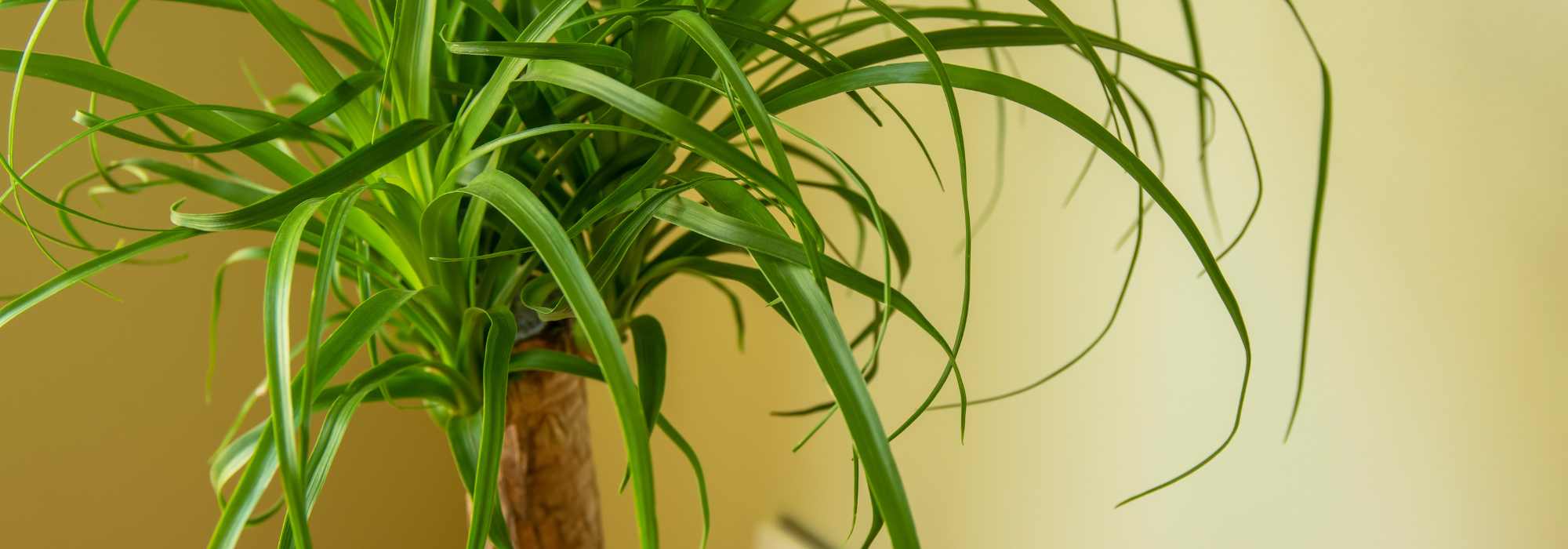
You like Beaucarnea recurvata for its bottle-shaped, swollen trunk and its cracked bark? Not to mention its tuft of fine, slender foliage that rises above this indoor plant and cascades down? Very on-trend thanks to its distinctive silhouette, this Central American plant, which forms a handsome tree in its natural habitat, is also very robust. If its high needs for light and warmth are met, and if you provide moderate watering, the elephant’s foot will reward you. Even though its growth is relatively slow.
Yet, despite its vigor, the foliage or trunk of Beaucarnea recurvata may sometimes show signs of weakness or distress.
Discover which diseases and cultivation problems affect the bottle-tree, or the parasites that may attack its foliage. By following our care and cultivation tips, your plant will quickly regain full health.

Growing conditions for Beaucarnea
For most houseplants, even the slightest appearance of a disease or a parasite is often linked to unsuitable cultural conditions. And this is all the more true for the elephant’s foot, as its needs can be summed up as good light, warmth and moderate watering. In a nutshell, that says it all.
By its origins, Beaucarnea recurvata appreciates rooms flooded with light, summer and winter alike. Moreover, during the summer season, it enjoys being outdoors, in the garden, on the balcony or on a terrace. You just need to shelter it from the weather, as it dislikes humidity. And in winter, don’t hesitate to place it near a window or, better still, in a conservatory that maintains a temperature around 10 to 15 °C.
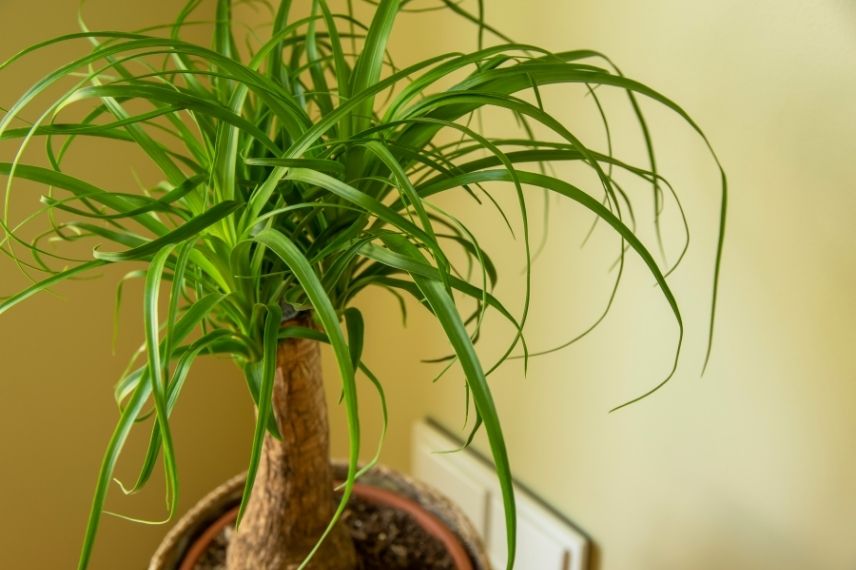
Beaucarnea needs light, warmth and moderate watering
Watering should be moderate. In its native habitat, the elephant’s foot grows in arid soils. That is why it has developed a degree of drought resistance and tolerance to water shortage, thanks to its swollen trunk. So don’t water it too much and wait for the substrate to dry between waterings. Additionally, it is preferable to use rainwater or demineralised water.
Read also
Growing Beaucarnea, the Elephant's FootBeaucarnea pests
If you fail to give your Beaucarnea recurvata the best growing conditions, pests will soon appear. And with houseplants, the same pests tend to appear — namely scale insects and two-spotted spider mites, commonly known as red spider mites.
Scale insects
Two types of scale insects can infest Beaucarnea’s foliage, namely cottony or mealy scale insects and brown shield scale insects.
They are tiny insects, difficult to reach as they often lodge in the axils of the leaves. Cottony scale insects are white and almost transparent, naked at the larval stage. These juveniles grow and develop by secreting a substance that resembles a tiny cocoon, in which they wrap themselves.
Brown scale insects are identifiable by their waxy shield, resembling a shield, which houses the eggs.
Scale insects are moderately mobile and thrive in warm, poorly ventilated environments.
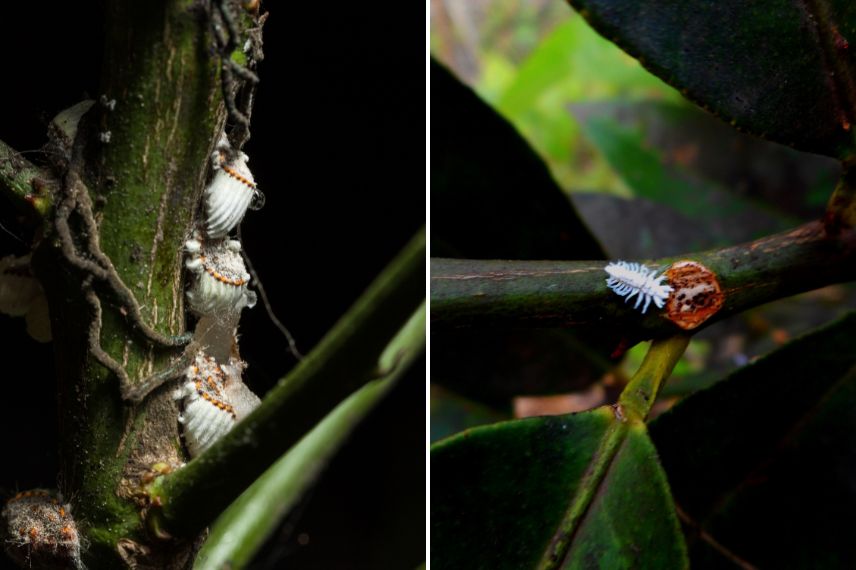
Scale insects can attack the foliage of the elephant’s foot
Symptoms
The leaves show cottony masses or grey-brown pustules. The foliage may yellow along the veins, dry and drop. In case of a heavy infestation, the scale insects secreting honeydew, a very sticky liquid, the leaf tissues suffocate. From then, sooty mould develops, a cryptogamic disease characterised by a black soot.
Curative control
To remove scale insects, first scratch them off gently with a fingernail or a match. Once this first step is done, dampen a cotton bud with denatured alcohol, or with soapy water, optionally mixed with a vegetable oil. It is necessary to run this cotton bud along the veins and in the axils of the leaves. It is a long and delicate task, but it allows you to get rid of scale insects effectively. The operation can be repeated the following week.
Your Beaucarnea recurvata should be isolated, as scale insects can infest other indoor plants.
Prevention
- Keep a close eye on any suspected signs of the pest and deal with it promptly
- Water your Beaucarnea moderately, without leaving water in the saucer or pot
- Carefully remove all dead or damaged leaves
- Space your plants apart to allow air to circulate
- In winter, keep Beaucarnea at 10–15 °C and ventilate the room where it is kept regularly.
Red spider mites
Red spider mites are parasitic arachnids identifiable by their roughly half-millimetre diameter globular bodies, four pairs of legs and their red, orange or brownish colour. This mite is an arachnid, named the twospotted mite, whose common name comes from what betrays its presence: a very fine silk web, woven mainly on the undersides of the leaves. This mite is endowed with a sucking organ with which it pierces the tissues and sucks the sap.
Red spider mites can multiply very quickly. The appearance of red spider mites is favoured by excessive dryness in the air.
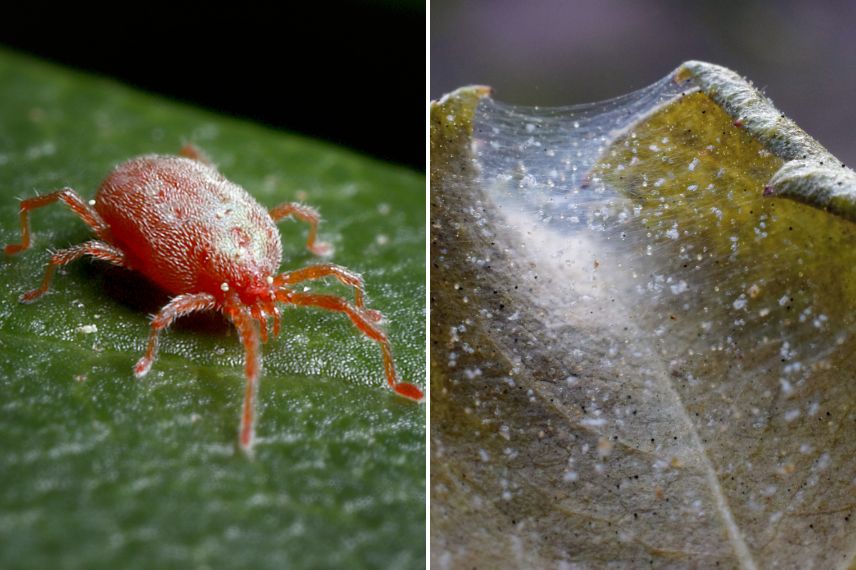
Red spider mites develop rapidly
Symptoms
In case of severe infestation, damage can be considerable, aggravated by rapid multiplication. The leaves take on a powdery appearance, become discoloured and eventually wither and dry out.
Curative control
- Isolate your Beaucarnea infested with red spider mites which could spread to another plant
- Rub the foliage with a damp cloth to remove the webs
- Place the plant under a strong jet of room-temperature water
- Spray a natural solution made by mixing one litre of water with 20 drops of rosemary essential oil, 3 drops of liquid dish soap and 5 ml of a vegetable oil such as canola oil. Garlic decoction is also effective.
Prevention
The best weapon against red spider mites is to mist the foliage with rainwater. However, you should not overdo it with the Beaucarnea, which dislikes humidity. You should also ventilate the room where it is kept.
Minor and major cultivation mishaps when growing the elephant's foot plant
Foliage is often the most heavily affected by poor growing conditions. But the swollen trunk can also be a symptom. However, if the leaves at the base of the Beaucarnea clump drop off occasionally, that’s normal. Your plant is growing (albeit slowly, but surely) and its foliage is changing. The oldest leaves make way for the new ones.
Why are my ponytail palm leaves turning brown?
However, leaves browning at their tips are not a usual symptom. Causes can be multiple. If your ponytail palm was placed near a window or a glass door, the foliage may have been scorched by direct sun. If it isn’t exposure, you’ll need to look elsewhere. And, in general, this problem can be linked to watering, either overwatering or underwatering. Remember to allow the potting mix to dry out between two watering sessions and remove any residual water an hour afterwards. Finally, leaves that seem burned at the tips may be due to the irrigation water. Perhaps it is too hard? In that case, water with rainwater. You can also let your irrigation water settle for two to three hours before watering.
A Beaucarnea that loses leaves in numbers should also be examined carefully. But, overall, a massive leaf drop is linked to overwatering. By spacing out watering, the problem should subside. This problem can also be due to poor exposure. Your Beaucarnea lacks light and urgently needs to be placed in a room flooded with light.
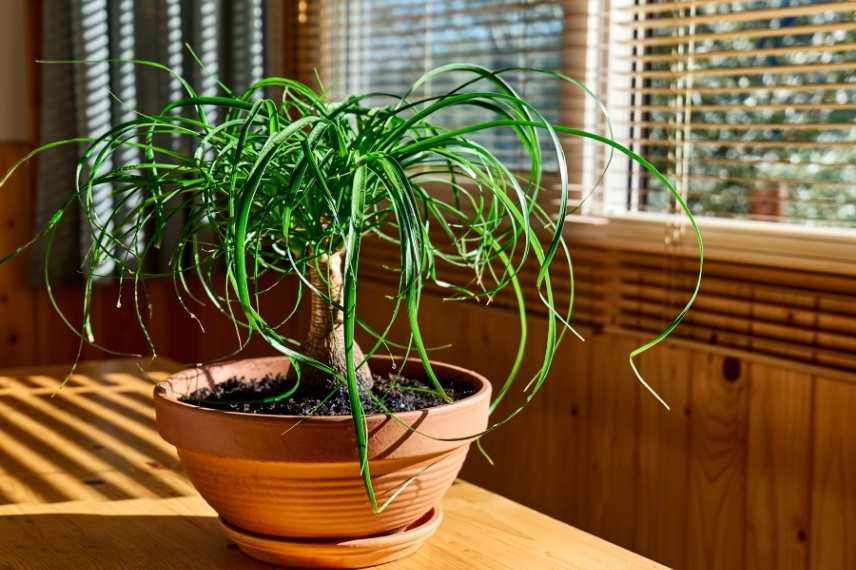
Beaucarnea needs plenty of light
The symptom of leaf drop can also be caused by a lack of warmth. Your ponytail palm may be installed in a room that is too cold or subjected to draughts? Try moving it.
Finally, the most serious problem is certainly root rot which manifests as a soft trunk or already afflicted with rot. In parallel, the foliage yellows. Again, you must act quickly by checking drainage. The pot must be perforated with holes and any residual water must be removed systematically. Do not hesitate to reduce or stop the watering. But the best solution remains repotting which will allow you to observe the state of the roots. You may need to remove some segments. Then, your Beaucarnea will be transplanted into a new pot, drained by a good layer of gravel or clay balls, and filled with a substrate composed of a general-purpose potting mix for green plants and a little heather soil.
Elephant's foot diseases
Overall, Beaucarnea recurvata is hardy and appears resistant to all common indoor plant diseases.
For more information about Beaucarnea
- Our plant profile: Elephant’s Foot – Beaucarnea: how to grow and care for it
- Subscribe!
- Contents
Comments