





























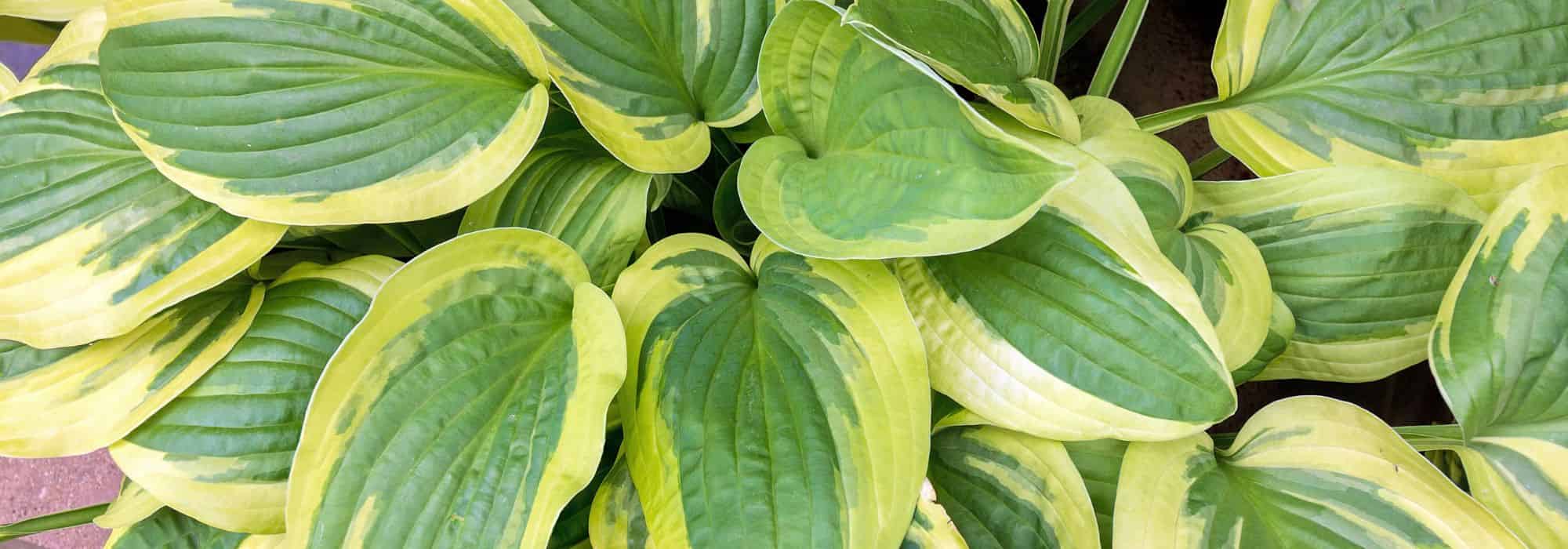
Adorn your garden with variegated foliage plants
Bring light, contrast and originality to your flower beds
Contents
A garden is like a painting nourished by the diversity and beauty of nature. To achieve perfect combinations, the gardener can call on a wide palette of colours, among other things through the foliage. In nature, most foliage is green. But, in a garden, the foliage colour chart ranges across different shades of yellow, purple, red, grey, bluish… to which variegated foliage is added.
These plants are distinguished by leaves that are maculate, striate, edged, punctate or variegated in colours ranging from white to cream, from yellow to pink. These plants can find a place in gardens thanks to their many aesthetic qualities. However, they should be used sparingly, otherwise you risk creating a garden where cacophony reigns!
Discover our tips for best incorporating variegated-foliage plants and some examples of remarkable trees, shrubs and perennials.
To find out more: Where does variegated foliage come from?

What exactly is a variegated foliage?
Variegated foliage is foliage that displays several colours and often different patterns. Indeed, whenever foliage is not uniformly coloured but maculate with various shades other than green, it is variegated. Specifically, these leaves are more or less maculated or spotted, or simply edged, or even striated with colours. These colours juxtapose and appear in lighter shades of white, cream, golden yellow, pink, grey… Beyond the multiple colours, variegated foliage is also distinguished by variations in pattern.
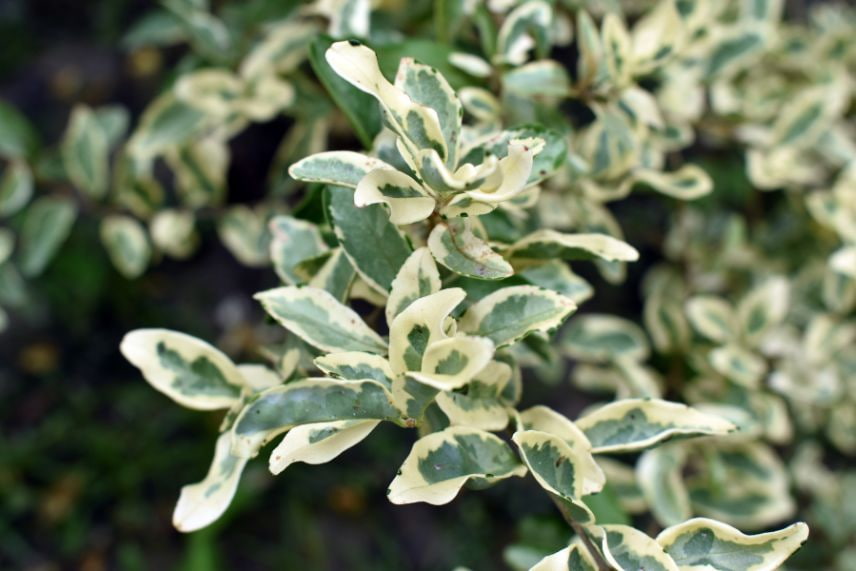
Variegated foliage stands out for its variations in colour and pattern
These variegations (or variegation) are essentially due to unexpected mutations or those deliberately induced by breeders who wish to create new varieties. Sometimes a virus is the cause of this variegation. But some plants naturally have bicoloured foliage.
Specifically, these variegations are the result of a lack of chlorophyll in the lamina of the leaves. As a reminder, the green of the leaves comes from chlorophyll, which transforms light into sugars, sources of energy for plants. As a result, plants with variegated foliage are generally less vigorous than the same species with uniform foliage. Quite simply, because they have less chlorophyll.
But that is not a valid reason to deprive yourself of these plants with such distinctive foliage.
Read also
10 perennials with variegated foliageExamples of trees, shrubs and perennials with variegated foliage
Many plants display marbling, variegation, spots, marbling… speckled with white, cream, yellow, pink or red. Generally, these plants bear Latin terms such as “variegata”, “maculata”, “marginata”…
Perennials with variegated foliage
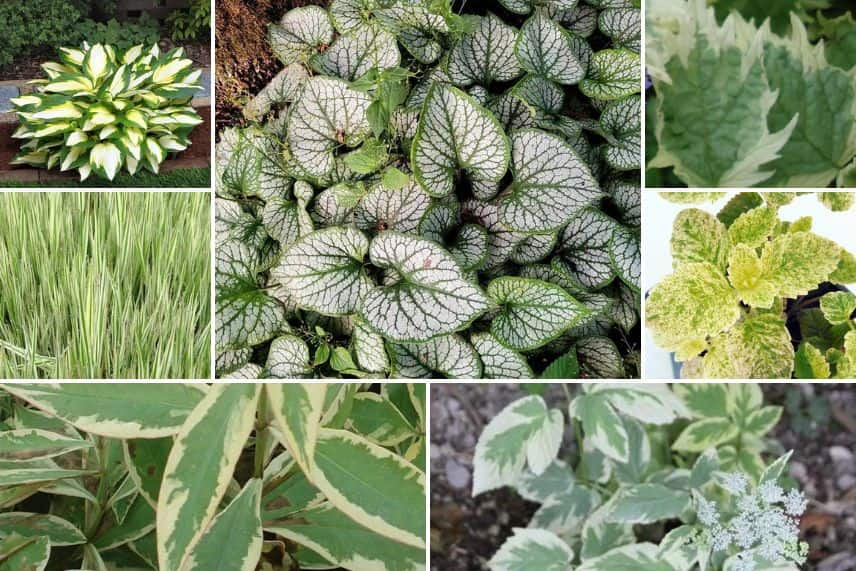
Hosta ‘Color Festival’, Holcus mollis ‘Albavariegatus’, Phlox paniculata ‘Becky Towe’, Brunnera macrophylla ‘Queen of Hearts’, Ajuga incisa ‘Frosted Jade’, Calamintha grandiflora ‘Variegata’ and Aegopodium podagraria ‘Variegata’
- The variegated creeping bugle (Ajuga reptans ‘Variegata’) with grey-green leaves marginate with cream, or the creeping bugles ‘Golden Glow’ or ‘Burgundy Glow’, not forgetting the incised bugle (Ajuga incisa) ‘Frosted Jade’ with very striking grey-green foliage variegated with white
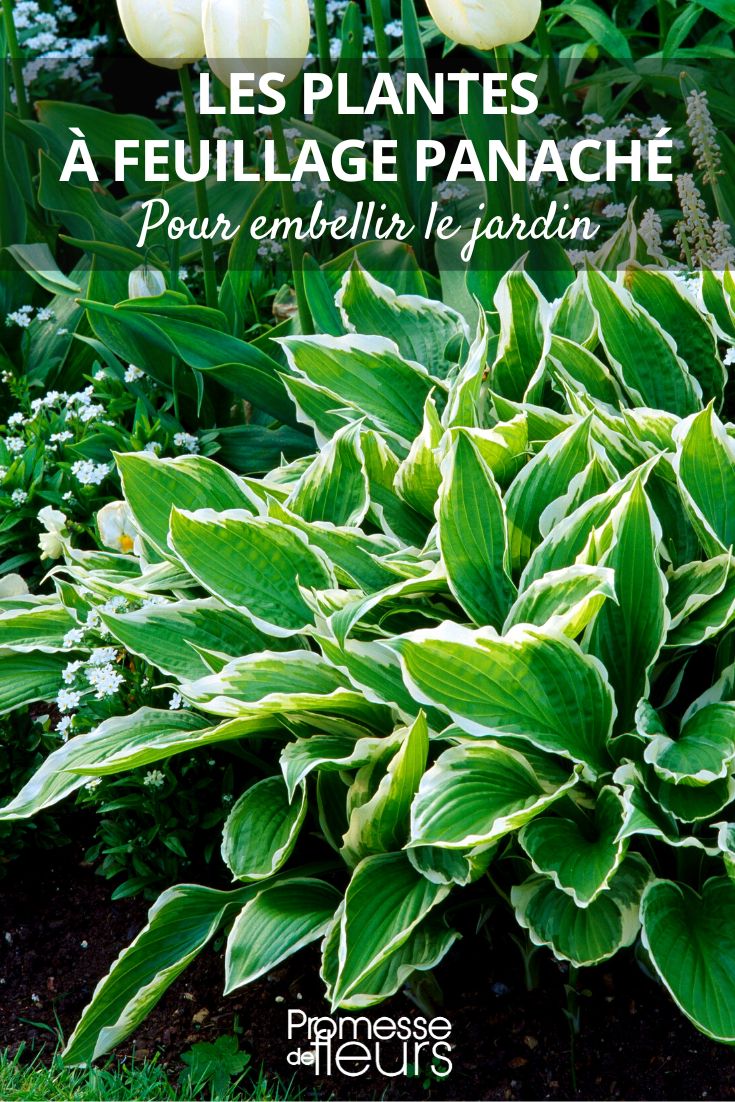
- The hostas: difficult to choose among these perennials mainly grown for their deciduous foliage marginate with white, cream, yellow, bluish… : Hosta undulata ‘Mediovariegata’ is quite exceptional, as is the Hosta ‘Color Festival’ — but it’s all a matter of taste…
- Holcus mollis ‘Albavariegatus’ is a perennial with long, narrow foliage, unique for its white and green variegation
- Phlox paniculata ‘Becky Towe’ with light green leaves marginate with yellow then white and with pink flowering
- Calamintha grandiflora ‘Variegata’ with scented, puckered pale-green foliage splashed with cream
- Aeopogodium podograria ‘Variegata’ or goutweed, with tender green foliage marginate with white
- The Caucasian forget-me-nots (Brunnera macrophylla) ‘Dawson’s White’ or ‘Queen of Hearts’ with splendid ornamental foliage.
Further reading : All our perennials with variegated foliage
Shrubs with variegated foliage
There are many shrubs with variegated foliage, among which are:
- Euonymus fortunei or spindle with evergreen foliage
- Cornus alba ‘Sibirica Variegata’ or white dogwood
- Salix integra or flamingo willow
- The Pittosporum eugenoides ‘Variegata’ or, even better, Pittosporum tenuifolium ‘Victoria’ with grey-green foliage with undulate cream-white margins that blush in the cold
- The variegated box (Buxus sempervirens ‘Elegans’)
- Weiglia florida ‘Nana Variegata’
Of course, the list is not exhaustive! Discover all our shrubs with variegated foliage
Some trees with variegated leaves
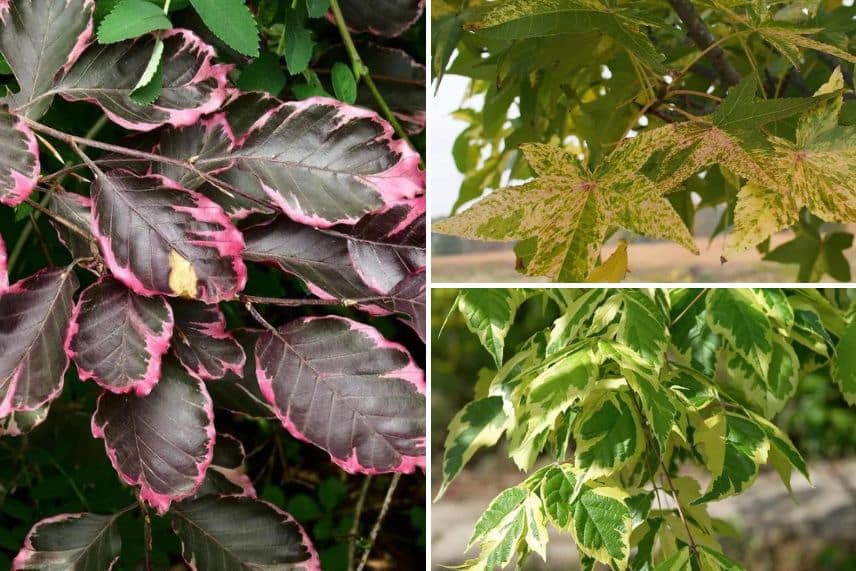
Fagus sylvatica ‘Purpurea Tricolor’, Liquidambar styraciflua ‘Aurea’ and Acer negundo ‘Aureovariegtaum’,
Fewer are the trees offering variegated foliage. But you can hardly ignore the ash-leaved maples (Acer negundo) ‘Aureovariegtaum’, ‘Variegatum’ and ‘Aureomarginatum’, the American sweetgum (Liquidambar styraciflua) ‘Aurea’, variegated beeches (Fagus sylvatica ‘Marmor Star’, or even ‘Purpurea Tricolor’).
The aesthetic advantages of variegated foliage
Plants with variegated foliage are undeniable assets for all gardens. Provided that you select the species and place them judiciously in the borders. Indeed, variegated foliage adds beauty and dynamism.
They create a focal point and draw the eye to a feature or area of the garden. Such a plant with variegated leaves can thus become a visual reference point throughout the seasons. Especially if it is planted in shade or partial shade, locations that this foliage particularly favours, where it brings a touch of light and brightness. A plant with yellow variegated foliage brings a certain kind of dynamism, whereas plants variegated in silvery grey add more refinement.
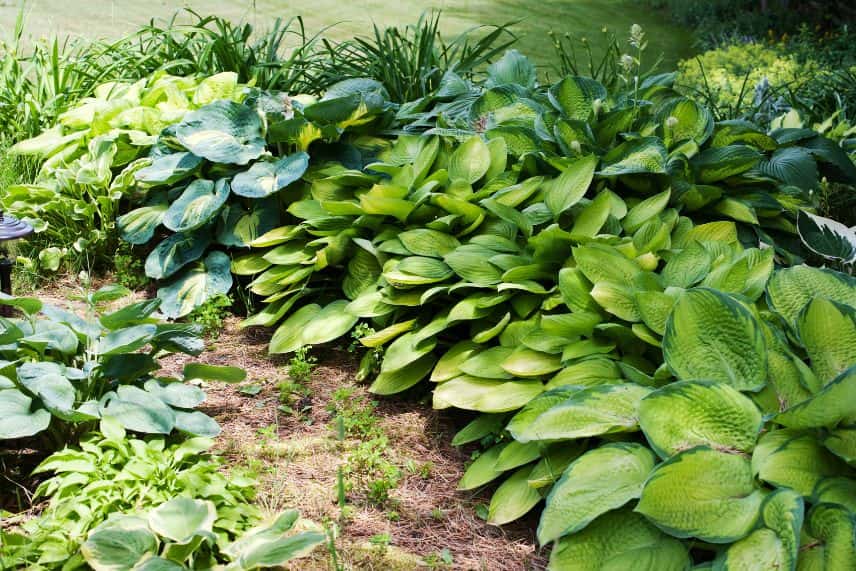
Variegated foliage forms a focal point in a garden
Perennials, shrubs and trees with variously coloured foliage can also break the monotony of a border or a hedge that is uniformly green. This contrast of colours will naturally add body to the border or hedge. These variegated plants will provide a permanent display in the garden with little effort. Especially when winter cloaks your garden in a somewhat dreary grey, or when the sun is conspicuously absent.
These plants with foliage tinted in various shades of green and splashed with white, pink or yellow are an excellent way to create transitions between plants with colourful flower displays. Thus, a shrub variegated with yellow pairs very well with perennials with yellow flowering. It kind of serves as a backdrop to create a genuine harmony within the borders.
However, if there is one essential point to remember, it is that you must not overuse variegated foliage. They should be sprinkled through a border or a hedge simply to punctuate it. An excess of variegated foliage can quickly tire the eye!
- Subscribe!
- Contents
Comments