





























Berberis: 5 easy and colourful varieties to grow in pots
Compact Berberis for terraces or balconies
Contents
Berberis, or barberry shrubs are very varied. Some are prized for their colourful foliage, while others are grown for their flowering and ornamental fruiting.
They are ideal for security hedges, thanks to their thorns. But they are, above all, easy to grow and low-maintenance, ideal for beginner gardeners.
Most Berberis can be grown in pots, but some varieties are more suited. This is the case for the roundest, least thorny forms.
So here is our selection of five Berberis to dress up your terrace or balcony.
And to successfully grow these shrubs, see our guide: Berberis, thorny barberry: planting, pruning and care.

Berberis thunbergii 'Tiny Gold'
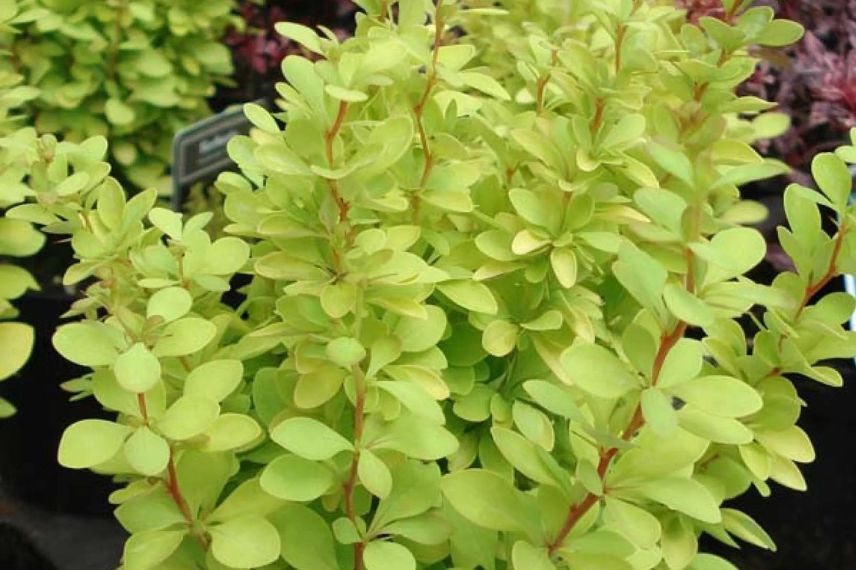
‘Tiny Gold’ is a dwarf Berberis that adapts very well to container growing. It’s a safe bet, with a neat globe-shaped habit not exceeding 40 cm in any direction – perfect for the smallest spaces!
Its thorns are not very aggressive, reducing the risk of injuries.
It stands out from other Berberis thanks to its particularly luminous foliage: it indeed produces small leaves in a pale green, tinged with gold. They are glossy and smaller in size than those of other varieties. Like most Berberis with coloured foliage, it is deciduous.
Flowering occurs in mid-spring, in May. It consists of clusters of small bell-shaped flowers. Their colour is yellow, speckled with red. This melliferous flowering attracts many pollinators. It then gives way to small spherical red fruits in autumn, for a display that lasts for many months.
Undemanding and easy to live with, it is as hardy as it is not particularly water-demanding. In pots, however, watering should be a little more regular than in the ground, since the soil dries out more quickly. It is a shrub that responds well to pruning, allowing you to maintain its pretty, harmonious silhouette. Place it in full sun or partial shade, in well-drained soil, so that water does not stagnate excessively.
Read also
Growing a berberis in a potBerberis buxifolia ‘Nana’
This box-leaved barberry forms a small bush of about fifty centimetres in all directions. These modest dimensions and its slow growth make it very easy to grow in a pot.
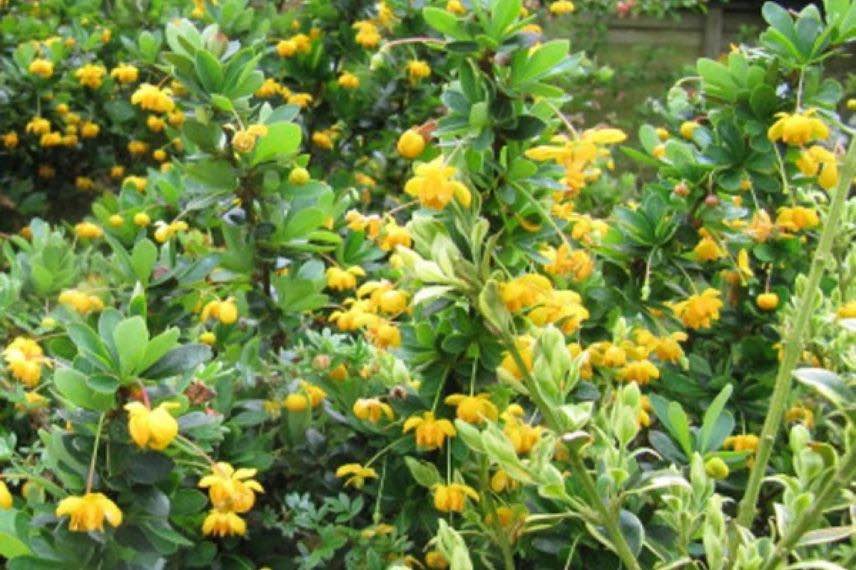
Its compact, rounded silhouette is made up of small leathery leaves, dark glossy green. They are evergreen, which makes this shrub decorative all year round.
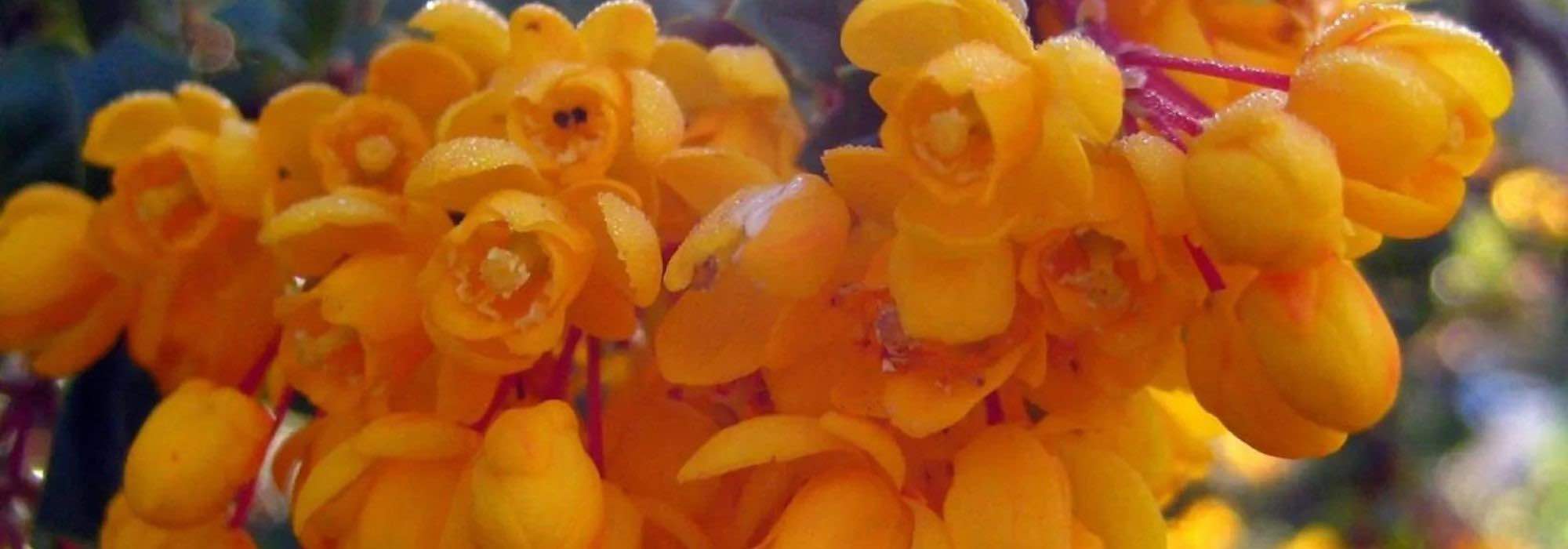
Its flowering occurs in late spring, between May and June. It then bears small bell-shaped flowers in a bright yellow-orange that light up terraces, balconies or an inner courtyard. After this flowering, small purplish fruits sometimes appear, which stay on the plant for a good part of the winter.
Another advantage for compact spaces: it is among the least prickly varieties, which will therefore not cause too much trouble if you need to pass by regularly.
‘Nana’ will acclimatise to conditions that are even somewhat difficult, dry, calcareous or cold.
Berberis thunbergii ‘Lutin Rouge’
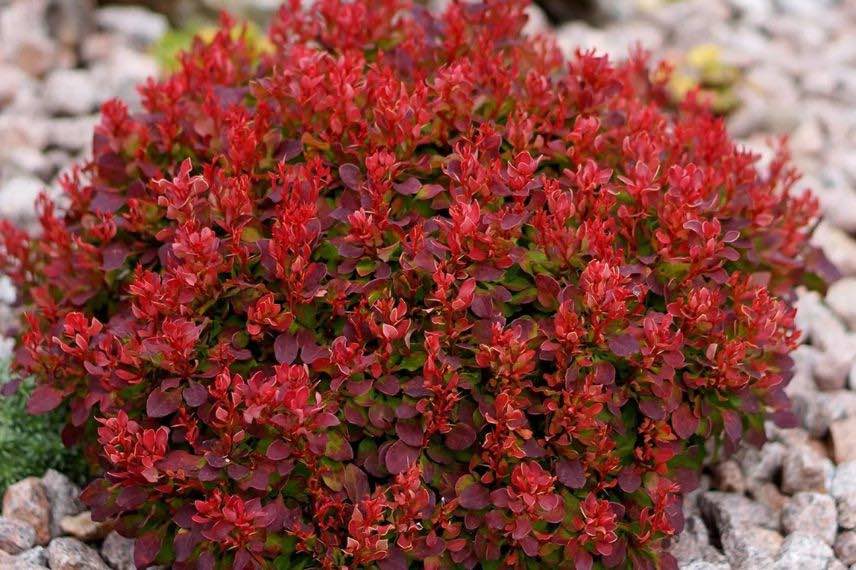
‘Lutin Rouge’ is another very small variety with a distinctly spherical silhouette. It grows to around 60 cm in all directions. What we particularly like about this miniature barberry is the scarlet colour of its foliage, particularly vivid in bright sunshine. Over time, the leaves develop deeper purplish, then violet tones, before fading in late autumn.
In spring, small yellow bell-shaped flowers appear. They are arranged in clusters and are a boon to insects. They are then followed by bright red fruits.
It is an ideal choice for contemporary terraces or balconies, as well as for a gravelled or hard-landscaped space. Its spines are also fairly unobtrusive.
Like its relatives, it is hardy to frost, drought-tolerant and easy to grow. Provide it with a sunny or partly shaded position in well-drained soil, even if poor. Note that in shade, the foliage takes on a more classic apple-green colour, then mid-green. That is why we recommend placing it in a bright, sun-filled position.
Read also
Choosing a BerberisBerberis darwinii 'Compacta'
The name ‘Compacta’ signals from the outset that it is a small variety with a moderately dense habit. A little larger than its dwarf counterparts, it reaches 90 cm in all directions.
This small spiny bush rewards us with evergreen foliage, ornamental all year round. Initially slightly tinged with green when young, the leaves display then a dark, glossy green. Slightly dentate, they resemble holly leaves.
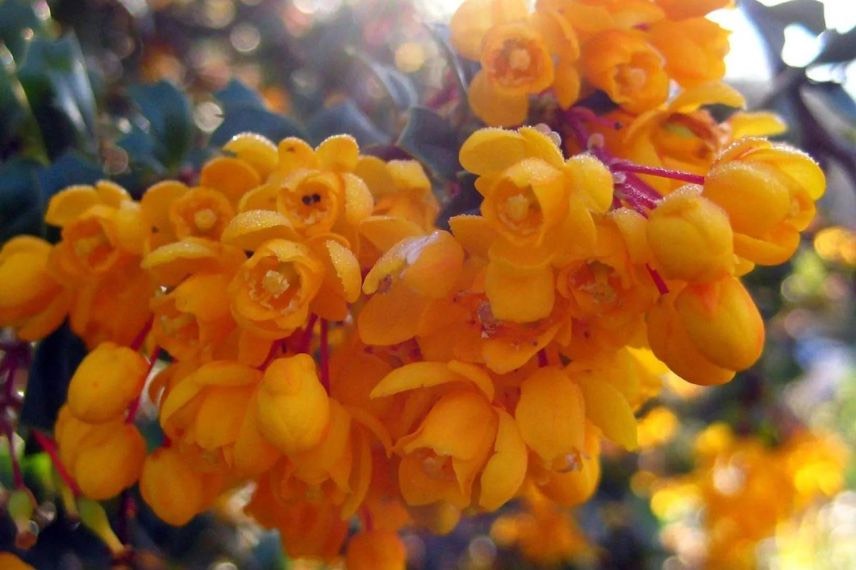
This dark foliage nicely sets off the spring bell-shaped flowering, with a warm yellow-orange hue, carried by bright red pedicels. In autumn, blue berries, followed by deep purple ones, take over. They delight birds until the start of winter.
This Berberis tolerates anything: sun as well as partial shade, frosts as well as sea spray, pruning as well as neglect. Simply remember to provide it with well-drained soil, even of mediocre quality.
The Berberis thunbergii 'Inspiration'
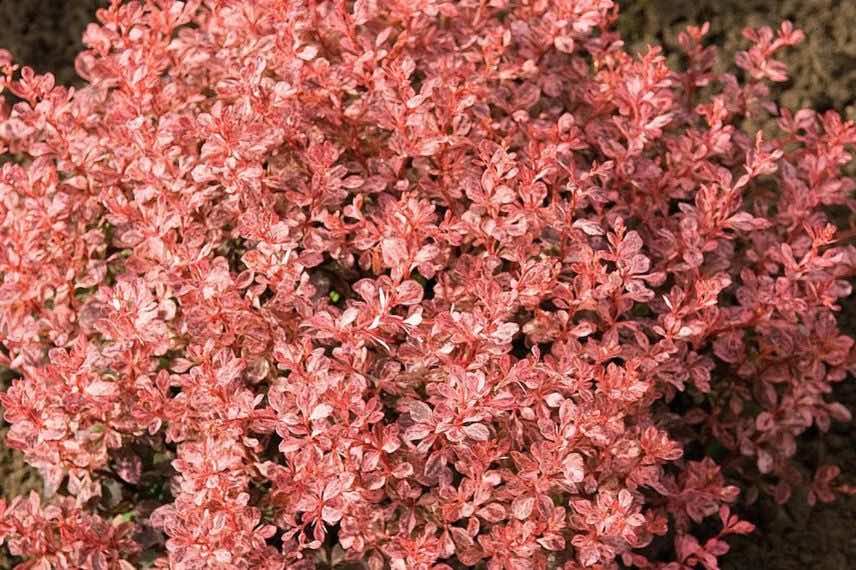
Another particularly colourful variety of barberry: ‘Inspiration’ offers foliage that is almost constantly evolving. Its young shoots are initially purple, marbled with white and pink. Then the leaves turn to deep purple, then will take on red and orange hues in autumn, before falling. This small shrub thus livens the space for several months without monotony.
Towards the end of spring, it is adorned with small cream-white flowers, which will be visited by pollinating insects. A fruiting in the form of red berries will follow.
A compact variety, ‘Inspiration’ will not exceed 50 cm in all directions. Its rounded silhouette is perfect for growing in pots.
Hardy, easy to grow and to maintain, it will thrive in full sun to enjoy the intensity of its foliage (or in light shade), in all well-drained soils, even if occasionally dry.
Note that this is quite a spiny variety: place it away from areas of foot traffic.
- Subscribe!
- Contents
Comments