


Bokashi, the Japanese method of composting
Everything you need to know about this compost that turns kitchen waste into a very rich fertiliser
Contents
Bokashi… No surprise, the term’s resonance takes us to the Land of the Rising Sun. As for its translation, it’s equally obvious. Indeed, bokashi is a Japanese-origin term that literally means “fermented organic matter”. It is therefore a composting technique that valorises your food waste, ideal in urban settings or flats. However, if you live in the countryside and have a garden, bokashi is also very interesting, mainly thanks to its ease of use.
Unlike vermicomposting, which relies on earthworms, bokashi works with bacteria in an anaerobic medium. Within days and weeks, kitchen waste is transformed into a rich and highly nutritious liquid fertiliser and a digestate that can be incorporated into the soil, or into an individual or communal compost bin.
Explanations on how bokashi works and its usefulness, not forgetting the advantages (and disadvantages) of this worm-free composting method.

What exactly is bokashi?
To put it simply, one could define bokashi as a kitchen or apartment compost bin that takes the form of a bucket, equipped with a tap and a lid, about 40 cm tall. Nothing out of the ordinary, except for what it contains inside! Indeed, bokashi is a method of recycling and composting kitchen waste. A bit like a worm compost bin or vermicomposter, but without earthworms! It’s therefore an ideal system for those who would never countenance housing these little creatures, certainly very efficient, but teeming, under their roof. It is also perfectly suited to those living in apartments in urban areas who would be too far from a communal composting facility.
For a reminder, since 1 January 2024, composting of organic waste is obligatory for everyone, city dwellers or rural residents.
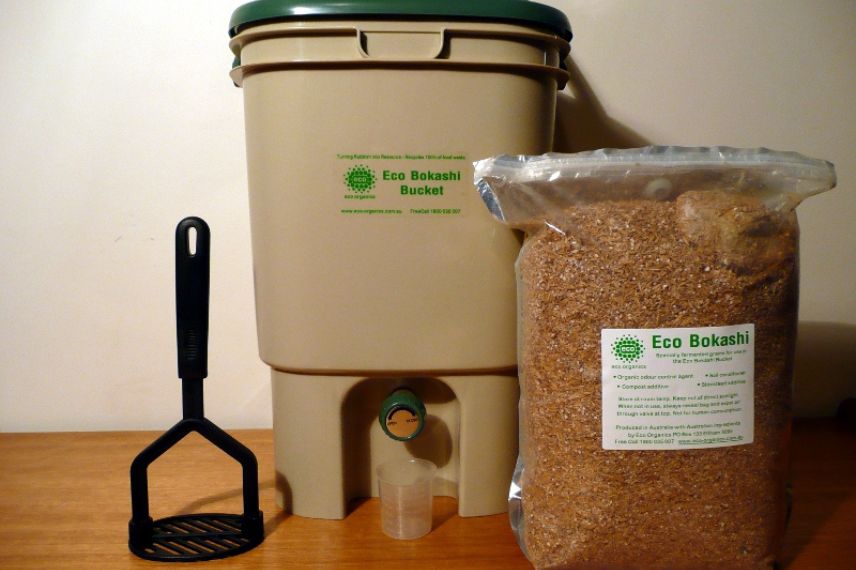
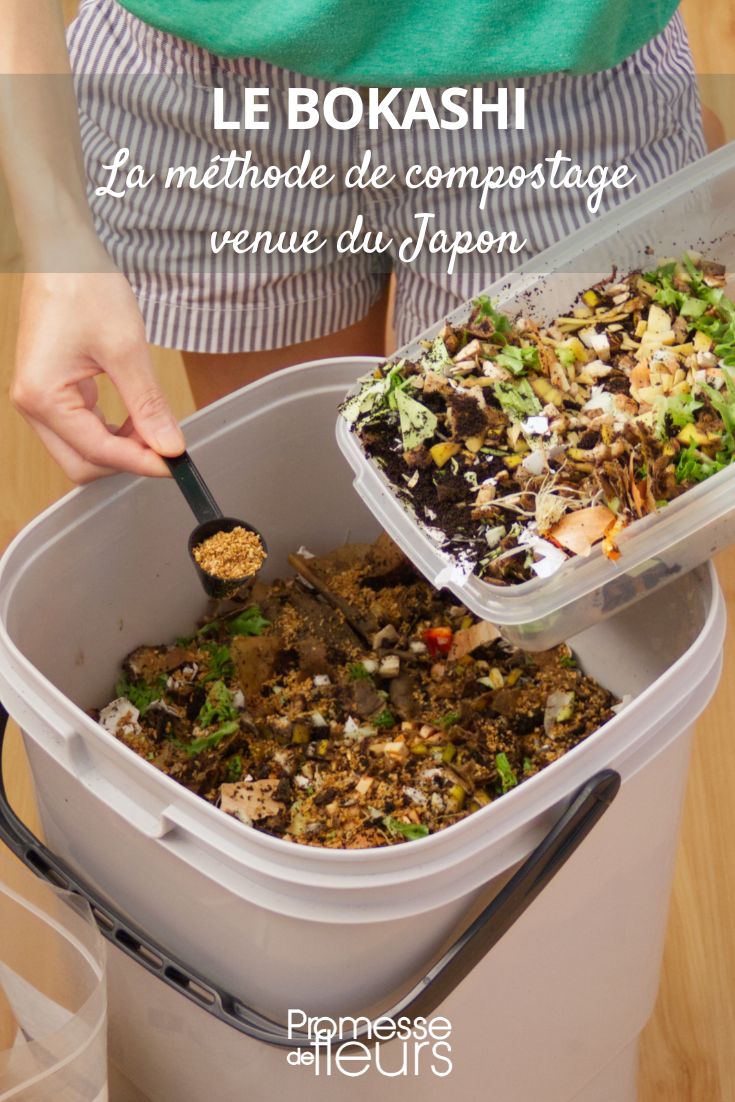
The basic equipment: the bokashi bucket, activators and the tamper for packing down (©Pfctdayelise via Wikimedia Commons)
Bokashi is therefore a method of composting food leftovers in a bucket the size of a domestic bin. And, unlike all other composting techniques, in bokashi, you can put all your waste. Starting with fruit and vegetable peels with no restrictions, eggshells, coffee grounds and tea bags, but also leftovers from cooked meals, starchy foods (pasta, rice…) and legumes, meat or fish (with small bones), dairy products, bread crusts, pruning waste from green plants, spent flowers… In short, your bin is significantly lighter and lighter. This can represent substantial savings in municipalities where waste collection is charged by weight.
The essential is to cut each piece of waste into small pieces before introducing it into the bokashi to aid disintegration.
Read also
Making compost on your balconyHow exactly does this composting system work?
This technique of composting food waste relies on a double-bottomed bucket, fitted with a lid to keep it hermetically sealed. Indeed, bokashi is a method of lactic fermentation in an anaerobic medium, i.e., without oxygen. In practice, in this closed medium, bacteria, known as effective microorganisms (EM), feed on the carbohydrates present in the waste you put into the bucket and convert them into lactic acids. The production of these lactic acids halts the normal putrefaction of the waste and preserves them.
After a few days, you obtain a liquid fertiliser rich in nutrients, and after a few weeks of rest, a kind of compost that looks very different from that produced in an outdoor compost bin or in a worm composting bin. In summary, in bokashi, the waste is fermented, whereas in the worm composting bin, it is decomposed. The other notable difference lies in its use: waste added to a worm composting bin or a garden composter must be perfectly balanced in nitrogen and carbon. In bokashi, you put in all waste without worrying about a precise balance.
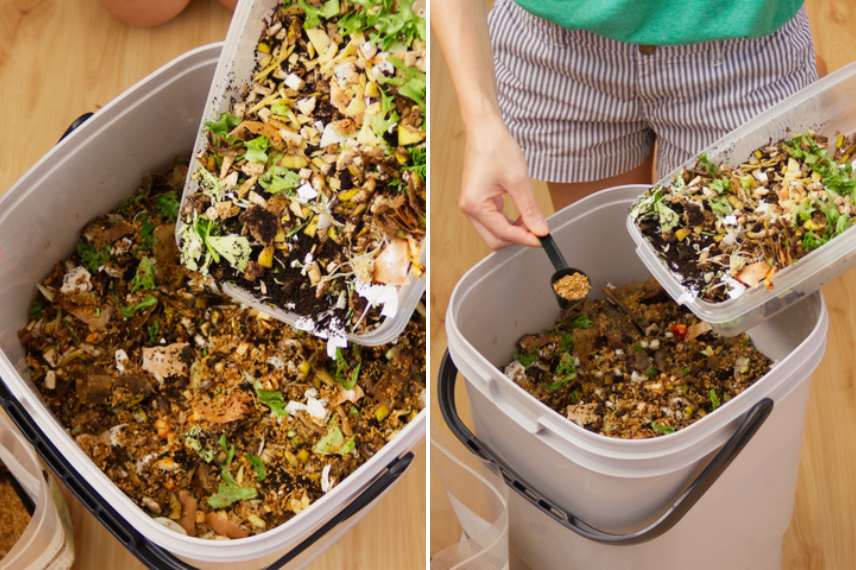
Filling the bokashi bucket is done in two steps. Pour in the food waste, then add a dose of activators
However, it is not enough simply to fill your bucket with food waste. Indeed, table scraps are deposited in 5 cm layers and tightly packed to remove air. Then a dose of activators composed of wheat bran, molasses and the famous effective microorganisms must be added. And the bucket is carefully closed with the lid. Waste and a dose of activators are added once a day to avoid introducing too much air. Until the bucket is full. At this stage, two weeks are required to complete the fermentation process. Two weeks during which the bucket remains closed. That is why it is recommended to obtain two bokashi buckets to continuously compost your organic waste.
And after two weeks, it’s ready!
How to use bokashi compost?
With bokashi, you obtain two types of fertilisers derived from the fertilisation of food waste:
- A very nutrient-rich liquid fertiliser, to be drawn off via the tap every two to three days. This liquid fertiliser, suitable for leafy plants, but also for spray application in the vegetable garden, is diluted to 1% in water (i.e., 10 ml per litre of water)
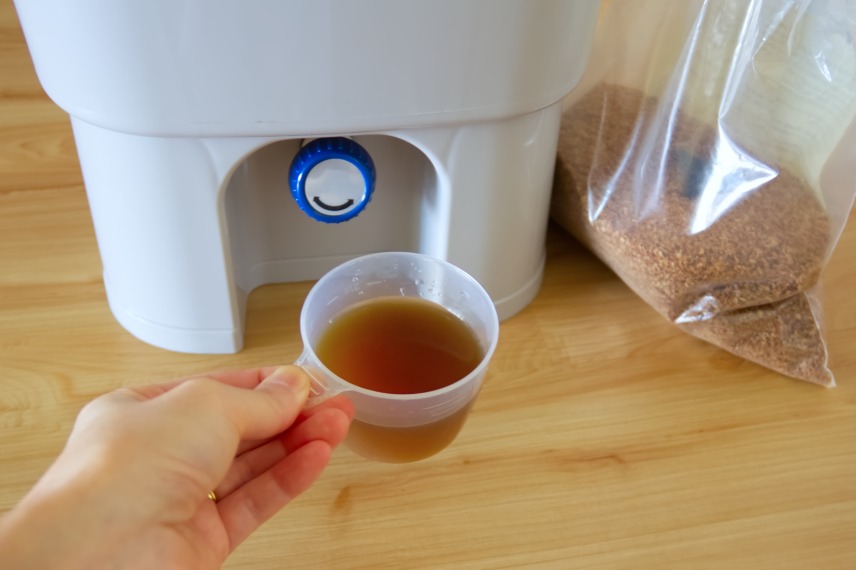
The liquid fertiliser produced after a few days of fermentation
- Digestate is a fermented material that looks completely different from traditional compost, produced after around twenty days. The waste, not being composted but fermented, retains its original appearance and displays a brown colour. Its acidity is high, the digestate cannot be used as such. It can be used in several ways: either you integrate it into your outdoor compost bin or into a community composting bin, or you bury it in the soil of your vegetable garden to support future harvests, or you place it in a hole to reduce its acidity.
The benefits of the bokashi method
Obviously, at first glance, Bokashi offers many advantages, especially when compared with traditional composting or the vermicompost bin:
-
- Its ease of use and storage : Bokashi can be set up either indoors (kitchen, laundry, garage…) or outdoors (balcony, terrace, small garden, yard…). Then you simply drop your waste daily, along with a dose of activators. However, buckets must be stored in a place where the temperature range isn’t too wide, as temperature fluctuations can block fermentation.
- All food waste can be recycled, including meat and fish.
- The ripening speed of the compost (2 to 5 days for the liquid fertiliser, around 20 days for the digestate).
- Maintenance is kept to a bare minimum since it only needs cleaning with hot water every six months.
- The system’s autonomy which requires no intervention, unlike outdoor composting that needs aeration and moisture, where you must monitor temperature and the balance between dry and moist materials.
- Bokashi emits no bad odour if the lid is kept closed properly. Likewise, it does not attract flies or other insects.
- This composting system helps save money (if bin collection is charged by weight).
- It adds value to waste.
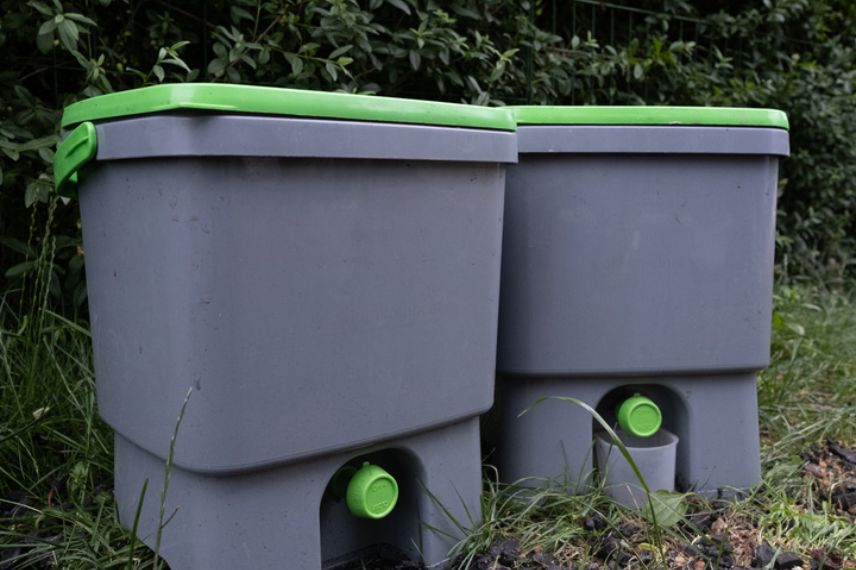
Ideally, two buckets are required to compost all your food waste
The drawbacks that should not be overlooked
If bokashi seems to offer many advantages, it nevertheless hides a few drawbacks worth knowing before investing. the bokashi represents a certain financial investment. Indeed, to ensure complete recycling of your food waste, you need to buy at least two buckets to establish a rotation. These buckets can be bought from garden centres, specialist shops or online. Expect to pay between €40 and €80 for a tap-equipped bucket, a figure to double. In addition to that initial outlay are activator sachets, priced between €5 and €10 for a 1 kg bag. A 2 kg bag is sufficient for a year’s use for a two-person household.
There is also a slightly sour-sweet odour detectable when opening the lid to deposit waste. If you are particularly sensitive to odours, you may find it disagreeable.
Similarly, if the lid is not properly closed or the bucket is too full, the waste literally rots, releasing a stronger odour and attracting insects. So you must be meticulous about closing the bucket.
And above all, the main drawback of this system is that it doesn’t really produce compost but digestate. To use it, it must be mixed into soil or traditional compost. This implies that you need a garden or access to a communal composting facility (if your local council has installed these communal composters on public land…). You could also give it to gardening friends, or to community or shared gardens.
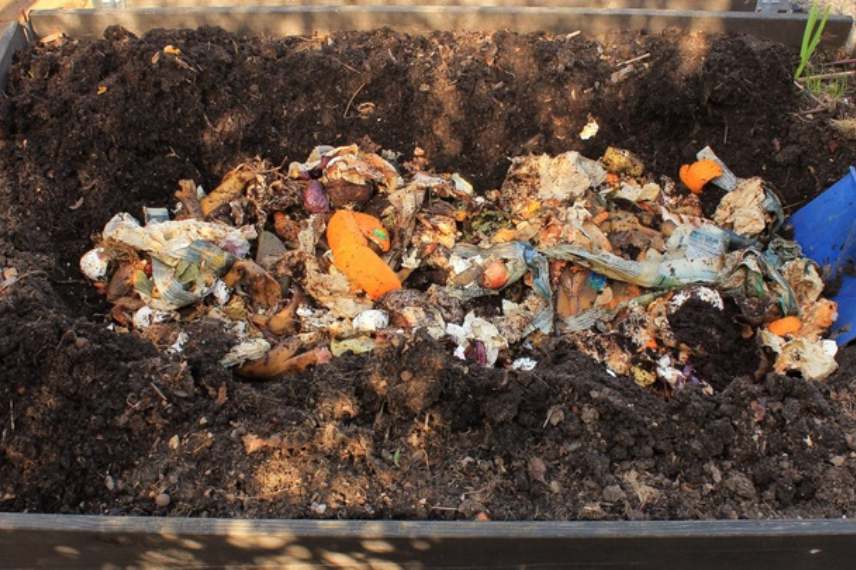
Too acidic, the digestate must be incorporated into soil or compost for use
Finally, perhaps it is wise to note that the fertiliser and the digestate obtained will be of much higher quality if you compost organic foods grown without pesticides and other herbicides and fungicides. While returning organic matter to the soil is generally a good thing, we may not yet have sufficient evidence to know their impact on soil microbial life in the presence of pesticide traces.
- Subscribe!
- Contents
Comments