





























Choosing a Brazilian guava or Feijoa : our buying guide
Our buying guide to find the ideal variety
Contents
Brazilian guava or Feijoa (Acca sellowiana) is a small fruiting tree just as much appreciated for its evergreen grey-green decorative foliage, its distinctive spring flowering, as for its tart green fruits with a look reminiscent of large kiwis and avocados. It forms a handsome tree with a bushy habit of modest proportions, rarely exceeding 4 m in height. In the garden, it can be planted as a hedge, as a specimen or in a pot in cooler regions. Relatively hardy (down to -12°C at least), Feijoa grows perfectly well here in full sun, in all soil types. However, it will only bear fruit in our warm regions. That said, you can grow it for ornamental purposes! Fruit flavour, flowering period or height; browse our buying guide to find the Feijoa that best suits you!
Discover our range of Unusual and exotic fruit trees.
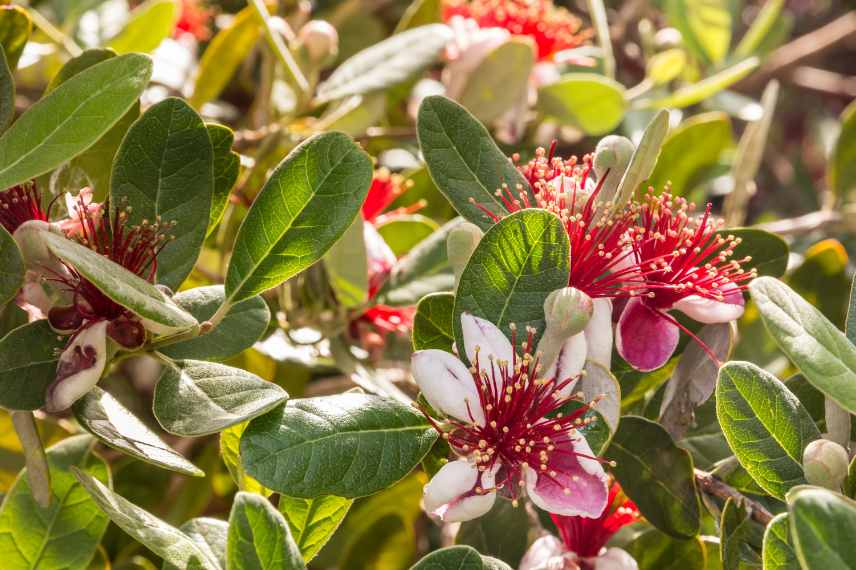
The Brazilian guava is as exotic as can be!

According to the flavour of the fruits
Feijoas only reach ripeness in mild-climate regions, as the harvest takes place in autumn. The fruits form on current-year shoots that grew in spring, then reach ripeness in October–November thanks to a hot and sunny summer. The fruits, green then yellow when ripe and fleshy, have a rough skin with an avocado-like appearance. They measure about 5–7 cm in diameter and contain granular, juicy and sweet pulp, with an exotic flavour. Brazilian feijoas display a diversity of cultivars, each with its own flavour, aroma and texture. Most have a flavour of pineapple, strawberry and guava. The fruits are very pleasant to eat, provided they are picked at full ripeness, even though they continue to ripen at room temperature. Some varieties may be sweeter with delicate, fruity and floral notes, while others may be more acidic or slightly astringent. Differences in soil, climate and growing conditions can also influence the flavour of the fruits. Feijoa can be enjoyed simply cut in half and eaten with a spoon or used to flavour jams and compotes. Among the varieties most prized for their fruiting quality:
- The Guava ‘Apollo’ yields large feijoas 6–7 cm long, weighing 60–80 g.
- Acca sellowiana ‘Mammoth’ produces large fruits of 5 cm in diameter, weighing between 50 and 70 g.
- Acca sellowiana ‘Triumph’ delights us with large fleshy fruits with a sweet flavour reminding of pineapple, banana and strawberry.
- Acca sellowiana ‘Gemini’ produces longer and smoother fruits than the other cultivars.
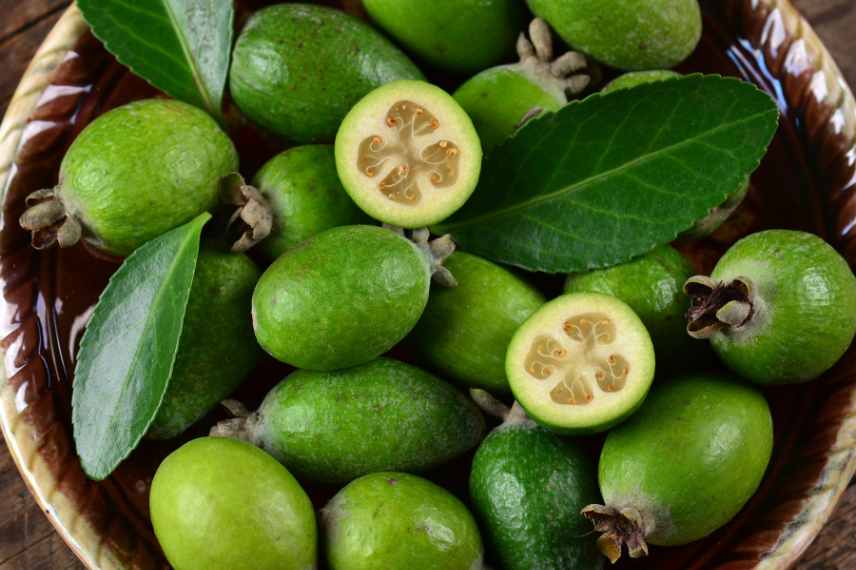
Fruits of Acca sellowiana
Is Brazilian guava self-fertile or not?
The Brazilian feijoa is partially self-fertile; it bears fruit better with another nearby plant. Thus, the Acca sellowiana ‘Gemini’, although self-fertile, will bear fruit nevertheless better with another plant nearby (variety Apollo, Mammoth or the Feijoa sellowiana type, for example). For good fruiting, it is therefore recommended to plant at least two Brazilian feijoas spaced 1 m to 1.5 m apart for cross-pollination. However, among self-fertile feijoas, you can choose:
- The Brazilian feijoa or Acca sellowiana ‘Coolidge’ is one of the few cultivars able to self-pollinate. A single plant is enough for a plentiful harvest in October and November.
According to the flowering period
The Brazilian feijoa, or feijoa, is acclaimed for its spectacular flowering. In temperate climates, fruiting can be erratic, so it is mainly grown for its ornamental qualities. It is cultivated as much for its spring flowering as for its fruit. It is a remarkable bush when its stylised, refined white flowers appear. They open into large four-petalled waxy corollas, marginate and washed pinkish-red on the inside. They contain in their centre a bouquet of long, bright red stamens, punctuated by yellow anthers containing pollen. Particularly decorative, they measure 3–4 cm in diameter. The petals are edible, revealing a mild and slightly sweet flavour, delicious in salads. Their late appearance, from May to August depending on climate and varieties, keeps them safe from spring frosts. Naturally, if you decide to plant several, it may be worthwhile to stagger the flowering. Thus the flowering begins and ends more or less early:
- The variety ‘Apollo’ : in mild climates, it flowers on new growth, in May–June, just like Acca sellowiana ‘Triumph’.
- Feijoa sellowiana : its fleshy flowers, so distinctive, will come into their own a little later, in June–July–August depending on climate
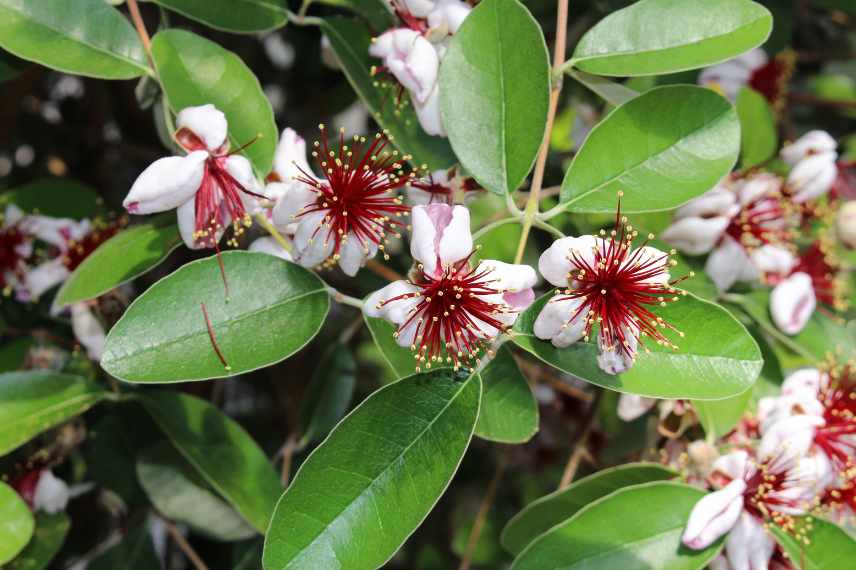
The type species, Acca sellowiana
Read also
Diseases and Pests of FeijoaAccording to height
Feijoa isn’t the preserve of large gardens! The Brazilian guava is a tree with beautiful reddish bark and a naturally bushy habit. Its very handsome evergreen grey-green foliage with velvety silver undersides makes it interesting to bring originality to the garden. With growth relatively slow in the early years, it does not grow higher than about 3–4 m, with a 2 m spread, rarely reaching 6 m in height. In a free hedge, as a focal point in a shrub border, as a specimen, or even in a pot on a terrace, it offers numerous possibilities. Its foliage also forms an effective screen even in winter.
For container growing
Hardy (down to at least -12 °C), Feijoa only fruits reliably in our milder regions. In cooler regions, it will not bear fruit or may not even flower. In cold climates, it is therefore advisable to grow it in a large pot to overwinter in a sheltered spot from the cold or to protect it with a winter veil. Placed in a greenhouse or conservatory, the fruits may reach ripeness. This handsome fruit tree can grace a balcony or terrace in the warmer months. The Brazilian guava varieties that do well in pots are preferably those that do not exceed 2.5 metres in height at maturity such as the Feijoa sellowiana, perfectly suited for pot culture in a cold region. You will plant it in a mix of garden soil, sand and potting compost and provide it with a very sunny spot sheltered from strong winds.
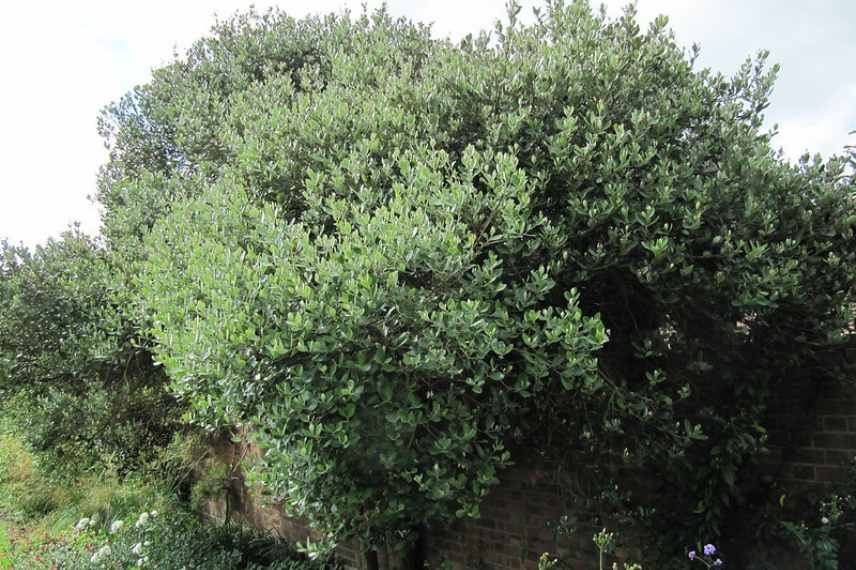
The Brazilian guava remains a shrub of modest dimensions (©Leonora Enking)
According to hardiness
Despite its origins, the Brazilian feijoa, or feijoa, is relatively hardy, to about -12/-15°C (USDA zone 8a), and capable of resprouting from the stump when it has completely frozen. It is grown in the same zones as kiwifruit, enjoying sun and mild winters. It will thrive in full sun, sheltered from cold winds. It will only be truly happy in a warm oceanic climate or in a Mediterranean zone, as it needs heat. It is a mild-climate fruit tree whose cultivation in full sun and in favourable climate poses no difficulties.
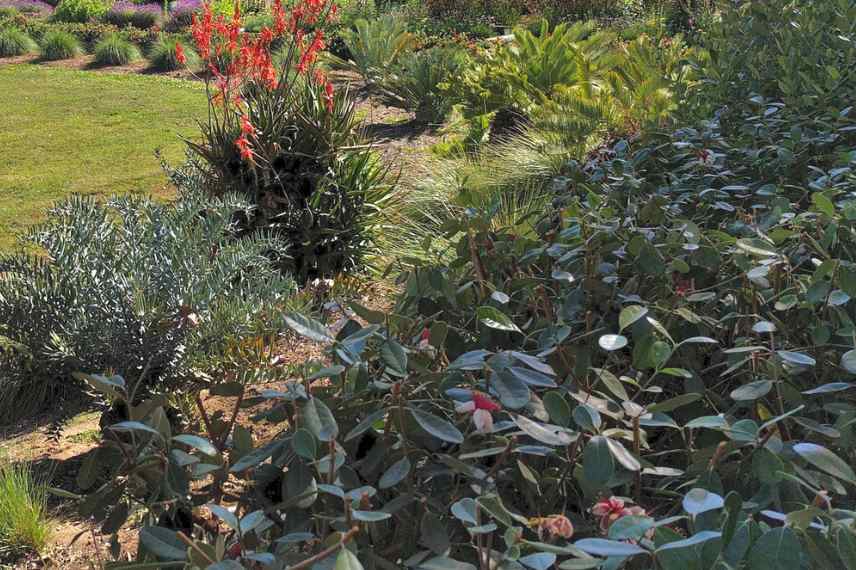
Acca sellowiana surrounded by an Encephalartos horridus and an Aloe dawei (©Cultivar 413)
- Subscribe!
- Contents

Comments