





























Choosing a Delosperma
Our Buying guide
Contents
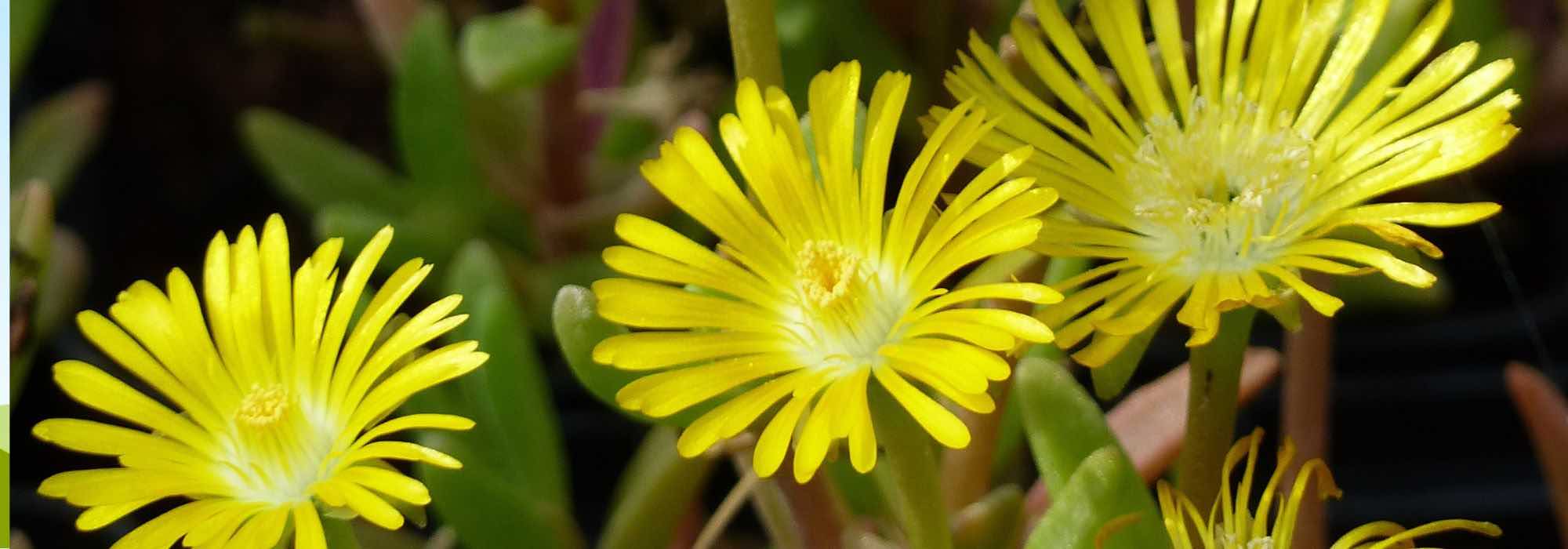
Delosperma is a low-maintenance plant, very useful in dry gardens, where water is scarce and where the soil is poor and sandy or stony. Native to South Africa, East Africa and Madagascar, it is not afraid of sun or drought, but is not very hardy, with a few exceptions. It bears abundant, daisy-like flowers in bright colours. Other plants, cousins, such as Lampranthus, Ruschia and Drosanthemum, are considered part of the Delosperma group because they display similar habits and qualities, and are aesthetically close.
Discover our tips for choosing a Delosperma or similar plant, according to size, flower colour, flowering period, hardiness and uses.

According to its dimensions
Delosperma and their close cousins, Lampranthus, Drosanthemum and Ruschia, form creeping evergreen groundcovers of low habit that gradually spread via their ramified stems that readily root. They reach 5 cm in height for the lowest, up to 30 cm in height for the tallest.
The lowest are Delosperma deschampsii and Delosperma lineare which grow at ground level, reaching 5 cm in height.
The other Delosperma and related plants reach 10, 15 or 20 cm in height.
Some reach 30 to 35 cm, such as Lampranthus auriantacus.
They spread to around forty centimetres for the more modest, 50 to 60 cm on average, and up to 1 m for the most vigorous, such as Delosperma from the Wheels of Wonder series. This ability to form large dense carpets depends primarily on their cultivation conditions. It is in optimal conditions that they are most vigorous, namely a very well-drained, poor and dry soil, in full sun. Note that winter conditions are also crucial, as excessive winter humidity can be fatal to them.
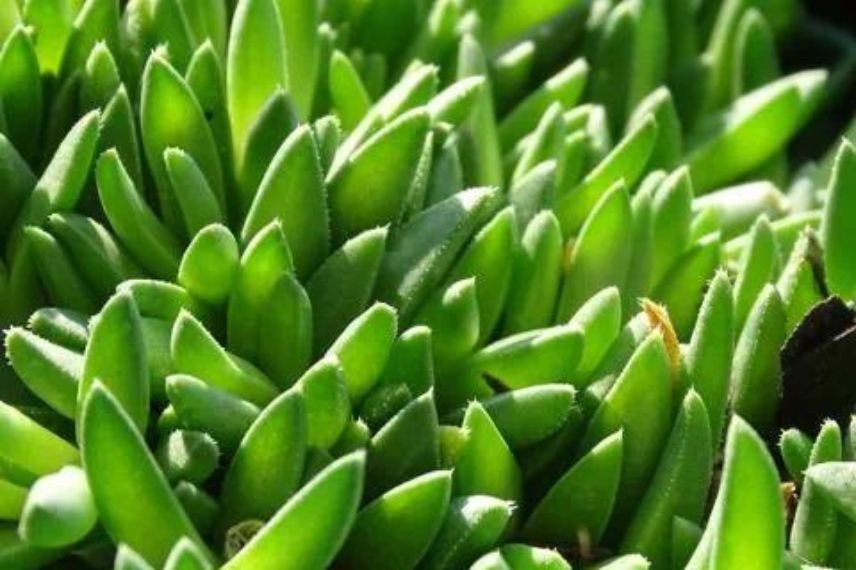
The succulent, carpet-like foliage of Delosperma
According to the colour of its flowers
Delospermas produce flowers in orange, yellow, pink, purple and, exceptionally, white. Some varieties are bi-colour.
Delosperma with white flowers
This Delosperma was selected in Japan, from the Wheels of Wonder series: ‘White’. It produces pure white flowers with a small yellow centre.
Delosperma with orange flowers
Here too, two varieties from the Delosperma Wheels of Wonder series, both bi-colour: ‘Fire’ in a coral-orange and yellow pairing and ‘Orange’, in bright orange and yellow.
Delosperma with yellow flowers
Several botanical species have yellow flowers: the Delosperma deschampsii, the Delosperma lineare, the Lampranthus aurantiacus ‘Yellow flowers’. Two cultivars from the Wheels of Wonder series are yellow: ‘Golden’ in golden yellow and ‘Limoncello’, bi-colour in lemon-yellow and white.
Delosperma with pink flowers
Firstly, the best known of them all, the botanical species Delosperma cooperi, or Cooper’s ice plant, and one of its varieties ‘Table Mountain’. The botanical species Delosperma sutherlandii is also found. Most of the cousin species of Delosperma have pink flowers: the Ruschia prostrata, the Drosanthemum hispidum, the Drosanthemum candens with pale pink flowers, and the Lampranthus aurantiacus ‘Pink flowers’.
→ Learn more with our care guide 6 Delosperma with pink flowers.
Delosperma with purple flowers
Notably, the beautiful Delosperma floribundum ‘Stardust’ with violet and white bi-colour flowers. Finally, the Delosperma Wheels of Wonder ‘Hot Violet’ offers bi-colour flowers in vivid violet and white.
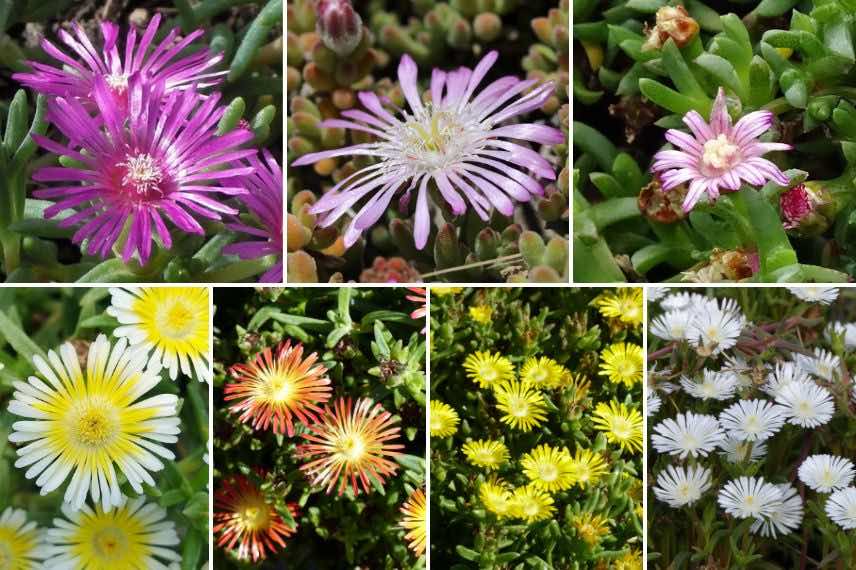
Clockwise from top left: Delosperma cooperi, Drosanthemum candens, Ruschia prostrata, and the Wheels of Wonder series: ‘White’, ‘Golden’, ‘Fire’, ‘Limoncello’
According to flowering period
The cousins of Delospermas bloom in spring. Drosanthemum, Ruschia and Lampranthus begin flowering as early as March and April in mild climates, a little later elsewhere, for Ruschia prostrata. Their flowering lasts at least six weeks, with the latest finishing in June, or even July for Ruschia prostrata. Drosanthemum candens holds longevity records as it can bloom from April to September.
Delospermas flower in summer, from June to September. Some slow down and take a break in August before resuming in September.
Read also
Pairing ideas with delospermaDepending on its hardiness
Delosperma and related plants are rather frost-tender, well suited to the mild coastal climate, in well-drained sandy soil. There are, however, some notable differences depending on the species.
Not hardy, down to -1 to -2°C
The Lampranthus auriantacus are not hardy. They are grown as annuals, or overwintered indoors.
Only moderately hardy, down to -5 to -6°C
The Ruschia prostrata, the Drosanthemum hispidum, the Drosanthemum candens show hardiness down to -5 or -6°C. This may be enough to keep them in the ground in Mediterranean climates and mild coastal climates.
Moderately hardy, down to -8 to -10°C
Delosperma are hardy down to -8 to -10°C at their limit, in suitable growing conditions, and without too much winter humidity.
Quite hardy, down to -15°C
Two species stand out for their greater resistance to the cold: the Delosperma deschampsii and the Delosperma lineare withstand temperatures down to -15°C, enabling cultivation in a wider range of regions. Also mindful of winter humidity.
Depending on use
Ideal drought-tolerant garden plants, Delosperma and their creeping relatives, shine for their durable groundcover in tough conditions. Here are some ideas for uses.
In a dry rock garden
Delosperma thrive in dry rock garden conditions: they grow between stones, even with little soil, and beautifully cover them with their succulent, dense, low-growing foliage and their sun-loving flowers.
On a slope
Slopes, being on a gradient, are naturally better drained than flat ground, since water does not stagnate there. For these conditions that are challenging for many plants, it is best to rely on plants with succulent foliage, which withstand drought longer, such as Delosperma. Moreover, if the slope is hard to access, creeping and colonising plants will, in their own time, effectively cover this unforgiving soil as they readily root.
On a low wall
Low walls host a few plants that require little substrate to root themselves. This is true for Delosperma.
In a pot, a trough or a hanging basket
Their creeping habit and prolific flowering make Delosperma ideal for raised pots, as they cascade gracefully over the edges. The frost-tender species are well suited to growing in these conditions.
Along borders, as groundcover
Delospermas make perfect groundcover for dry soil, generously forming beautiful low carpets of flowers to be admired at the front of a border or a flower bed.
To fill the base of perennials, shrubs or bushes with the same growing conditions
In pots or in the garden, alongside plants with similar growing conditions, Delosperma creep between trunks and stems without robbing other plants of the resources they need.
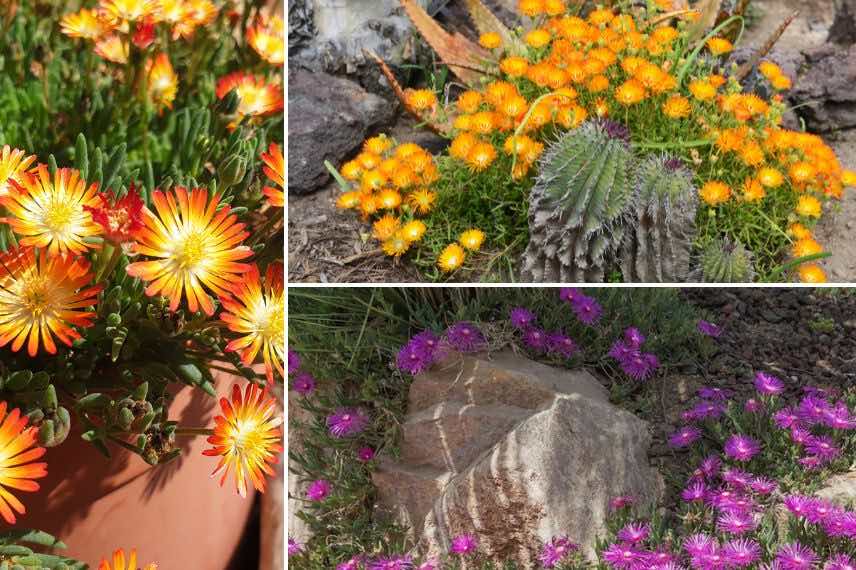
Delospermas are perfect in dry soil, in a dry rock garden and in pots
- Subscribe!
- Contents

Comments