





























Companion planting: what is it? How to do?
How to optimise space and time in your vegetable garden?
Contents
Is the reading of this title leaving you puzzled? Despite all your efforts to think it through, the term “companion planting” may not evoke much for you. Perhaps this is because you shouldn’t interpret the preposition “against” in the sense of “opposite to” but rather as “near to, in proximity”… And from there, this gardening concept will become clearer to you. You may have even tried it in your vegetable garden without realising it! Indeed, companion planting refers to a technique that involves sowing or planting vegetables close to others that are at the very beginning of their growth or, conversely, at the end of their production. The sole aim is to optimise space, and incidentally time, in your vegetable garden. It is, in a way, a form of crop association, not for allelopathic purposes, but purely related to yield and increasing vegetable production.
Let’s discover together what companion planting really is and how to implement it, not forgetting the benefits that can be gained from this technique derived from traditional market gardening. We will conclude with some concrete examples.
If you are not yet familiar with the concept of crop association, I invite you to read Ingrid’s article: Crop Association in the Vegetable Garden: Why? How? Benefits and Examples.

What exactly is companion planting?
Revived by permaculture, intercropping is a concept, or rather a way of growing vegetables, that is relatively old. Indeed, historical writings reveal this notion explained by market gardeners from Île-de-France in the early 18th century. They were already practising intercropping for purely mercantile purposes. Produce more to earn more!
Today, intercropping is back in vogue, embraced by the wave of permaculturists. However, upon closer examination of this concept, we realise that we are all, to some extent, “intercroppers.” This is especially true for gardeners who have a vegetable patch that is far too small to satisfy their desires to sow, plant, and harvest… Indeed, these gardeners (of which I am one) often display remarkable creativity to maximise the use of their space. Plant more to harvest more!
For that is the true definition of intercropping: sowing or planting simultaneously, juxtaposing different vegetable plants in the same plot. Of course, it is essential to ensure that these vegetable plants have the same needs in terms of soil, seasonality, watering, and even exposure (though we will see later that the latter notion is less important). It is also crucial to consider the basics of crop association, avoiding planting side by side plants that cannot tolerate each other.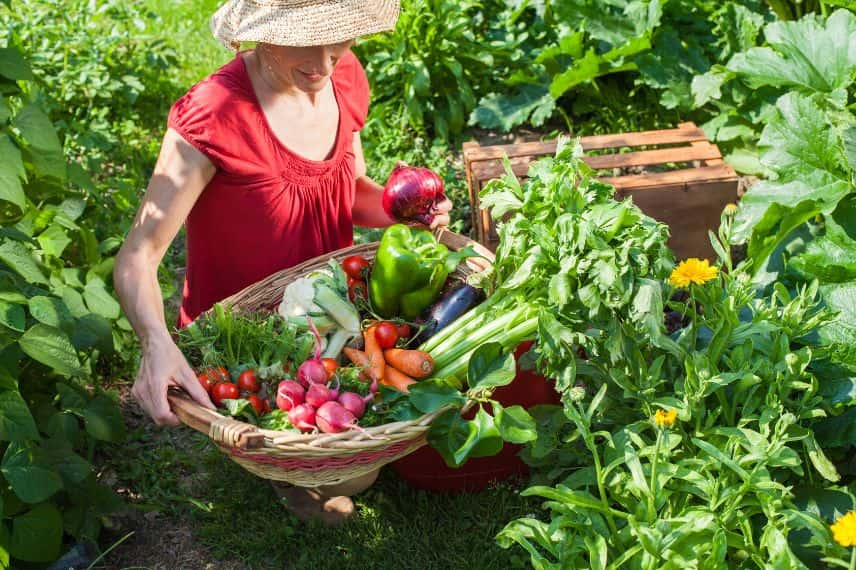
This gardening technique thus aims to optimise and make the most of space while increasing vegetable production.
The practical implementation of companion planting
A typical gardener primarily seeks to feed their family with their produce. Although most do not aim for self-sufficiency, many try to increase their yield by applying space-saving tips, especially in a small vegetable garden. Among these tips, companion planting, or intercropping, is effective and profitable.
How exactly does one do this? There are actually two ways to apply intercropping:
- Vegetable plants of different genera are sown or planted at the same time, more or less simultaneously. Each plant grows at varying rates. Thus, short-cycle vegetables can be sown or planted alongside long-cycle ones, with the former reaching ripeness earlier than the latter, which will continue to develop.
- Vegetable plants are sown or planted in a staggered manner. This means sowing or planting one vegetable close to another that is nearing the end of its growth. One will die to make way for the other. This saves time by anticipating sowing without waiting for a plot to become available.
With this gardening technique, crops (and harvests) follow one another without any downtime, and without tilling the soil between each planting. However, this technique does require a good sense of organisation and planning. In this regard, we provide you with some tips for planning and spreading out your harvests in the vegetable garden.
That said, intercropping must be done with respect for the space requirements of each plant. Indeed, it is well known that vegetable plants grown too closely together, without adequate airflow, are more susceptible to fungal diseases. Therefore, it is essential to respect the planting distances of the main crop (for example, tomatoes) and only then consider sowing other vegetable plants that will not hinder the main crop.
The benefits of companion planting
We have seen that companion planting primarily aims to optimise and maximise the space in the vegetable garden while significantly increasing production. However, companion planting offers many other advantages:
- Vegetable plants protect each other, or at least provide some benefit. For instance, a less developed vegetable will be shaded by another vegetable plant. Alternatively, it will be sheltered from the wind.
- Sowing or planting certain varieties of vegetables will occupy the bare soil and somewhat replace mulching. This way, the growth of weeds is reduced.
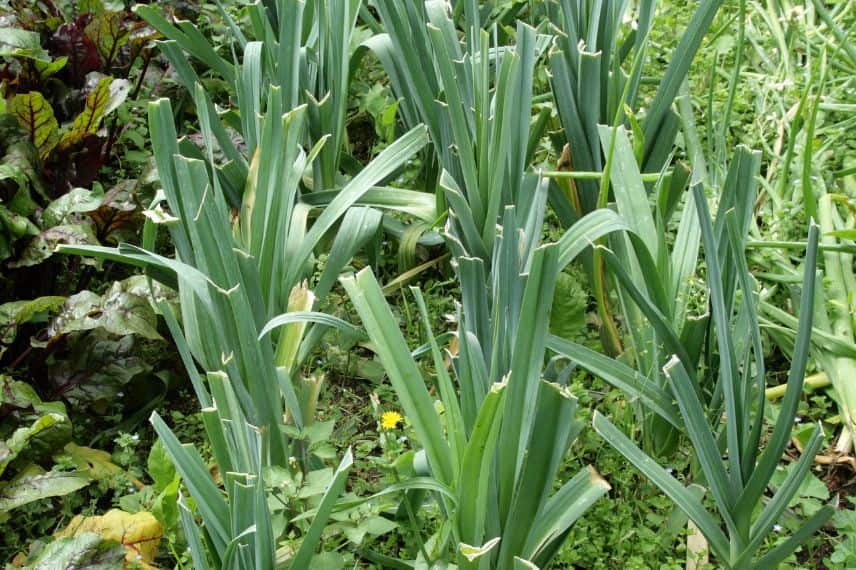 Sowing lamb’s lettuce between rows of leeks helps prevent weed growth.
 - Vegetables have different root systems, some deeper and others shallower. By practising companion planting, vegetable plants take advantage of all available nutrients, whether near the soil surface or deeper down.
- By planting vegetables in close proximity to Fabaceae (formerly legumes), they fully benefit from the soil’s fertility. Indeed, Fabaceae have the ability to capture atmospheric nitrogen and return it to the soil through the nodosities of their roots. This is a win-win for their neighbours! I explain this capability in detail in the following article: How to improve your vegetable garden’s soil with legumes.
Read also
Germination of vegetable plantsCompanion planting in practice!
After the theory, let’s move on to practice to better understand this “concept” of companion planting. We’ll start with tomatoes, which lend themselves easily to companion planting.
When tomatoes reach the end of their production, in August-September depending on the regions, it is wise to sow and plant other vegetables at their feet. And this should be done without waiting for the plants to be pulled up, to save time. The possibilities are numerous: spinach, salads, radishes, cabbages, onions… To ensure the full growth of the sown or planted vegetables, it is recommended to remove the lower leaves of the tomato plants to allow sunlight to pass through. The tomatoes will continue to produce at the top, and the seedlings will benefit from the light and watering. This method can also be applied with aubergines or peppers. If you wait until the tomato plants stop producing or freeze, around October or November, it will be too late to sow.
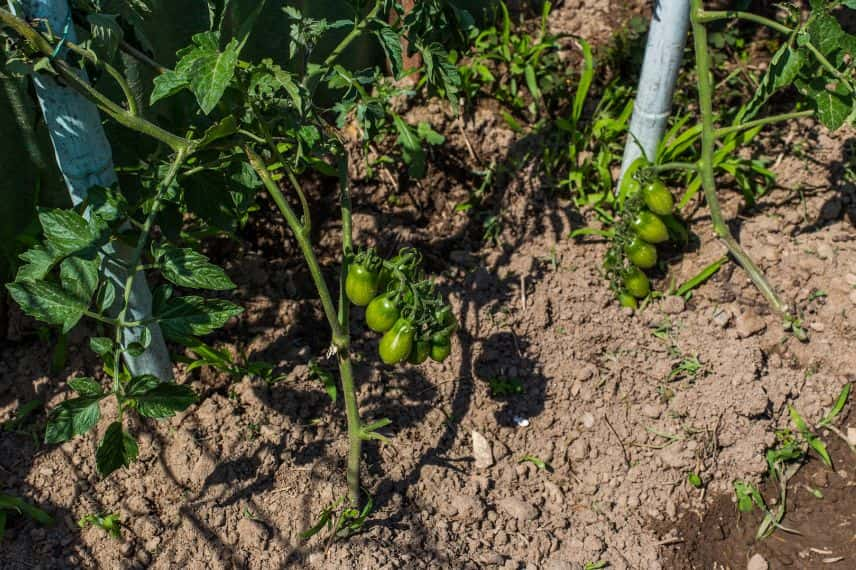
Tomatoes lend themselves easily to companion planting
It is also possible to sow basil or parsley between the tomato plants at the very beginning of their planting. They will develop in parallel.
Courgettes also lend themselves to companion planting at the end of their cycle. Simply remove the tired leaves at the beginning of September. The space freed up will allow for the sowing of the last lettuces or some endives. These same lettuces can also be transplanted when the courgettes are still small. The lettuces can be harvested (and eaten) before the courgettes take up all the space.
You can also apply companion planting in your winter leek beds, transplanted in summer in rows spaced at least 30 cm apart. Once your leeks have been earthed up, between August and October, you can sow lamb’s lettuce in the intermediate rows. It will thrive there, as lamb’s lettuce appreciates soils that have not been overly worked and are slightly compacted. Additionally, as it fears scorching sunlight, it will benefit from the shade of the leeks. At the same time, it occupies the ground and prevents the proliferation of weeds.
Another option if you are growing artichokes that remain in the ground for a long time: do not hesitate to plant broad beans between each artichoke plant, which will add nitrogen to the soil.
- Subscribe!
- Contents
Comments