






























Watterlogged gardens: designing and managing
Practical tips and solutions for designing a flood-prone garden
Contents
A watterlogged garden is not like any other: you’ll always have to make do with it, not fight it, as is often the case when nature proves unpredictable or uncooperative. The flood-prone garden, however, should be viewed with nuance: you are typically dealing with a garden where only a lower portion, situated downstream along a river or watercourse, will experience temporary, even episodic flooding during the winter months, or sometimes in autumn or spring, leaving another, higher part of the garden drier.
How to manage and design a flood-prone garden for part of the year? What can you do to live well with this unusual garden? We answer these questions by offering a few practical ideas and tips to get the best from this garden.
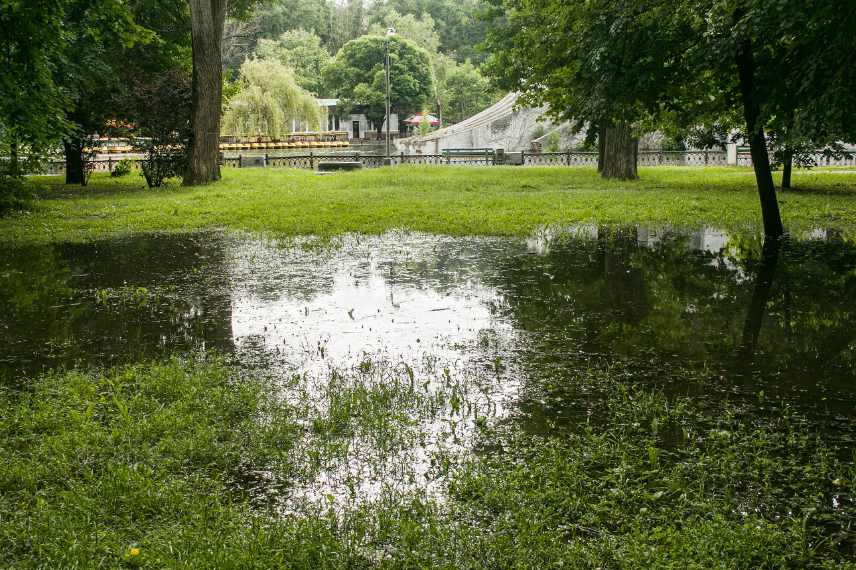
Parts of gardens become more or less flooded depending on the geography and topography of the site

Flood-prone garden... and flooded garden
First of all, it is important to differentiate between a garden that is occasionally flooded by torrential rain, for example, and a garden that will systematically have its feet in water every year because it is located near a river or watercourse that overflows its banks and is in flood for part of the winter.
If you are in any doubt, obtain an essential document that defines land zoning according to the PPRI (Flood Risk Prevention Plan), from your local council. It lists, in your area, several types of flood-prone zones, ranging from very high risk (in red) — which is the very type of garden frequently flood-prone —, to medium risk in blue, and the white zone, no risk or only exceptional. If it is used mainly for planning rules and building permissions, it gives an idea of the water levels that can be reached in winter or during floods and inundations.
Flood-prone gardens are therefore mainly due to topography and a geography that combines a dense hydrographic network with a confluence of rivers. In mountainous areas marked by steep relief, it is torrential floods that can cover a garden. In the plain, when water can no longer infiltrate normally, because the soil is saturated or has suffered erosion, but often due to the proximity of impermeable soils in urban areas, gardens are very vulnerable to heavy weather. They experience runoff and no longer have the absorption capacity required.
We advise you to observe your land across the different seasons over a year. This analysis will give you a concrete overview of water heights and fluctuations, the overall level of inundation, but also flood frequency, as well as groundwater rises (which occur notably in the floodplains along rivers or streams).

Gardens heavily affected by flooding lie along watercourses
Read also
Heavy rain in the garden: how to manage?Rule No. 1: Drain!
The flood-prone garden is among those so-called resilient gardens, one that must cope with submersion to varying degrees and over long periods. Before you even start planting, let’s focus on the soil that will need to accommodate vegetation well suited to these conditions.
The rule here is to drain this soil effectively to allow it to evacuate the large volume of water more quickly. Without drainage, plants, even those accustomed to damp conditions, could have their roots die prematurely.
There are several landscaping techniques to tame this soil:
- Aerating the soil in advance is an essential task to prevent compaction. You will need to mix it with drainage materials (gravel, grit, pebbles, stones) in a good thick layer before proceeding with planting, as is done in municipalities for soil–stone mixes. It is a substantial job, often requiring the help of a professional or at least a mini-digger, but it has proven its worth in many flood-prone gardens.
- Lightening heavy clay soil by altering its structure to make it more permeable and less compact: incorporate organic matter (compost, manure, leaf mould…) – this is THE key to obtaining a more well-drained substrate.
- In extreme cases, installing drains is unavoidable. It is used on sites highly exposed to rising water, in order to discharge the surplus water into a sump or a drainage ditch. Again, you will need to call on a landscape gardener or a groundworker, as these are substantial and technical works, where you dig infiltration trenches and sometimes alter the levels of the soil. This solution requires the creation of water-retention zones with retention basins.
→ Also read: Gardening in heavy, wet soil ; How can I make my soil more free-draining?
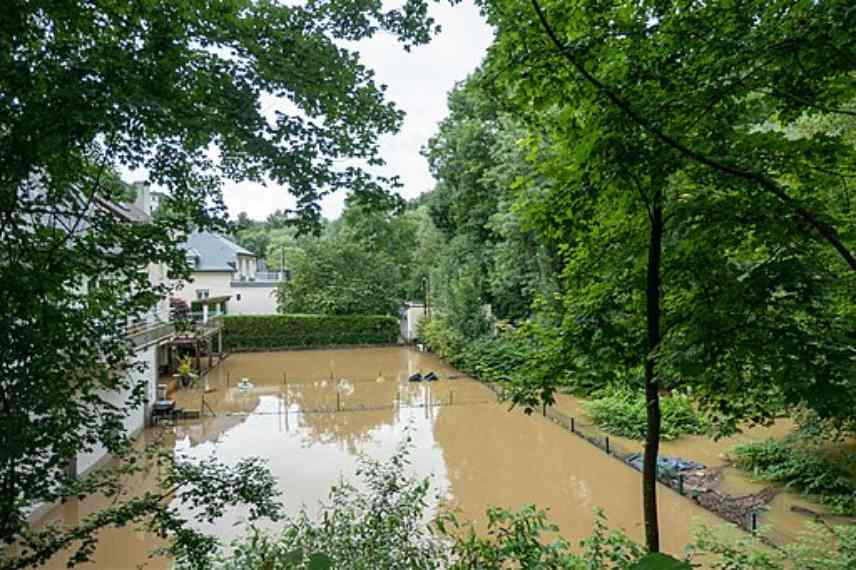
A river overflowing its banks and the garden turning into a giant swimming pool (@Tristan Schmurr)
Rule No. 2: choose hygrophilous plants
Fortunately, there are plants that love having their feet in water and in waterlogged soils, and we’ll bet on those, especially as they are particularly ornamental! So we’ll look to these plants, known as hygrophilous, that is, those that favour damp habitats. They withstand prolonged submersion and marshy ground, making them useful on flood-prone sites. You’ll find many suitable plants under the labels shoreline plants or riverbank plants, which will grow in water depths from 0 to 1 m.
Please note : The vast majority of plants tolerate a brief flood of 1–2 days without issue. We are talking here about gardens flooded for several weeks following floods.
- Trees: the bald cypress or Taxodium, a standout on waterlogged soils, stunning in autumn. Also well suited to these difficult conditions are birches, willows (Salix alba, Salix fragilis), alders (notably the glutinous alder), poplars and swamp oaks (Quercus palustris), or the European Larch (Larix decidua) and Nyssa sylvatica. Plant them in a woodland setting for a lovely backdrop effect at the back of the garden, for example.
- Shrubs : Some Cornus (C. sericea, C. amomum and C. alba) and Salix thrive and will particularly withstand waterlogged soils (such as Salix aurita, Salix caprea, Salix viminalis) as well as Clethra alnifolia. Hydrangeas also if you’ve prepared a very well‑drained mix.
- Perennials: There are many that tolerate up to 15 cm of water at their base! Loosestrifes, bonesets, Filipendulas, Lysimachias, Mimulus, Lythrums, Ligularias, ferns (Matteuccia, Osmunda, Polystichum…), Iris siberica and Iris pseudacorus, Butomus umbellatus, Symphytum (comfrey), Sagittaria sagittifolia, Houttuynia…
- Grasses and associates: led by all Carex and rushes (Juncus spp.), but also Typha, Acorus and Scirpus, or the shepherd’s ribbon (Phalaris arundinacea) and the Phragmites.
- Groundcovers: Eleocharis palustris.
My advice: also look for plants whose Latin name contains the word palustris (French: des marais) or lacustris, which are generally well suited to your temporarily marshy area!
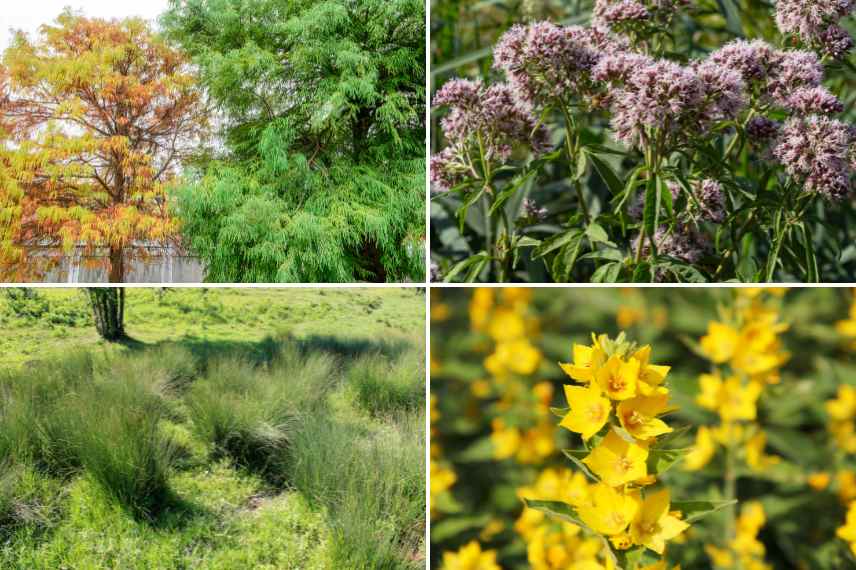 Bald cypress, boneset, bulrush, and punctate Lysimachia
→ Also read: 12 perennials for heavy, wet soil; 10 shrubs for heavy, wet soil; 7 grasses for wet soil; 10 trees for heavy, wet soil.
Rule No. 3: Choose aesthetically pleasing and creative layouts
Perhaps even more than for a classic garden, a flood-prone garden deserves refined, even original, landscaping. Learn to make the most of these marshy areas to create atmospheres of their own, charming or downright spectacular.
One thing’s for sure: when it comes to hard landscaping (paths, decking), you’ll need materials that are suitable and water-resistant. Wood is out for vegetable beds and arches. We also favour metal-framed structures for movable furniture, and we favour stone as well. Obviously, an in-ground pool won’t be possible.
- Create a natural pond or basin. Position it so that its outlines are blurred to integrate it best by surrounding it with shoreline plants that will render the boundary indistinct. See all of Olivier’s tips on Create a natural pond in your garden and Where and how to plant plants in and around a pond?
- Incorporate stilts-based structures such as perched huts, or a network of walkways, or even a pontoon, which, in addition to aesthetics, allows you to move around the garden. By emphasising a lake-like or lagoon-like effect, the garden is enhanced!
- Terraced beds, a kind of stepping or terraces. If they are emblematic of Mediterranean gardens, you can draw inspiration from them in certain zones to open up new possibilities. You will need to provide drainage and install drainage channels to facilitate water evacuation, so that you can grow exotic plants with broad foliage there, for example.
- Construct raised elevations and earth banks to rise above inundation. This allows you to grow other wet-soil plants that are not submerged, and to enjoy a raised vegetable bed.
- Design a rain garden downslope from the main garden: it’s an infiltration garden.
- Last option, less glamorous but obvious in highly exposed areas, is the construction of a dyke at the far end of the garden to limit damage.
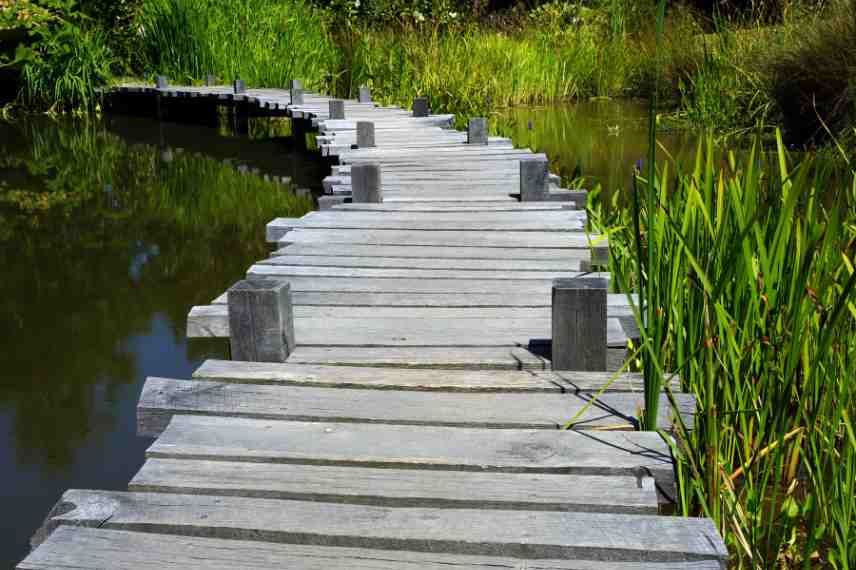
Creating lake-like structures in a large garden gives it a lot of appeal!
Examples to inspire you
Several beautiful gardens in France are subject to recurrent flooding. I invite you to visit them; they offer excellent ideas for designing these zones in a sustainable and attractive way, despite being deemed inhospitable.
Among them: Liliane’s Garden (a garden in Limousin), Caradec’s Garden in Morbihan. Our collaborator Virginie Douce had also designed a very beautiful garden in the Ardennes (find her interview in our related articles below).
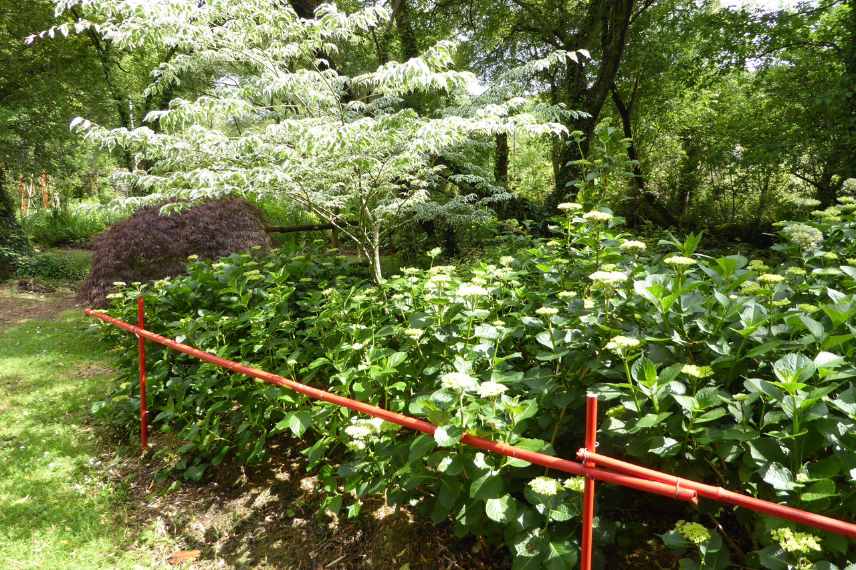
The back of the garden, regularly flooded at Marie-Madeleine Kerbart’s place, required months of work, for an extraordinary result (© Gwenaëlle David)
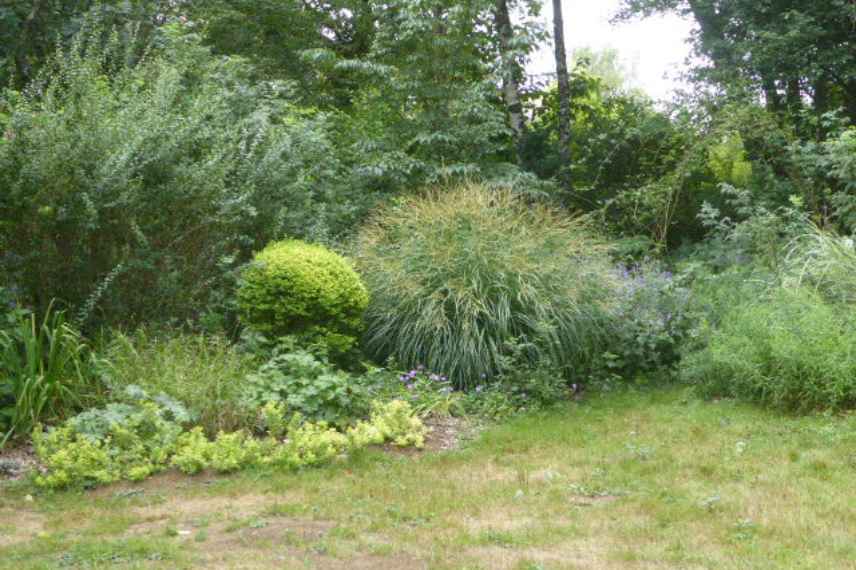
Here, Liliane’s Garden, left very natural in the area that will be flooded in winter (© Gwenaëlle David)
- Subscribe!
- Contents
Comments