





























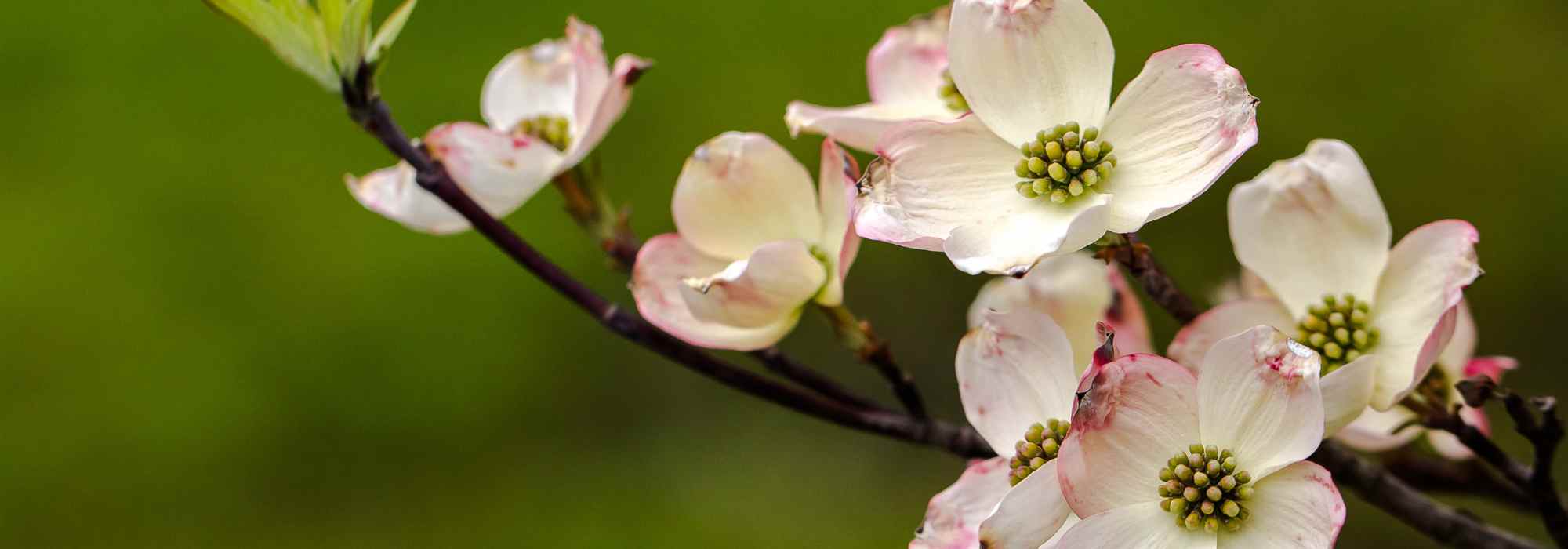
Diseases and pests of Cornus or dogwoods
For healthy Cornus
Contents
Cornus or dogwoods are renowned for their exceptional resistance to diseases and pests. This is true for fruiting dogwoods (Cornus mas and Cornus officinalis), decorative wood dogwoods, and most Asian Cornus (Cornus kousa, Cornus controversa…). Among the more “fragile” varieties are American flowering dogwoods like Cornus florida and Cornus nutalli. These, in fact, can be susceptible to more or less serious diseases such as dogwood anthracnose or powdery mildew.
→ Let’s explore the diseases and pests that can affect Cornus or dogwoods and how to prevent and cure them!
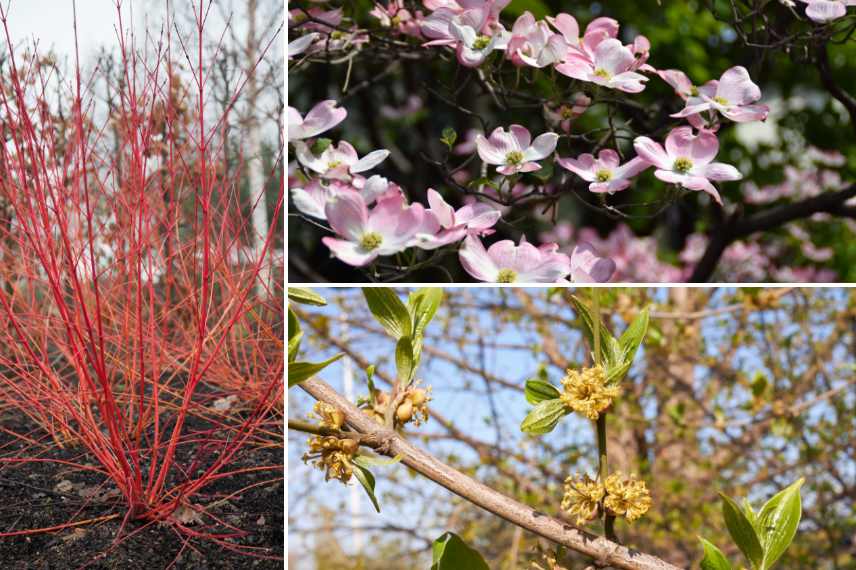
Wood, flowering, or fruiting dogwoods

Powdery mildew on dogwood
Powdery mildew on dogwood (sometimes referred to as powdery mildew) is a fungal disease caused by two fungi: Microsphaera pulchra and Phyllactinia guttata. This powdery mildew proliferates in dry weather following a very humid period.
The most affected dogwoods are the American Cornus florida and Cornus nuttallii. This is one of the reasons why Cornus florida is grafted onto Cornus kousa or Cornus kousa var. chinensis.
The symptoms of powdery mildew on dogwood manifest as a felting on the leaves, followed by a white or greyish powder that invades the entire plant, primarily on the young shoots. Powdery mildew infects the plant in spring, and as the dry summer progresses, symptoms will appear.
Powdery mildew can cause the plant to decline if it is already weak and stressed. However, most of the time, only a simple growth delay or reduced flowering is observed.
To prevent the onset of this disease, it is advisable to aerate the branches and avoid overly dense planting. It is also important to avoid excess nitrogen, choose cultivars or species that are less susceptible (Cornus kousa), and ensure that the tree always has enough water at its base in summer (mulching and watering).
If powdery mildew has developed: spray a mixture of 5 teaspoons of bicarbonate with 3 tablespoons of black soap in 5 litres of water once a week in the evening. A spray of diluted milk or a garlic macerate is also effective.
→ To combat or prevent powdery mildew, follow Virginie’s helpful advice.
The septoria leaf spot of dogwood
Septoria leaf spot is a fungal disease caused by the fungus Septoria cornicola. The so-called septorian spots appear on the surface of the leaves: they are brown, of regular size, and cause necrosis of the leaf, giving the impression that it is burnt.
Septoria leaf spot occurs during warm, humid springs, but it is relatively rare and only affects isolated cases. Furthermore, the disease, although unsightly, does not endanger the tree or bush.
As a preventive measure, one can apply horsetail manure. For treatment, a spray of a preparation made from 5 teaspoons of bicarbonate with 3 tablespoons of black soap in 5 litres of water should be applied once a week in the evening. Do not hesitate to remove the branches severely affected by septoria.
→ To find out how to prepare horsetail manure, follow Virginie’s advice.
Discover other Cornus
View all →
Available in 0 sizes
Available in 0 sizes
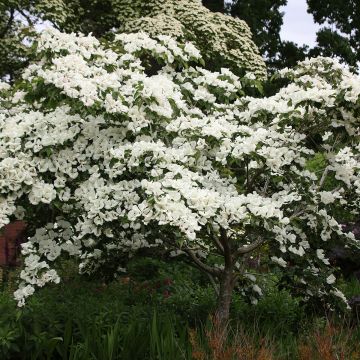
Available in 2 sizes
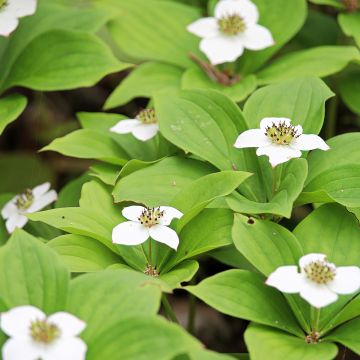
Available in 2 sizes
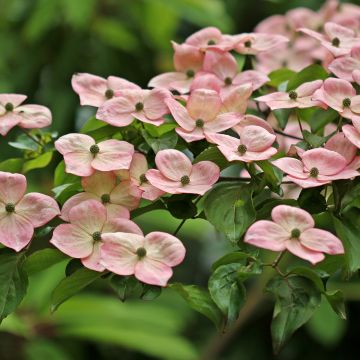
Available in 2 sizes
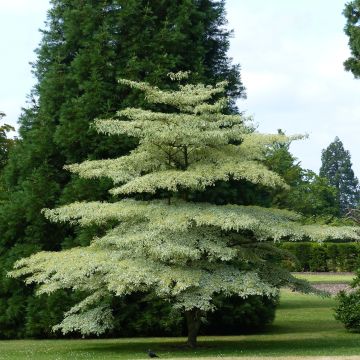
Available in 3 sizes
Available in 2 sizes
Available in 6 sizes
Available in 1 sizes
Available in 1 sizes
Cornel anthracnose
Dogwood anthracnose is a fungal disease caused by a fungus named Discula destructiva. This disease has wreaked havoc on natural populations of Cornus florida and Cornus nuttallii across North America, with mortality rates reaching up to 90% in some areas.
The initial symptoms are simple leaf spots (similar to those of anthracnose spot, but much larger), followed by symptoms on the branches, leading to a sudden dieback of the lower branches. The affected leaf will undergo complete necrosis, with the infection spreading to the petiole and then to the cambium of the branches and trunk. Cankers will appear, causing the tree to weaken and eventually die.
Factors that can cause or exacerbate this disease include: trees growing too much in the shade, in heavy, wet soil in winter, and suffering from drought in summer.
For prevention, American dogwoods (Cornus florida and Cornus nuttallii) should be planted in full sun or light partial shade in well-drained soil and the branches should be thinned through pruning for better air circulation. It is also advisable to never water the foliage in summer, but to maintain good mulching at the base of the Cornus to assist during summer droughts. The most effective preventive treatment (while being natural) is baking soda, using 5 teaspoons of baking soda with 3 tablespoons of black soap in 5 litres of water, to be sprayed once a week in spring.
Currently, no curative treatment is effective. However, many new cultivars and hybrids of American dogwoods, particularly hybrids from Rutgers University (Cornus x Rutgersensis), are extremely resistant to anthracnose. Anthracnose can also affect other species of dogwood, but cases are rare. No need to panic!
Please note: there is another type of anthracnose in dogwoods. This disease is called “anthracnose spot” and is caused by a fungus named Corni elsinoe. Symptoms include clear circular spots surrounded by purple on the foliage and bracts. Often confused with septoria, this type of anthracnose is equally harmless and is treated in the same way.
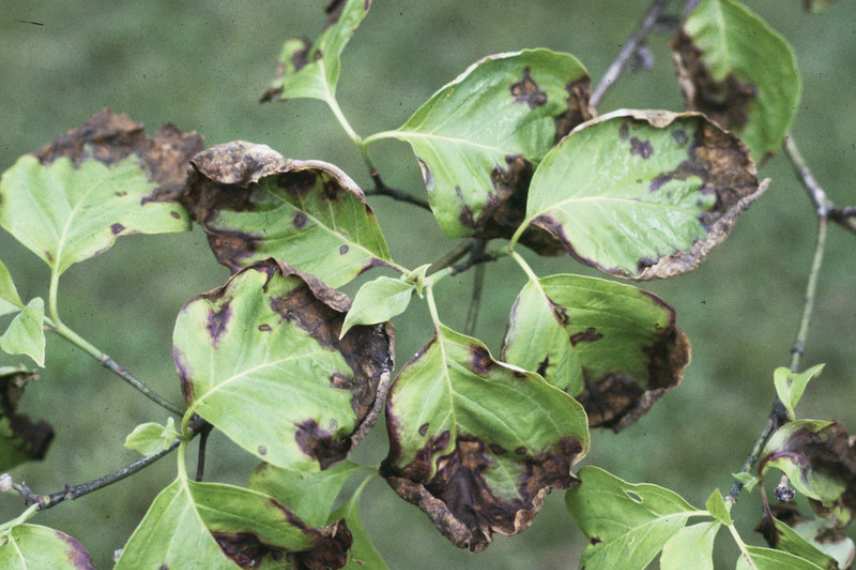
Dogwood anthracnose (© NatureServe)
The Dogwood Clearwing Moth
The Dogwood Clearwing Moth (Synanthedon scitula) is a day-flying moth whose caterpillars can consume the wood of Cornus florida, especially when the tree is under stress or diseased. The moth is stunning, with its transparent membranous wings (typical of clearwing moths) and a black body striated with yellow. Rest assured, this moth is currently only found in North America. It is mentioned here merely as additional information. Moreover, it is not uncommon nowadays for a distant insect to establish itself in our ecosystems. There are pheromone traps available to capture male Dogwood Clearwing Moths.
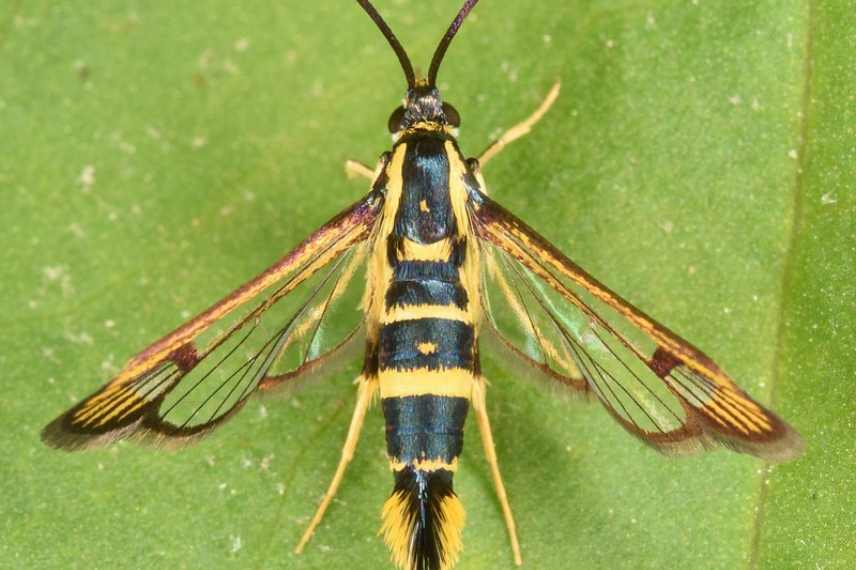
Synanthedon scitula (© Christina Butler)
Having healthy dogwoods
Each species of dogwood has specific needs regarding soil, exposure, and climate. However, if we were to generalise, we would say that dogwoods require cool, well-drained soil, ranging from acidic to neutral, summers that are not too hot or dry, and a sunny or partially shaded location. Feel free to consult our product sheets or your local nursery for more information.
A dogwood planted correctly and in the right location will always be healthier than one that has to struggle for survival.
→ The Plantfit web application developed by Promesse de Fleurs can also assist you in choosing your trees and bushes.
- Subscribe!
- Contents
Comments