





























Diseases and Pests of Willows
But there's no need to worry...
Contents
Willows, Salix in Latin, are trees and shrubs that are very easy to grow and very hardy. Among willows, there are large trees with a bushy habit reaching up to 20 m in height, sometimes weeping down to the prostrate creeping undershrub. We are well acquainted with weeping willows, basket willows, or willows from our flora such as, among others, Salix caprea or Salix alba. There are also many ornamental varieties suitable for modest gardens, such as Salix gracilistyla, Salix ‘Mount Aso’, Shrimp willow and ‘Golden Sunshine’, remarkable for their silky aments, their habit, or their colourful foliage.
Willows are generally quite robust as long as they do not experience stress from a lack of water or severe pruning. However, in very rare cases, they may suffer from diseases or pest attacks.
→ Let’s explore the various health issues that willows can suffer from in this advice sheet.
 Willows, all very ornamental – here the majestic weeping willow – can sometimes be attacked by pests or fall ill…

Fungal diseases
Fungal diseases appear in willows when they are weakened (drought, repeated pruning…) and often when the weather is warm and humid.
- Willow anthracnose: in spring and summer, small pale brown lesions appear on the stems and reddish spots appear on the leaves. The leaves eventually fall, and the terminal shoots wilt. The weeping willow may even lose its habit. Prune the affected branches and remove them!
- Rust: discoloured spots appear on the upper side of the leaves, along with orange or brown pustules (hence the name rust) on the underside. These spots darken by late summer and autumn, and the leaves eventually fall. As soon as you notice the first affected leaves, remove them to limit the spread of this disease. Infusions of horsetail are effective when applied every two weeks. This treatment can also be used preventively, as it strengthens your plants and makes them more resilient.
- Scab: black spots appear on young leaves and near the veins on mature leaves. The shoots curl, dry out, and then become covered with small black lesions. A treatment with baking soda acts curatively by blocking the development of the fungus and is very effective without the toxicity of copper for our soils.
- Black canker of willow: this canker is caused by a pathogen named Glomerella myabeana. The leaves, attacked at the base of the petiole, dry out and fall, then dark brown or black cankers form on the stems. Whenever possible, remove all branches affected by canker (depressed or blackened areas)!
- Collar gall: this disease is caused by a bacterium of the genus Agrobacterium. Round swellings appear on the branches that can sometimes dry out and die. Remove the affected branches!
Important!: Remember to clean and disinfect your cutting tools before and after work.
Potential pests or parasites
Willows are host plants for a large number of insects. Our native willows (Salix alba, Salix viminalis, Salix caprea, Salix aurita…) are excellent trees and bushes for a garden that embraces nature. Although “attacks” may concern gardeners, most of the time, there is no need to intervene.
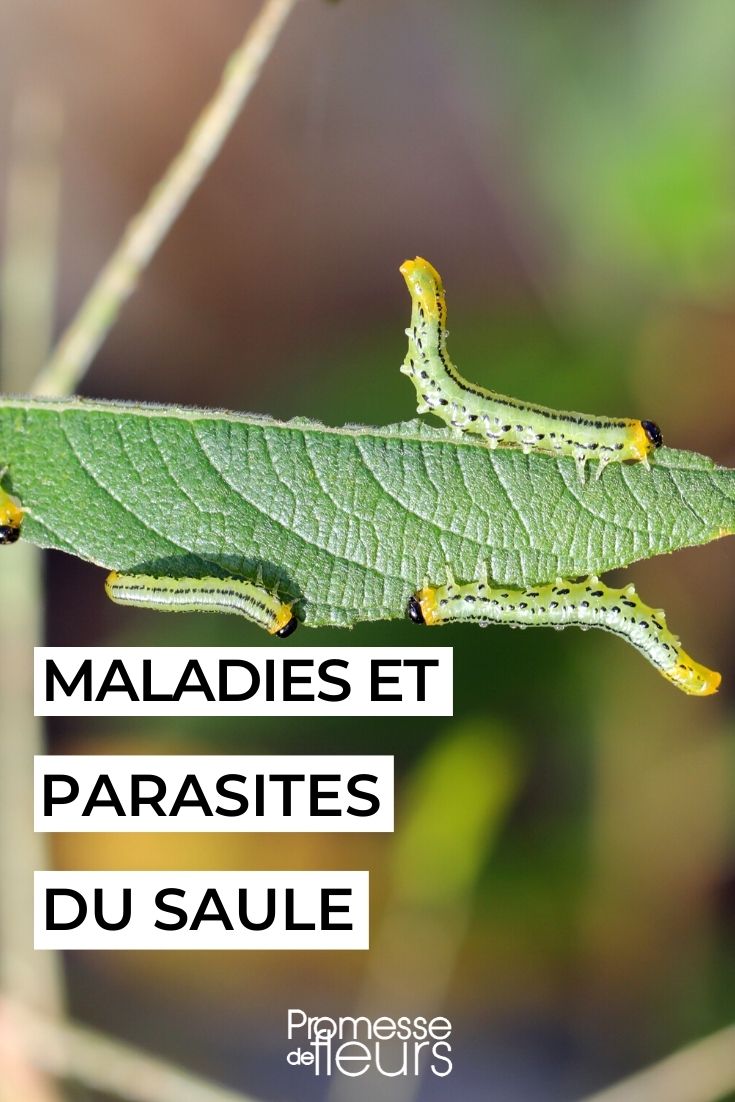
- A number of butterfly caterpillars and sawfly larvae (notably the Willow Sawfly) feed on willow leaves. Infestation is rarely significant. In any case, insectivorous birds, particularly tits, will quickly regulate the larval population.
- Aphids can sometimes cause deposits of sooty mould. Sooty mould is only truly problematic on very young plants. Here too, aphid populations are quickly controlled by their various predators (lacewing larvae, hoverfly larvae, and ladybirds).
- The Willow Scale: these are white, round-shelled scales that attach to the branches to feed on sap. To eliminate them on young willow plants, you can use a treatment based on black soap. For this, dilute in 1 litre of water: 1 teaspoon of liquid black soap, 1 teaspoon of denatured alcohol, and 1 teaspoon of vegetable oil. Mix and spray twice at 30-minute intervals and then make one spray every 8 days until the scales disappear.
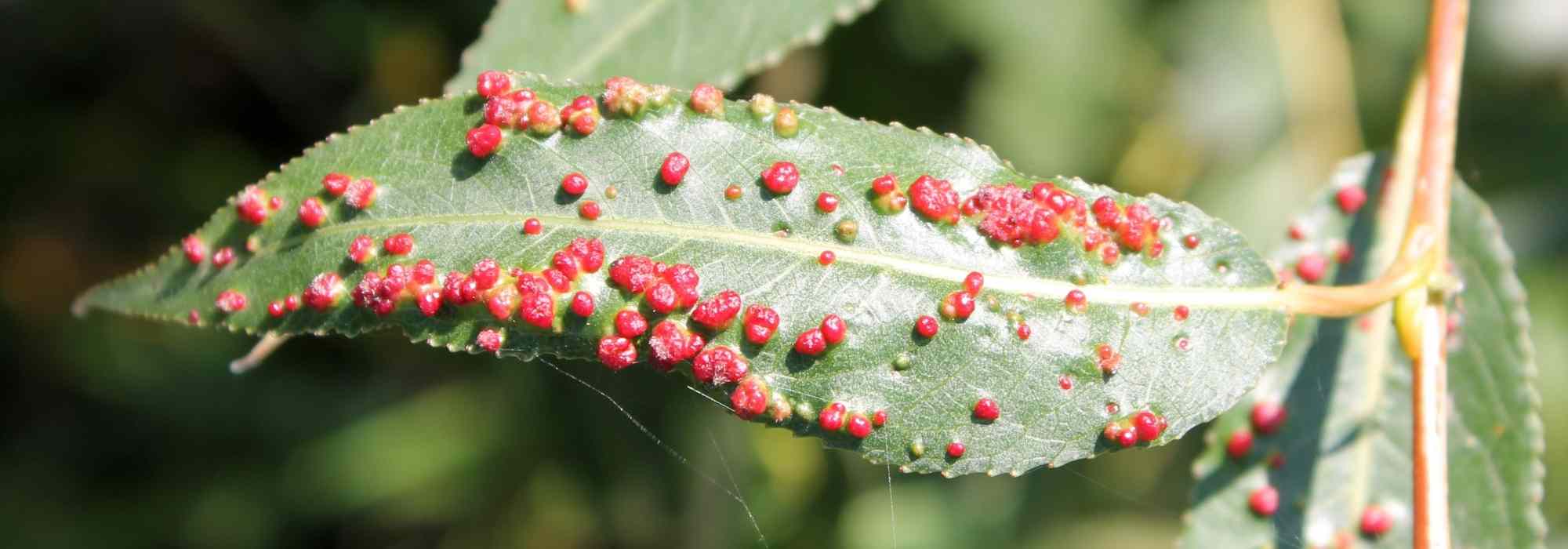
Note: willows can exhibit galls (with two “l”s, do not confuse with disease) or zoocecidia caused by insects or mites. These galls are merely a reaction of the tree to the laying of an insect’s eggs (most of the time). These galls or cecidia can take various forms: balls, growths, leaves clustered in a terminal rosette, thickening of branches or buds… All these “deformations” pose no danger to willows.
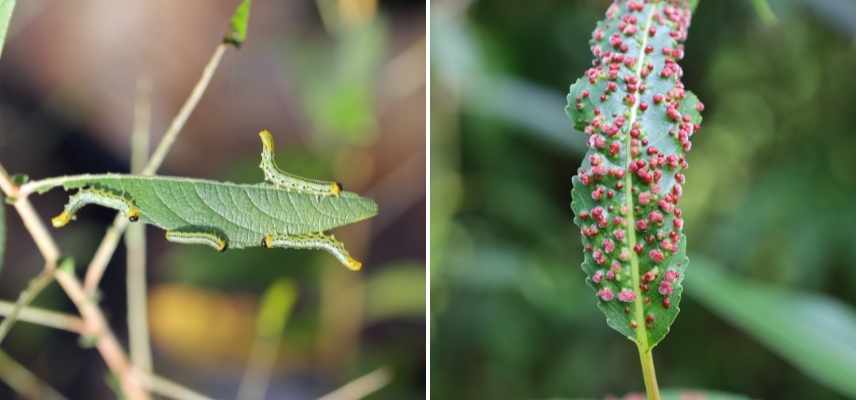
On the left, Pterodinea salicis (Willow Sawfly). On the right, a willow leaf affected by the gall of a mite (Aculus tetanothrix)
Discover other Willow - Salix
View all →
Available in 5 sizes
Available in 3 sizes
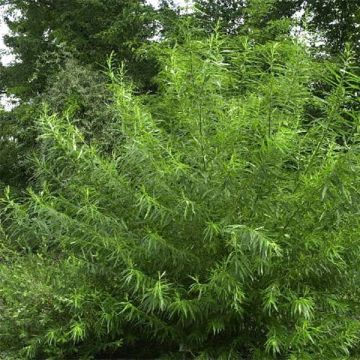
Available in 2 sizes
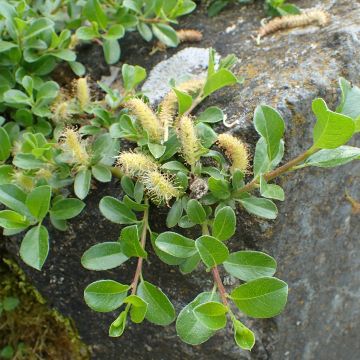
Available in 1 sizes
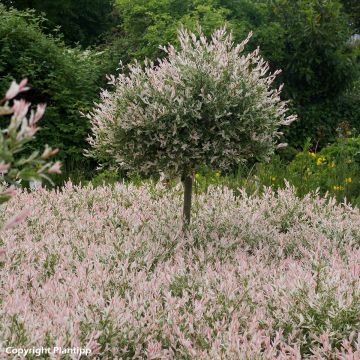
Available in 4 sizes
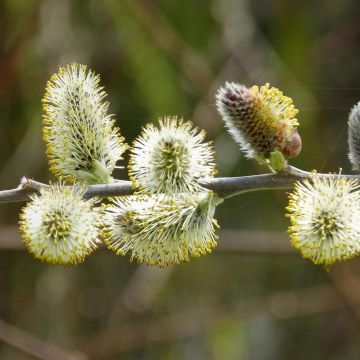
Available in 3 sizes
Available in 1 sizes
Available in 1 sizes
Available in 1 sizes
Available in 4 sizes
Leaf loss due to severe droughts
Even though they can sometimes be surprisingly resistant to drought episodes (though this also depends greatly on the soil), most willows love water. So much so that when it becomes scarce, willows tend to lose a significant portion of their foliage in summer to limit evapotranspiration, and thus their water loss. They are not the only trees to behave this way.
In theory, this is not concerning, as the foliage will regrow with the first rains. However, this weakens the trees and bushes, and if drought periods increase year after year, the lifespan of willows will be affected. In the case of young willows and those newly planted, consider good watering once a week during hot, dry spells.
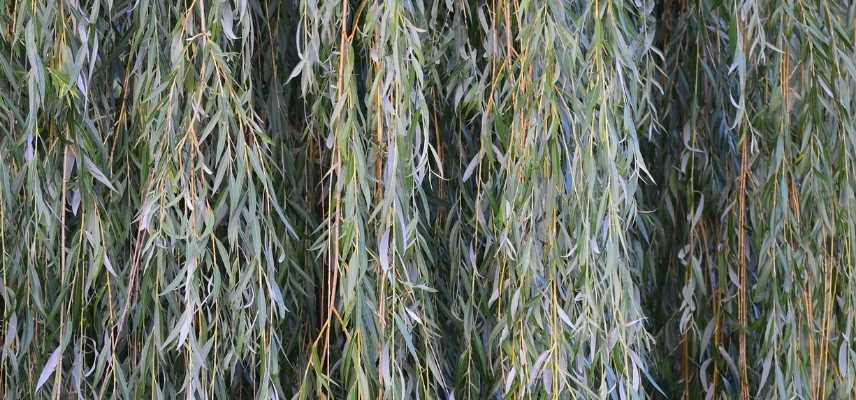 A healthy weeping willow here, unaffected by drought, makes a stunning green curtain.
- Subscribe!
- Contents
Comments