





























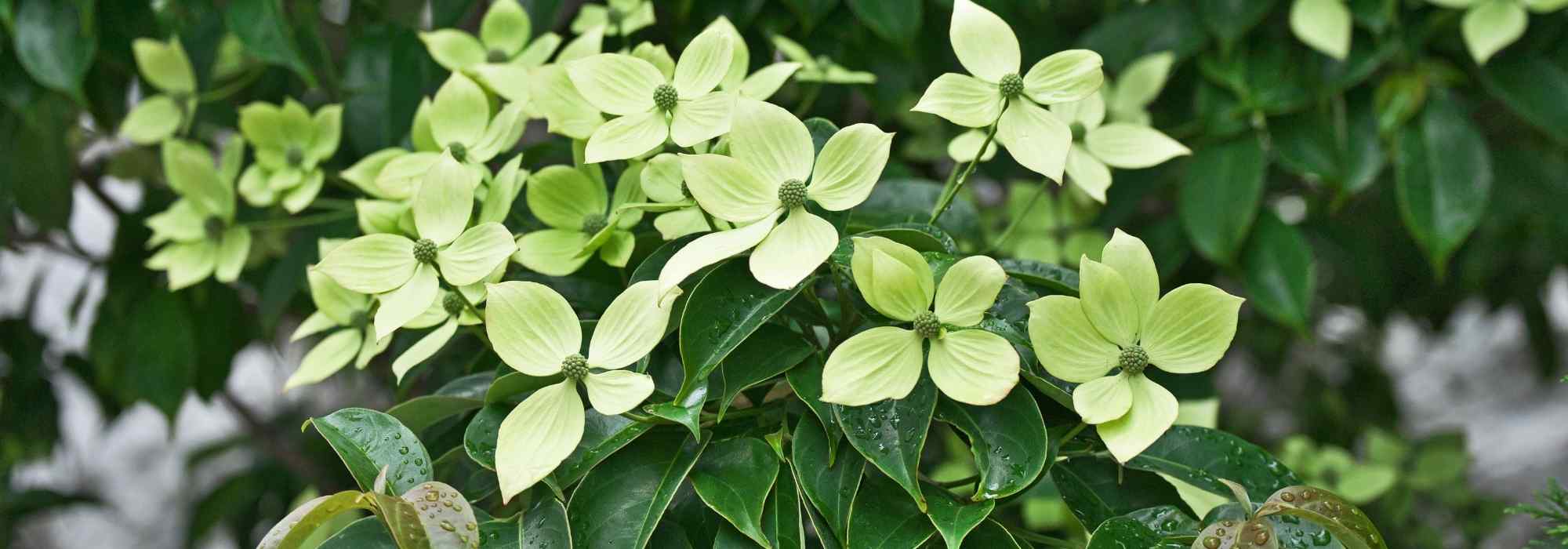
Does a cornus with evergreen foliage exist?
yes, yes, it exists...
Contents
It never fails! Whenever we talk about a botanical genus of trees or bushes, there’s always someone who asks the fateful question: “Is there one with evergreen leaves?” Well, in the case of dogwoods or Cornus, we can answer: yes!
And they are indeed very beautiful and, for the most part, hardy enough to be grown here. Let’s explore, in this advice sheet, flowering dogwoods with evergreen or semi-evergreen foliage such as Cornus capitata, Cornus angustata, the Hong Kong dogwood, and the fascinating Cornus urbiniana!
Reminder: evergreen or semi-evergreen, what does that mean? Evergreen foliage continuously renews its leaves, regardless of the season. Each leaf has a lifespan of between 3 and 5 years. Semi-evergreen foliage is a type of deciduous foliage that does not drop immediately. The leaves of this type will remain green and on the tree or bush throughout winter, provided the summer hasn’t been too dry, the winter isn’t too harsh, and there isn’t too much wind… But come spring, these leaves will be replaced by new foliage.

Cornus capitata: evergreen in mild climate
The Cornus capitata (syn. Benthamia capitata) is native to the eastern Himalayas, specifically in an area stretching from Nepal to China, where it can be found growing at the edges of coniferous and leafy forests, under a mild and humid climate.
This Himalayan dogwood has a rounded habit and features evergreen foliage (down to -5°C) that is bright green to dark green. Its late spring flowering, with cream-white bracts tinged with yellow, is stunning. The fruits, resembling large strawberries (but without the taste!), that follow the flowering are also ornamental. This large bush or small tree adapts to a wide range of soils, provided they are well-drained and remain cool. Its hardiness is around -10/-12°C, possibly a bit more depending on soil drainage. However, it cannot withstand extreme heat or severe winter cold: give it a spot in the shade and well protected!
Note: the Cornus ‘Norman Hadden’ is the result of a cross-breeding between Cornus kousa and Cornus capitata. The result of this cross-breeding has produced a small tree that produces large bracts changing from cream-white to deep pink and semi-evergreen foliage that turns yellow or red in autumn. A marvel!
⇒ A word from Oli: the Cornus capitata can grow without issue in the northern part of France and up to Belgium if the soil is sufficiently drained. However, near me in Lille, it behaves more like a semi-evergreen, or even completely deciduous during harsher or windier winters. No worries, the foliage will return the following spring.
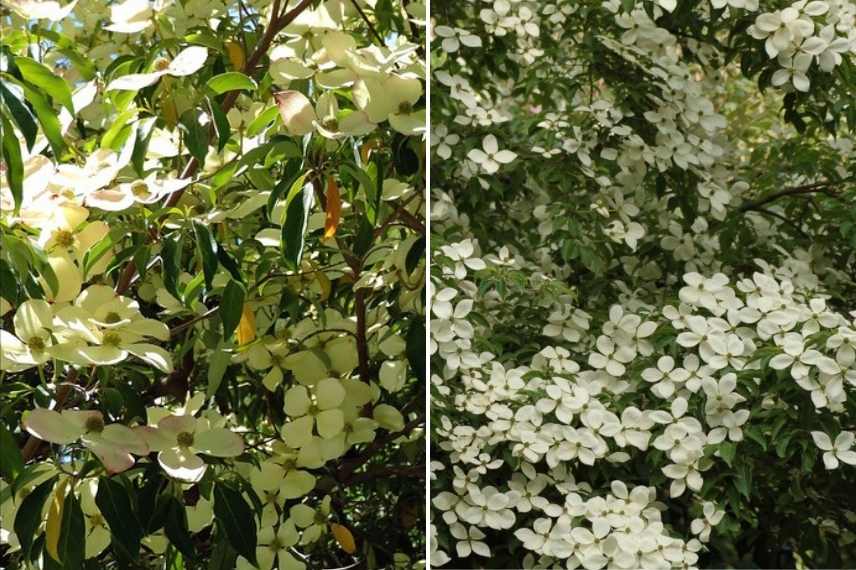
Cornus capitata (© Globetrotteur 17), and on the right the cultivar ‘Norman Hadden’
Cornus hongkongensis: true evergreen
Cornus hongkongensis or Hong Kong Dogwood is native to southern China, Laos, and Vietnam, where it grows in leafy forests. It is a vigorous small tree with a bushy and upright habit, and its beige bark, marked with white furrows, is very decorative in winter. The foliage is evergreen, but variable: young leaves are tinged with purple, then the foliage turns green, eventually changing to orange and purplish-brown in autumn. In June-July, this dogwood reveals a multitude of fragrant flowers, surrounded by four large cream-white bracts. This flowering is followed by fruiting in September-October, producing round, granulose red fruits.
The cultivar ‘Parc de Haute Bretagne’ differs from the typical species by its pale pink flowering. In short, it’s the same, but better.
Hong Kong dogwoods are quite hardy (-12°C or lower in well-drained soil), but are sensitive to cold winds, especially in spring. Provide them with a sheltered position, preferably in partial shade.
⇒ Oli’s little note: Cornus hongkongensis is probably the fastest-growing flowering dogwood (well, bract-bearing dogwood!). In just two years of cultivation in my garden, it has already surpassed me a bit, measuring just over 170 cm.
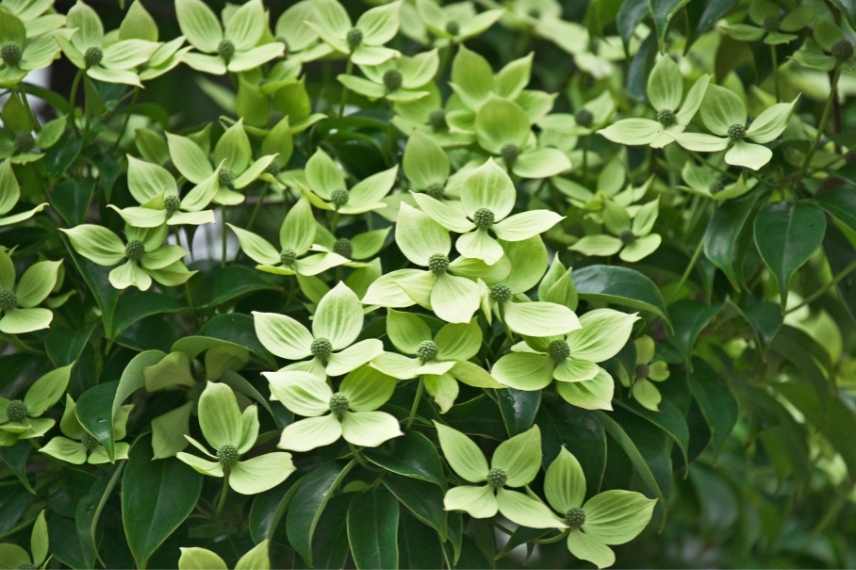
Cornus hongkongensis
Discover other Evergreen shrubs
View all →
Available in 1 sizes
Available in 2 sizes
Available in 1 sizes
Available in 1 sizes

Available in 2 sizes
Available in 1 sizes
Available in 1 sizes
Available in 1 sizes
Available in 1 sizes
Cornus angustata: evergreen in mild climate
Cornus angustata (syn. Cornus elliptica, Dendrobenthamia angustata) is native to South-East China and can become a small tree of 4 m in all directions. The foliage is formed of leathery, glossy leaves of a light green, but iridescent with shades of pink, turning purple-red in autumn and greening again in winter. The flowering consists of small green flowers surrounded by 4 cream-white bracts. This is followed by an ornamental fruiting: fruits similar to those of Cornus kousa.
The cultivar Cornus angustata ‘Empress of China’ (sometimes referred to as ‘Elsbury’) is the best-selling and most spectacular, featuring a more enduring and generous flowering and exceptional vigour. It is also a cultivar less sensitive to cold than the typical species.
⇒ Oli’s little note: the Cornus angustata ‘Empress of China’ remarkably and surprisingly withstood the 3 months of drought experienced this summer (northern France). However, although hardy down to -18°C, it behaves more like a semi-evergreen during cold winters.
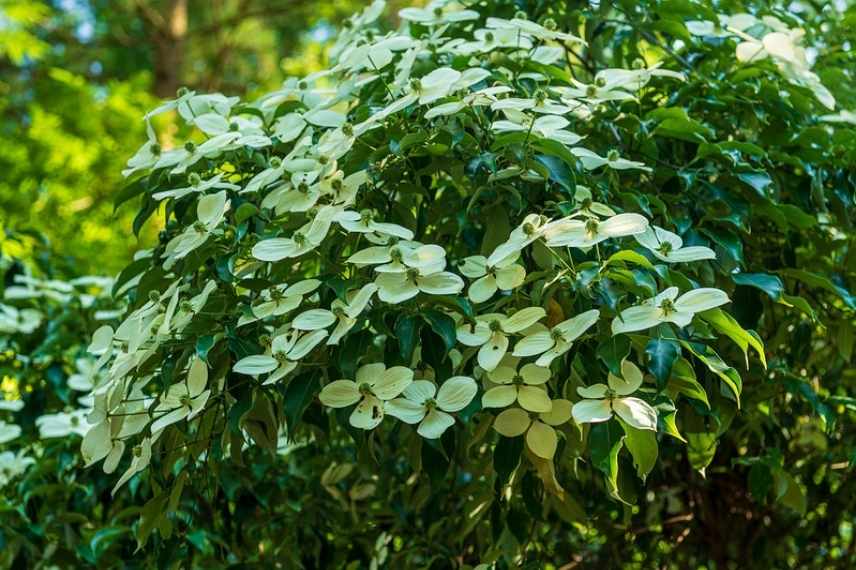
Cornus angustata (© Puddin Tain)
The specific case of Cornus florida subsp. urbiniana
The Cornus florida subsp. urbiniana or Mexican Flowering Dogwood is a subspecies of the Cornus florida more commonly known to gardeners. This remarkable small tree grows in the forests of eastern Mexico. The flowering is as surprising as it is characteristic: the pure white bracts close around the flower, giving the appearance of a Chinese lantern. The green-blue foliage is semi-evergreen, except during cold winters. It is advisable to protect it from the cold, especially in the first few years, and to plant it in partial shade within a woodland. It cannot tolerate scorching sun.
There is a cultivar with slightly pink bracts and almost golden foliage: the Cornus florida subsp. urbiniana ‘Le Try Soleil Printanier’. The Cornus florida var. pringlei, even rarer, resembles urbiniana, but may be a tad more hardy.
⇒ Oli’s little note: this dogwood is truly a rare gem. One of the most sought-after cornus by collectors. However, beware! : it will not survive below -10°C, even in well-draining soil and well protected. Furthermore, this tree can become deciduous as early as the first frosts. A rarity to reserve for regions with a mild and humid climate.
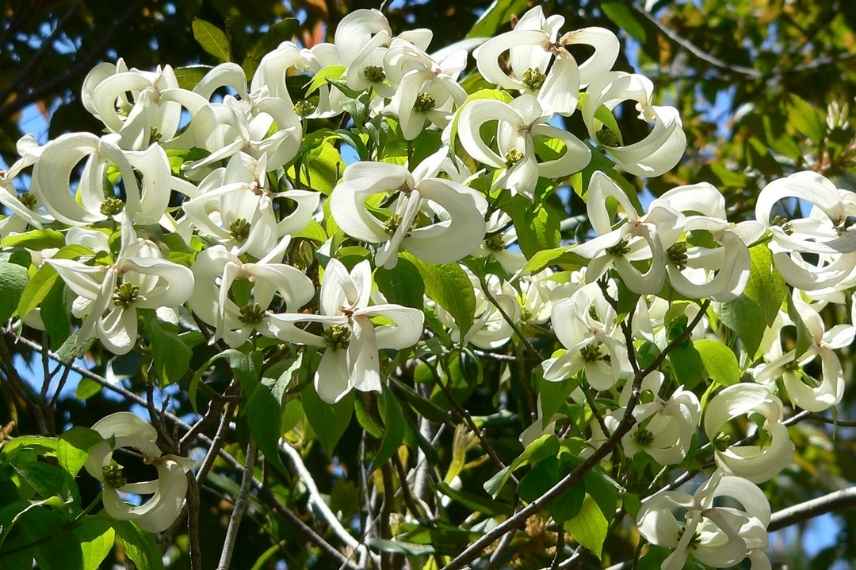
Cornus florida subsp. urbiniana
Evergreen dogwoods that are even more exotic
Dogwoods can be found on every continent (well, almost: Oceania and Antarctica are missing). Some, which we unfortunately cannot plant at home, grow naturally in Africa or South America. These “tropical” Cornus all have evergreen foliage.
This is the case with Cornus volkensii (or Afrocrania volkensii), a large tree over 30 m tall and the only dioecious species in the genus, which grows in Africa: from Congo, South Sudan to Kenya, Zimbabwe, and Tanzania.
Cornus peruviana (syn. Swida boliviana) is a small tree (10 m), a coloniser of clearings and steep slopes, found in Peru, Colombia, Ecuador, the Andes, Bolivia, and Costa Rica.
In Central America, we find the largest of all dogwoods (over 30 m): Cornus disciflora. Along with a species that produces a smaller tree, Cornus excelsa.
In short, as you can see, the genus Cornus is vast and can be found all over the world. The few species mentioned were only for informational purposes. None of them could survive here. Well… at least not for now.
- Subscribe!
- Contents

Comments