





























Dwarf hollies: varieties to structure your garden and terrace
Find the ideal dwarf holly
Contents
Dwarf hollies, with evergreen foliage and compact forms, are versatile shrubs that fit into almost any garden, regardless of size. If you’re looking for an easy-to-maintain ornamental plant, an alternative to boxwood, a structural element for borders, low hedges or container displays, these small hollies are an ideal solution.
With a wide range of foliage colours – from glossy green to bright gold, including purple – and sometimes enhanced by decorative berries, these offer year-round aesthetic appeal. Their slow growth and tolerance for regular pruning also make them ideal choices for topiary art, allowing elegant shapes to be sculpted in French- or Japanese-style gardens.
Resistant to diseases and to a range of climatic conditions, these robust shrubs fit into tight spaces such as terraces and balconies, as well as into more elaborate schemes. It’s the perfect blend of elegance, durability and ease of use. Discover their benefits and the varieties that deserve pride of place in your garden or on your balcony.

Differences in the foliage of dwarf hollies: a palette of textures and colours
Our selection of dwarf hollies stands out for the diversity of its foliage, offering gardeners a palette of shapes, textures and colours that suit a wide range of garden styles and moods. Here’s an overview of the most remarkable variations in this selection.
Glossy green foliage: elegant restraint
Some dwarf hollies carry dark-green, glossy, uniform foliage, perfect for lending an elegant, timeless structure to borders, hedges or beds.
The Ilex crenata ‘Stokes’ develops small, rounded, glossy leaves, reminiscent of boxwood, ideal for a neat appearance.
The same is true for the Ilex crenata ‘Luxus Globe’ with dense, glossy foliage. The variety ‘Green Lustre‘ offers leaves in a deep green, slightly larger, providing a rich and luminous texture.
Golden foliage: a touch of light
Golden-foliaged hollies brighten the garden, particularly in winter, when their glow contrasts with the darker tones of other plants. For example, the Ilex crenata ’Golden Gem’ offers compact, richly golden foliage from October to March, which catches the eye in landscape plantings. Conversely, the Ilex crenata ‘Convexed Gold‘ features small, convex leaves of a bright yellow, remaining decorative all year round.
Variegated foliage: a note of whimsy
Variegated hollies add a touch of originality thanks to their golden margins or to their subtle contrast between hues. The Ilex crenata ‘Lingold’, for example, is distinguished by dark green leaves edged with bright yellow, forming a luminous ball particularly attractive in shaded areas.
Purple foliage: a seasonal charm
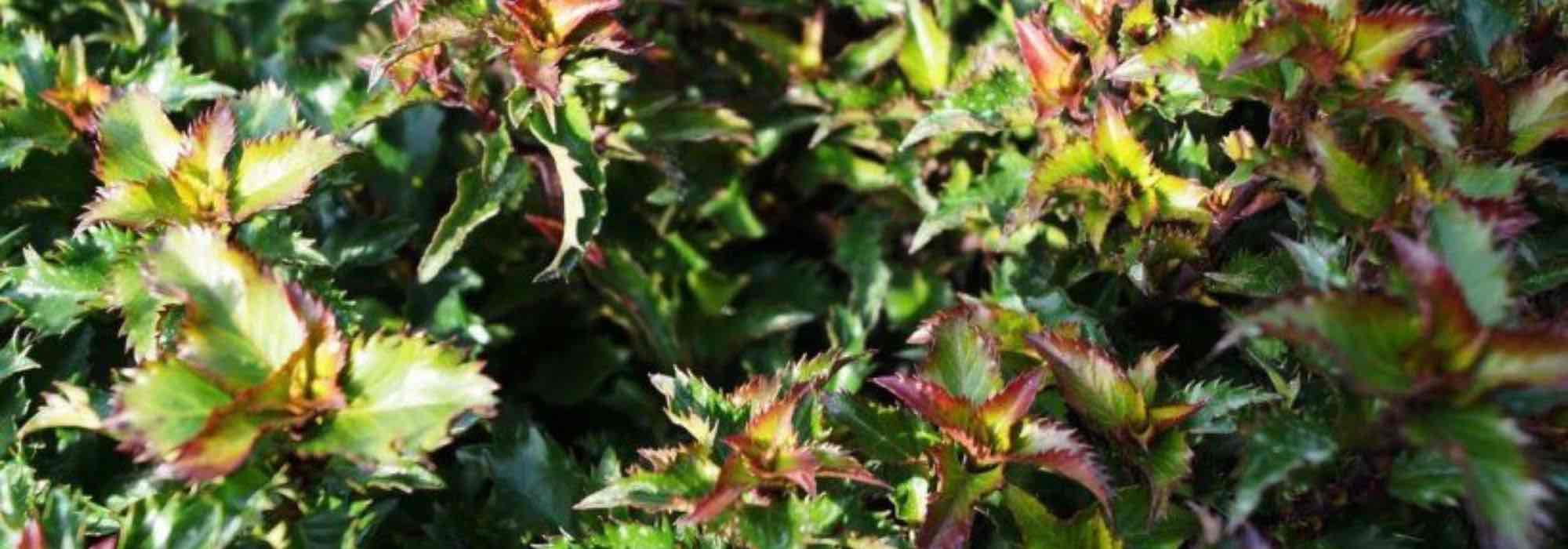
Some dwarf hollies change colour with the seasons, turning purple as cold weather arrives, adding seasonal interest. Ilex meserveae Meso Little Rascal a un feuillage vert foncé qui devient pourpre avec des reflets métalliques en hiver. Similarly, the Ilex meserveae ’Gentle’ possesses tough, light-green leaves at bud burst period, which take on a purple hue in winter.
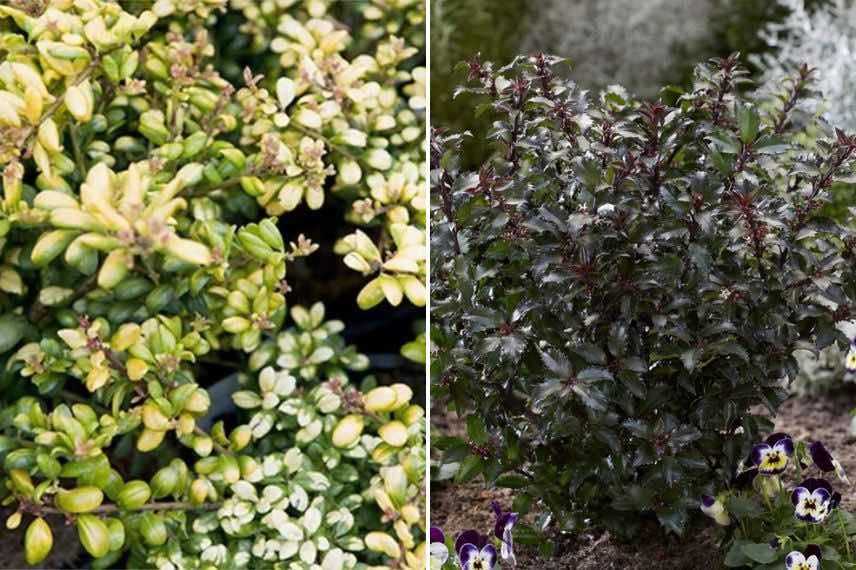
Ilex crenata ‘Convexed Gold’, Ilex meserveae ‘Gentle’
Leaf shape and texture
Finally, the shape and texture of the leaves also vary, adding depth and visual richness.
The Ilex crenata Convexed Gold stands out for its convex, glossy leaves, unique in their three-dimensional appearance. The Ilex glabra ‘Gem Box’, for its part, features elongated, narrow, glossy leaves, with a fine and regular texture.
Leaves that are dentate or crenate add an ornamental and more structured look, while remaining soft to the touch. This is the case for the leaves of the Ilex meserveae ‘Little Rascal’ and for the Ilex meserveae ‘Gentle’ with oval, finely dentate leaves.
Read also
Holly: planting, pruning and careDwarf hollies with or without thorns
The issue of thorns is not a major consideration for dwarf varieties that would make poor defensive hedges.
Some varieties have dentate and thorny leaves, but these thorns, far from being aggressive, are rather soft to the touch. For example, Ilex meserveae ‘Little Rascal’ and Ilex meserveae ‘Gentle’ display leathery, finely dentate leaves. These traits lend them extra charm while remaining easy to handle.
Other dwarf hollies are distinguished by completely smooth foliage, without thorns. The Ilex crenata ‘Stokes’, the Ilex crenata ‘Green Lustre’, and the Ilex crenata ‘Luxus Globe’ feature rounded or elongated leaves that are not prickly, resembling those of box.
These varieties are ideally suited for borders, low hedges and home gardens.
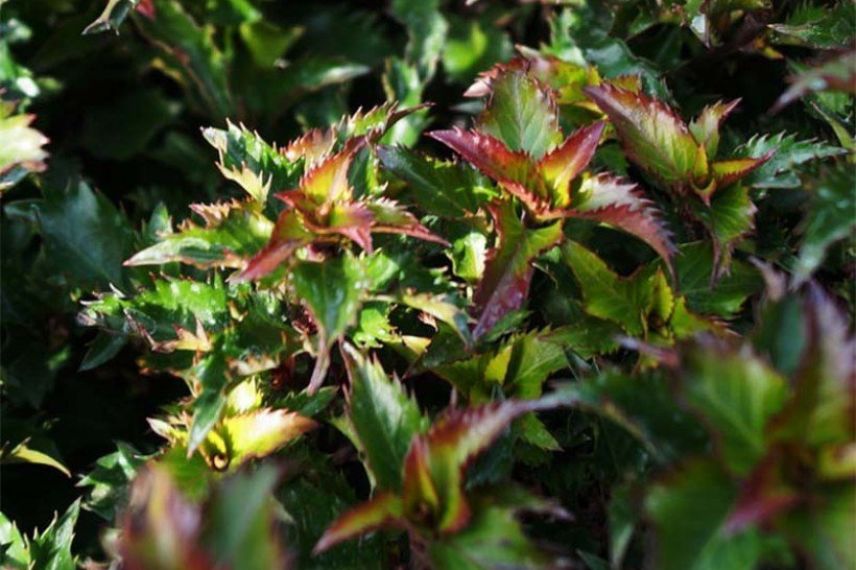
Ilex meserveae ‘Little Rascal’, with dentate and thorny foliage, soft to the touch
Dwarf hollies with slow growth and a very compact size: an ideal choice for small spaces and the art of topiary
Some varieties in this selection grow particularly slowly and reach an adult size even smaller than the other dwarf hollies, making them ideal bushes for small gardens, terraces and even balconies. Their moderate growth allows them to maintain their natural shape for long periods, reducing the need for frequent pruning while offering lasting appeal.
For example, Ilex crenata ‘Stokes’ does not exceed 50 cm in height and 70 cm in width, and Ilex meserveae ‘Gentle’ reaches barely 70 cm high and 50 cm wide. These compact dimensions allow them to be used in tight spaces without risk of becoming invasive. Similarly, Ilex crenata ‘Luxus Globe’, with its naturally rounded habit and a maximum height of around 50 to 60 cm, is ideally suited to pot culture or integration into discreet borders.
This slow growth is also an advantage for topiary enthusiasts. Dwarf hollies such as Ilex crenata ‘Glorie Dwarf’ or Ilex crenata ‘Luxus Hedge’ are particularly well suited to pruning, allowing you to create elegant, neat shapes while requiring little pruning. They thus offer the possibility to sculpt low hedges, borders or intricate topiaries without excessive effort.
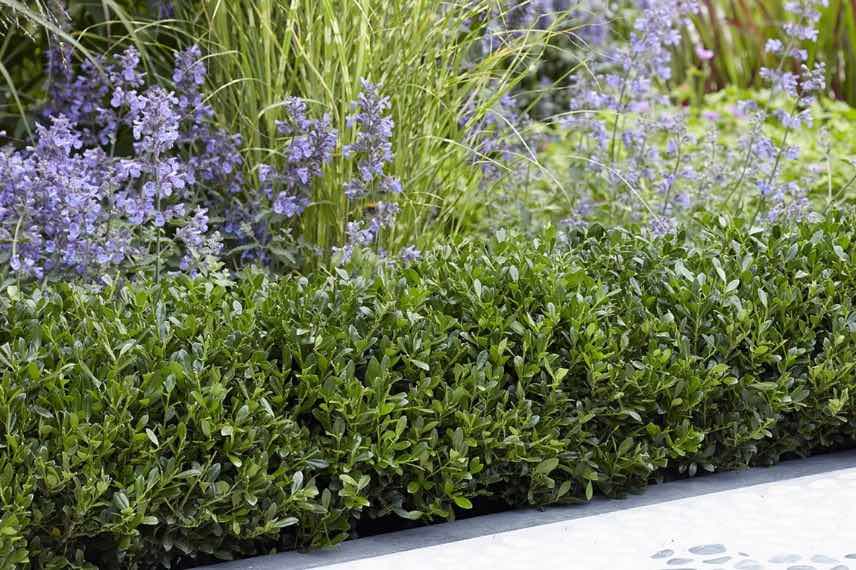
‘Luxus Edge’, an ideal holly for a low hedge or border
Read also
5 hollies to plant in potsDwarf hollies as a robust and elegant alternative to boxwood
Cultivars derived from the species Ilex crenata provide ideal alternatives to boxwood. Boxwood, although historically prized for borders and topiary art, is increasingly affected by the box tree moth.
Varieties such as Ilex crenata ‘Green Lustre’ or Ilex crenata ‘Luxus Hedge’ feature evergreen foliage, fine and dense, very close to that of boxwood, but without its drawbacks. These shrubs resist diseases, tolerate frequent pruning, and offer an impeccable display in borders or geometric displays. Their robustness allows them to be grown successfully in regions where boxwood can no longer thrive.
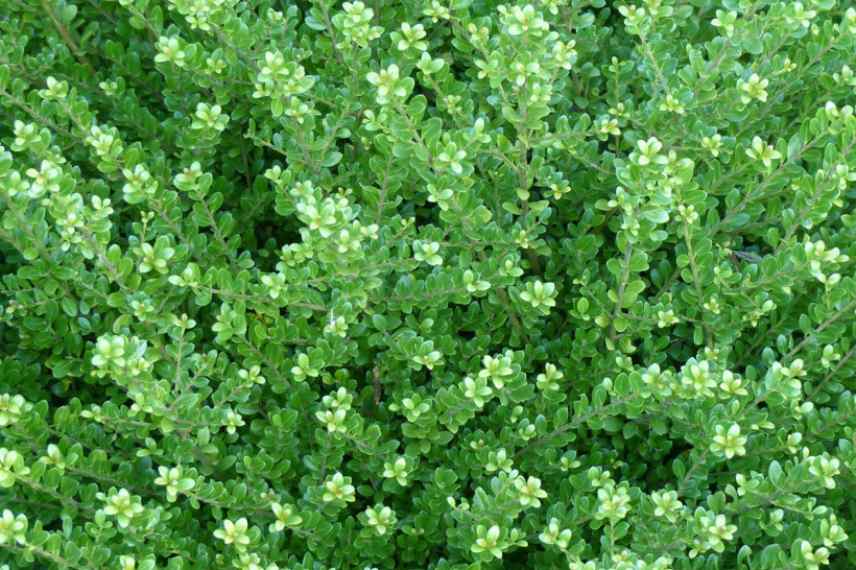
Holly from Ilex crenata makes good subjects as an alternative to boxwood (here ‘Glorie Dwarf’)
Some differences in growing conditions
Where can you plant a dwarf holly?
Hollies are extremely versatile bushes that adapt to a wide range of conditions and situations, making them easy to integrate into different kinds of gardens. These bushes generally prefer well-drained soils that are slightly acidic to neutral. They prefer moist but not waterlogged soils, which makes them ideal companions for regions where the soil is naturally moist but well-structured. Partial shade or gentle sun suits them perfectly. Conversely, exposures that are too hot or soils that are too dry should be avoided to ensure they thrive.
- Cultivars derived from the species Ilex meservae tolerate more calcareous soils and prefer a sunny exposure.
- Variegated hollies require a little more sun than the green-leaved varieties to express their potential.
How to use them?
Dwarf hollies are perfect for creating neat borders or structuring a bed thanks to their compact habit and evergreen foliage.
They are also suitable for forming low hedges, whether clipped for a neat appearance or left to grow for a more natural look.
In pots, these bushes become decorative elements ideal for terraces and balconies, adding structure and elegance.
Dwarf hollies are also particularly appreciated in specific themed gardens such as Japanese gardens, where their neat form and dense foliage blend harmoniously, or in French-style gardens, where they allow you to practise the art of topiary.
They can be used to delineate spaces or to mask less aesthetically pleasing areas of the garden, while adding an ornamental touch.
- Subscribe!
- Contents
Comments