





























Early potatoes: our complete guide to choosing and growing them
Different varieties, planting and growing
Contents
In the kitchen garden, the year is punctuated by small and large joys, linked to early sowings, planting young plants, and the harvest of vegetables of excellent flavour. Among these highlights, the harvest and tasting of early potatoes (Solanum tuberosum), with a thin skin and a delicate flesh, almost reach ecstasy for most gardeners. And especially, these early potatoes, regarded as a premium product, relatively pricey on market stalls, remain easy to grow. And above all, quick to produce.
Discover everything you need to know about early potatoes, from planting to selecting the best varieties, including care and harvesting.
For further reading: Potato: planting, growing, harvest.

What exactly is an early potato?
For a plant, the term “early” denotes a plant that matures earlier than others of its species. In practice, a early potato refers to a potato that reaches maturity before the tubercles of other varieties. They are therefore early or new potatoes that will be harvested before the others, i.e. about 70–80 days after planting. For comparison, semi-early varieties are harvested after roughly three to three-and-a-half months after planting, and late varieties around four months.
Early potatoes are therefore planted at the time of lilac flowering, i.e. between March and April–May, depending on the region. And the harvest will take place from mid-June to mid-July. 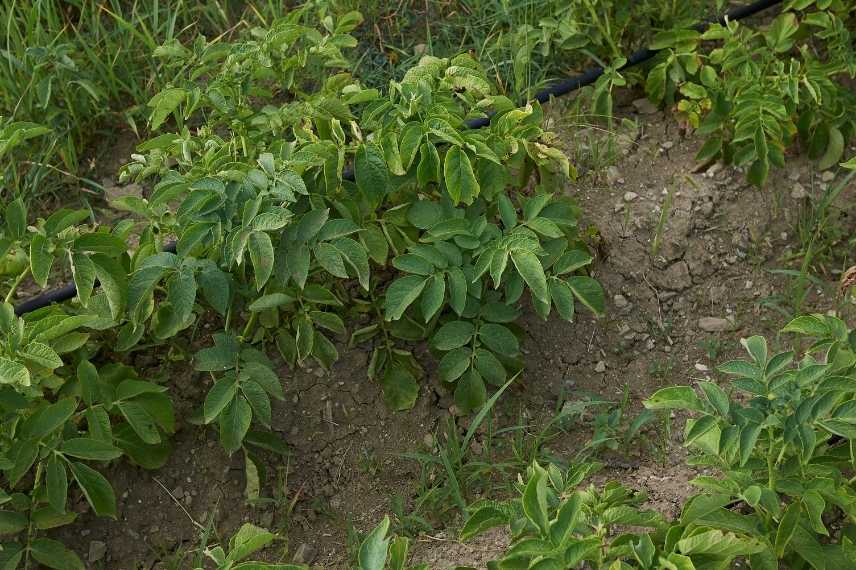
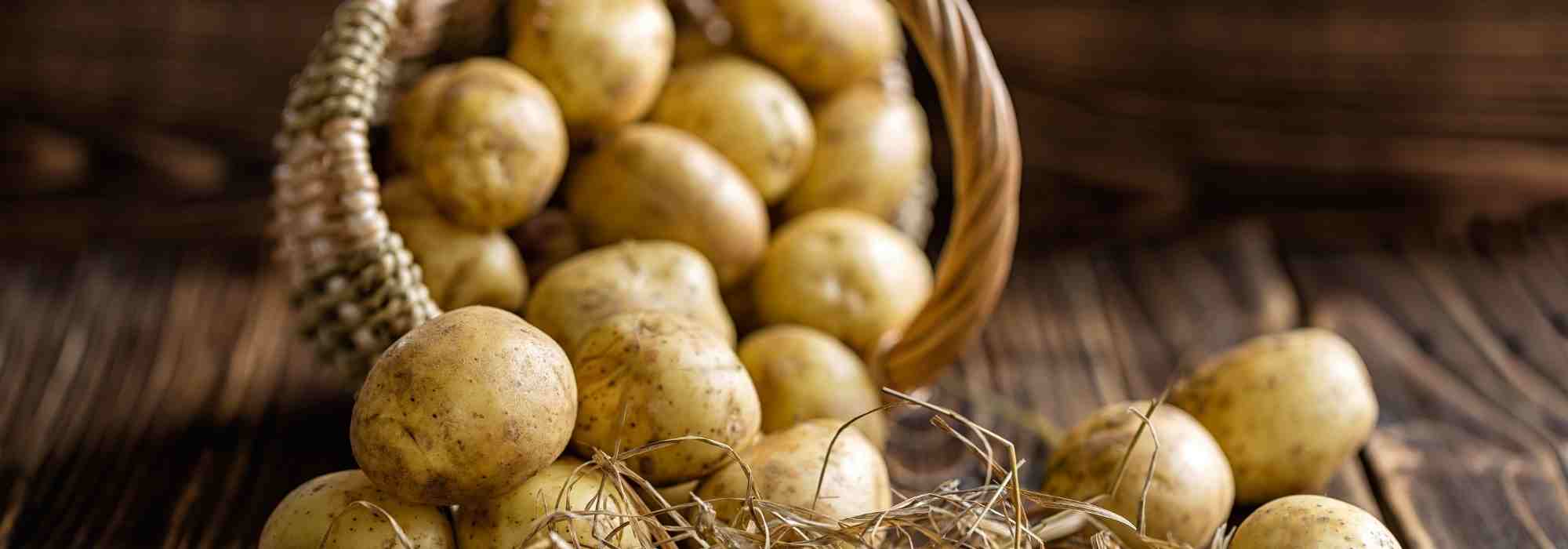
These potatoes are generally recognised by their particularly fine skin which does not need to be peeled. A simple rinse under clean water or a light brushing is enough. As for the flesh of these early potatoes, it is delicate and melt-in-the-mouth, with a mild and slightly sweet flavour.
Potato varieties with genuine early maturity are rarely high-yielding. Similarly, their tubercles are often small in size. By contrast, their flavour is undeniable. They are also more difficult to store, which requires consuming them quickly to enjoy all their advantages. But can one resist the flavour of these early potatoes for long?
Read also
Planting potatoHow to plant and grow early potatoes?
Planting and care of early potatoes are no different from those of later storage potatoes. The tubers are traditionally planted in open ground and in rows, but it is always possible to test other growing methods, which I invite you to discover: the growing potatoes under mulch and the growing potatoes on lawn.
Preparing potatoes before planting
About a month before planting, you will need to germinate your tubers. It suffices to place your freshly bought tubers in a crate, which you will place in a bright, well-ventilated room that is relatively cool (while frost-free). An unheated conservatory is ideal for the light and the relative coolness it offers. The sprouts appear very quickly on the tubers.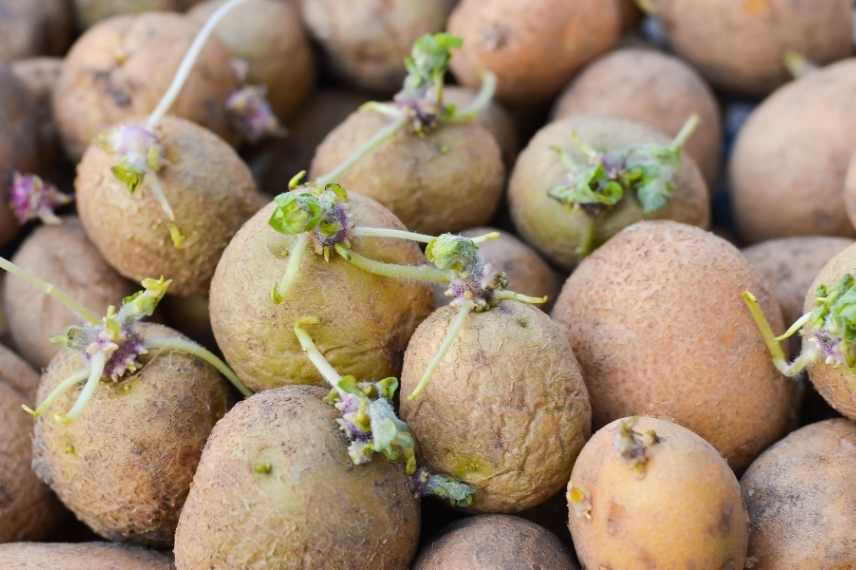
You will also need to prepare your soil a little ahead of planting, in a sunny or semi-shaded location. Indeed, potatoes prefer light, deep soils that are well-aerated and friable. In the autumn preceding planting, the soil will be enriched with farmyard manure. Then, during soil preparation before planting, well-decomposed compost can be incorporated. Potatoes dislike excess moisture, so the soil must also be perfectly drained.
Also consider crop rotation, essential for potatoes that should not be grown in the same spot for two consecutive years.
Certainly, Colorado potato beetles have less time to develop on early potato crops, but wireworms, which overwinter in the soil, can be formidable. The same goes for blight.
Planting in open ground
- Dig furrows 10 cm deep with a hoe, spaced 40–50 cm apart
- Place a sprouted potato tuber every 30–40 cm
- Cover with soil, not compacting
- Water only if the weather is dry.
L’entretien des pommes de terre précoces
Early potatoes require little maintenance. Watering is not normally necessary unless rainfall is deficient. But in general, rainfall suffices.
The only truly essential task for potatoes is the hilling. This operation involves bringing soil up around the potato plants to form a small mound. This hilling prevents the tubers from turning green by shielding them from light, protects the plants from cold and frost, while also limiting weed growth. You should hill early potatoes at least twice during their growth.
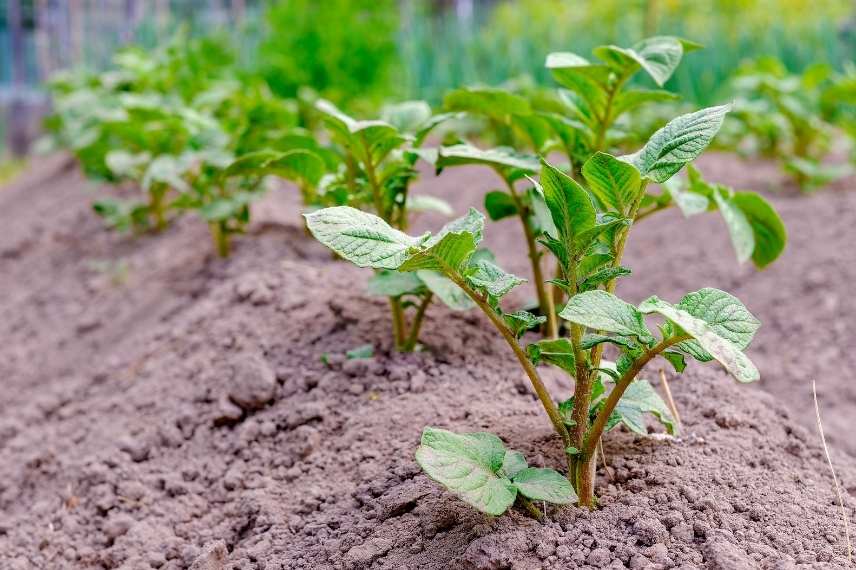
The potato plants must be hilled at least twice
Further reading : When and how to earth up potatoes?
Our selection of the 10 earliest potato varieties
Some varieties are champions of precocity. Here is the list of the ten earliest potatoes, noting that harvest depends on site-specific factors related to growing conditions or climate.
The ‘Linzer Delikatess’
The ‘Linzer Delikatess’ is a Ratte-type potato, but with flesh that is firmer, creamier and more melt-in-the-mouth. Of elongated shape, this medium-sized potato is harvested 75 days after planting. Its flesh is creamy to pale yellow. With a yield of around 15 potatoes per plant, this variety is fairly productive for an early one. It also stores well for 5 to 7 months. It is delicious in salads, steamed or pan-fried.
The ‘Amandine’
The potato ‘Amandine’ is also harvested 75 days after planting. It is a potato with flesh that is both firm and melting, of excellent flavour. In addition to these qualities, it has a pale skin and an elongated, harmonious shape. Its flavour recalls that of fresh butter. The tubers are medium-sized, but fairly numerous. It can be eaten with the skin.
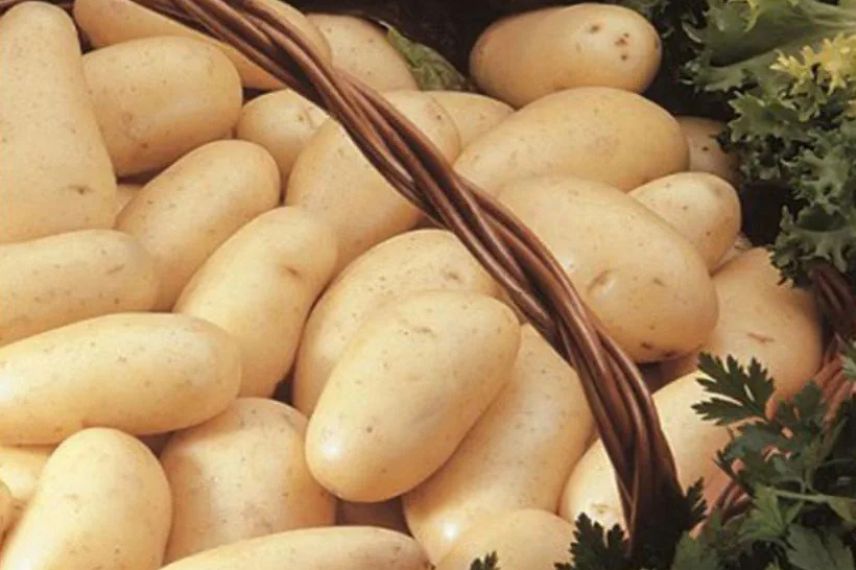
The variety ‘Amandine’
The ‘Belle de Fontenay’
The ‘Belle de Fontenay’ is very early, since harvest can take place 70 days after planting. Elongated, it has an irregular shape with one end wider and larger. Its flesh and skin are rather yellow. It compensates for lower yield with a texture of great finesse and a very delicate flavour. It is an ideal potato for salads. Cooked, it is perfect pan-fried.
The ‘Anaïs’
Regarded as early, the ‘Anaïs’ variety stands out for its productivity and the size of its potatoes. 75 days after planting, it produces oblong, rather large and short tubers, with eyes superficially marked and slightly sunken. The skin and flesh are yellow. This potato is of good culinary quality and has good cooking stability. It is also recommended for making pan-fried potatoes, but is fairly versatile in culinary use.
The ‘Sirtema’
The ‘Sirtema’ is an old consumer potato variety, renowned for its precocity. It is harvested 70 days after planting for fresh potatoes. It yields large tubers, round to oval with eyes slightly sunken, and rather short. Its skin is yellow, as is its flesh which remains stable when cooked. This flesh is particularly tasty, firm and melting. It can be stored for 3 to 4 months. It shows average productivity.
The ‘Annabelle’
The variety ‘Annabelle’ is an early potato that is harvested 80 days after planting. The tubers produced are rather small, oval and elongated, with very surface eyes. It has a pale yellow, smooth skin beneath which lies a yellow, firm, fine and tasty flesh. Thanks to its shape and flavour, it is an ideal potato for steaming, or for pan-frying.
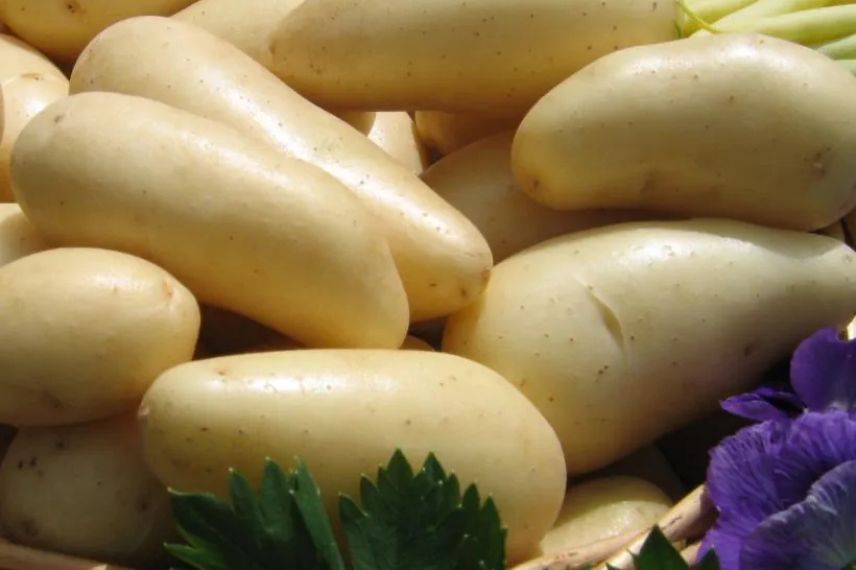
The variety ‘Annabelle’
The ‘Apollo’
The variety ‘Apollo’ also yields 80 days after planting. It produces medium-sized, oval potatoes with yellow skin and pale yellow flesh. It is particularly suited to growing in regions with cold climates. Its yield is average but respectable.
The ‘Penni’
The variety ‘Penni’ is a fingerling-type potato, offering oblong and round tubers with shallow eyes. Its skin and flesh are yellow. It is a medium-sized potato but fairly productive. It is mainly resistant to scab and blight. It stores reasonably well.
The ‘Jeannette’
Issue du croisement entre ‘Charlotte’ et ‘Franceline’, this potato variety ‘Jeannette’ stands out for its pink-red skin and yellow flesh, fairly firm, very fine and tasty. This productive variety, highly resistant to blight, is harvested 80 days after planting. With excellent yield, this variety produces large tubers. It is a versatile potato in cooking.
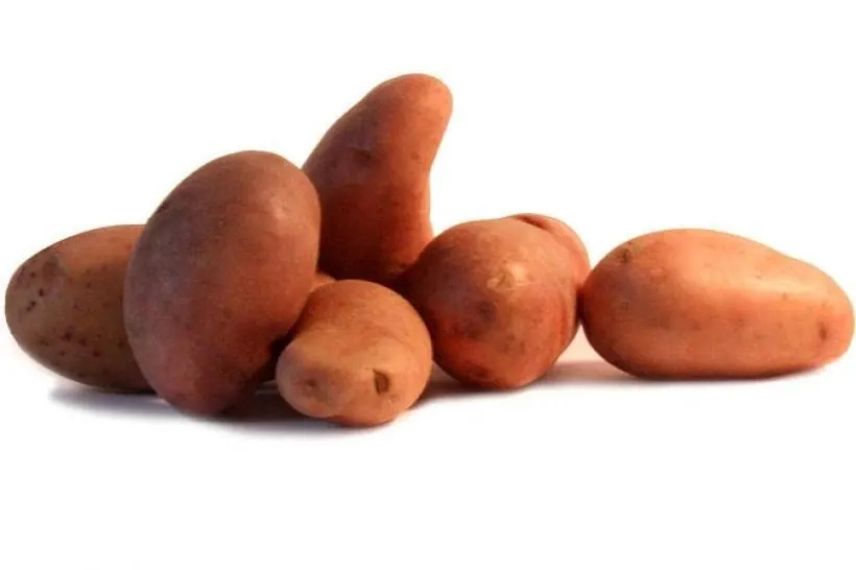
The variety ‘Jeannette’
The ‘Artémis’
The ‘Artémis’ variety also falls into the category of early potatoes, since its tubers are harvested 80 days after planting. Its oblong, homogeneous tubers are numerous but rather small in size. Its skin is yellow with very shallow eyes, and its pale yellow flesh is very tender. Benefiting from excellent cooking performance, it allows for making chips, purées, or soups and oven dishes.
- Subscribe!
- Contents
Comments