





























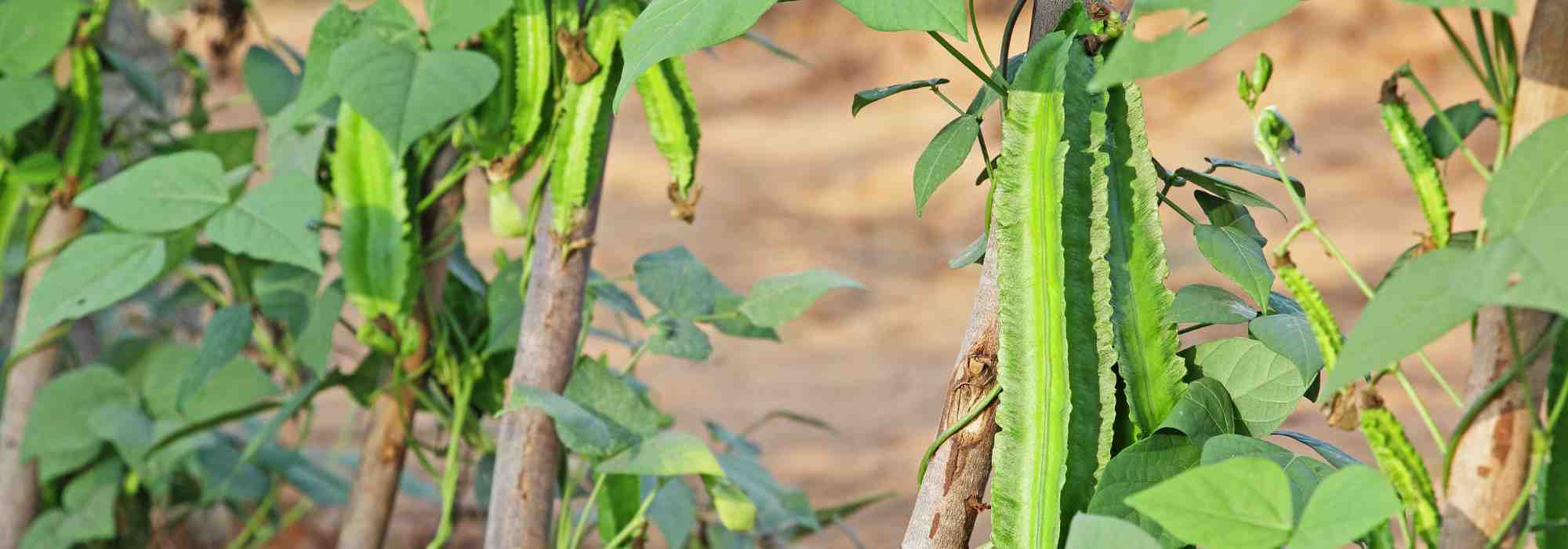
Easy and delicious to grow: the asparagus pea, a vegetable to discover
A practical guide to sowing, caring for, harvesting and preparing asparagus peas or purple sweet peas
Contents
Asparagus pea, red trefoil, purple trefoil, wetland trefoil, coffee pea… There are no shortage of names for designating this pea whose pods have a somewhat distinctive look. Botanically speaking, the asparagus pea is designated by the Latin terms Lotus tetragonolobus purpureus or more simply Tetragonolobus purpureus. But, for convenience, let’s call it asparagus pea!
Widely cultivated until the 16th century, this legume species is an annual vegetable plant with edible pods and peas. Admittedly, said as such, the “pitch” isn’t particularly attractive. Yet, this asparagus pea deserves a large place in the kitchen garden (or even in a flower bed thanks to its ornamental flowering!). Indeed, its pods and its peas conceal a very pleasant and delicate asparagus flavour. If we add the fact that this cousin of the garden pea and the broad bean is easy to grow in fairly poor soil, or in soil that is less amended, why not try growing this legume?
I’ll explain everything you need to know to succeed in growing this asparagus pea, which will bring a touch of whimsy to your garden, and to your plates. Sowing, care, harvest, storage, preparation methods, you’ll learn all about the asparagus pea.

What exactly is the asparagus pea?
Lotus tetragonolobus purpureus is an annual vegetable plant with deciduous foliage in the Fabaceae family (formerly Leguminosae). Very branched and bushy, this plant displays a habit that is upright at first, then trailing and rambling. Thus, this cousin of peas and beans easily does without stakes or supports. Reaching about 30 cm tall, this vegetable plant, once wild, spreads to about 50 cm across.
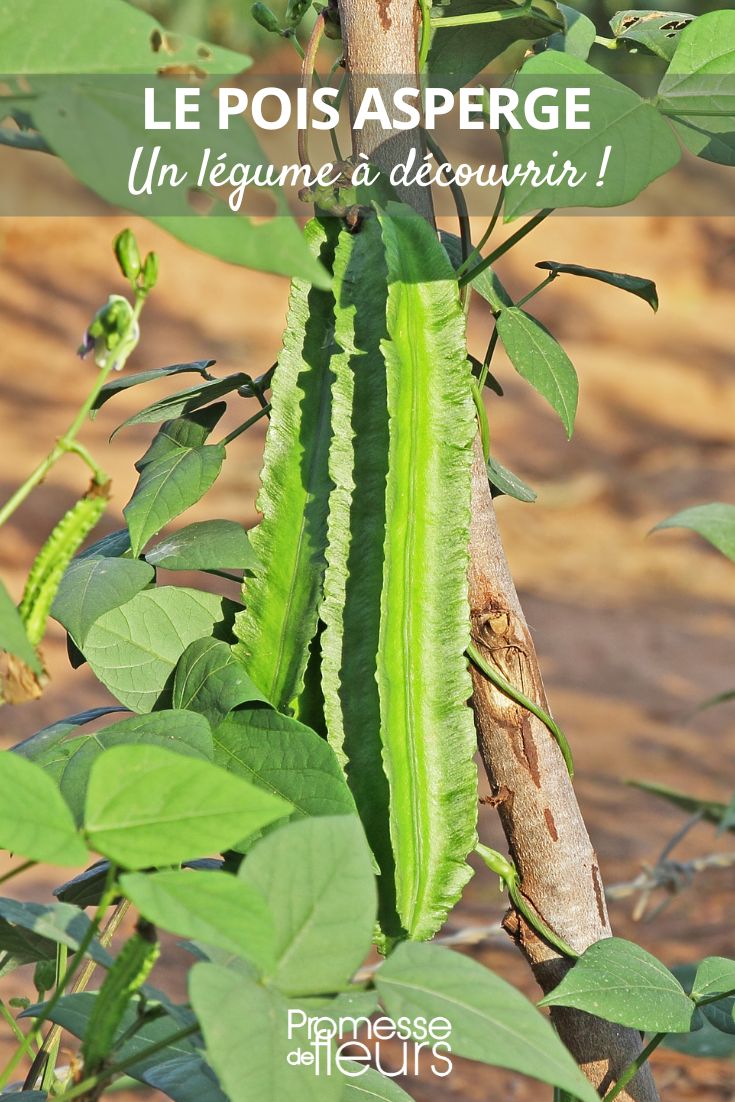
The oval leaves, divided into three leaflets, display a soft blue-green colour, quite decorative. The leaves are slightly hairy. From April to June, at the leaf axils on petiolate leaves, the first papilionaceous flowers appear in a fairly deep red, typical of Fabaceae. Grouped in pairs, these flowers open continuously, sometimes until July. Then, they bear pods with longitudinally winged, delicately scalloped edges. Square in cross-section, these pods contain seeds similar to peas.
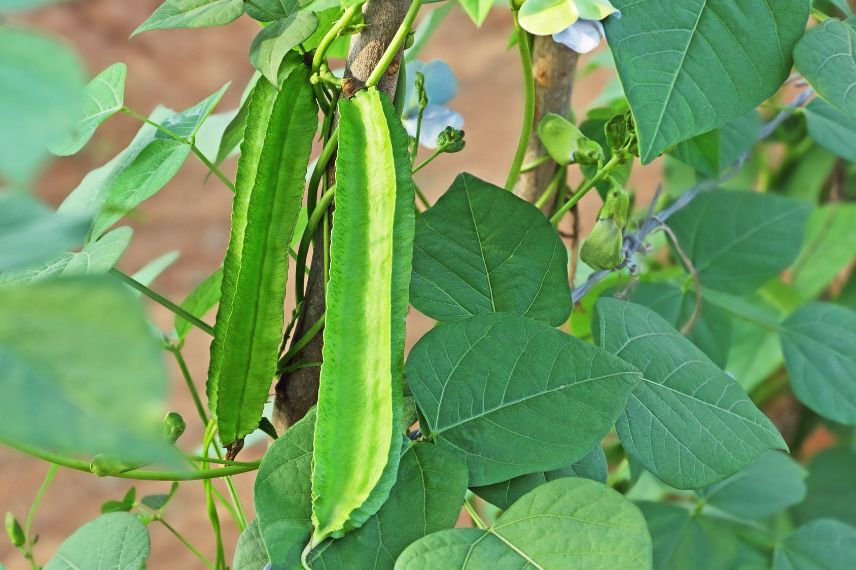
The striking pods of asparagus beans
As with all Fabaceae, asparagus beans have the ability to enrich the soil. Indeed, the root nodules fix atmospheric nitrogen and return it to the soil. This nitrogen is a boon to nearby vegetable crops or to those that will follow in crop rotation. It is therefore a useful plant as a green manure or as part of the crop rotation. It also has a very decorative flowering that can add a touch of charm to a cottage-garden border.
Planting asparagus peas
The asparagus bean is grown under the same conditions as garden peas or mange-tout peas, or sugar snaps. To start with, due to its preference for warm temperate climates, it needs a bright, warm position. It is, moreover, capable of tolerating some drought. However, this may adversely affect its pod yield.
Not particularly fussy, the asparagus bean can tolerate relatively poor, unamended soil. However, a richer soil, supplemented with a light manure dressing, may also suit it. This soil should also be fairly loose and deep, fairly light and rather cool and humus-bearing.
To germinate, the seeds of Lotus tetragonolobus purpureus require a soil temperature of at least 20°C. This is why, depending on the region you live and garden, there are several options available. Knowing that sowing takes place between mid-March and the end of May. The asparagus bean can thus be sown under cover from mid-March to mid-April. After that, sowing is carried out directly in the ground. It is up to each gardener to decide according to the climate in their region…
How to sow the asparagus bean?
- Loosen the soil with a tarpaulin or a hoe
- Mark deep furrows about 5 cm deep, spaced 40–50 cm apart
- Sow in clumps of 3 seeds every 30 cm or one seed every 5 cm
- Cover with 2–3 cm of soil and lightly firm with the back of the rake
- Water generously
Germination of the seeds occurs after 6–9 days, depending on the weather. If you wish to lengthen the production period, simply stagger sowings every 2–3 weeks.
Like all Fabaceae, the asparagus bean does not care for the company of onions, garlic and shallots. However, the presence of carrots, beetroot and lettuce is fairly beneficial.
Caring for asparagus peas
To promote seed germination, the soil should remain moist. This is why, depending on the spring climate, a few watering sessions may be recommended. After that, these waterings will continue because the pods will perform better in soil that stays cool. Without water, the pods quickly become stringy. To space out watering, a mulch can be laid. It will retain some moisture and limit weed growth until harvest.
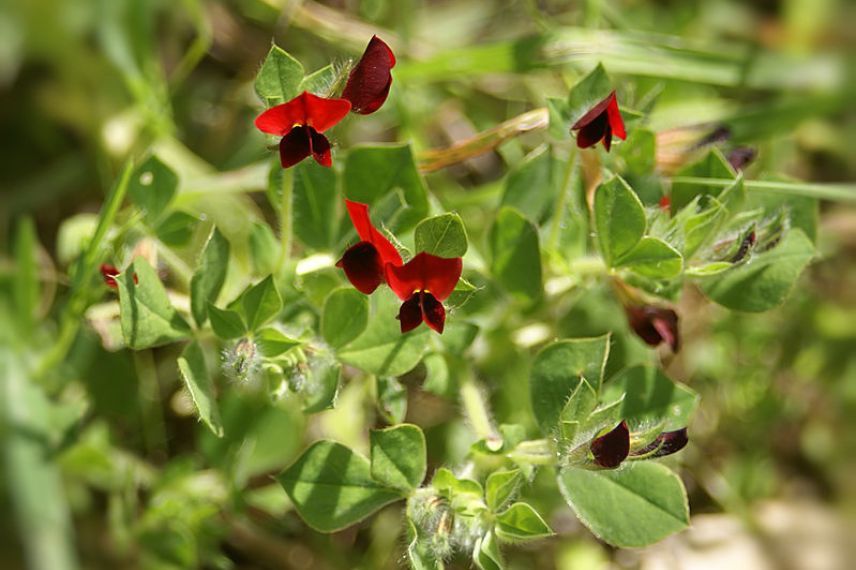
The asparagus pea flowers (©Hans Hillewaert for Wikipedia)
Little prone to disease, the asparagus pea nevertheless has formidable enemies: slugs and snails, irresistibly attracted by the tender young shoots. To avoid bother, Ingrid B. shares 7 ways to fight slugs and snails effectively and naturally.
From harvest to kitchen preparation
Asparagus bean harvest takes place every two to three days, when the pods reach 2 to 3 cm in length. Harvesting runs from July to September, and may extend right through to the first frosts. Pods form very quickly after flowering. If you leave them to age too long, they become hard and stringy. And the more pods you harvest before ripeness, the more the asparagus bean flowers.
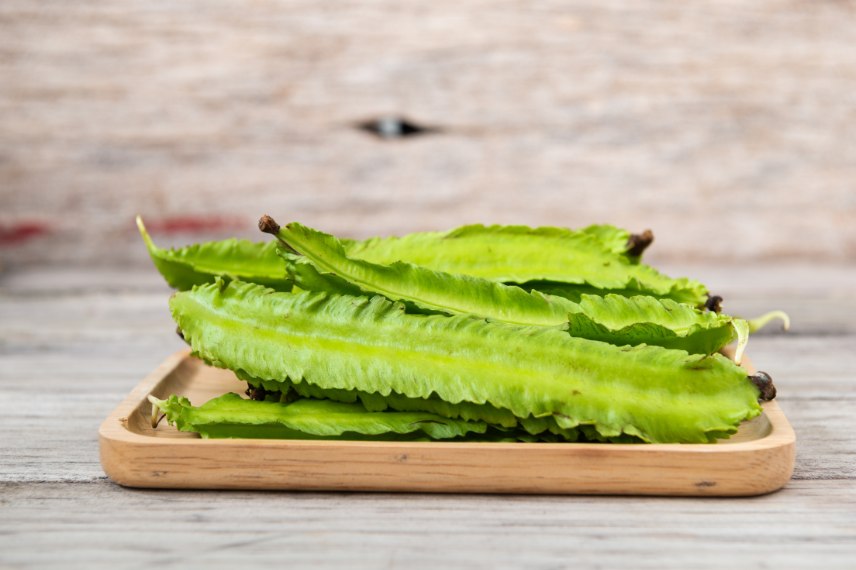
Asparagus bean pods are harvested immature
Seeds can also be allowed to swell so they can be eaten fresh, like garden peas, or even let the pods dry like dried peas.
At the immature stage, the whole pod is eaten. Then, the seeds are eaten as garden peas. The flowers are also edible and can be decorative on a salad.
Pods or seeds of asparagus beans can be steamed, boiled, or melted in a little butter as a fricassee.
Asparagus beans can be eaten cold in salads, for example with asparagus, or hot to accompany pasta or a risotto.
- Subscribe!
- Contents
Comments