


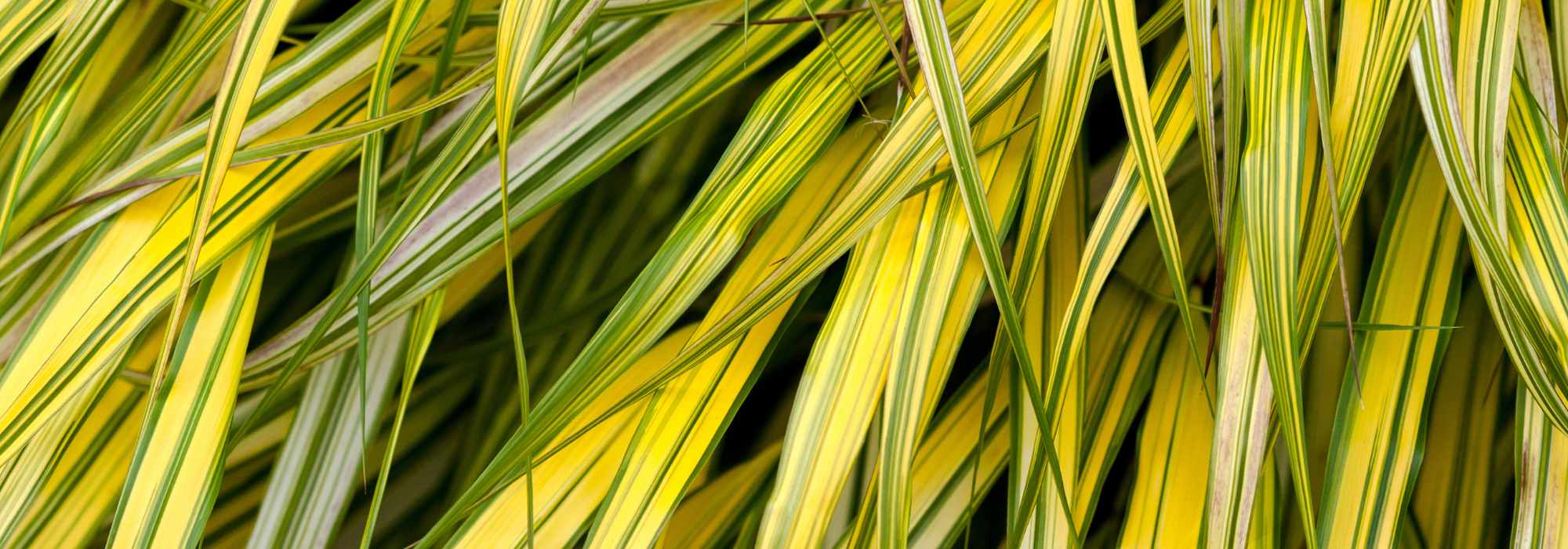
5 grasses with variegated foliage
Ultra-bright ornamental grasses for on-trend gardens
Contents
Grasses form a wide family of plants that are very on-trend, gracing naturalistic to contemporary gardens. Variegated varieties differ depending on whether a finer or broader margin stripes or borders the leaves, or whether a bi-colour appearance, often yellow, red or orange, colours the leaves, as with the popular Imperata cylindrica. Many Carex, grass-like perennials, are variegated, but also the iconic Hakonechloa macra ‘Aureola’. This feature gives variegated grasses a generally lighter look, which is ideal for brightening the garden, or a bold personality with more vibrant tones. Variegated grasses are often known as ‘Variegata’ or ‘Zebrinus’. In this guide we present five particularly ornamental and radically different varieties.
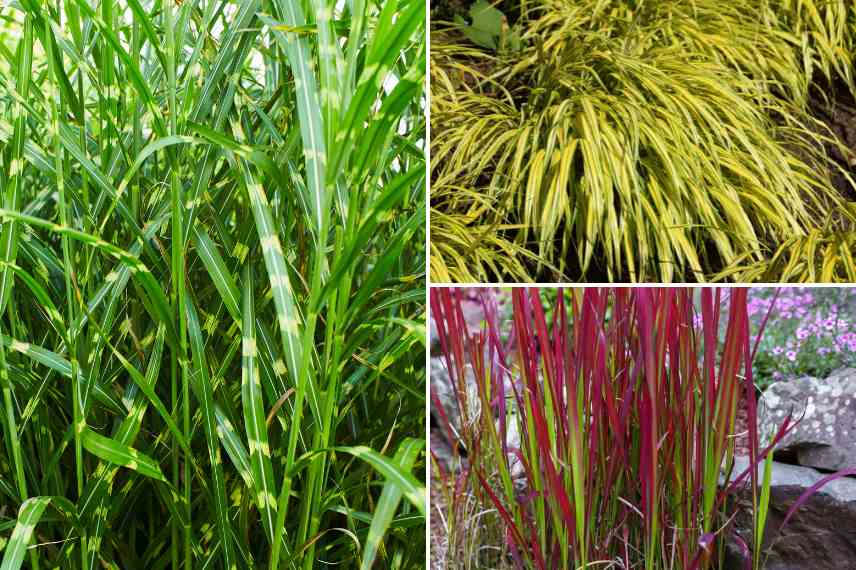 Miscanthus sinensis ‘Zebrinus’, Hakonechloa macra ‘Aureola’, Imperata cylindrica ‘Red Baron’: three varieties often seen… but there are indeed many more variegated grasses!

Miscanthus sinensis 'Morning Light'
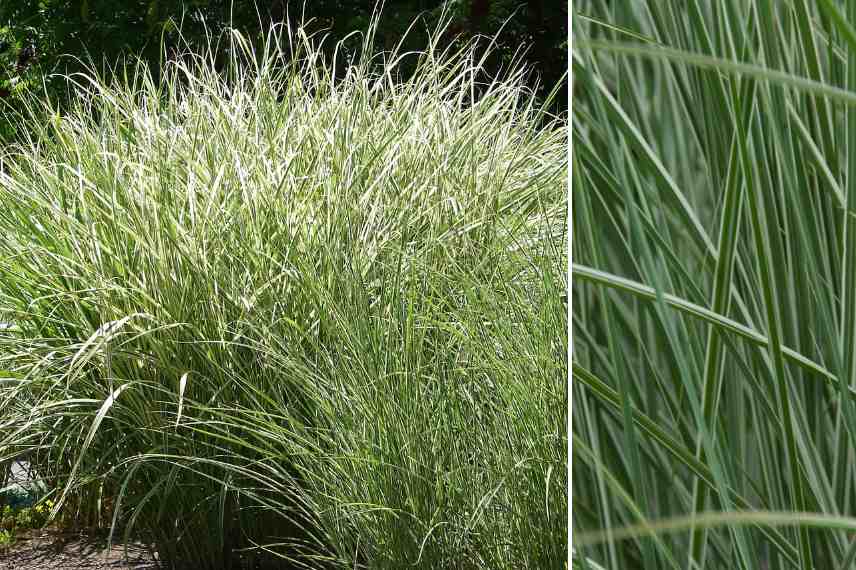
A must-have in this selection, Miscanthus sinensis ‘Morning Light’ is certainly one of the most elegant. The foliage is particularly fine, truly graceful, measuring barely 1 cm wide. Its variegation remains very fine, streaking the middle of the leaves with white and silvery hues, giving it a lovely brightness.
This Miscanthus forms part of the intermediate Miscanthus, forming a superb, spreading tuft about 1.50 m tall. ‘Morning Light’ flowers sparingly, and when it does, it flowers late in the season, from September to October, with silky spikes, copper-red. It requires fertile, well-drained soil and thrives in full sun or light shade.
The striking silhouette of this Miscanthus lends itself to a wide range of uses: classical, contemporary, natural or rustic. Its delicate form allows it to be used, for example, in pairs framing a path, or in groups of three interplanted with box or Pittosporum pruned into spheres in a modern garden, or as a standalone specimen. It can also be inserted into a large mixed-border with delicate colours, white and blue-tinged, alongside Veronicastrums, Perovskias and Spiraeas.
⇒ Miscanthus are certainly the grasses with the most variegated foliage. Also discover the horizontal striping at Miscanthus sinenis ‘Strictus’, and Miscanthus giganteus ‘Alligator’, as well as our buying guide: Choosing a Miscanthus
Read also
Grasses: which variety to choose?Calamagrostis x acutiflora 'Overdam'
Calamagrostis x acutiflora offer a typical, slender silhouette, and a flowering display in the form of beautiful culms with elongated panicles, beige to old-rose, lasting for many months. We are best known for the cultivar ‘Karl Foerster’ and for diamond grass (another species, Calamagrostis brachytricha).
The Calamagrostis x acutiflora ‘Overdam’ presents foliage very elegant, striped with white and green. This variegated foliage also takes on pink tones in spring, producing a very striking effect. It prefers ordinary, well-drained soil and can be grown in full sun or partial shade. Its height reaches around 90 cm (sometimes up to 1.2 m), and its feathery panicles, from June to September, add an interesting texture. Pair them with Miscanthus sinensis ‘Nepalensis’, which bears brush-like flowers, Nepeta and Caryopteris for a blue-tinted touch in a grass garden.
The Calamagrostis x acutiflora ‘Eldorado’ is another variegated option, more golden, blending yellow and silver.
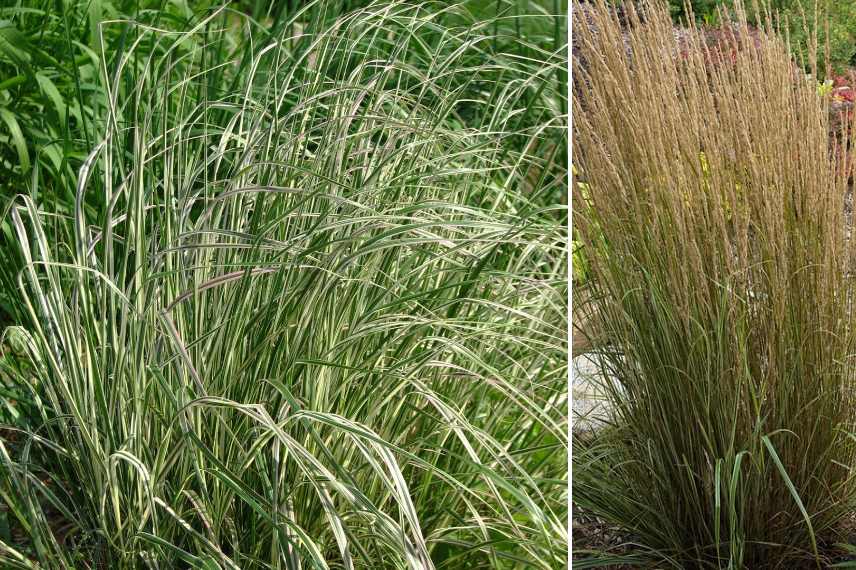
Calamagrostis Overdam © FD Richards
Pennisetum x alopecuroides 'Windy Simonette'
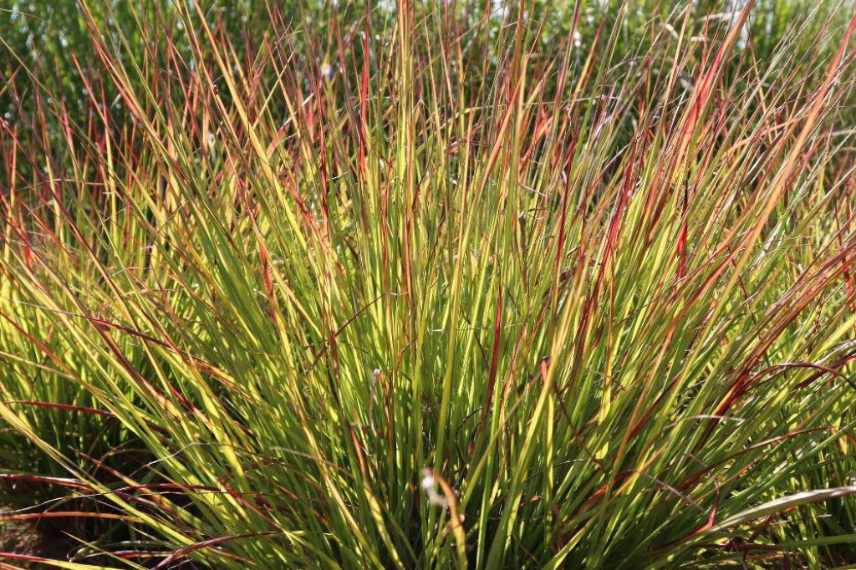
Pennisetums, grasses with delightfully soft plumes, are mostly unicoloured in foliage. Some new cultivars, such as ‘Windy Simonette’, offer a new look with variegated leaves, a little like the Imperata cylindrica ‘Red Baron’.
Here, it isn’t a blood-red colour that splashes the foliage, but a fiery red on a green base, from late summer into autumn, which takes over from an early flowering. The plume-like inflorescences are brown, gradually turning beige.
This hardy Pennisetum, hardy to -15°C, prefers well-drained soil and full sun. Slightly taller than the Imperata cylindrica, ‘Windy Simonette’ remains a compact grass, ideal for container plantings, but also for border planting in the garden, closer to Panicums, or Persicaria amplexicaulis Persicaria amplexicaulis ‘Bloody Mary’ or to reddish shrubs (Berberis, Pittosporum ‘Tom Thumb’, etc).
Panicum virgatum 'Blue Darkness'
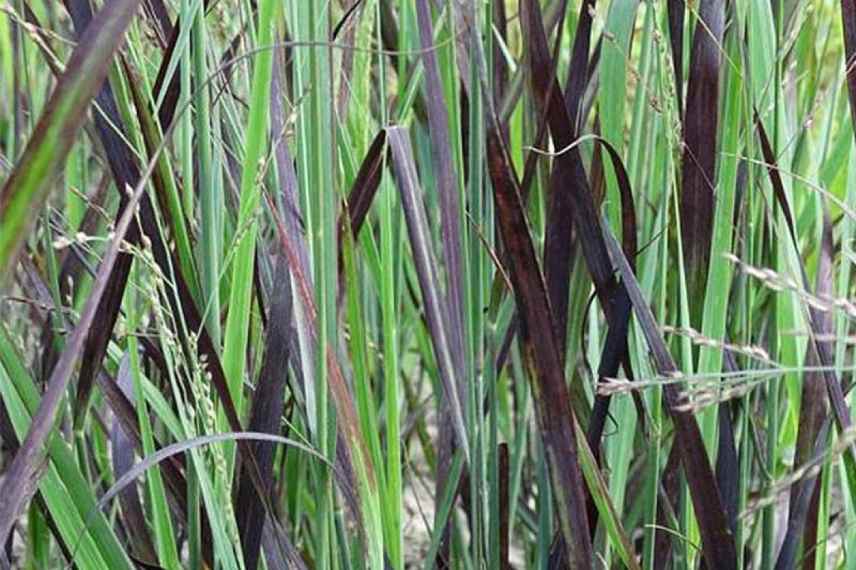
Panicum virgatum is a beautiful grass with a fairly narrow habit, whose flowering is one of the lightest there is, appearing as an ethereal, very airy cloud above the foliage. The Panicum virgatum ‘Blue Darkness’ stands out for its green foliage that gradually shifts to deep blue, purplish and almost black at the base, offering an astonishing appearance with this variegation that could be described as evolving. It prefers well-drained soil, not drying out too much in summer, and a sunny position. Of modest size, it can reach a height of 80 cm to 1 m, and its purple flowering from August to October is simply spectacular.
This beautiful compact and decidedly graphic variety will enhance a contemporary terrace, as it can be grown in a large pot. In the garden, pair it with Coreopsis or Helianthus salicifolius for a striking contrast of yellow tones, and a few purple sedums such as ‘Matrona’ or ‘Emperor’.
Phalaris arundinacea 'Picta'
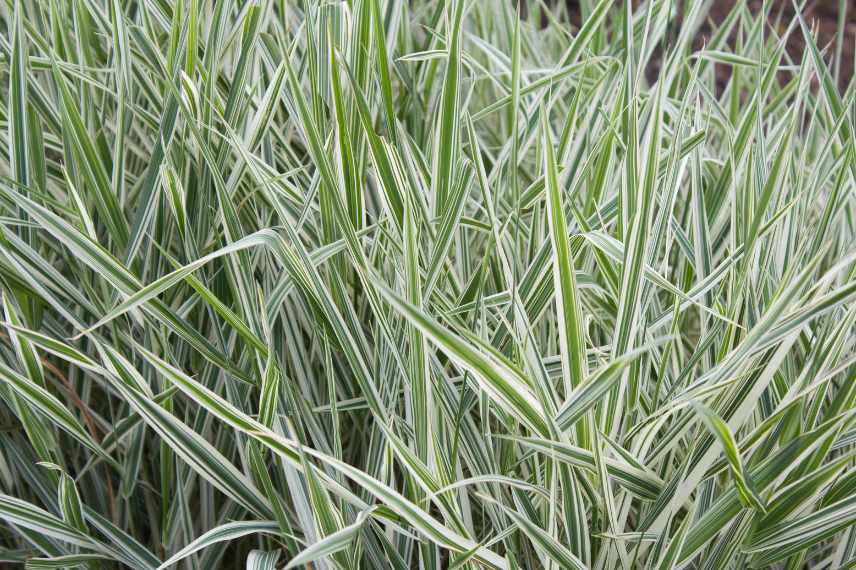
Here is a grass to grow in moist to wet soil: Phalaris arundinacea ‘Picta’ is indeed recommended for bank plantings, even woodland edges, and stands out with a broad white-cream variegation in longitudinal bands on narrow green foliage about 60 cm tall. It can be planted in full sun or partial shade. Its flowering is fairly discreet; what makes it interesting is the bright clump and its suitability for partial shade.
Phalaris arundinacea are reputed colonisers, and this variety is no exception. Therefore, when planting them, ensure regular maintenance to keep them in check by reducing the diameter of the clumps; in drier soil, however, they will be less prone to spreading across the garden. The cultivar ‘Feesey’s Form’ remains somewhat less invasive.
In terms of companion planting, this grass works wonderfully in open, wild spaces or areas occasionally mowed at the back of the garden, for example, with lamiums or periwinkles, water irises or primroses.
- Subscribe!
- Contents
Comments