





























American groundnut: planting, care and harvest
Discover how to grow Apios americana, an ancient forgotten vegetable, in your vegetable garden
Contents
Wisteria, no doubt you know it for the beauty and fragrance of its blue, pink or white flowers. Trellised along facades, it also cascades over porches, arbors, pergolas and conservatories, all with a romantic touch. But this wisteria belongs to the genus Wisteria and forms part of the Fabaceae family (formerly Leguminosae). The tuberous wisteria that we will discuss in this article is also a member of the Fabaceae family, but is named Apios americana. It is the tuberous wisteria, also called potato bean (or potato-pod), or chain potato or American groundnut. As these names suggest, the tuberous wisteria is an edible crop and food plant whose harvest and consumption recall the potato. Listed among forgotten heirloom vegetables, the tuberous wisteria indeed produces edible tubers with a potato-like flavour.
Nevertheless, it remains a magnificent climbing ornamental plant, with flowering typical of Fabaceae. And like all Fabaceae, its root system can fix atmospheric nitrogen and return it to the soil. It is therefore a useful plant that does not deplete the soil but enriches it. It is often cultivated in forest-garden projects or edible-forest permaculture schemes.
If I’ve piqued your curiosity even a little, I’ll explain how to plant and care for this twining tuberous wisteria, and above all how to harvest its tubers. And if you live and garden in a region with hot, long summers, you may even be surprised to taste the edible pods of this plant originating from Central America.

What exactly is tuberous wisteria?
Apios americana. The term is explicit enough to understand that this tuberous wisteria is native to Central America, and more specifically Mexico and the southern United States, extending to western Colorado and southern Canada. As for the term Apios, it comes from ancient Greek meaning pear. Simply because its tubers recall the shape of pears. The tuberous wisteria is therefore a herbaceous, climbing, perennial plant that produces clusters of small edible tubers, very rich in proteins, in carbohydrates, particularly starch, and in calcium. Although listed as an old forgotten vegetable, this perennial, by its tuberous stock, is making a comeback for its nutritional qualities. It is precisely this nutritional richness that the Native Americans sought, who consumed it long before the arrival of the first colonists in the New World. These same colonists who looked to Indigenous peoples for sustenance and survival in the years following their settlement.
Let’s close this historical page to focus on this herbaceous plant that attracts the attention of permaculture enthusiasts. Apios americana is therefore a fast-growing climbing plant that produces long twining vines. Very prolific, these vines can spread 2 to 4 m, taking advantage of the slightest support, fencing, trellis, pergola, or even the trunk and branches of a tree to climb and gain height. You can therefore enjoy its beauty. For the tuberous wisteria, before being edible, it is an ornamental plant by its flowers and its foliage.
Depending on the climate, the foliage is evergreen or deciduous. But, in our latitudes, it tends to be deciduous. In autumn, the vines dry up and the aerial part of the vegetation disappears to reappear in spring. The leaves are thick, alternate and pinnate, and lobed into 5 to 7 lanceolate leaflets. Of a bright green colour on the upper surface, they are slightly glaucous on the reverse. A pale midrib runs through them.
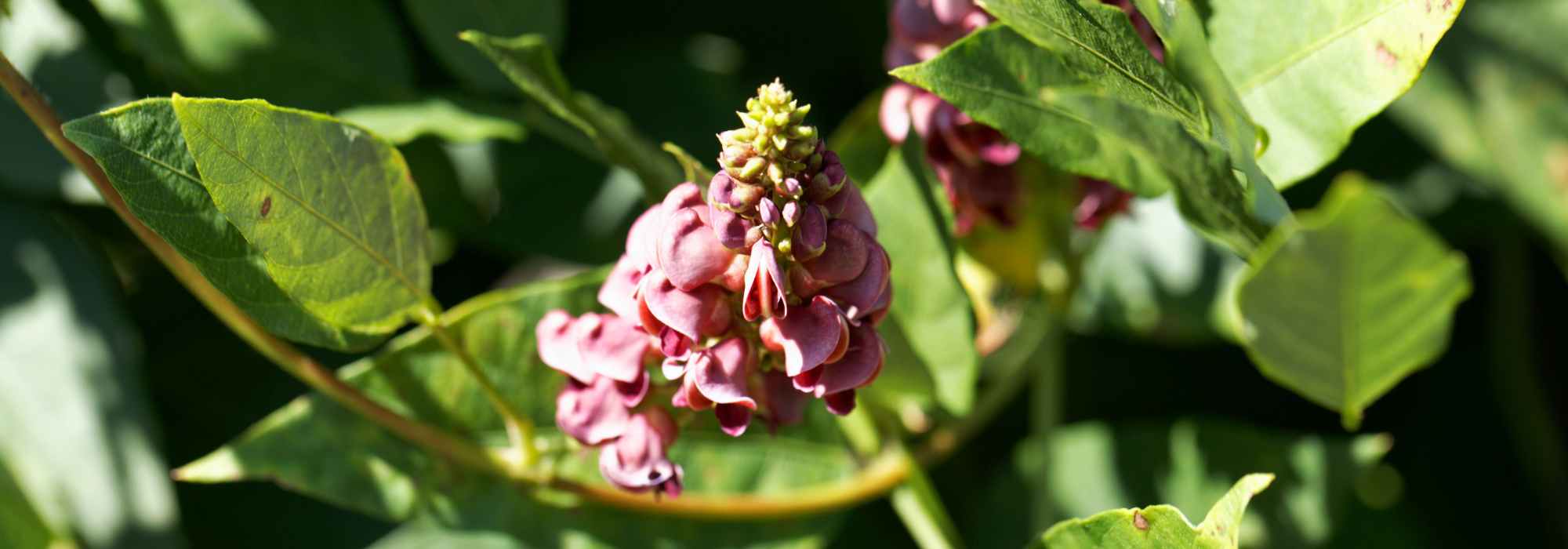
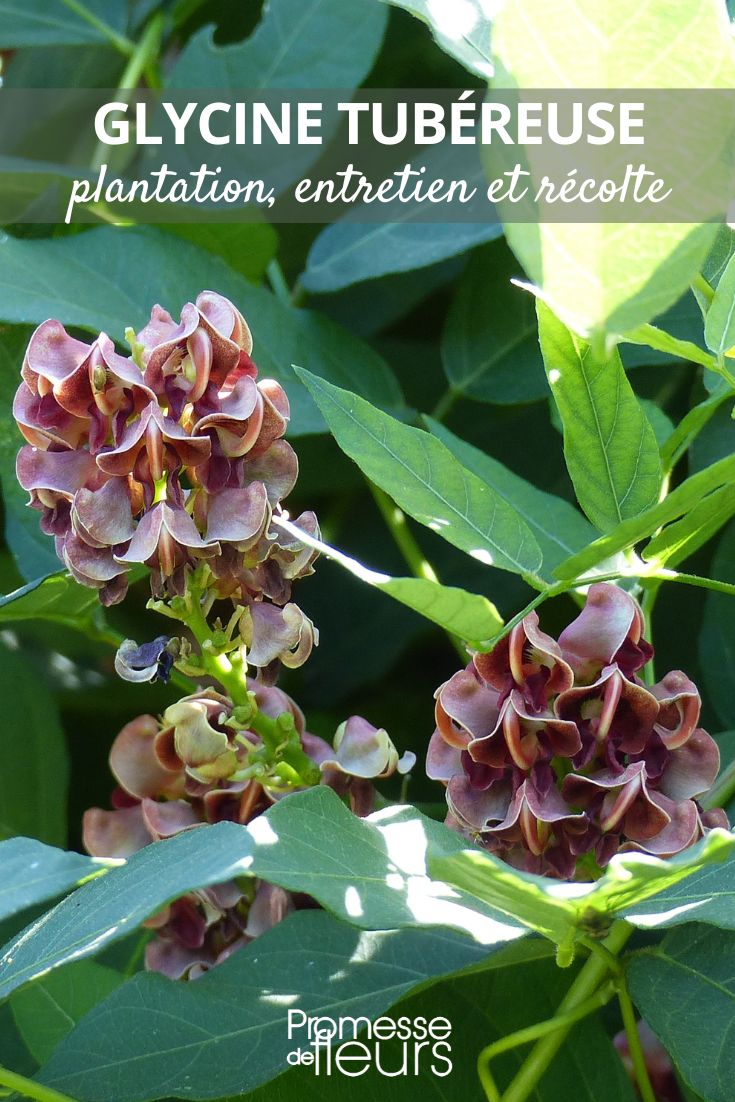
The flowering, typical of the Fabaceae, occurs between June and September, and more broadly from May to October. The tuberous wisteria flowers in simple racemes of pea-like flowers, slightly curved, in colours ranging from pink, through mauve to purple. As for the floral buds, they bear a milky white colour. The stamens, the anthers and the calyx are pale green. These flowers, fragrant and nectariferous, attract bees, bumblebees and a few butterflies. After the papilionaceous flowers, in mild and warm climates, long edible pods appear, giving the plant the common names wild bean, potato bean or potato-groundnut for the tuberous wisteria.

American groundnut flower
But it is mainly for its tubers that the American groundnut is cultivated in our regions! Thanks to their nutritional value, these tubers attract interest and are the subject of medicinal and medical research. The only snag lies in the patience required before they can be eaten. It takes at least two years, and more likely three to four years, to taste its tubers. Then, once well established, this tuberous wisteria can be somewhat invasive.
Very appreciated by permaculture gardeners, Apios americana is beneficial for the soil. Like all Fabaceae, its tubers benefit from nodules that have the ability to capture atmospheric nitrogen to return it to the soil. This nitrogen enriches the soil and can be used by other plants.
Planting Apios americana
As with potatoes, plant a tubercle of Apios americana. Planting of tubercles generally takes place in spring, between March and May, once frosts have passed. Indeed, the tubercles require soil warm enough to be planted.
The planting is carried out in light, fertile soil, rather cool. The potato bean can even tolerate very wet soils since, in its natural habitat, it withstands floods well. It is not uncommon to find it along riverbanks. Nevertheless, loose, non-compacted soil makes it easier to lift the tubercles. The soil type matters little, provided it is not too acidic.
In terms of exposure, a sunny location is recommended. But the potato bean also grows in partial shade.
How to plant tubercles in the ground?
-
- Prepare the soil by hoeing to a depth of about 10 cm, removing weeds and stones
- Enrich the soil with a well-decomposed compost or manure
- Rake the soil and break up clumps to loosen, lighten and refine it
- Dig holes 5 to 10 cm deep, 1 m apart, and place the tubercles
- Provide a sturdy support to allow the trailing stems to climb (trellis against a wall, pergola, or tepee in the middle of the veg patch…)
- Cover with soil and firm gently
- Water well.
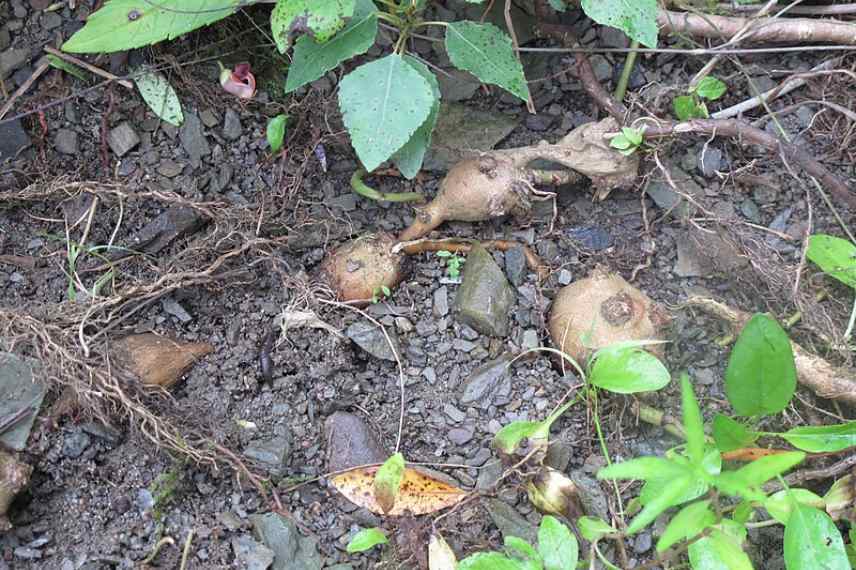
The tubercles of the tuberous wisteria often protrude at the soil surface (©Gilles Ayotte Wikipédia)
Young shoots emerge in June. Their growth is fairly slow in spring, but accelerates thereafter.
In cooler regions where the soil warms up more slowly in spring, tubercle planting can be carried out in pots using a light potting compost. The pots should be kept under a frame and the seedlings transplanted into open ground in April or May. Dig a hole two to three times larger than the root ball and cover with fine soil.
Sowing seeds of Apios americana is possible but you will have to wait at least two to three years to see the first tubercles appear.
Caring for tuberous wisteria
Once planted, the tubers of the American groundnut require little maintenance. A few simple steps are enough to maintain good growing conditions:
- Around young seedlings, lay a good layer of mulch made from plant debris resulting from the pruning debris of shrubs or trees, or RCW (ramial chipped wood). You can lay a 10 cm layer that will retain moisture and facilitate harvest of tubers when the time comes. These plant debris will also form a barrier against slugs and snails, particularly fond of the young shoots of the tuberous wisteria. To reinforce this barrier, feel free to spread coffee grounds or ash around your mulch as gastropods are tenacious… and hungry. Other tips for fighting these slimy invaders with Ingrid.
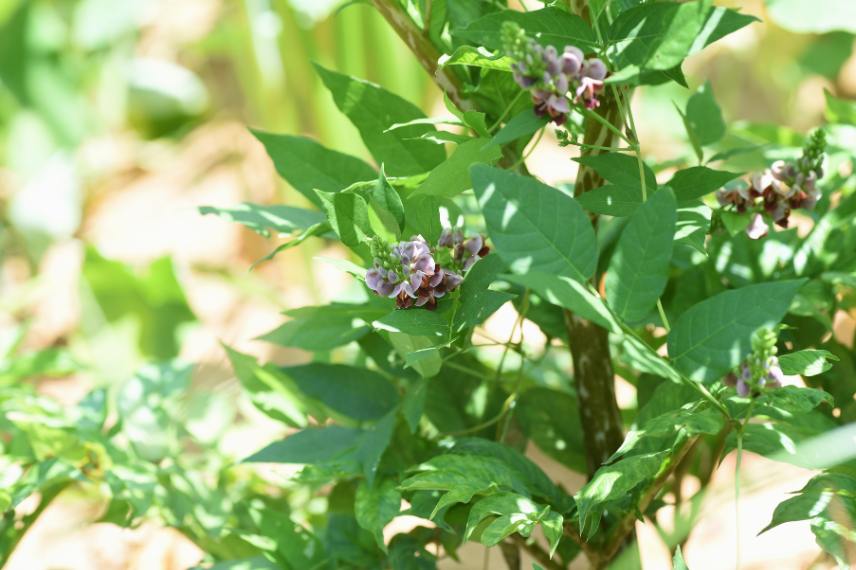
Apios americana has voluble stems
- Water during the first two years during hot spells, even though the tuberous wisteria is fairly drought-tolerant
- Apply compost in autumn. Simply spread it on the soil and very lightly scratch the surface because the tubers grow very little from the soil surface
- Cut back the dry foliage to ground level in winter and lay down a good winter mulch (dead leaves, lawn clippings, …) to protect the tubers from cold and frost. You may also decide to leave this dry foliage in place, which will shelter insects during their hibernation.
Harvest and storage of tubercules
To enjoy the tubercles of Apios americana, patience is essential. Indeed, you should allow two to three years after planting to harvest new tubercles of a good size that come in clusters. It suffices to use a garden fork to lift the cluster, which lies a few centimetres below the soil.
It is possible to harvest the tubercles from April, but they are considerably better after they have weathered the first frosts. They are harvested from autumn to spring when the foliage is absent. These tubercles should reach the size of a medium-sized potato.
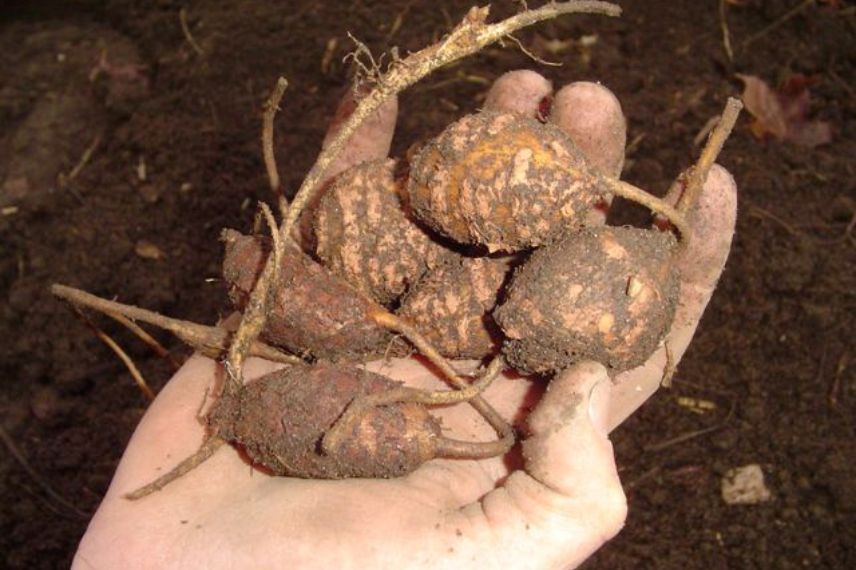
The tubercles of the tuberous wisteria (© Eric Toensmeier Wikipedia)
These tubercles from the American groundnut keep in the fridge for only about a week. You can also store them in a silo filled with slightly damp sand in a cellar. But they are best when freshly harvested.
The tuberous pea, from garden to plate
In terms of flavour, the potato bean tubers resemble potatoes and sweet potatoes, with a hint of hazelnut and peanut. As for the texture of tuberous wisteria, it resembles that of a potato, but drier. Indeed, it contains more starch than a potato.
After peeling, the tubercles are cooked in water or steam. Cooking time is slightly longer than for potatoes. The tubercles can then be prepared as a gratin, fries, crisps, purée, pan-fried or cold in a salad.
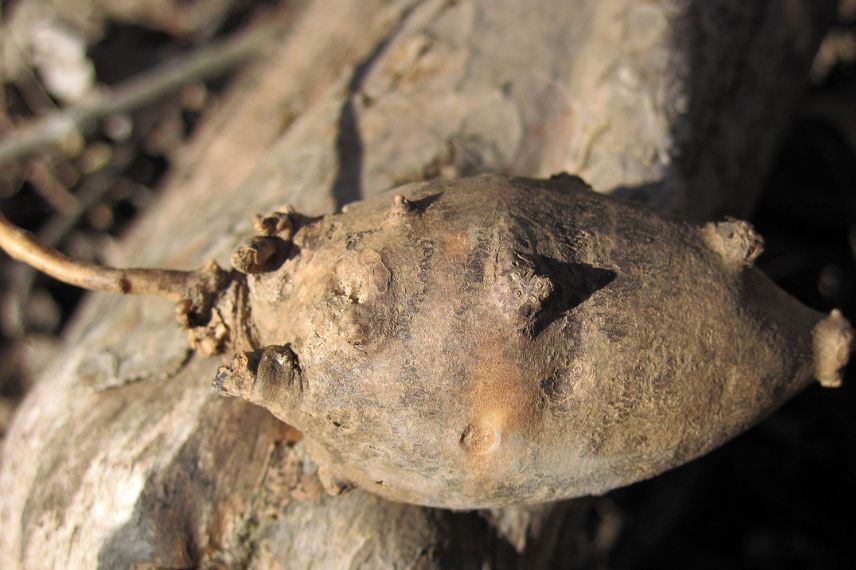
Potato bean tuber (©James St Jones Wikipedia)
If you’re fortunate enough to live in a region with hot, long summers, you can certainly taste the beans, whose seeds are eaten like peas. These pods are harvest in late summer. Even the flowers can be eaten raw in a salad.
To discover other perennial vegetables.
Listen to our podcast “Discovering Perennial Vegetables”:
- Subscribe!
- Contents
Comments