







Green roof, blue roof: the many benefits of ecological roofing
A comparison of these two types of green roofs and their benefits
Contents
Rooftop landscaping is attracting an increasing number of enthusiasts. Utilising this surface can meet several objectives, both aesthetic and environmentally beneficial. If green roofs or vegetated roofs are well known and popular, blue roofs are only starting to attract attention.
And it’s not simply their colour that differentiates these types of rooftop installations: let’s explore their principles and the benefits they can bring.

Green roofs: what are they?
Characteristics and Functions
The principle of green roofs or vegetated roofs involves installing specific plants on the top of a building. We find them in Nordic countries, but also in other European countries. Germany, in particular, is one of the pioneers in the field. But it is, in fact, a very ancient installation, which would have been used for millennia.
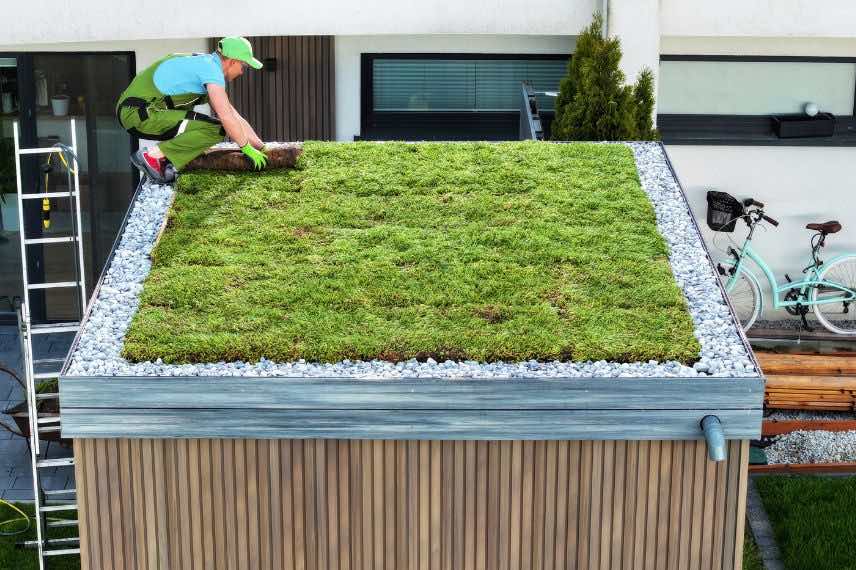
Green roofs are more common in northern countries
If green roofs are gaining ground, it is because they offer a number of advantages.
- They are particularly beneficial for thermal insulation. They combat heat island effects and absorb atmospheric pollution, particularly in cities. Thanks to the evapotranspiration of the plants, humidity levels rise, bringing greater ambient coolness. This, in turn, enables energy savings.
- They provide sound insulation, helping to absorb sound waves to reduce surrounding noise (airborne and road traffic noise…).
- They have a good water retention capacity, retaining part of the rainfall in the substrate and the plant roots. This limits runoff, reduces flood risk and the load on drainage installations (sewers, wastewater treatment works…).
- They increase the roof’s airtightness and watertightness, as well as its resistance to UV, to fire and to wind. This helps reduce the number of claims.
- They are highly aesthetic and blend easily into all types of environments.
- They promote biodiversity, particularly in highly urbanised areas where it is compromised.
- They require little maintenance.
- They can be installed on both small and large surfaces. They take up no ground space, freeing space for other uses.
- They are compatible with sustainable development principles and can use locally sourced materials.
There are three types of green roofs: extensive planting, semi-intensive planting or intensive planting. These three models vary according to substrate thickness (soil), total weight, plant growth and the irrigation system.
Installation
These green roofs can be installed on both individual dwellings and collective housing, public buildings (schools in particular), office buildings or even on transport (for example barges). They are ideal for new builds, but can also be fitted on existing roofs. These green roofs can be installed on different types of support : wood, steel, concrete, etc.
The installation of a green roof isn’t necessarily complicated on a small area, but will require more know‑how on a larger area, such as a house or building roof.
The installation requires taking into account different factors:
- the natural slope of the surface to be vegetated (ideally a gentle slope) ;
- the strength of its structure (taking into account the weight of the roof, but also that of water or snow) ;
- its accessibility for maintenance of the plants to be grown.
The installation of a green roof will then require several steps.
- The installation of a waterproof layer preventing rot of the timber frame (tarpaulins, sheets, specialist tiles, membranes…), which can be paired with a root barrier.
- The installation of a layer optimising drainage and filtration, made of expanded clay beads, gravel or alveolate plates (with possibly the installation of additional gutters).
- The setting up of a frame ensuring the retention of the plants and the substrate.
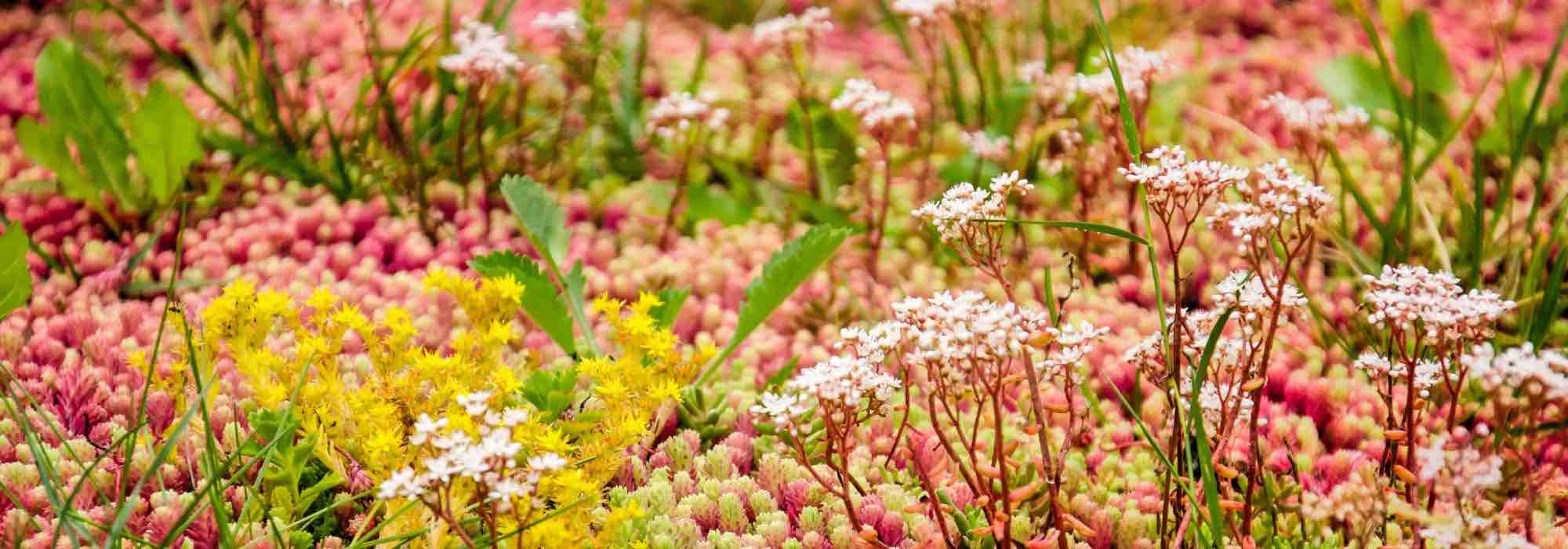
- The addition of growth substrate and the planting of the plants. Regarding plant choice, undemanding and hardy varieties, which require little substrate and care, will be best suited. They will be able to withstand extreme conditions, resisting both heat, drought and frost. Rock garden plants, succulents, some groundcovers or alpine plants are thus ideal (sedums, houseleeks, saxifrages, phlox, Aubrietas, carex).
Maintenance
The appeal of the green roof is that it largely operates autonomously. It will not require weekly care, only occasional maintenance tasks.
In the first year, however, it will be essential to water during dry spells to allow the plants to establish themselves properly. Even drought‑tolerant plants need an adaptation period to become resistant to water shortages.
Afterwards, annual maintenance in autumn or spring will usually be sufficient. This will consist of possible weeding to prevent competition from unwanted plants, trimming of damaged or faded parts, as well as checking the proper drainage of the water.
For more information: How to create a green roof?
Disadvantages
Installation can be costly, especially if the project has not been considered in advance of the roof’s construction. This type of roof does require a flat or gently sloping surface, which is not necessarily the most common model in our country (particularly for individual homes).
The green roof will require a little patience before it is fully performing, as the plants grow.
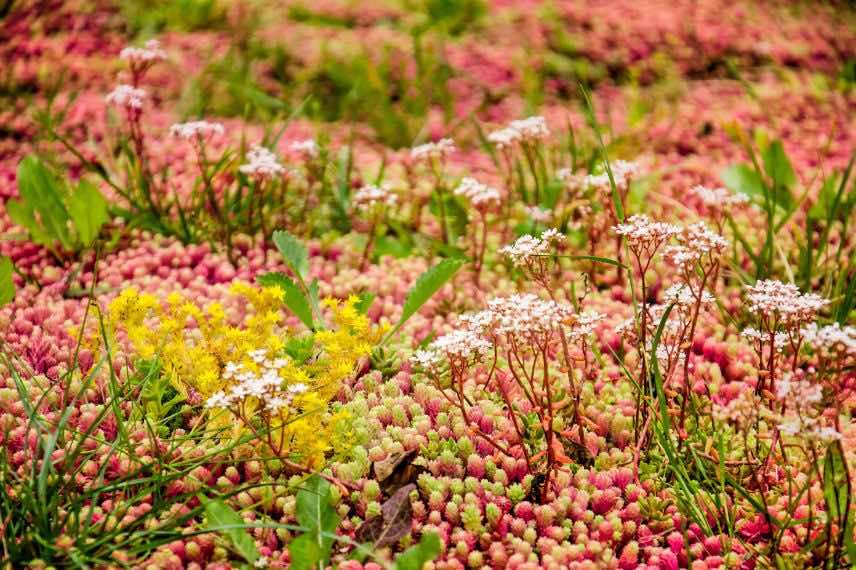
The type of plants suited to a green roof are the most drought-tolerant plants
Read also
7 plants for green roofsBlue roofs: how do they work?
Features and functions
The blue roof is a relatively new concept, still underdeveloped in France. It aims to capture and better manage rainwater. We know, with climate change, water management has become a fundamental issue. We are indeed faced with heatwaves and water shortages as well as floods and the excess water generated.
This watertight roof will be able to control runoff by capturing rainwater and releasing it gradually. The blue roof thus has several advantages.
- It limits the saturation of conventional drainage systems in case of heavy rainfall. It retains water, reducing runoff and the volume reaching the ground. This limits the risks of flooding and infiltration. Rainwater is then progressively redirected towards the sewers and pipes. Thanks to their structure, blue roofs retain more rainwater than green roofs.
- The blue roof allows the reuse of water in the domestic network: in the toilets, for irrigating plants or for washing a vehicle. This is ideal in periods of drought, but also helps save money all year round.
- It provides insulation against heat and cold by regulating the temperature, which helps reduce air conditioning and heating costs.
- Its installation would be up to ten times cheaper than a green roof.
Installation
Installing a blue roof requires a suitable structure and will usually be preceded by a feasibility study. The roof must first be flat, to be able to retain precipitation. A slope, even a small one, will prevent effective water retention.
It must also be sturdy enough to support the weight of the materials, but also that of the water. This arrangement can be implemented on a new build as well as in the case of refurbishment.
Installing a blue roof then requires several elements:
- a flow limiter (manual or electronic valves) ;
- a insulating layer;
- a drainage layer (which prevents water from stagnating in puddles) ;
- a lightweight alveolar structure, which naturally promotes the evaporation of water.
The system can be paired with gutters and rainwater harvesters.
There are several types of blue roofs:
- passive roofs (water is retained temporarily and will drain gradually to the outlet drains) ;
- active roofs (the flow of water is mechanically controlled by an electronic valve or a timer) ;
- modular blue roofs, which have additional storage trays.
Some so-called “smart” blue roofs are also equipped with sensors. They help prevent leaks or infiltrations, measure the amount of water, control the flow, quantify the energy savings achieved, or take weather conditions into account.
Maintenance
Regular inspection and maintenance will keep a blue roof performing well over the years.
Disadvantages
The concept is still novel in France : few professionals seem to offer this service. This type of installation seems mainly tailored to large commercial and industrial buildings, but still not common for individual and private housing. Installation requires more specialised expertise than a green roof and requires a flat roof.
The blue roof is less aesthetically pleasing than a green roof. Its lifespan also appears shorter (30 to 35 years), since synthetic materials are subjected to considerable stresses, notably from sun exposure.
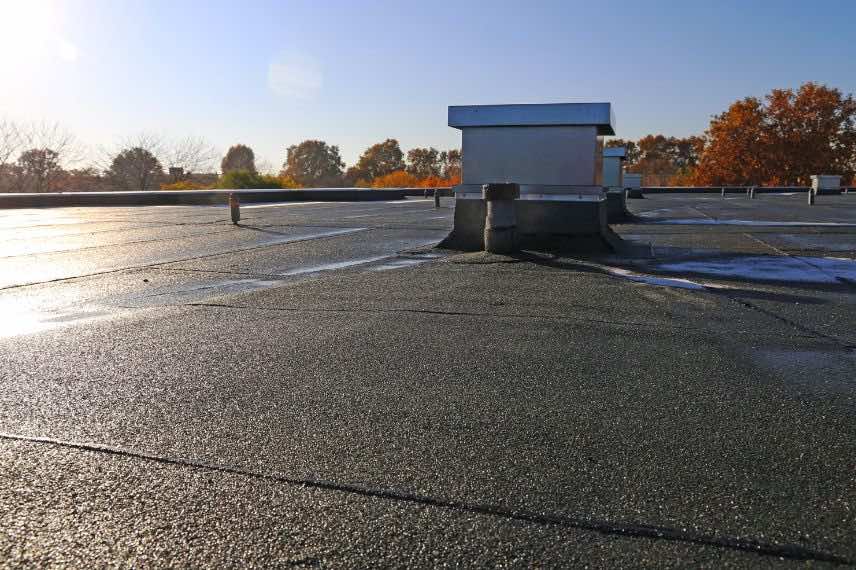
The blue roof can only be installed on a flat roof
Which roof design should you choose?
We’ve seen that these two roof types therefore address different objectives and projects. Choosing one or the other will depend on several criteria.
- Your needs: aesthetics, cost-effectiveness, insulation, improvements to air quality, water harvesting, etc.
- The structure of your roof (pitched or flat).
- Your budget.
Note that you can certainly combine these two roof types, to take advantage of their benefits and enjoy enhanced performance. The blue roof, paired with a green roof, will indeed help to retain even more rainwater and ensure optimal insulation. It will, in parallel, naturally irrigate the plants and offer an aesthetically pleasing appearance, while addressing our current ecological challenges.
- Subscribe!
- Contents
Comments