





























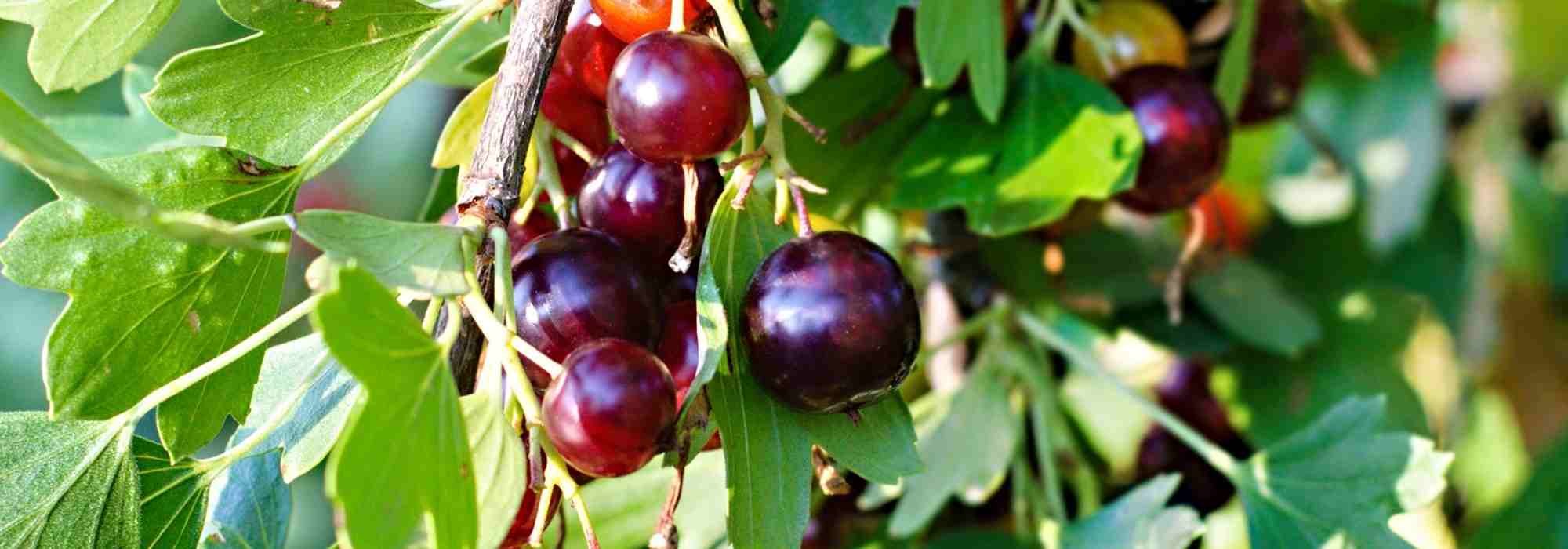
Grow jostaberries, fruits that lie between blackcurrants and redcurrants
Everything you need to know about planting, growing and care of jostaberries
Contents
If you enjoy small fruits with a slightly tangy flavour and bursting with vitamins, the jostaberry is worth your attention. An exotic fruit, you might say? Not at all. Jostaberries are the result of hybridisation between the blackcurrant bush (Ribes nigrum) and the gooseberry bush (Ribes uva-crispa) which gave rise to this bush whose fruits have the roundness of blackcurrants and the colour of blueberries. And at once, perhaps it is worth opening a short semantic aside. The jostaberry , and Ribes x nidiglolaria are also known as jostaberries. Having made this digression, let’s return to our small fruit bush, easy to grow, very productive and hardy.
Discover everything you need to know about jostaberries, from planting to care, including the harvest of the fruits.

What exactly are the jostaberries?
The jostaberry shrub is a hybrid, thought to have been obtained in Germany in the 1980s, classified in the family Grossulariaceae. Born from a cross between a blackcurrant bush and a gooseberry bush, the caseillier forms a small shrub about 1.20 to 1.50 m tall. Its deciduous, trilobed and palmated foliage displays a handsome dark green colour. Flowering takes place in April: the small red flowers, borne in clusters, attract numerous insects that ensure pollination. Moreover, as the caseillier is a self-fertile bush, a single plant in the garden is enough to produce fruit. It is a non-spiny shrub, a feature that greatly facilitates harvesting.
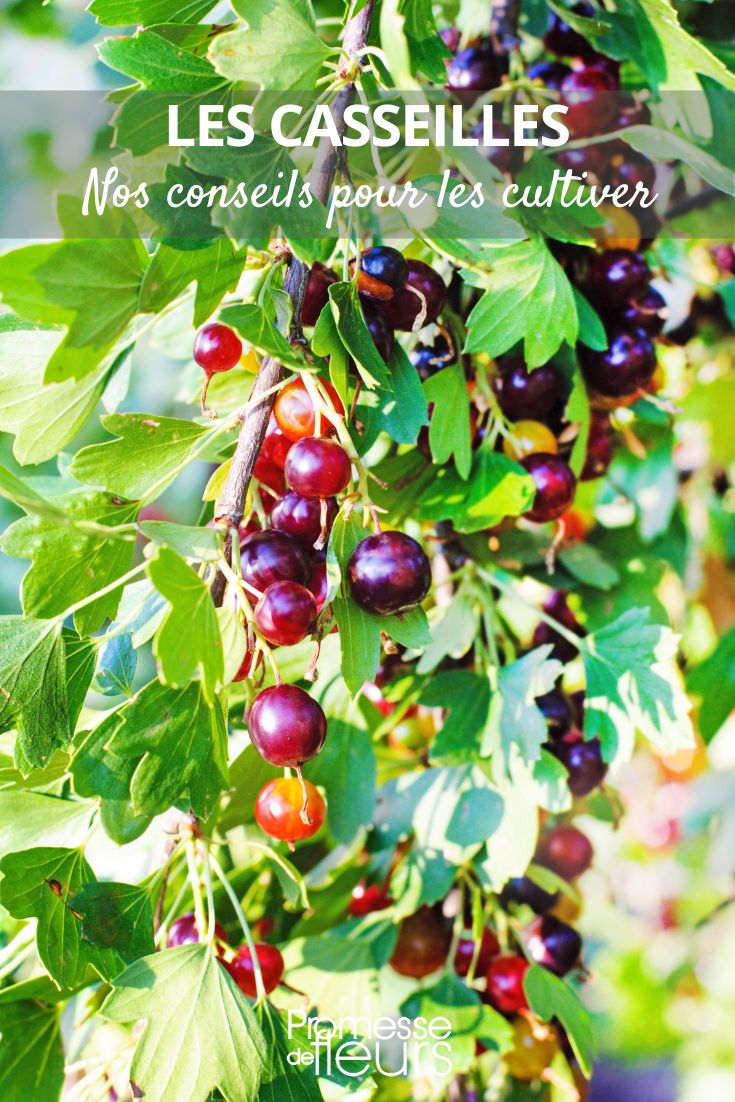
The fruits obtained, jostaberries, resemble grains of about 1 cm in diameter, weighing around 10 g, quite close to blackcurrants, but slightly larger. They display a magnificent purple-black, glossy colour, contain no seeds and are not fuzzy. In terms of flavour, jostaberries are not very sweet, but very fragrant and slightly tart. In fact, their flavour is a true blend of blackcurrant and gooseberry. These berries, gathered in clusters, are also very rich in vitamin C and antioxidants.
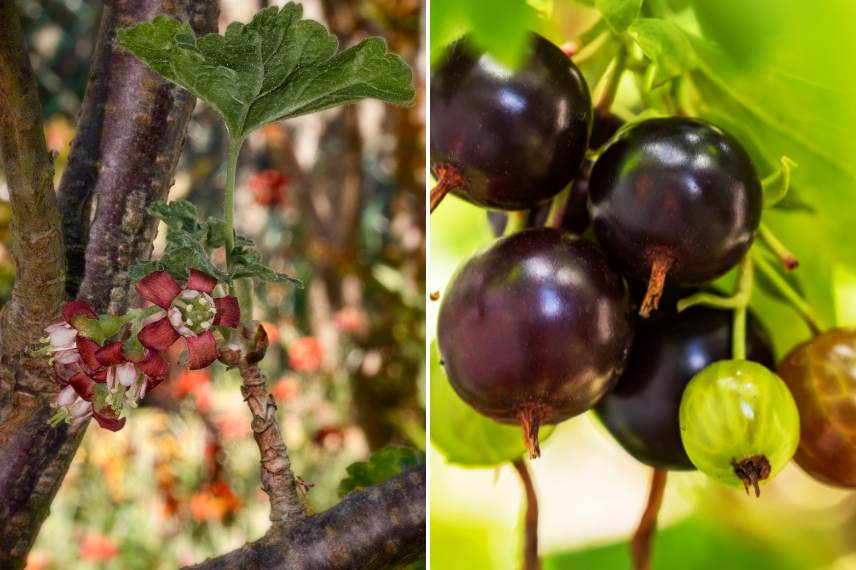
Flowers and fruits of the caseillier
Caseilles are therefore small fruits to discover. They are in no way inferior to blueberries, raspberries and other currants. Moreover, the caseillier is very easy to grow.
Where and when to plant jostaberries?
The gooseberry bush is a vigorous, hardy shrub able to withstand temperatures well below -20°C, which can grow in good garden soil. Versatile, it can find a place anywhere in the garden, or even in an orchard. It is also a deciduous shrub with foliage that is both practical and attractive.
When to plant?
Thanks to its hardiness, the gooseberry bush can be planted in autumn as well as in spring. However, you should wait until there is no frost and the soil is not too waterlogged. In autumn, ideally, plant it in October–November and, in spring, between April and May, once late frosts have passed.
Where to plant?
To bear fruit, the gooseberry bush needs sun. However, in regions with scorching summers, planting can be done in partial shade.
This small fruit shrub tolerates ordinary soil, such as good garden soil, rather neutral to acidic, as it dislikes calcareous soils. The soil should also be deep, cool and not waterlogged, not too heavy. It should, above all, have good drainage, since the gooseberry bush dislikes stagnant moisture. It also enjoys fertile soils.
Thanks to its versatility, this shrub, averaging around 1.2 m in height, can easily fit into a border or along a bed. It can also be planted as a fruit hedge, spaced 1.2 m apart, alongside raspberries, currant bushes and blackcurrant bushes. For added variety, it can be paired with fruiting trees such as aronia, serviceberry, the edible honeysuckle (edible honeysuckle (Lonicera caerulea var. Kamchatka)) which bears berries in May, goji berries (Goji berries (Lycium barbarum), and cranberries (Vaccinium macrocarpon). Gooseberry bushes also suit the vegetable garden.
By contrast, planting in pots or containers is hardly feasible.
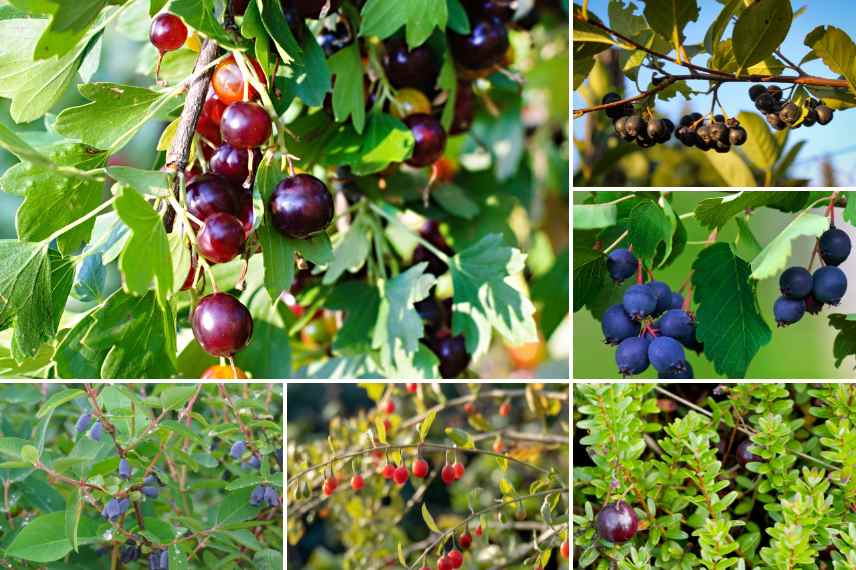
Gooseberry bushes fit very well into a fruit hedge
Read also
5 red berries for beginnersHow to plant the caseillier?
Planting jostaberries, sold in a container, is very easy to carry out:
- Soak the pot in a bucket of water to ease removal from the pot and to thoroughly moisten the root ball
- Dig a hole two to three times the size of the root ball
- Loosen the bottom of the hole with a garden fork
- Place a little sand or gravel at the bottom of the hole, especially if your soil is heavy clay
- Add to the excavated soil some well-rotted manure, mature compost or nitrogen-rich potting compost
- Set the root ball in place and backfill with the soil mixture
- Firm down with your feet to remove air pockets
- Water thoroughly.
If planted in spring, ensure regular watering to aid establishment.
What care does a productive jostaberry require?
Gooseberry bush care is as simple as planting. To ensure excellent fruiting, it needs a few care measures :
- In the two years after planting, you should water regularly to keep the soil moist, especially during periods of high heat
- Mulching helps to space out watering and retain moisture. You can apply mulch based on RCW (ramial chipped wood), pine bark or fallen leaves.
- A spring application of special soft-fruit fertiliser is recommended when growth resumes
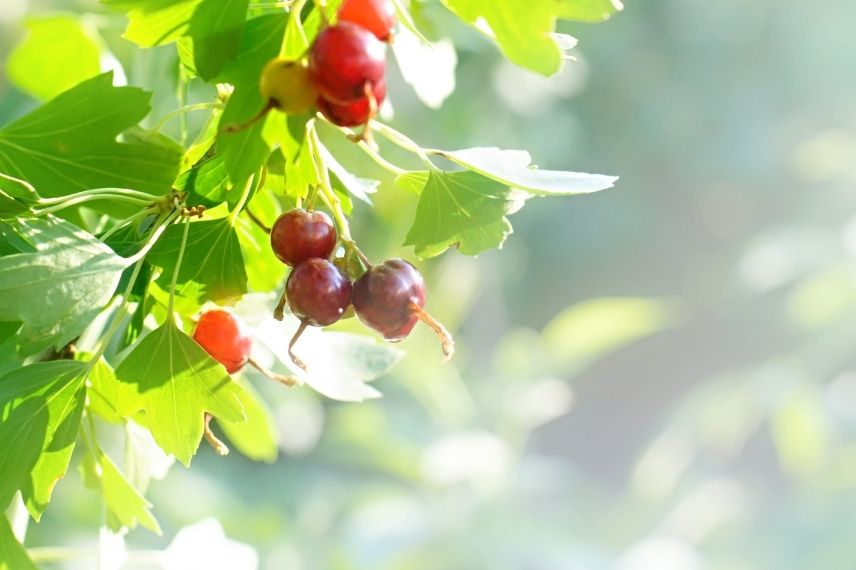
- The first pruning will not take place until after two to three years of growth. For this formative pruning, keep only 6 to 8 productive branches, ensuring a balanced silhouette. In the years that follow, the fruiting gooseberry on 2- to 3-year-old wood should be pruned sparingly. Only prune damaged, dead or too-old-to-fruit branches. This pruning always takes place in late winter, between late January and late February
- The gooseberry bush is a hardy shrub that is relatively resistant to diseases. However, the sawfly larvae, also known as false caterpillars, can infest the foliage and devour it. Manual removal helps to get rid of them, and in cases of heavy infestation, you can treat with a pyrethrum or with black soap.
- A little before harvest, place a bird protection net over the gooseberry bushes, as birds love these juicy berries. It is essential if you want to enjoy these small black fruits.
Jostaberry harvest: when and how?
The berry harvest is staggered throughout July. Indeed, the fruits do not reach ripeness at the same time, so you should allow about a fortnight to harvest all the berries. A harvest that is easy to pick. The bush grows no more than about 1.5 m, and its shoots bear no thorns.
Harvest is more berry-by-berry, with care, somewhat like raspberries. You can also cut the clusters if all the fruits show uniform ripening.
The fruiting of the berry bushes generally begins after two years, at most three. Then these bushes become highly productive in berries. In the early years, it is possible to harvest 3 kg of berries, but, over time, yield reaches 5 to 6 kg per plant, provided the soil is regularly enriched.
How to cook jostaberries?
With their slightly tart edge, jostaberries are delicious in a fruit salad to add colour. But they are perfect for making jams and jellies, tarts and muffins, crumbles, sorbets, and juices… Of course they can be eaten raw like gooseberries. 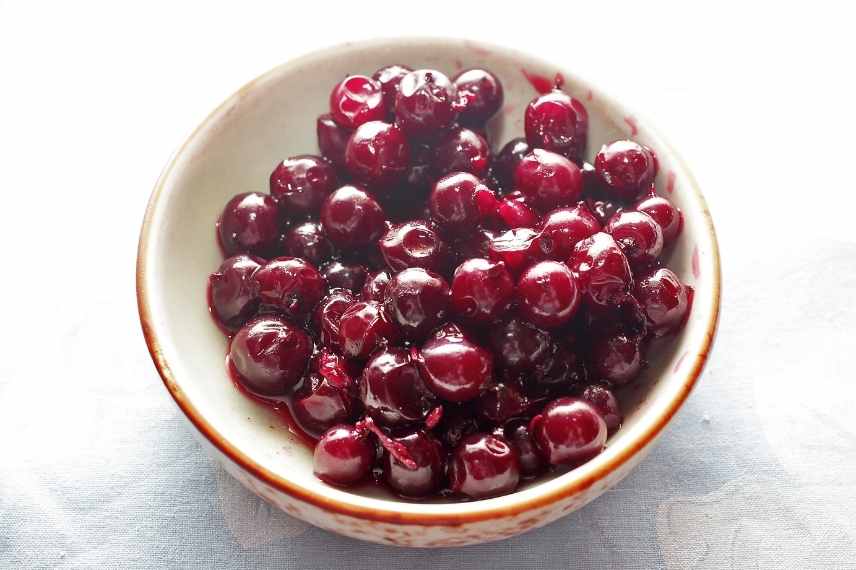
Jostaberries also freeze very easily. Simply spread them on a tray to freeze flat, then transfer them to an airtight container.
- Subscribe!
- Contents
Comments