





























Growing a vegetable garden in loamy soil: our tips and tricks
How to work soil rich in silt?
Contents
Lucky you, gardener, if you’re fortunate enough to own a loamy-soil vegetable garden! Let’s face it from the outset: loamy soil offers fertile ground, easy to work with, and a soft texture. But don’t imagine you’ll have nothing to do! Loamy soil demands indeed a little care and a minimum of maintenance to become your best ally. With just a little work, you’ll harvest abundant harvests of vegetables and fruit.
Discover how to grow a thriving and productive vegetable garden in loamy soil with minimal effort.
If you don’t know your soil type, Olivier explains everything: Determine the texture of your soil: clayey, sandy or loamy.

What exactly is loamy soil?
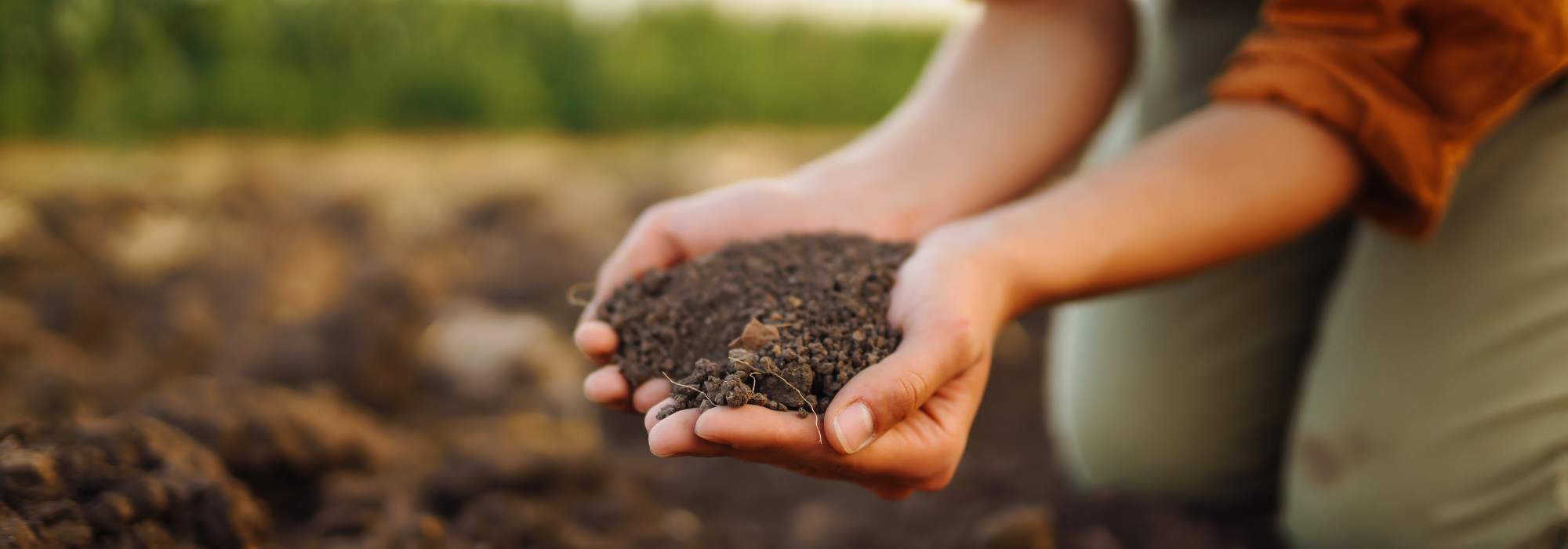
Loamy soil is typical of lands near watercourses, rivers and streams. It is a soil naturally rich in loam, that is to say in sediments derived from the breakdown and erosion of rocks, and in alluvium laid down thousands of years ago. It is therefore a soil that sits between sandy soil and clayey soil, with a texture that is quite pleasant and silky to the touch, somewhat like talc. When you take a handful of this soil, it leaves a few brown marks on your hands, but feels silky and not sticky. Loamy soil contains less than 10% clay.
Sandy soil will have a coarser granulometry, clayey soil finer. However, purely loamy soils are quite rare. If this soil also contains a little sand, it is called sandy loam. And with a little clay, it is a clay loam. The former will be lighter, the latter heavier.
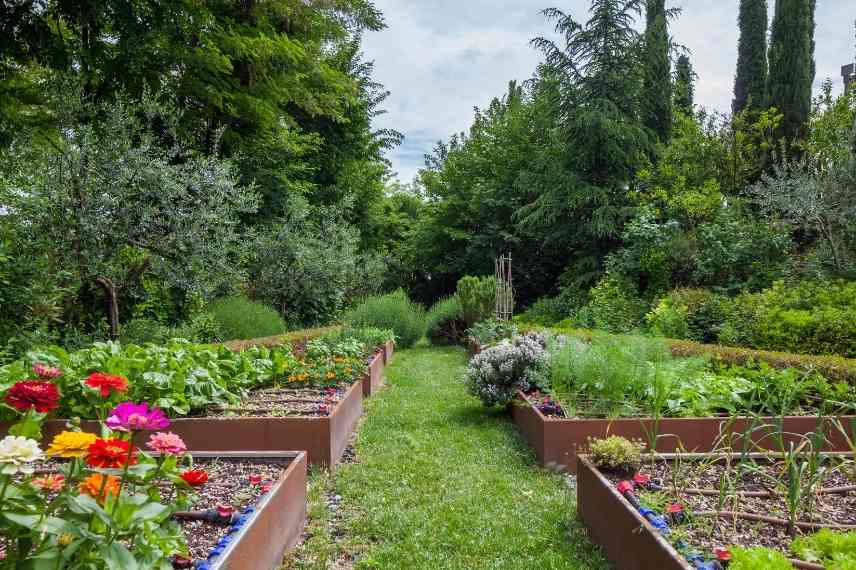
Still, having loamy soil is a real boon for a gardener, because it is a rich and fertile soil, relatively easy to work.
A little extra info: where I live, we call these loamy soils “chambons”, which are fertile lands located near the Loire.
What are the advantages and disadvantages of loamy soils?
Loamy soil is a gardener’s dream, offering the right balance of elements. It is, above all, rich soil that provides many advantages for the gardener. However, there must be some drawbacks to offset the positives.
The advantages of loamy soil
- As we’ve said many times, loamy-textured soil is a fertile soil naturally suited to cultivation
- A loamy soil is made up of fine particles, so it is relatively light and easy to work
- It is permeable to water and air
- Loamy soils warm up much faster in spring than clay soils, allowing earlier sowing and planting
- They are well-drained soils that retain just the right amount of moisture. This is a desirable property during drought periods. A loamy soil dries more slowly than a sandy soil.
The drawbacks of loamy soils
- Loamy soil is relatively fragile, which means that at the slightest trampling it easily compacts
- Logically, as it quickly becomes compacted, a surface crust forms on the soil, after the first heavy autumn rains, during storms, or in case of too much watering. This crust increases the runoff of rainwater, carrying away nutrients. Moreover, plants growing in this unworked loamy soil tend to suffocate
- Loamy soils are fertile indeed, but only for a short period. Without amendments, these loamy soils become depleted and poorer, as nutrients are leached.
How to prepare loamy soil?
To sum up, loamy soils are ideal for cultivation and farming, but they can be tricky to work when they become waterlogged during heavy rainfall. Prone to compaction, they can become airless. That’s why they need to be worked fairly regularly, while enriching them. And in return, you’ll harvest an abundance of vegetables.
Regular soil amendments
As noted above, loamy soil tends to leach nutrients quickly. Consequently, after a few years of cultivation, nutrient levels decline. That is why it is essential to enrich and amend this soil every year. How? Simply by adding compost which will, on the one hand, boost microbial activity, and, on the other, aerate the soil.
Aerate the soil regularly
In loamy soil, conventional autumn digging will be more harmful than beneficial. Indeed, it risks breaking the soil structure and drying it out, and above all, it will destroy the microfauna. That said, not digging doesn’t mean doing nothing. Due to its tendency to form a crust on the surface, the loamy soil should be hoed regularly, either with a hand hoe, or with a garden fork. Thus, the soil becomes lighter and less compact. Seedlings will emerge more easily and water will infiltrate the soil more readily.
The best time to aerate the soil is after rainfall, when it is sufficiently moist but not waterlogged.
Mulching all year round
Mulching serves to reduce watering frequency and limit the growth of adventives. But on loamy soil, it offers other notable advantages. Indeed, by mulching, you will limit the formation of the crust since the soil is not directly exposed to the weather. Moreover, this mulching will decompose over the months, thus feeding and enriching the soil.
It is possible to cover loamy soil with various materials such as grass clippings, crop residues, straw or hay, pruned clippings, dead leaves, but also nettle leaves or comfrey…
Mulching can be started in spring, but also throughout winter, a period when the soil tends to compact if left bare.

In loamy soil, mulching is essential
Watering with a fine spray
Certainly, if you mulch your soil, watering will be less frequent. However, with recurring heatwaves and drought, they can be indispensable in midsummer.
In loamy soil, it is better to water thoroughly once a week rather than every day in small amounts. Likewise, it is advisable to water with a fine spray, again to limit soil compaction. The porous hose and drip irrigation can be useful solutions for large gardens.
Sowing green manures
Always with the aim of aerating and decompacting the soil, sowing green manures is a good solution. Indeed, thanks to their root systems, green manures limit erosion, improve soil structure, aerate the soil while feeding beneficial insects. Thus, mustard (to be sown from March to September) or broad bean (to be sown in September–October) have very deep root systems. They can easily be grown with a cereal crop such as oats or rye.
Which fruits and vegetables should be planted in a loamy soil vegetable garden?
A light, sandy soil that is poor is ideal for growing root vegetables such as carrots, beetroot, turnips… and also peas and beans. A clay soil, often rich in organic matter, is well suited to fruiting vegetables that are fairly hungry for nutrients, such as tomatoes, melons, courgettes and squashes, peppers… Leeks will also show good growth there, as will cabbages, spinach and lettuces.
With loamy soil, it’s much easier.
Naturally suited to market gardening, loamy soil can readily accommodate all vegetables grown in the vegetable garden. Not to mention soft fruits such as raspberries or strawberries, or fruit trees.
As loamy soil warms up much faster in spring than other soil types, it is possible to sow or plant earlier. Thus, it is a soil very well suited to the cultivation of early-season vegetables.
Thus, loamy soil is the best soil for establishing a productive vegetable garden, provided, of course, that it is enriched, mulched and regularly cultivated.
- Subscribe!
- Contents
Comments