





























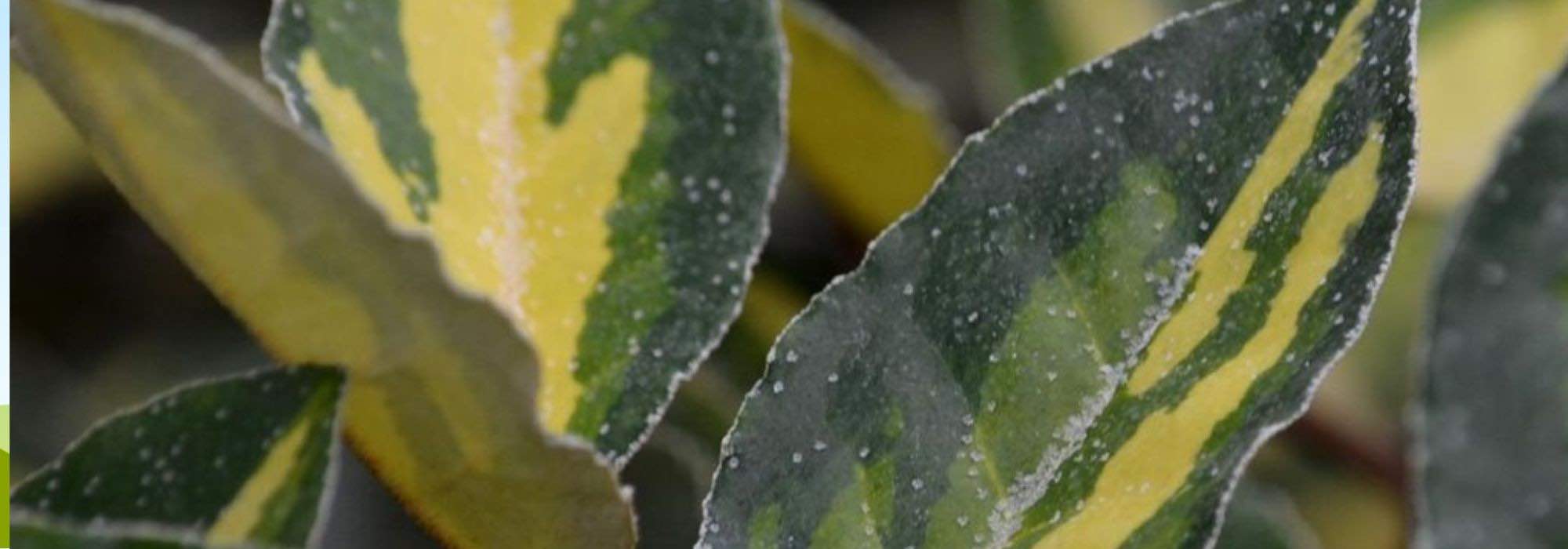
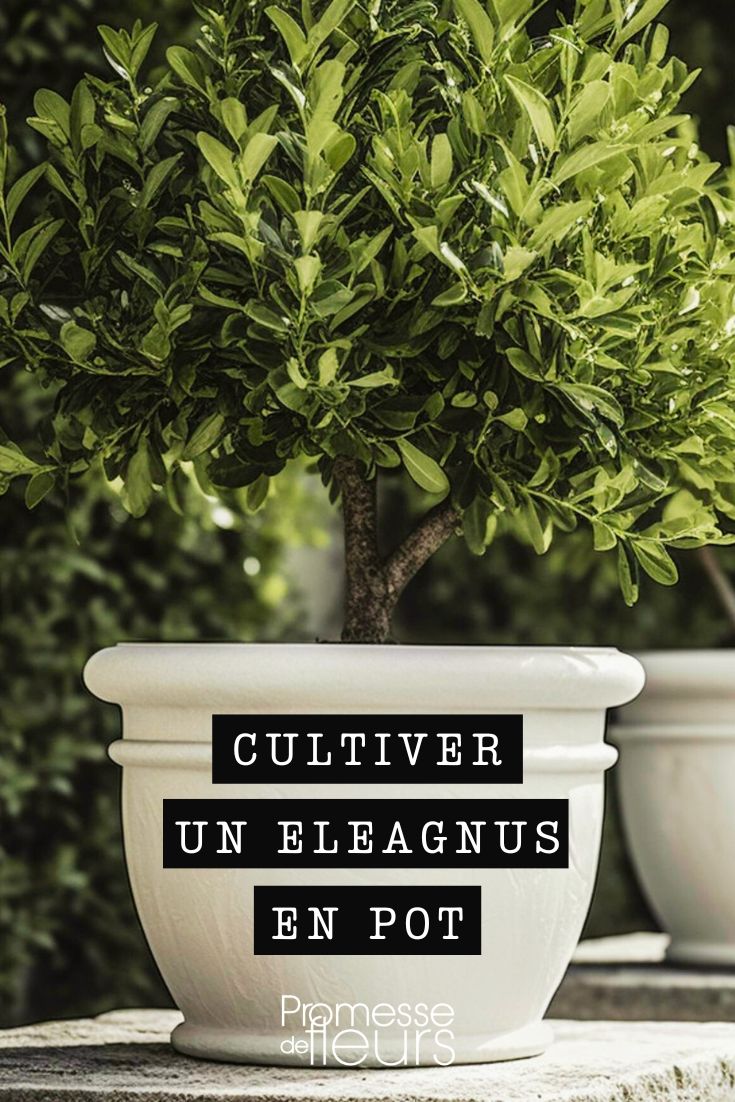
Growing Eleagnus in pots
To enjoy its evergreen foliage and fragrant flowering
Contents
Eleagnus is a shrub often used as a hedge, windbreak or privacy screen. Easy to grow and hardy, it is appreciated for its discreet white, fragrant flowering and its leathery foliage, green, silvery-grey or variegated. The flowering is followed by the appearance of fruits that delight birds and can also be eaten by people. The most compact varieties can be grown in pots and benefit from evergreen foliage. Useful for creating a privacy screen on a terrace or enjoying fragrant flowering in autumn. Discover our tips for planting and growing Eleagnus in pots.

Which varieties to grow in pots?
For container culture in a tub or large pot, opt for compact Elaeagnus, not exceeding 2 to 2.5 metres in height at ripeness.
Among the smallest Elaeagnus to grow in pots, you can choose :
- the Elaeagnus ebbingei, which do not exceed 2 metres in height at ripeness. They have evergreen foliage and flower from September to November. Opt for the varieties ‘Compacta’‘ (2 metres) with green-silvery foliage, as well as ‘Eleador’ (1.75 metres), ‘Glit Edge’ (2 metres) and ‘Maryline’ (abrela) (2 metres) with variegated yellow and green foliage.
- The Elaeagnus pungens ‘Hosoba Fukurin’ (2.5 metres) with green leaves margined in cream white. For this variety, flowering occurs from September to December.
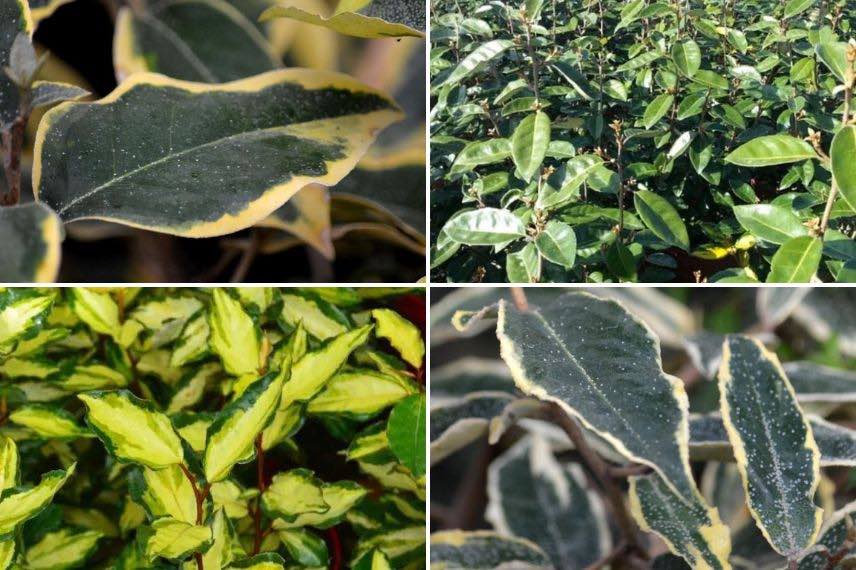
Clockwise from top left: Elaeagnus ebbingei ‘Gilt Edge’, Elaeagnus ebbingei ‘Compacta’, Elaeagnus pungens ‘Hosoba Fukurin’, Elaeagnus ebbingei ‘Maryline’
Where and when to plant an Eleagnus in a pot?
- Eleagnus thrives in full sun or partial shade, with a caveat for regions with hot climates where direct sun should be avoided to prevent leaf scorch.
- In terms of climate, the Eleagnus ebbingei varieties can withstand short frosts down to -15°C when planted in the ground and in well-drained soil. Bear in mind that for container growing, Eleagnus will be somewhat less frost-tolerant than in the ground. The Eleagnus pungens ‘Hosuba Fukurin’ tolerates slightly more frost, down to -18°C in the ground. If needed, the Eleagnus in a pot can be easily brought indoors.
- Eleagnus should preferably be planted in spring, in March, or in autumn, in September, but it can also be planted from February to May, outside frost and drought periods.
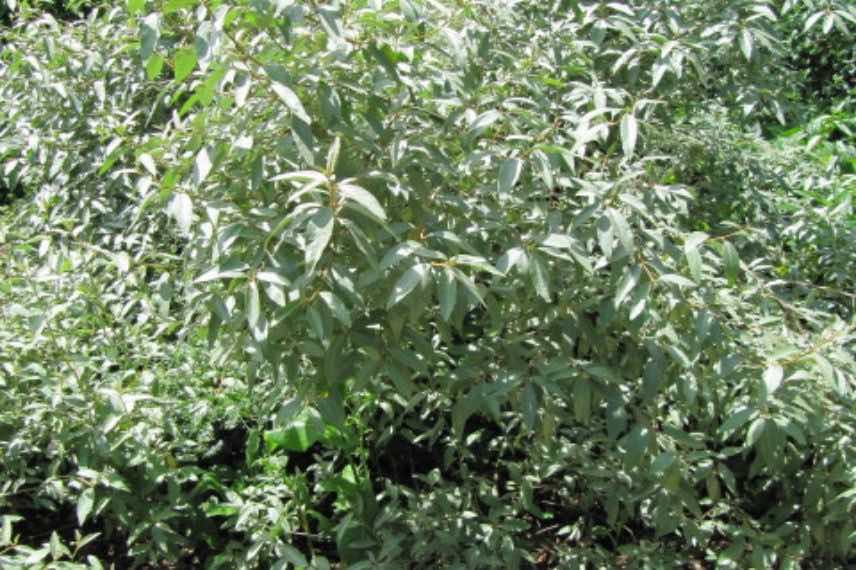
Eleagnus thrives in sun or partial shade
How to grow an Eleagnus in a pot
What container?
- Container must be deep and large enough. Use a pot or tub at least 30 cm deep and 40 cm in diameter.
- Pot or tub can be terracotta, wood or plastic. Terracotta containers, however, allow better aeration of the roots.
What substrate?
- Elaeagnus requires a well-drained substrate because excess moisture is fatal to it.
- Plant it in a rich, loamy soil mix, such as a mixture of soil and potting mix to which you can add sand to improve drainage if necessary.
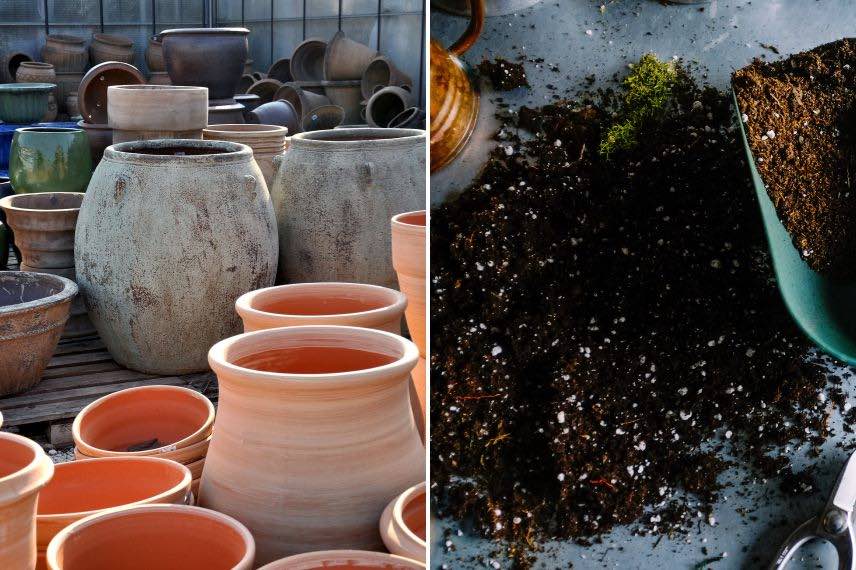
Elaeagnus needs a well-draining substrate so water does not stagnate: terracotta is also well suited
Planting
- Choose a sufficiently large and perforated pot or tub
- Place at the bottom a layer of clay pebbles to ensure good drainage
- Add the soil and potting mix.
- Place Elaeagnus in the centre of the pot, taking care not to bury the collar.
- Fill the rest of the pot with the soil and potting mix, and firm it around the root ball to expel air pockets
- Water generously.
Read also
Elaeagnus: when and how to prune?How to care for an Eleagnus in a pot?
Watering
- Water regularly, ensuring moisture does not stagnate and that the growing medium is well drained.
- From March to October, the period corresponding to vegetative growth, watering should be heavier but not excessive.
- In winter, during the dormancy period, reduce watering.
Fertilising
- Apply regularly an addition of compost or turf especially in autumn, which corresponds to the flowering period.
Pruning
Eleagnus responds very well to pruning, which is best carried out once a year. It helps to counteract the shrub’s rapid growth and to maintain the height and shape you want. Pruning is carried out at the end of winter, in February or March, during the rest phase so as not to deprive it of the fragrant flowering of the Eleagnus in the following autumn.
- In the first years, cut a third of the branches to densify the shrub and encourage new shoots.
- Then, maintain pruning every year by removing dead or damaged shoots and rebalancing the silhouette and height. For Eleagnus with variegated foliage, systematically remove the green shoots that are not variegated.
For more on the subject, consult our pruning page for Eleagnus.
Repotting
- You can repot your Eleagnus every three years into a larger pot or trough.
Diseases
Eleagnus is a shrub resistant to diseases and pests. It fears excess moisture the most, which can be corrected by proper watering and good drainage of the substrate.
- In damp soil, it can be attacked by fungi such as coral disease, which is recognisable by orange pustules speckling its trunk. Read our article on coral disease to learn how to get rid of it.
- Planted in a calcareous or damp substrate, Eleagnus may also develop chlorosis, which shows as yellowing leaves. Discover our article on chlorosis and its treatment.
- Finally, Eleagnus can be attacked by psyllids, species of aphids that weaken it and whose presence is visible through the yellowing of leaves and the appearance of waxy filaments. This problem is treated with sprays, on the shoots, of a mixture of water and soap, as with the aphids. You can also use ladybirds or hoverflies, natural predators of psyllids.
Overwintering
- Depending on the species, Eleagnus tolerates frosts down to about –15 or –18°C when planted in the ground. In regions where temperatures drop even lower in winter, you can bring Eleagnus into a pot, shelter it in a veranda or a non-heated greenhouse. In some cases, you can simply protect it with a winter shielding fabric.
For more on Eleagnus, see our complete fact sheet dedicated to this lovely plant, as well as our complete Eleagnus collection.
- Subscribe!
- Contents
Comments