


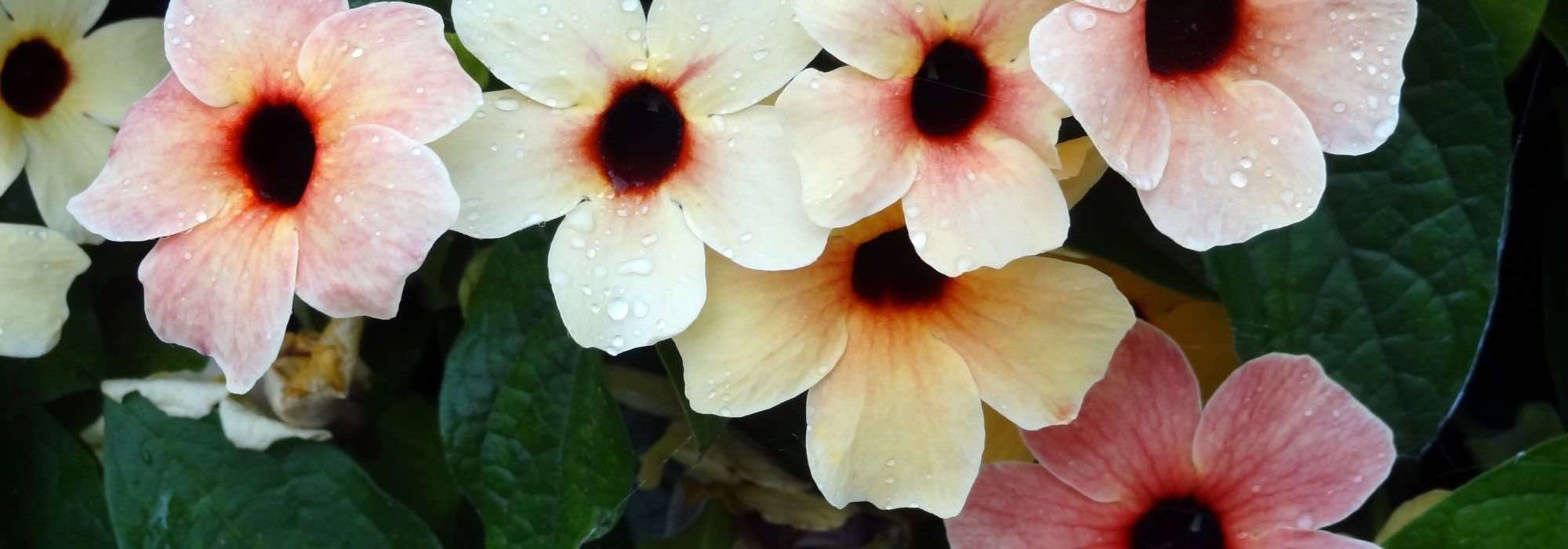
Growing Black-eyed Susan in a pot
And enjoy this exotic climbing plant.
Contents
The Thunbergia, more commonly known as Black-eyed Susan, is a beautiful climbing perennial from tropical regions. Here, it is grown as an annual, due to its sensitivity to cold: it is only hardy above 8 to 10 °C. Its rapid growth, reaching 2 m in a single season, allows you to enjoy it for a full cycle. However, if you have the option to bring it indoors to a greenhouse or conservatory during winter, you can keep it and bring it out again the following spring. It grows well in pots, which offers several advantages: quickly filling and flowering a balcony or terrace from spring to autumn, and being easily movable to protect it during winter. Voluble, it climbs on its support by itself and rewards you with lush, bushy foliage, adorned with simple, open flowers in exotic colours: yellow, orange, brick red, cream, pink, and all the shades in between. They all feature a black eye, the signature of Thunbergia and the reason for its poetic vernacular name. Have fun sowing or planting it in plug plants to fill a pot, and then quickly a support of your choice.
Follow our tips to learn everything about growing Black-eyed Susan in pots.

What type of pot? What size?
Use a pot with a diameter and depth of at least 20 to 30 cm. If you plan to keep it for several years in a greenhouse, consider increasing this base size further.
Regarding the material of the pot, choose according to your preferences, but keep in mind that a porous terracotta pot requires more frequent watering, which can be significant during a hot summer for a fully flowering Black-eyed Susan.
Also decide whether you want to train your Black-eyed Susans to climb on a support or if you prefer them to cascade from a hanging basket, and plan the appropriate installation.
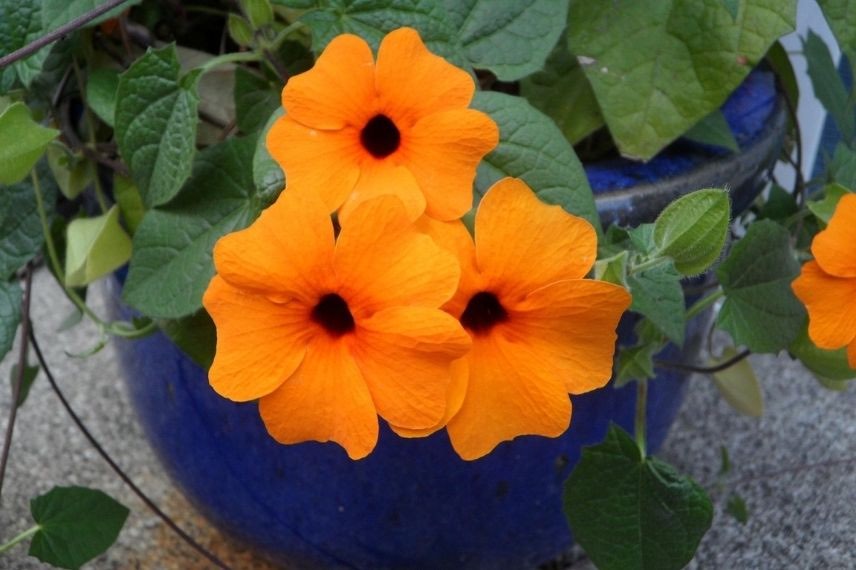
Contrast of complementary colours between this blue pot and a bright orange Thunbergia alata
What substrate?
With their exotic pedigree and lushness, Black-eyed Susans are quite demanding! Compose a rich and humus-bearing, light and well-draining substrate. For example, you can mix 50% of quality potting soil with good water retention, 25% of sand, and 25% of compost or garden soil. You can adjust these proportions, increasing the amount of potting soil, but be sure to add at least 15 to 20% of river sand.
Also, ensure proper drainage using clay balls, pumice, or gravel. Finally, equip yourself with an organic mulch.
Discover other Black-eyed Susans
View all →
Available in 1 sizes

Available in 0 sizes
Available in 1 sizes
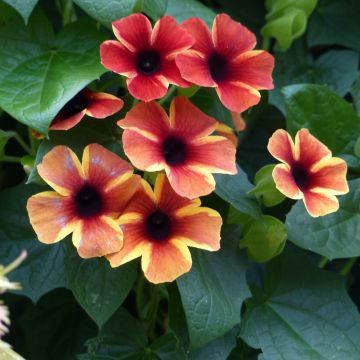
Available in 2 sizes
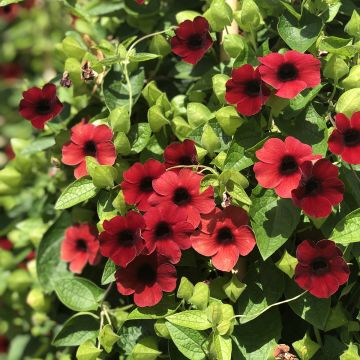
Available in 1 sizes
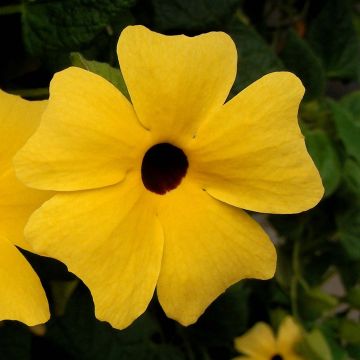
Available in 1 sizes
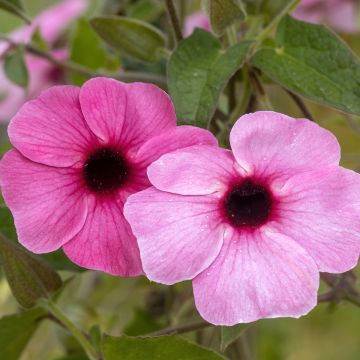
Available in 1 sizes
When and how to plant?
If your Suzanne is grown from sowing, then you will have started the process in February-March and you will be able to pot it in May, after the last frosts.
If you choose a Thunbergia in plug plants, you must keep your plants above 14 °C upon receipt and for a few weeks, placing them in light and ideally at a temperature of 20 °C until you can plant them in May after the risk of frost has passed.
Follow these steps for planting:
- Lightly moisten your plants.
- Prepare your substrate as mentioned above.
- Add a layer of drainage at the bottom of the pot using clay balls, pumice, or gravel.
- Fill your pot with your substrate to about two-thirds full.
- Arrange your plants harmoniously, ensuring they are positioned 2 to 3 cm from the edge of the pot.
- Level off with a bit more substrate, pressing down lightly.
- Water generously.
- Add a bit more mix if necessary, if any “holes” have formed.
- Gently mulch around the plants.
Read also
Sowing Black-eyed SusanWhere to place the black-eyed Susan?
Install your pot out of the cold winds, as Black-eyed Susan loves warmth. Choose a sunny spot, but in southern regions, protect the location from the scorching rays of the summer sun during midday hours.
You can keep your Thunbergia over winter if you can place it in a very bright location, with temperatures always above 10 °C, ideally in a greenhouse or conservatory.
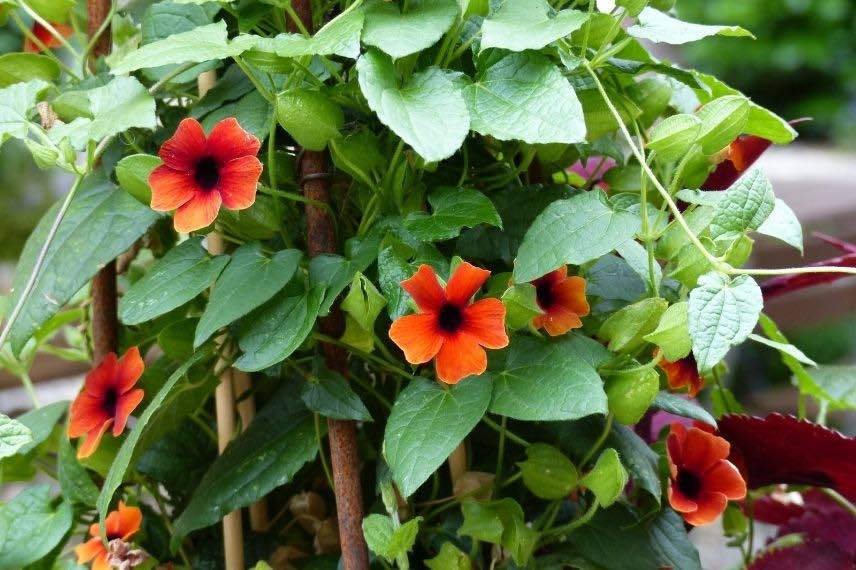
A Thunbergia alata ‘Sunny Susy Brownie’ on a bamboo support
Watering and fertilising
Ensure regular watering during the growth period of the leaves. During the flowering period, starting in June, you will need to increase watering. Water as soon as the top 4 to 5 centimetres of substrate in the pot are dry, but do not allow standing water at the bottom of the pot. Keep the substrate moist throughout the summer. If you can keep your Suzanne over winter, occasional watering should suffice; allow the substrate to dry out between waterings.
Feel free to provide outdoor pot plant fertiliser during the flowering period. Choose a PK-dominant fertiliser (phosphorus and potassium) rather than an N-dominant one (nitrogen), to encourage flowers more than leaves. You can also opt for a balanced natural fertiliser, or even an organic fertiliser specially for tender climbing plants! Depending on your choice, refer to the usage instructions and use it sparingly.

Thunbergia is water-hungry in summer
Maintenance
Once installed in the right spot and once they show you that they are happy with their conditions and that you are providing the right care, Black-eyed Susans reward you with their generosity.
Simply remove the faded flowers regularly to encourage new flowering. If, in August, your Thunbergia shows signs of fatigue, lightly prune the stems to restore its vigour.
If it remains outside, it will be time to say goodbye in October-November. Remove the stems and empty your pot!
If, on the other hand, you keep it sheltered all year round, it is good to thin it out a bit to channel its vigour and rejuvenate the stems. You should do this in September or February-March. Using pruning shears, observe your plant and remove the dead stems at the base, the crossed stems, and the weak stems. Cut back the spent shoots or, if you prefer, lightly trim the entire clump.
- Subscribe!
- Contents
![[black-eyed Susan vine] pot [planter] [window box]](https://en.promessedefleurs.eu/blogwp/wp-content/uploads/2022/04/Cultiver-la-Suzanne-aux-yeux-noirs-en-pot.jpg "Grow Black-eyed Susan in a pot")
Comments