





























Growing Cordyline in pots
All our tips for succeeding on the terrace!
Contents
Cordyline australis are beautiful evergreen young plants with a palm-like appearance, and growing them in pots is quite feasible here to add a touch of exoticism to a terrace or balcony. Sometimes referred to as Dracaena australis, they are tender plants, often grown indoors, but also very attractive outdoors in pots to create stunning scenes. As some varieties are more tender than others, it is essential to select those best suited to thrive in pots and provide them with appropriate care.
Let’s see how to grow cordyline in pots successfully!
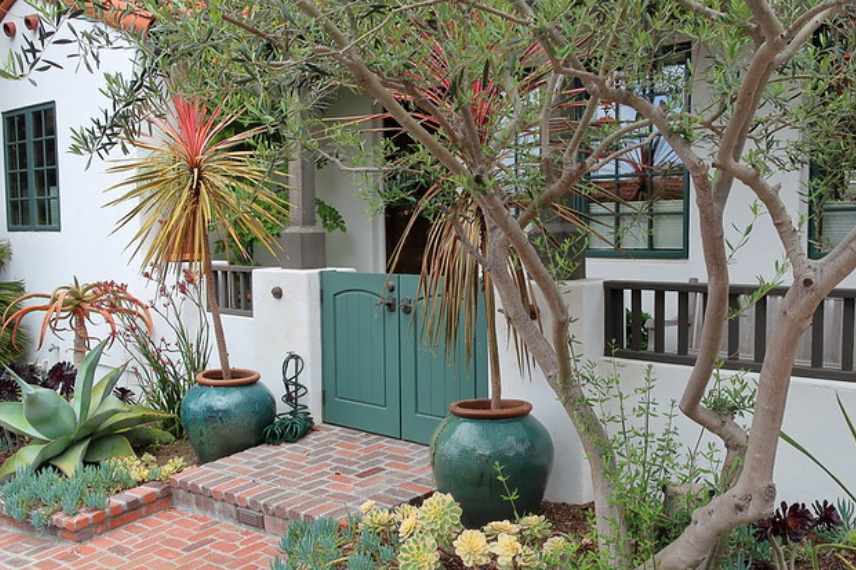
These two cordylines beautifully enhance the exotic touch of this house entrance! (© KM)

What varieties of Cordyline?
Potted cultivation is always more critical during cold spells in winter. For this plant of southern origin (Pacific, New Zealand), the least frost-sensitive varieties should be selected, as cordylines suffer as soon as the thermometer drops below -3°C (they can withstand brief periods of frost down to -7°C on paper, always in open ground). It is the Cordyline australis type that will fare best, as it tolerates down to -8°C for short durations, and generally green-leaved cordylines.
Be aware that, like with Phormiums, variegated and coloured foliage in pink or purple is the most vulnerable. The choice of variety can still be made with a coloured or striate Cordyline if all precautions are taken in winter to protect it well, especially in the mildest regions.
N.B.: Cordyline fruticosa or Cordyline indivisa, with their broad foliage and quite different habit, are mainly grown indoors except in exotic countries.
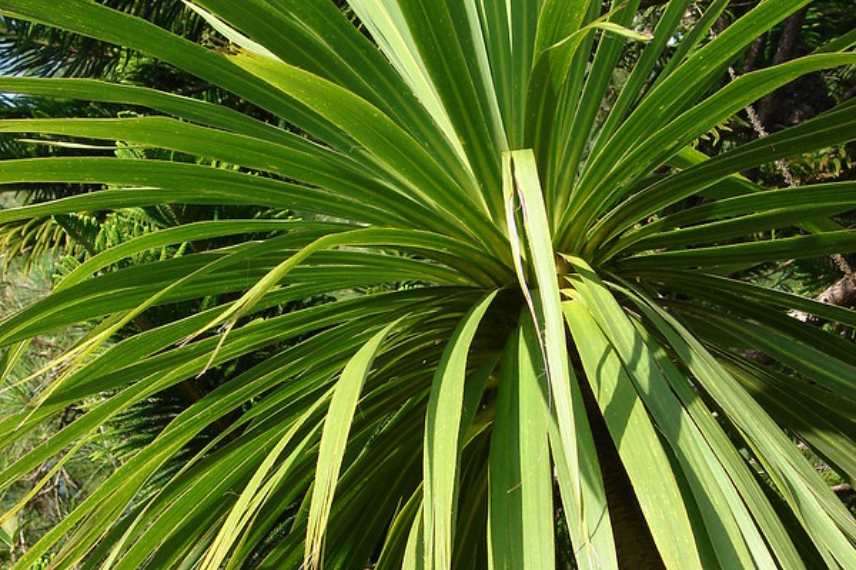
Green-leaved cordylines, like the type species, are the most suitable for pot planting (© Forest and Kim Starr)
Read also
Cordyline : to plant, to grow, to careWhat type and size of pot?
A Cordyline planted in a pot will be less vigorous and voluminous than one planted in the ground. It will grow to a maximum reduced height of 1.5 m, compared to 3 to 5 m in the ground. The growth is slow; however, after a few years, a Cordyline australis will also develop a trunk in a pot (but very rarely will it flower). As the leaf rosette is wide, it is important to provide it with a sufficiently large pot, and in all cases, enough substrate to counteract the effects of drought in summer and cold in winter. Therefore, we recommend a pot with a minimum diameter of 50 cm. The pot should have a drainage hole. In terms of material, try to maintain harmony on your terrace or balcony, knowing that terracotta pots, being more porous, will retain less moisture, and you will need to water a bit more often in summer.
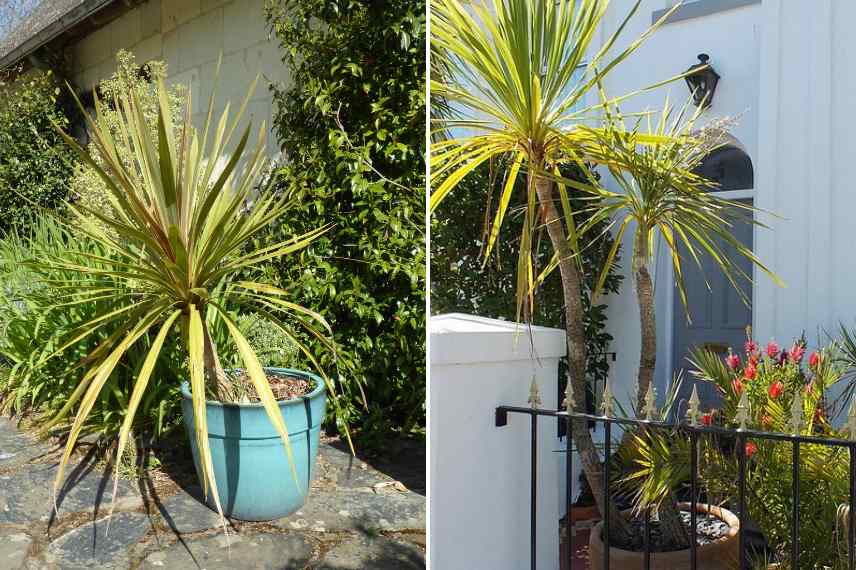
Cordyline australis ‘Torbay Dazzler’ grown in a pot (© Gwenaëlle David Authier) and Cordyline australis (© Torquay Palms)
What substrate?
Cordyline thrives in well-drained soils, remaining cool in summer. In pots, it is advisable to provide a mix of light, well-draining compost, supplemented with a bit of sand. It is important to remember that Cordyline australis detests waterlogged soils, so the potting substrate must be well-prepared, and attention should be given to the drainage layer at the bottom of the pot.
Read also
Choosing a cordylineWhere to place your cordyline?
You must plant your cordyline pot in a sheltered spot away from cold winds. A pot placed against a wall that protects the plant and retains heat accumulated during the day is ideal.
The exposure should be south or west, in full sun or partial shade, so that the plant receives maximum sunlight and warmth. However, red to purple foliage and variegated foliage should only be placed in partial shade to prevent burning.
Cordyline always thrives by the sea, where it tolerates salt spray very well. It also fits beautifully into contemporary settings, adding a lot of graphic appeal.
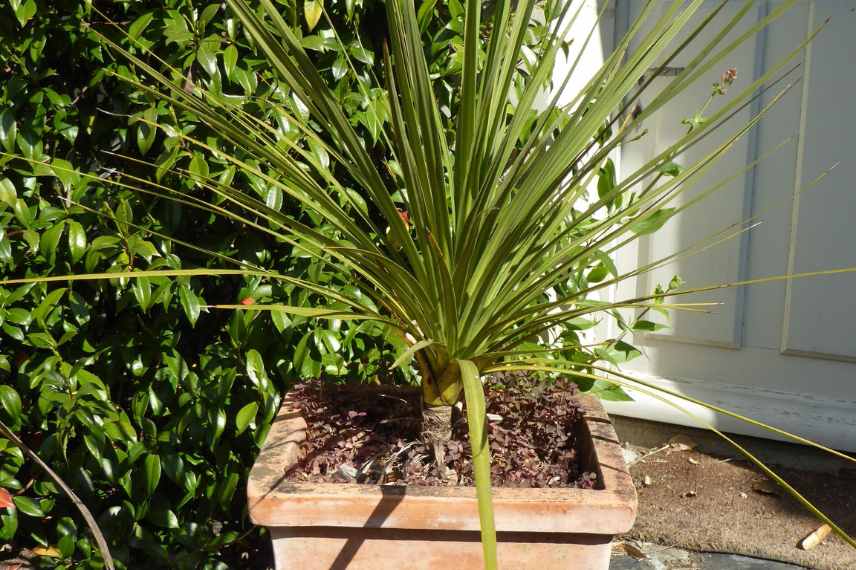
A young Cordyline australis planted in a terracotta pot in the sun (© Gwenaëlle David Authier)
When and how to plant?
Plant in spring (ideally mid-April to the end of June), when morning frosts are no longer a concern in your area, to give the plant time to settle in before winter.
- Choose a piece of pottery and place it over the drainage hole
- Add a layer of at least 10 cm of drainage material (clay balls, gravel)
- Install the plant, removed from its plastic pot, in the centre of the pot previously filled with about half of the substrate mix
- Fill in with the remaining substrate
- Water
- Apply an organic or mineral mulch, or even clay balls, to protect the Cordyline from summer heat.
Caring for a Cordyline in a pot
In pots as well as in the ground, Cordyline is an impressive plant that requires minimal maintenance. You should gradually remove the unsightly dry leaves, revealing a trunk that becomes wider over time. However, a young plant must be properly protected during the winter months, at least for the first three years.
-
Watering
Be moderate with watering, as Cordyline australis is sensitive to root moisture, but be attentive in summer to ensure the cordyline always has a fresh substrate (about twice a week, try to be regular). In winter, water lightly every 10 days to 2 weeks only if the plant is placed in a greenhouse or conservatory.
-
Fertiliser
Not really necessary for this hardy plant, you should only apply it if the plant is not developing its leaves properly. In this case, do so in spring when the plant is regenerating, and consider renewing the application in summer (a fertiliser for green plants works perfectly; you can also use a fertiliser for palms).
-
Repotting
It is not necessary if the plant has been planted in a sufficiently large container, as the plant grows slowly. Otherwise, repot every 3-4 years in spring.
-
Winter protection
Winter protection is necessary if you do not live on the Atlantic coast or in a Mediterranean zone. The strategy will focus, as often, on four essential points:
– Mulching: this is crucial! By covering the soil with a mixture of well-dried leaves and shredded material, for example, you limit the cold’s effect on the substrate, and thus on the nearby roots. Do this before the cold sets in, in mid-autumn.
– Protecting the foliage with a fleece: this can provide an extra 1 or 2 degrees, which is useful during harsh winters. Alternatively, a piece of hessian cut large enough to wrap around the rosette of leaves is very practical. The permeability of the fleece or hessian allows you to leave them in place for several weeks. As soon as temperatures rise and the sun appears, you can uncover the plant (remember to reapply the fleece during cold nights…).
– Protecting the pot: by wrapping the pot in bubble wrap, hessian, doormats, ground mats, or any other material that can block the cold, you create a small protective barrier that insulates the pot from the cold.
→ Learn more with our article Wintering Cordyline.
– A final easy measure: elevate the pot on a few boards or bricks to avoid contact with cold or frozen ground.
- Subscribe!
- Contents
Comments