





























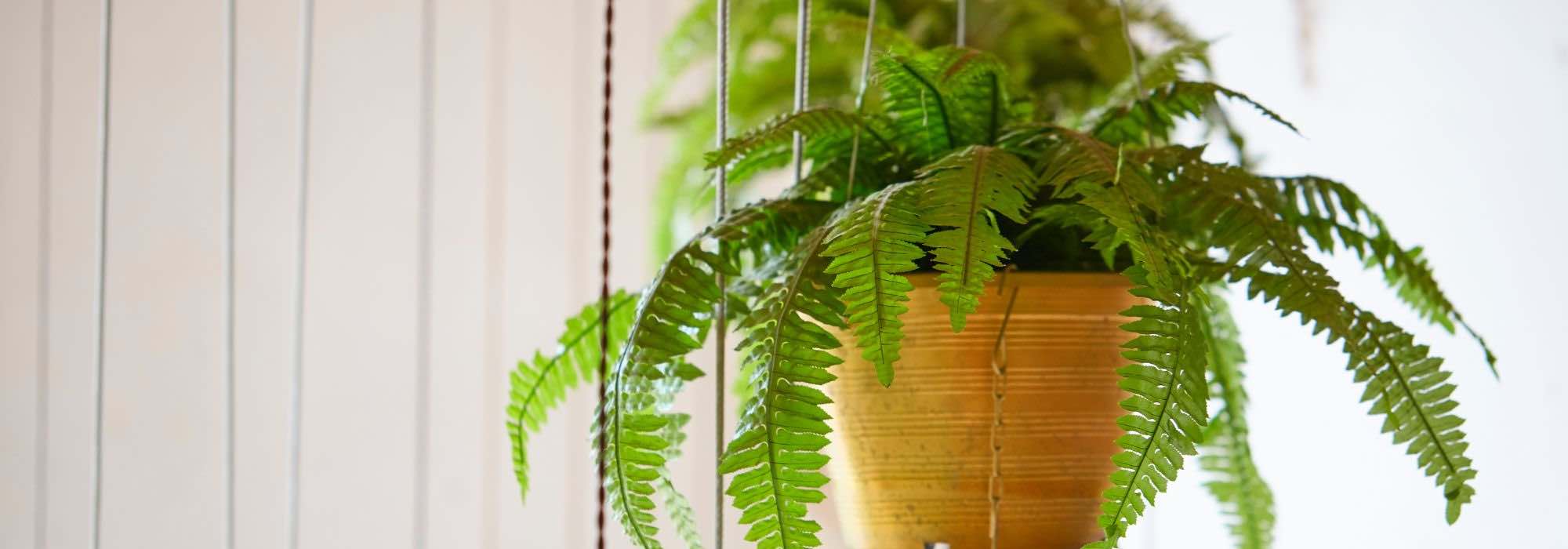
Growing ferns indoors
Our care and decoration tips
Contents
Ferns are familiar plants of our woodlands and gardens, a little less so in our interiors. Many species can, however, be grown as houseplants or indoor plants in the living room, the kitchen or even the bathroom. They have undeniable aesthetic qualities: their trailing foliage, graceful and light, sometimes wispy, making them invaluable for bringing nature into the home. They are surely among the most evocative houseplants of nature.
In this article, discover our tips for growing and installing ferns at home: care and decorating tips.

Best varieties of indoor ferns
There is one we meet most often: Nephrolepsis or Boston fern. It’s an interesting fern that forms a dense, broad clump of trailing fronds.
We are increasingly seeing Asplenium nidus and some cultivars with crisped leaves or coloured veins.
Platyceriums are epiphytic ferns (which grow by using other plants as support) with a distinctive silhouette, often cultivated on pieces of wood that are hung like a frame on the wall.
Phlebodiums, and especially Phlebodium aureum, impart a bluish colour to their fronds that are full and slightly undulated.
Adiantum is a wonderful maidenhair fern, but a little tricky to grow.
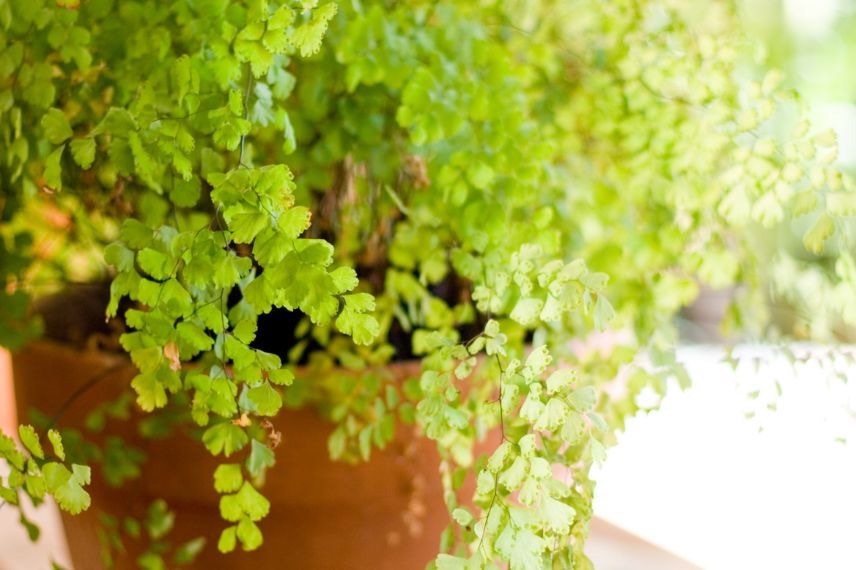
Adiantum is an absolutely lovely fern, but a little delicate to grow
Humata or Davallia tyermanii, commonly called rabbit’s-foot fern, is a fern that is not very fussy, with handsome, finely cut fronds and velvety, aerial rhizomes.
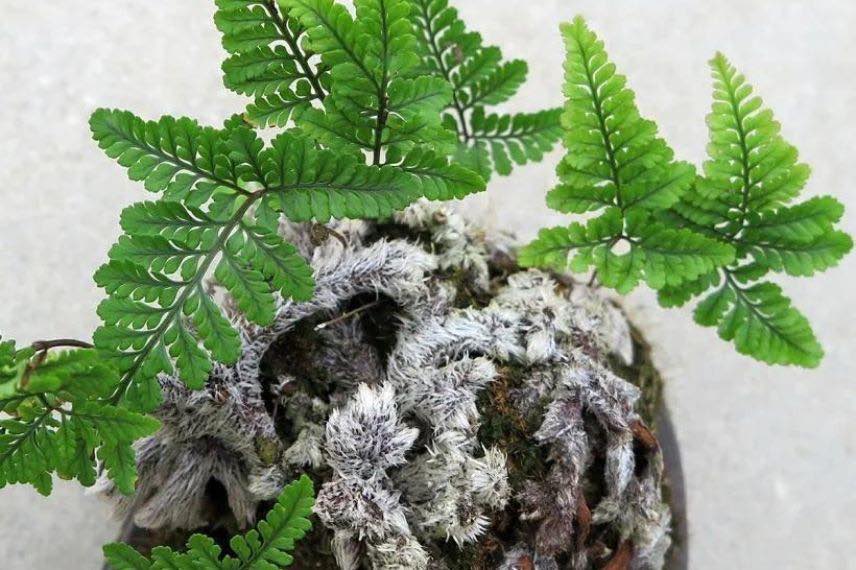
Humata tyermanii is easy to grow and visually interesting
Arachniodes simplicior is an outdoor fern not commonly cultivated, which can also be used as an indoor houseplant.

Arachniodes simplicior s’orne de frondes bi-colourées très élégantes
Do all ferns have the same growing conditions?
All ferns have similar needs: not too fussy about light, they prefer relatively high humidity, but good drainage. From this starting point, some have slightly different needs that should be checked before acquiring them.
Platyceriums are in a class of their own: they grow almost without substrate as epiphytic plants.
Where should I place a fern at home?
Ferns aren’t very particular about light, accustomed to growing under tree fronds, the amount of light indoors isn’t the same as outdoors.
A fern doesn’t like direct sun exposure, and it doesn’t share the needs of many indoor plants that are best placed close to a window. If it’s a bathroom skylight, place it on the windowsill!
So, indeed, ferns tolerate moderately bright light, but don’t place them at the bottom of a shelf, under a window (there is little light directly under a window, unless you’re right underneath it).
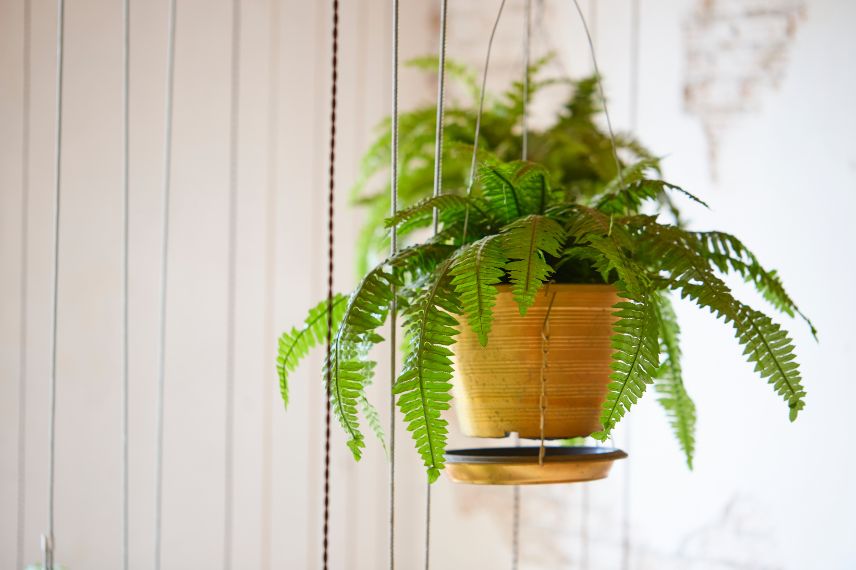
A Nephrolepsis, nicely showcased by a hanging basket
How to care for an indoor fern?
Substrate
Ferns prefer a substrate that retains moisture well, but is well-drained to allow excess water to escape and to prevent root rot, which often affects fine roots. Allies for achieving good water retention in the substrate are turf or sphagnum (read the potting mix and its water-retention percentage, which is always indicated). For drainage, opt for the perlite, the vermiculite, the clay balls.
Watering
Ferns should be watered fairly frequently, one can reasonably start with an average of about once per week. Then adjust according to substrate, pot, indoor conditions and the season. Always allow the substrate to dry between two waterings, but as soon as it is dry, water again. Special note for maidenhair fern, which requires a substrate that remains consistently moist.
Ambient humidity
These green plants enjoy a fairly humid atmosphere, but it is not necessary to invest in a humidifier. You can certainly place them in the most humid rooms in the house such as the bathroom or kitchen. Never place them near a heat source such as a radiator.
Fertilisation
Opt for standard fertilisation during the plant’s growing months, from spring to autumn, at a rate of once a month or every two months.
Diseases and parasites
Make sure they have a well-draining substrate to prevent root rot. Apart from that, they can suffer attacks from the traditional indoor plant pests : red spider mites in case the substrate is too dry or the air is too dry, thrips or aphids, and fungus gnats. That said, I have never observed thrips or aphids on my ferns, even when surrounding plants are affected.
Treat red spider mites with frequent sprays on the foliage and the potting mix, aphids with black soap and thrips with neem oil. For fungus gnats, refer to Marion’s article: how to get rid of fungus gnats?
How can you showcase them in your home?
There are many ways to display your ferns attractively. Once you’ve considered pot choices, decided whether they should all be different or rather homogeneous in colour or style, or all terracotta, you can think about the layout of the ferns.
Ferns are special plants, for among houseplants they are probably the ones that best evoke nature, especially because some species are close to our familiar woodland-floor plants. We are less used to encountering our tropical indoor plants on a forest walk.
Take advantage of this quality, this very natural look, to bring them together, group them on a table, a side table or on a piece of furniture, or on a shelf. The grouping effect is always aesthetically pleasing for houseplants. You can add decorative elements such as branches, pieces of wood, ivy to amplify this woodland ambience.
Platyceriums with a very distinctive style are perfect decorative elements in themselves; they embellish walls when mounted on pieces of wood, panels, sphagnum moss or other moss.
When they are very small, ferns make perfect terrarium plants and serve as vertical features in these small, landscape-like ecosystems.
→ See article: choosing terrarium plants.
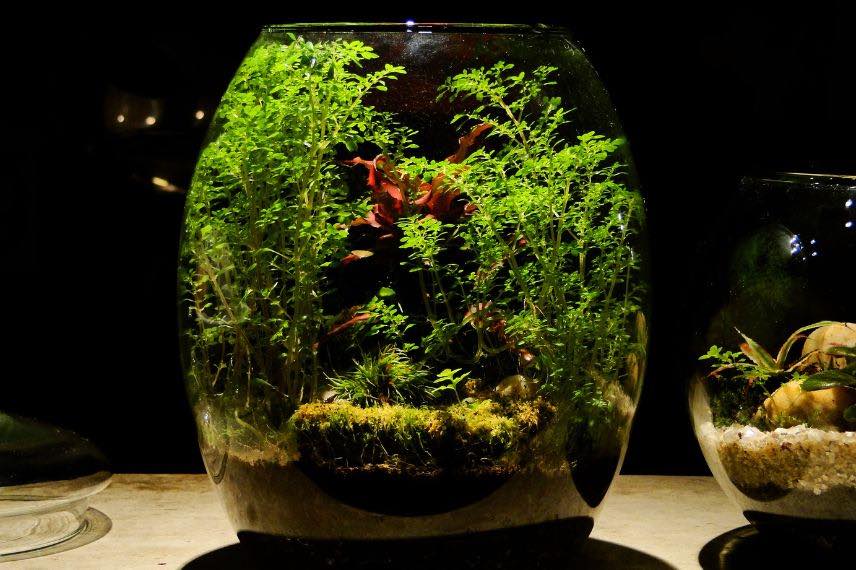
Ferns make excellent terrarium plants
Ferns are also beautiful kokedama plants, these pretty hanging moss-ball installations.
Ferns such as Nephrolepis or Adiantum make lovely hanging subjects, and the others too, even when their fronds are not trailing.
Generally speaking, given their aesthetic qualities, even without these tips, they brighten up any interior!
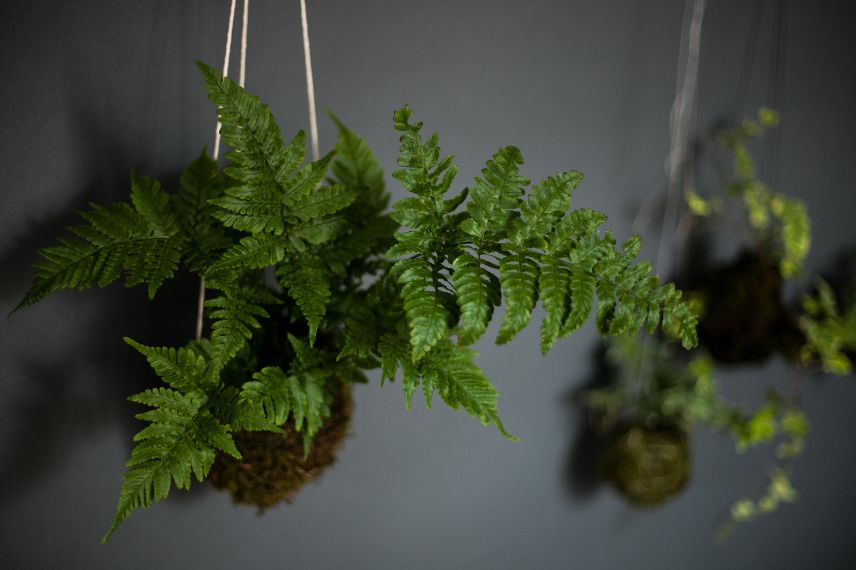
Beautiful kokedama subjects
- Subscribe!
- Contents

Comments