





























Growing Grevillea in pots
Bring some exotic flair to your terrace or balcony with this drought-tolerant evergreen bush.
Contents
Native to Australia, the Grevillea is a small evergreen bush with foliage resembling pine needles or fern fronds depending on the species. Its very exotic flowering occurs in clusters or corymbs of curly filament flowers. It lasts from late winter to autumn, with a peak in spring. It is coloured red, pink, white, or orange. It prefers poor, well-draining, non-calcareous, and rather dry soil.
As it is only semi-hardy, it is wise in many regions to plant it in a pot, especially since it requires little watering. This allows for better control of its planting substrate, ensuring it is acidic or neutral and sufficiently draining. This also allows for it to be brought indoors in winter to protect it from frost.
Here are our cultivation tips for Grevillea to enjoy the exotic charm of this evergreen bush, in a pot for the terrace or balcony.
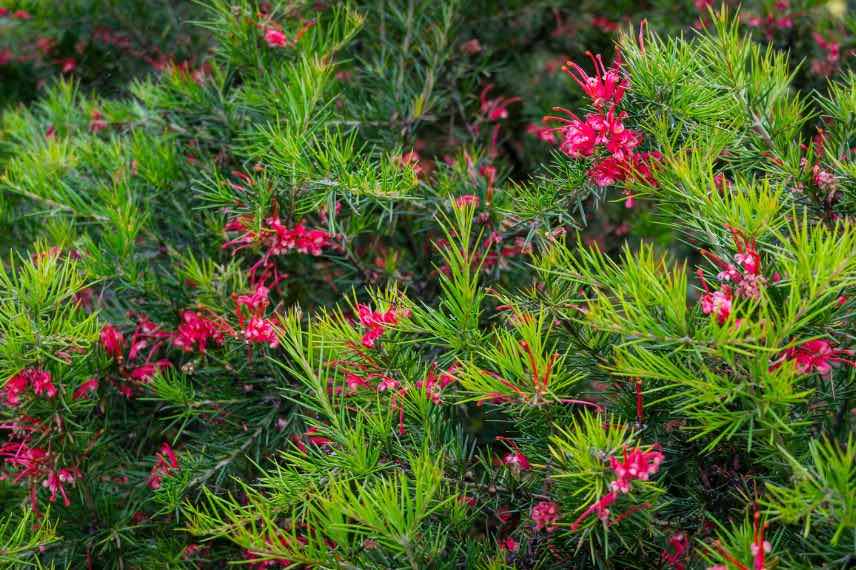
The Grevillea in all its glory (here Grevillea juniperina ‘Canberra Gem’)

What species and varieties?
Avoid potting Grevillea robusta, which can grow into a tree reaching heights of 10 m, or even 15 m!
Grevilleas generally form bushes that are as wide as they are tall, averaging 2 m in height: some varieties measure 1.20 m in all directions, while others can reach 3 m. They can all be planted in pots. However, they do not all have the same hardiness conditions. Grevillea rosmarinifolia, the hardiest, can withstand frosts of around -12 to -15° C under good conditions, meaning in very well-drained substrate, once mature. The Grevillea juniperina ‘Canberra Gem’ tolerates temperatures down to -10/-12°C or occasionally some frosts down to -15°C. Others can withstand frost between -5° C and -10° C depending on the species and varieties.
There are also creeping grevilleas : their height ranges from 30 to 60 cm, spreading over 1.50 m and in some cases up to 3 m in width. They can be grown in large containers as groundcover, provided the container is very large. This use is best reserved for the mildest areas of the country, as you will likely not be able to bring this type of container indoors in winter to protect it from frost. Creeping varieties, such as Grevillea ‘Bronze Rambler’, Grevillea gracilis ‘Alba’, Grevillea juniperina ‘New Blood’, and Grevillea lanigera ‘Mount Tamboritha’ are classified in zones 9a and 8b. They can withstand frost from -4° C to -9° C depending on the varieties.
Winter hardiness also depends on other surrounding factors: the degree of humidity, the duration and frequency of frost periods, the presence of protective elements around the plant, such as other plants or a wall, wind, and the quality of drainage. Additionally, potted plants are more sensitive to frost than those in the ground. Subtract 2 degrees from the hardiness ratings given above to get a more accurate idea of their resistance. Growing in containers allows the shrub to be wintered in a cold greenhouse or a very bright, minimally heated conservatory.
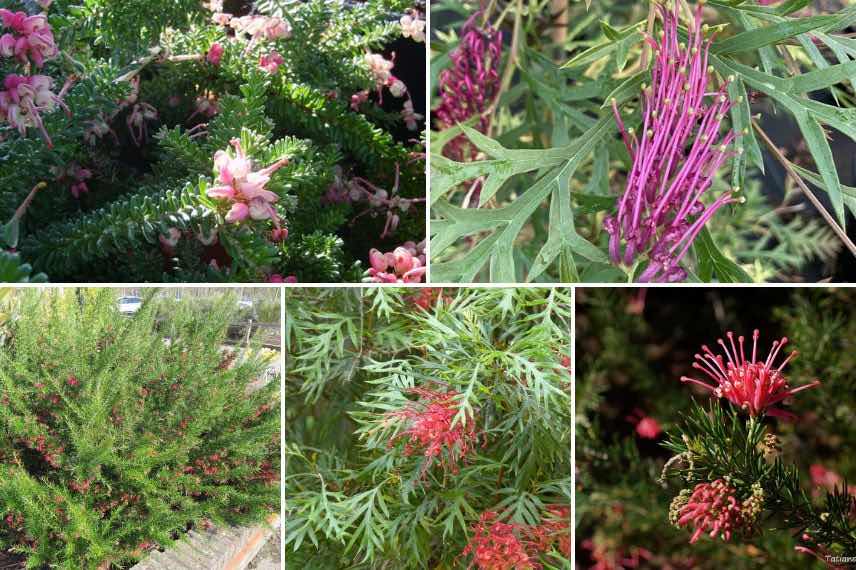
The creeping Grevillea lanigera ‘Mount Tamboritha’, foliage and flower of Grevillea ‘Bronze Rambler’, flower of Grevillea juniperus, fine and dissected foliage and flower of Grevillea ‘Robyn Gordon’, bushy habit of Grevillea juniperina ‘Canberra Gem’
Read also
Grevillea: planting, pruning and careWhat type of pot? What size?
Choose your preferred material, just keep in mind that terracotta, being porous, is well-suited for dry-soil plants, as water is quickly absorbed and does not stagnate, but it requires more frequent watering.
If you live in a very rainy region during winter, favour terracotta to prevent water from soaking the substrate for too long in the bad season.
Generally speaking, terracotta is a suitable material for growing Grevillea. Do not place a saucer under the pot to avoid stagnant water in winter and the proliferation of mosquitoes in summer.
Ensure the pot is three times larger than the root ball in both depth and width. More specifically, it should ideally be at least 50 cm in diameter and 40 to 50 cm deep.
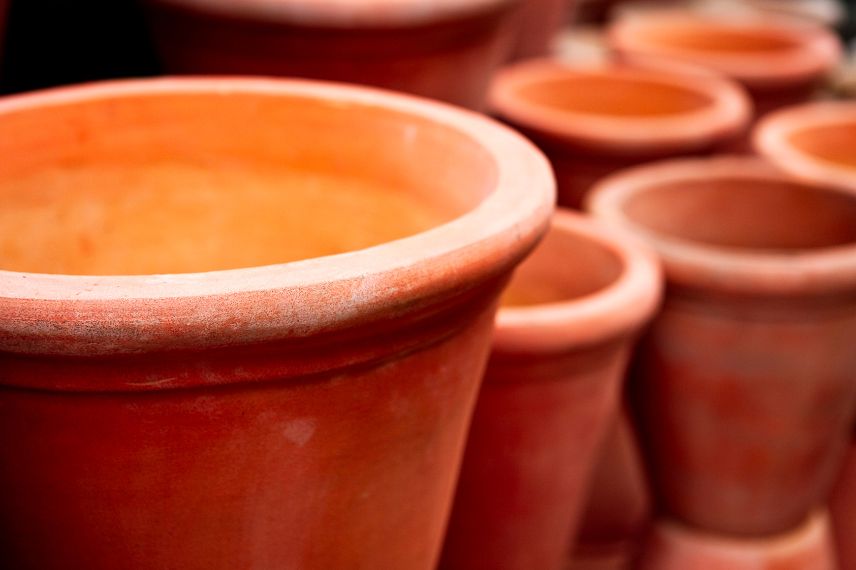
Terracotta is well-suited for growing Grevillea
What substrate?
Choose or create a draining substrate that is not too rich but has good water retention, as the substrate for potted plants dries out much faster than soil in the ground. Its pH should be acidic or neutral, below 7, which generally corresponds to commercial potting soils. You can check this information on the back of the bag or on the compositions listed on our site. Water retention is also indicated there. Use a light potting soil that is well-drained but remains moist, thus ensuring good water retention.
Selecting a quality potting soil, rather than a budget option, ensures better water retention, making you less dependent on watering potted plants, and promotes better growth for the plant. Additionally, it is lighter and has superior drainage quality.
Create a mix consisting of 70% quality potting soil with good water retention and 30% river sand.
Ensure drainage at the bottom of the pot using clay balls, pumice, or gravel. Also, consider an organic mulch such as B.R.F. for the top of the pot. This mulch helps to limit water inputs. Be sure to keep the collar free when applying the mulch.
When and how to plant?
Planting Grevillea takes place in spring after the frosts, when temperatures rise to around 10°C, from March to May depending on the regions.
In areas of France where the temperature does not drop below -4°C, or USDA zones 10a and b and 9b, namely the Mediterranean climate and the South-West basin, you can also plant it in October, which is preferable for its establishment. In this case, do remember to provide protection from frost in winter (see last chapter).
For planting, proceed as follows:
- Remove the root ball from its nursery container and untangle the roots if necessary.
- Soak it in a basin of water while preparing your pot.
- Pour a layer of drainage a few centimetres deep at the bottom of the pot using clay balls, gravel, or pumice.
- Separately, mix the various components of the substrate.
- Pour your substrate to about 1/3 of the pot.
- Position the root ball of your Grevillea, ensuring that the collar of the bush is level with the surface of the pot.
- Check that the appearance and orientation of the bush are to your liking and that it is upright.
- Fill in with substrate, pressing down lightly and evenly.
- Fill to a few centimetres below the rim of the pot and press down once more.
- Water generously.
- When the water has been absorbed, add a little substrate if necessary, if any gaps have appeared.
- Mulch with a few centimetres, leaving the collar exposed.
Where to install your Grevillea?
Grevillea enjoys being exposed to sunlight and tolerates a bit of shade in pots. During hot weather, feel free to move the pot to a shaded area to prevent the plant from suffering. In the southernmost regions, you can place it in light shade, but ensure it is not dense and provide a clear and bright situation. Overall, apart from during extreme heat when potted plants suffer more quickly than those in the ground and where the foliage can be damaged by the sun, keep in mind that Grevillea enjoys full sun. This observation is tempered by the fact that in pots, it can sometimes be wise to provide a little shade.
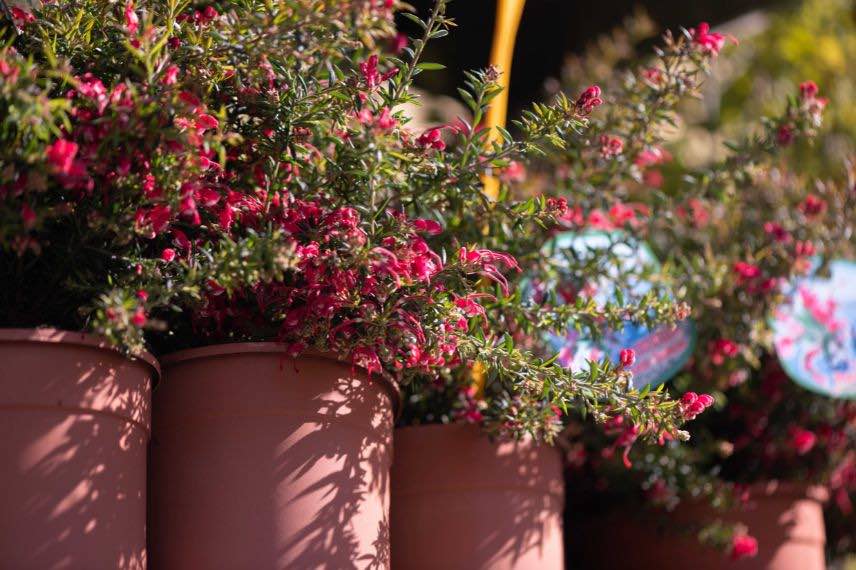
Grevillea in pots, in the sun
Watering and fertilising?
Watering
Potted Grevillea requires regular watering, but not too frequently. Water thoroughly and then allow the medium to dry out between waterings. Be attentive and water more often during the growth of new leaves and flowering, and when temperatures rise.
Reduce watering in autumn and winter. If you bring your plant indoors, maintain a monthly watering schedule.
Avoid using hard water, as it can cause yellowing of the leaves.
Fertiliser
For fertilisation, it is advisable to use a fertiliser that is very low in phosphorus, as failing to do so may reduce the bush’s resistance to drought by damaging the thick root hairs that develop just below the surface of the soil. A fertiliser with an N-P-K ratio of 18-2-10 is well suited. Phosphorus is the “P” in the middle of the formula.
Entretien
Maintenance
Repot in spring, for the first few years, every year or every two years. After that, simply practice surface topping by renewing the top few centimetres of soil in the pot.
Reduce the branches by one-third of their length after flowering or during their growth period if you wish to keep the plant compact.
Wintering
In regions with mild winters (see chapter “when to plant?”), you can leave the pots outside as long as you protect them. Mulch the top of the pot with a thick layer of organic mulch or dry ferns to insulate the roots from the cold as much as possible. Wrap the pot with cardboard and/or hessian or bubble wrap and protect the aerial parts with a fleece.
Elsewhere, bring your pots indoors in autumn to a frost-free, bright, and unheated room.
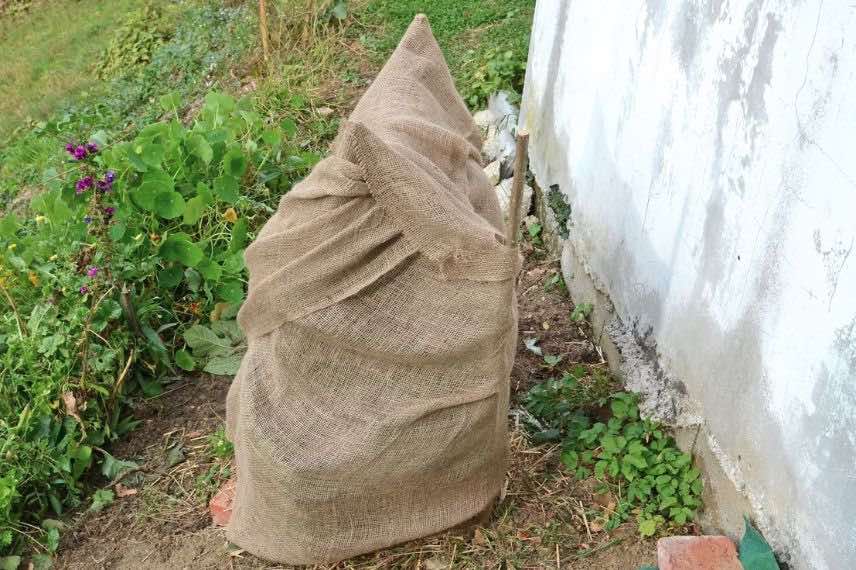
Winter protection outdoors can also be achieved with hessian
- Subscribe!
- Contents
Comments