


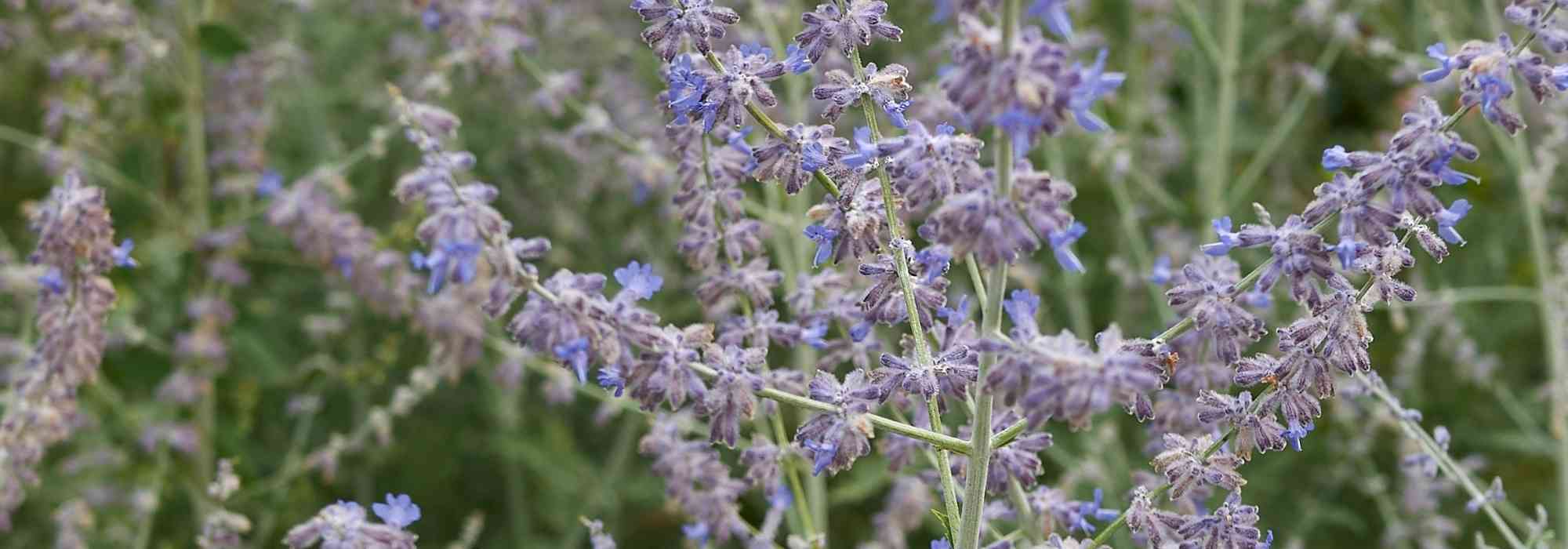
Growing Perovskia in pots
All our tips for succeeding with this cultivation
Contents
The Perovskia or “Afghan Sage”, also known as “Russian Sage”, “Afghan Lavender”, or “Siberian Sage”, is a small bush that showcases a long and generous lavender-blue flowering throughout the summer. Its aromatic, silvery foliage, stunning in its delicacy, also contributes to its popularity. Hardy, it withstands everything: cold, drought, sea spray, neglect in watering, pollution, and diseases. While the tallest specimens reach around 1.20 m in full bloom, smaller varieties can also be grown in pots to enhance sunny balconies and terraces.
To enjoy its spectacular blue flowering, it requires the right growing conditions and care: plenty of sun and a very well-draining substrate.
Here are our secrets for growing this attractive little bush in pots!
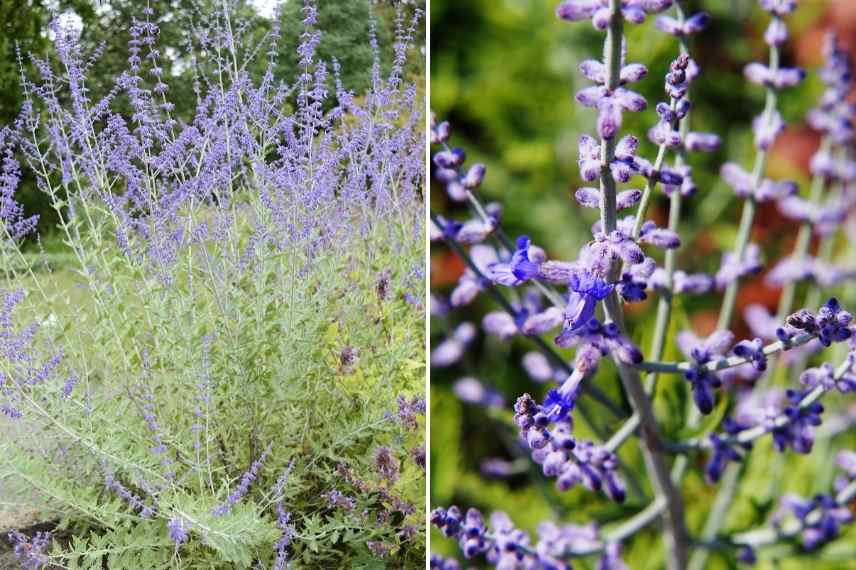
And to learn more, feel free to check our complete guide: “Perovskia: planting, pruning and maintenance”

Which varieties to choose?
The genus comprises 7 species, the most common in our gardens being Perovskia atriplicifolia and its cultivars. They form a large, bushy, opulent clump and grow quickly. Alongside the giant ‘Blue Spire’, there are dwarf varieties that do not exceed 50 cm at ripeness, well-suited for pots.
The most suitable varieties are:
- The Perovskia atriplicifolia ‘Little Spire’ is a selection of compact Russian sage, approximately 80 cm tall and 60 cm wide, which displays a mist of lavender flowers all summer long.
- The Perovskia atriplicifolia ‘Lacey Blue’ is a variety with a very compact habit that does not exceed 50 cm in height, adorned in summer with bluish-purple flowers.
- The Perovskia (x) atriplicifolia ‘Silvery Blue’ is a hybrid form with almost white foliage, very compact, not exceeding 60 cm in height and 70 cm in width.
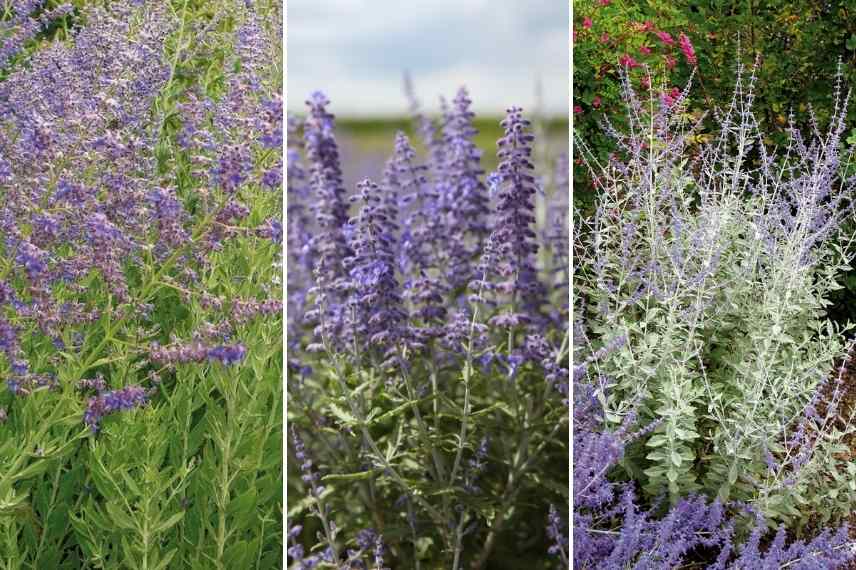
From left to right: Perovskia atriplicifolia ‘Little Spire’, Perovskia atriplicifolia ‘Lacey Blue’, and Perovskia x atriplicifolia ‘Silvery Blue’
What pot for Russian sage?
Choose preferably a pot taller than wide to ensure good drainage and allow it to express its verticality. A large terracotta pot of at least 40 cm in diameter is preferable as it is more porous and breathable, facilitating water evaporation, with Perovskia needing a well-drained and dry substrate. However, you can also opt for a plastic container, which will have the advantage of being lighter and more economical. In any case, the bottom of the pot must have drainage holes to allow watering or rainwater to drain properly.
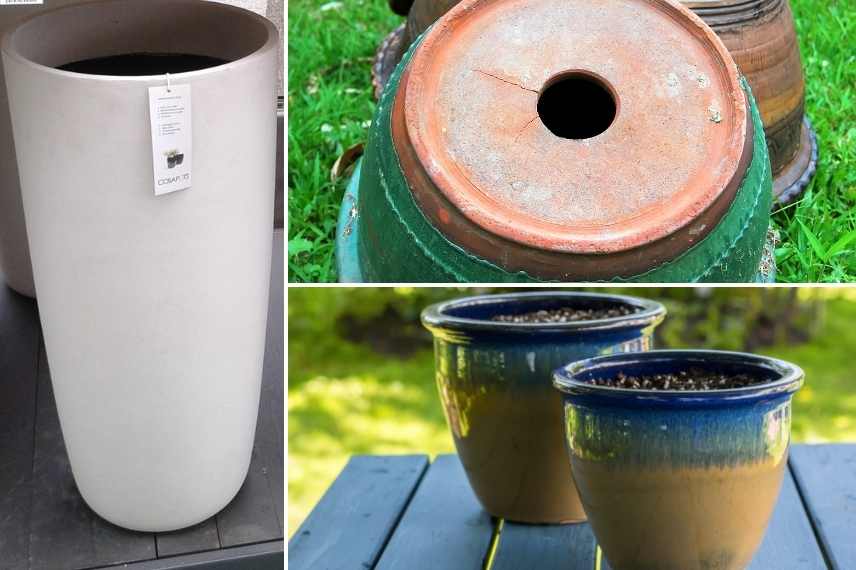
A tall pot or a shorter one, as long as it has good drainage at the bottom, will be a lovely ornament for your Perovskia
Discover other Perovskias
View all →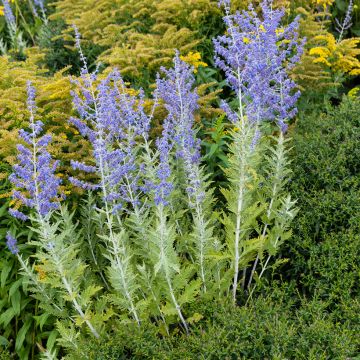
Available in 4 sizes
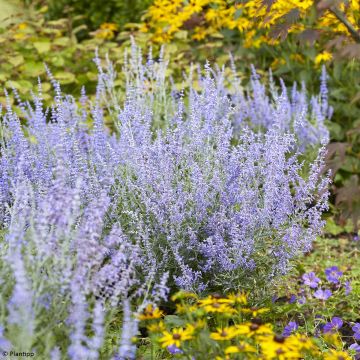
Available in 2 sizes
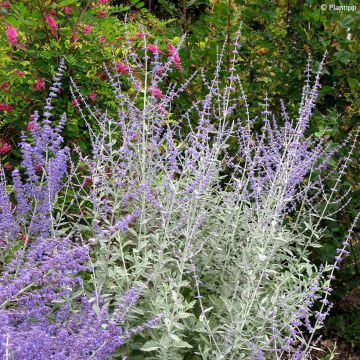
Available in 4 sizes
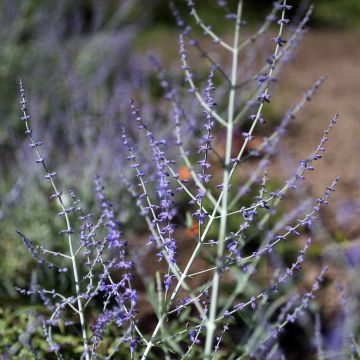
Available in 2 sizes
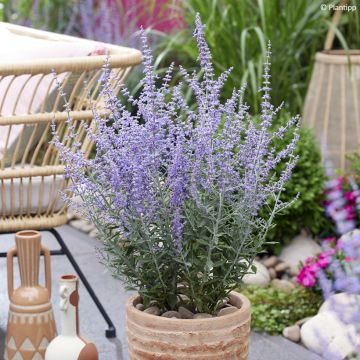
Available in 2 sizes
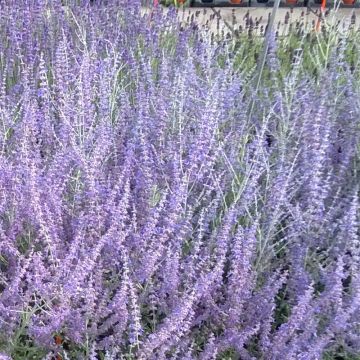
Available in 3 sizes
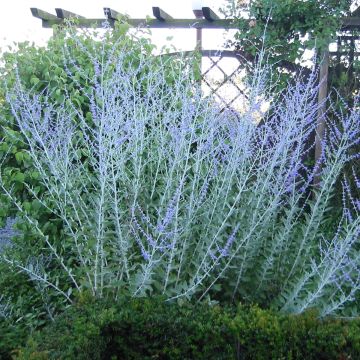
Available in 1 sizes
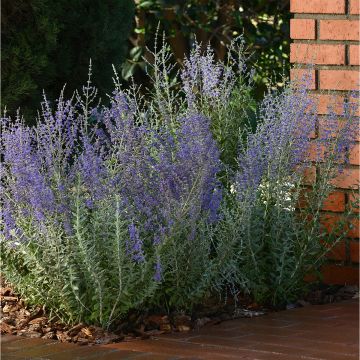
Available in 1 sizes
What substrate?
The Perovskia is a drought-tolerant plant that thrives in light, stony, even calcareous soils that are well-drained and low in fertility. As it dislikes waterlogged substrates, ensure the soil is well-drained to prevent moisture from stagnating around the roots. Spread a layer of gravel or clay balls at the bottom of the pot. In overly rich substrates, the plant tends to become leggy and lose its attractive upright form. We recommend planting it in a mixture composed of equal parts:
- good garden soil,
- potting mix for Mediterranean plants
- coarse sand, pebbles, and small gravel
Read also
Pairing ideas with PerovskiaPlanting Perovskia in Pots
The planting of Perovskia in pots or containers should be done in spring between March and May. Planting can also take place in autumn, from September to November, in regions with mild winters. Always outside of frost periods.
How to plant it in a pot?
- Place a layer of gravel, pouzzolane, or clay balls at the bottom of the pot to ensure good drainage
- Add the substrate mix until about halfway up the container
- Place the root ball in the pot, with the collar positioned a few centimetres below the rim
- Fill in with the remaining substrate
- Water to ensure the plant establishes well
- You can spread a mineral mulch or organic mulch
What exposure does Afghan lavender in a pot require?
Drought-tolerant plant par excellence, Perovskia thrives in warmth. Position your pot in full sun to enhance the silver colour of its foliage and intensify its fragrance. It requires a well-exposed terrace or a sunny balcony, which is essential for abundant flowering. In the hottest regions, it will tolerate partial shade. Perovskia is not afraid of pollution or sea spray; it will thrive equally well in the city or by the seaside.
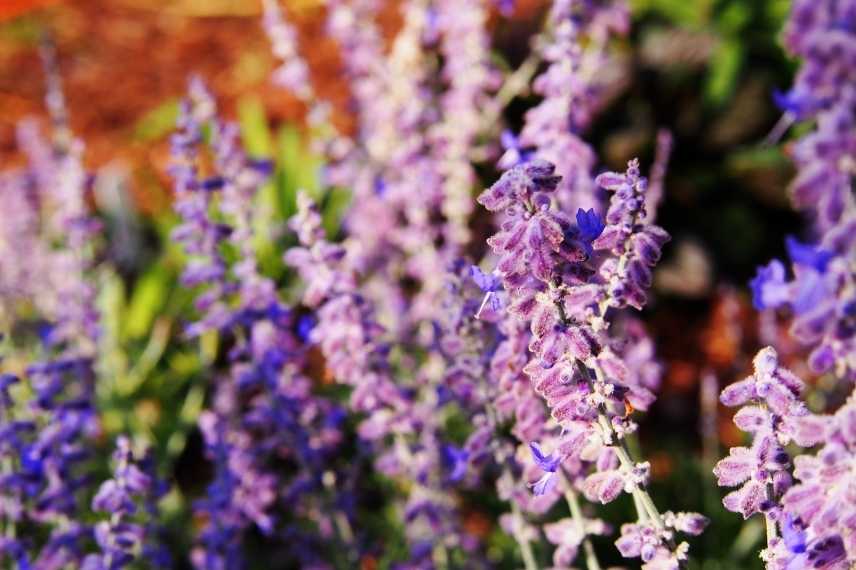 Two imperatives for your Perovskia in pots: sun and warmth
Caring for Perovskia in pots
Perovskia is an undemanding plant suited to challenging conditions that requires almost no maintenance.
Watering
A true camel plant, while it forgives missed waterings when grown in the ground, in pots it will need to be watered occasionally, as the substrate dries out more quickly. Avoid excessive watering: water moderately as soon as the substrate begins to dry out on the surface. Allow the soil to dry well between waterings. Increase water supply during prolonged dry spells. Conversely, in winter, stop watering.
Fertilisation
No fertiliser is really necessary for this small bush with exemplary frugality. Excess fertiliser could harm its dense, upright appearance, causing the bush to become leggy. Optionally, apply a little slow-release fertiliser for flowering plants in summer to compensate for the inevitable depletion of the substrate in pots.
Pruning
Pruning helps maintain a lovely, dense shape. Cut back the clump using a pruning shear or shears by trimming the dry stems to 10 cm above the ground at the end of winter. Young shoots will appear from the stump at the beginning of spring.
Wintering
The Perovskia is very cold-resistant, tolerating temperatures down to -15 °C to -20 °C. However, in the event of a frost risk below -10 °C, the potted plant may suffer, as its roots are more exposed. In our harshest regions, we recommend protecting the pot from winter rains to prevent any water stagnation around the roots in winter.
Repotting
After 2-3 years, when the substrate has exhausted all its reserves and your Russian Sage has grown well, you can repot it into a larger container. In the meantime, every year carry out a top dressing to renew the old compost with fresh material.
Discover in this article all our tips on repotting plants.
- Subscribe!
- Contents
![[perovskia pot_size="large" container="planter"]](https://en.promessedefleurs.eu/blogwp/wp-content/uploads/2022/05/Cultiver-le-Perovskia-en-pot-1.jpg "Growing Russian Sage in a Container")
Comments