





























Growing vegetables and fruits in the city: our tips
Growing an urban vegetable garden is entirely possible with a few tips
Contents
Today, growing your vegetable garden is more about pleasure than real necessity, as it was still the case last century. Gardening has become a true passion shared by millions of people in France. Perhaps this is because environmental concerns are increasingly prominent. Maybe it’s also because people need to reconnect with simple things like “turning the soil” and harvesting the fruits (and vegetables) of their labour.
Nevertheless, gardening is no longer reserved for rural dwellers, fortunate owners of a small (or large) plot of land. Even though, in some cities, particularly industrial or mining ones, allotments have long been considered essential for feeding one’s family. Today, they still exist and attract more and more young generations of gardeners. However, not all large urban areas offer this possibility. As a result, many city dwellers make do with a balcony, a small terrace, or a tiny courtyard to create and grow their vegetable garden.
Discover all our tips, tricks, and techniques for growing your fruits and vegetables in the city.

The benefits of creating a vegetable garden in the city
Certainly, growing a vegetable garden in the city has its drawbacks: you may sometimes suffer from back pain, success isn’t always guaranteed, and you’ll need to be attentive to watering… but the benefits far outweigh these minor inconveniences. Because growing your own vegetables and fruits in the city offers numerous advantages for both your well-being and the preservation of the environment. Not to mention your wallet and the joy it brings, an invaluable notion in these sometimes challenging times.
Thus, sowing, planting, and growing your vegetables and fruits in an urban environment provides significant advantages:
- Improving your health. By cultivating your garden naturally, you can be sure of the quality of the fruits and vegetables that grow there. What you put on your plate is undoubtedly healthier, making it much better for your health. The vegetables and fruits grown in your garden are free from pesticides and chemical treatments, harvested at full ripeness. They don’t linger in refrigerated spaces, don’t come from the other side of the world, and aren’t damaged by transport and handling. Most importantly, they have an unmatched flavour and taste quality.
- Combating sedentary behaviour. The garden, even on a balcony or terrace, encourages movement, fresh air, and physical activity. Even if it’s minimal, it’s always better than spending time on your phone or in front of a screen!
- Preserving the environment. By cultivating a garden in the city, you create a space of nature in an urban setting, an ecosystem that welcomes beneficial insects. Additionally, you reduce your carbon footprint since your vegetables and fruits go directly from your garden to your kitchen.
- Saving money. Although setting up a garden incurs some costs, such as purchasing seeds or young plants in pots, the financial benefits are tangible.
- Learning and discovering. Gardening (in a small space) allows you to experiment, test, and try… Sometimes the crops are profitable, sometimes they are less so. But both failures and successes are always sources of enrichment. Moreover, a garden in the city is an invaluable source of discovery and learning for children.
So, go ahead and garden!
The constraints and challenges to overcome when creating a vegetable garden in an urban environment
Creating a vegetable garden in the city may seem complicated, especially if you have no arable land. You will need to overcome and navigate several challenges:
- Space is inevitably limited, and it is relatively rare to have all the square metres you dream of. Therefore, you will need to employ ingenuity to learn to garden differently by making the most of all available spaces.
- Light in the city can be diminished by surrounding buildings that create shaded areas. You will need to take advantage of this shade by growing suitable vegetables.
- Conversely, on a balcony or terrace, the heat trapped by concrete can be stifling. This extreme heat leads to substrate drying and leaf burn. An east/west exposure is ideal for all vegetables, while a south exposure is favourable for sun-loving fruits and vegetables.
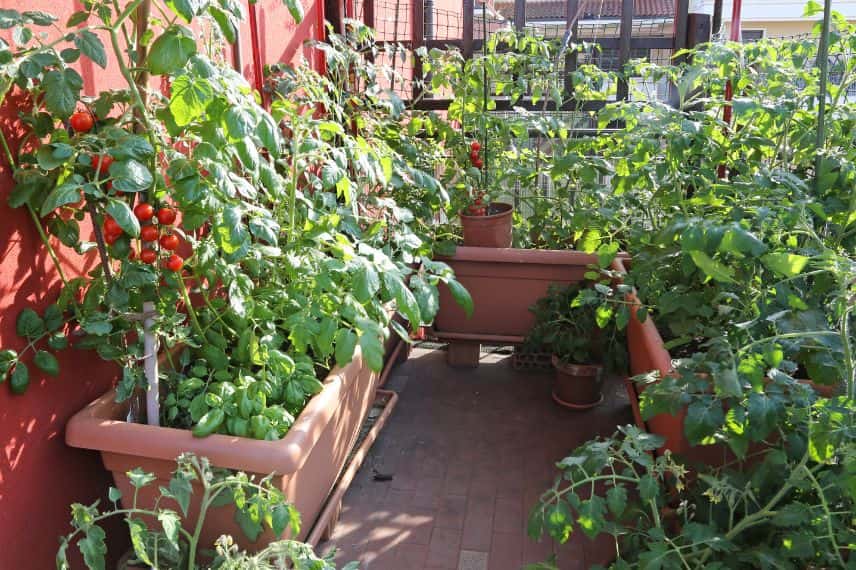
- Wind is an important factor to consider, especially on the higher floors of buildings.
- Air pollution is a reality in the city, especially near heavily trafficked roads. However, metals concentrate in vegetables only if the garden is located near a major traffic route. As for soil pollution, it is more unpredictable… unless you know the site’s history. The best solution is to grow in containers.
The different gardening techniques in the city
In an ideal world, you have a small plot of land, no matter how tiny, that allows you to garden in the ground or in raised beds (as the soil may be potentially contaminated). You can sow, plant, and grow just about anything… You can even plant dwarf fruit trees or espaliered trees. I also offer a selection of 6 fruit trees for urban gardens.
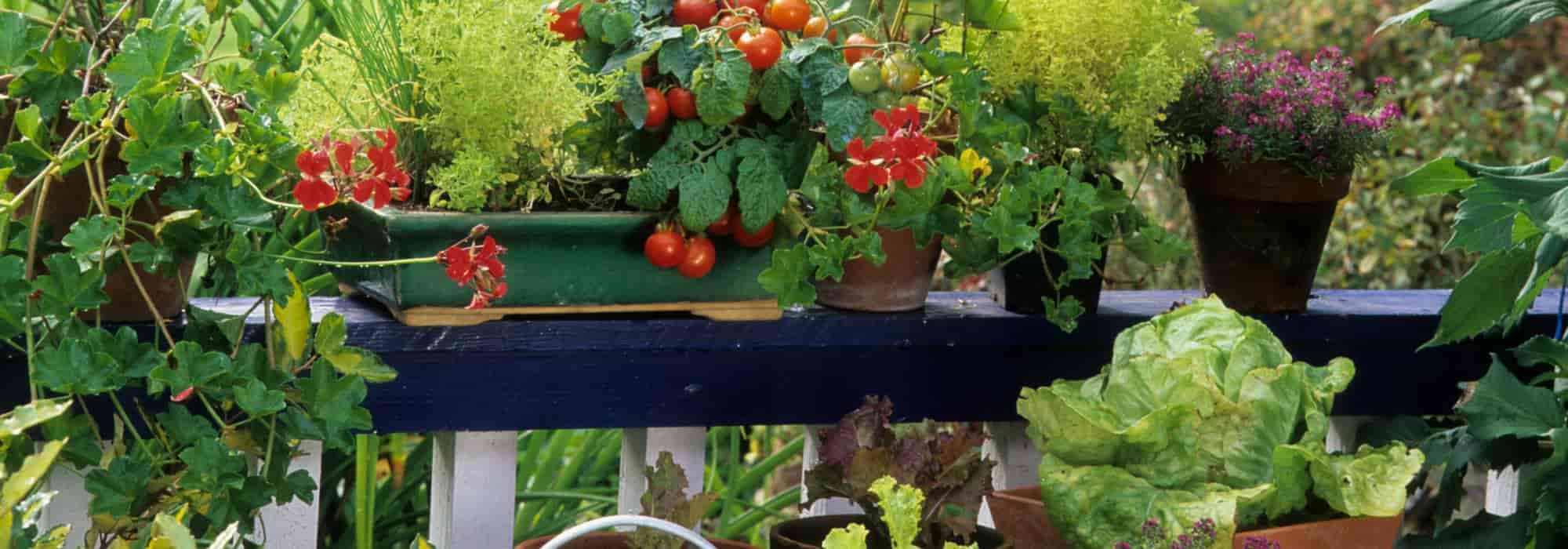
However, many city dwellers only have a windowsill, a balcony, a terrace, a courtyard, or a patio… Thus, container gardening becomes essential. The techniques for container gardening have significantly evolved:
- Raised beds: these follow the principle of square gardening but are at waist height. They are available in wood, resin, or wicker, but DIY enthusiasts should easily be able to make them from reclaimed materials.
- Pots and planters are easy to use but offer little substrate. Therefore, you will need to fertilise the soil regularly. However, fruit trees can be grown quite easily in pots. Check out our selection of 10 dwarf fruit trees to grow in pots.
- Gardening bags: we explain the principle in our article: Urban gardening, it’s all in the bag!
- Hydroponic systems, still quite expensive, allow you to grow small vegetables like tomatoes, salads, herbs, or strawberries without soil.
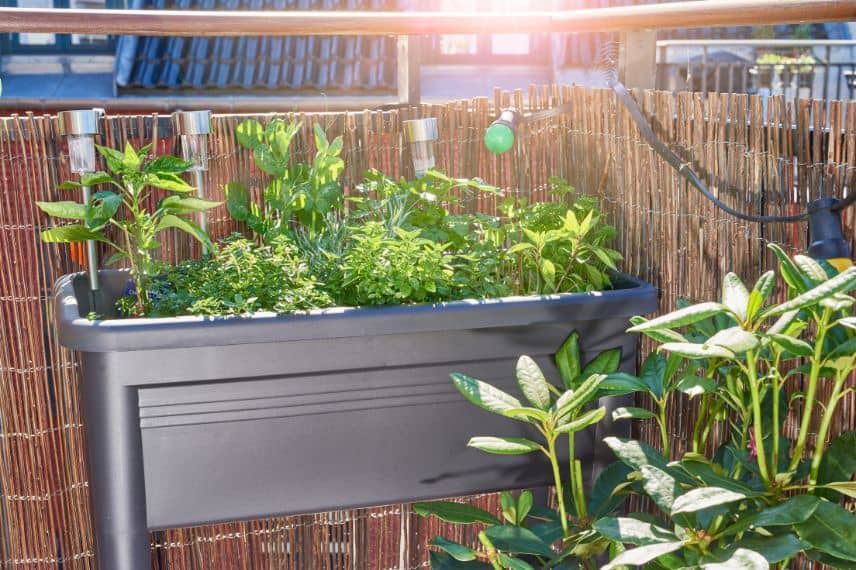
Beyond the containers, the way of gardening must evolve in the city. Indeed, on a balcony or terrace, in a courtyard or patio, you need to maximise space. This means utilising all dimensions. You can garden horizontally, but also vertically by installing trellises or stakes that allow you to grow climbing beans, courgettes, cucumbers, and squashes… Balcony railings can also support certain plants.
Use hanging planters to grow strawberries. Or planters attached to a balcony railing (be careful with the fixings to avoid any falls!). Similarly, don’t hesitate to install shelves by recycling furniture or wooden pallets. You can place pots or wooden boxes for your sowing.
For urban gardening, a worm composter is essential. Easy to set up and space-efficient, it provides rich compost to add to the substrate, and percolate, a liquid fertiliser to dilute in watering water. To learn more: Worm composting, the practical side.
Otherwise, it is always possible to approach your landlord or property owner to request permission to utilise rooftop terraces. Cities and social landlords also facilitate the creation of community gardens at the foot of buildings. Sometimes, all it takes is to launch the project…
Which vegetables and fruits for an urban garden?
Besides growing vegetables or fruits typically consumed by your family, it is essential to select productive vegetable plants that yield quickly to free up space rapidly. Among the easiest vegetables and fruits to grow in the city are:
- Tomatoes, peppers and chillies
- Salads such as cutting lettuces or rocket
- Radishes
- A plant of courgette
- Climbing beans, gherkin, melons, and small squashes on trellises
- Aubergines for a south-facing garden
- Spinach
- Strawberries
- Herbs
- And don’t forget a few small flowers to deter harmful insects and encourage pollination
To save time, you can buy plug plants or sow seeds in a nursery or indoors. Seed tapes are also very handy for maximising your sowing.
Regardless of the container or the vegetables grown, it will be essential to:
- Drain pots, planters, raised beds, or grow bags to prevent the risk of rot (without disturbing the neighbours)
- Use a rich and fertile substrate such as vegetable compost
- Water carefully and very regularly, especially in summer
- Subscribe!
- Contents
Comments